


Pennsylvania tint laws are built in two layers, and confusing them is where most drivers go wrong. The statute, 75 Pa.C.S. § 4524(e), never mentions a percentage at all — it bans any sun screening material that does not permit a person to see or view the inside of the vehicle. The number everyone quotes, 70% light transmittance, lives in a different book: Table X of PennDOT’s regulations (67 Pa. Code ch. 175), which demands 70% at every window of a passenger car — and because factory glass already sits near 70%, almost any aftermarket film puts a Pennsylvania car over the line.
- Quick Answer
- Two Laws in One: The Statute and Table X
- Pennsylvania Tint Limits by Window and Vehicle
- Windshield Rules: A Transparent 3 Inches
- The Inspection Myth: What PennDOT Actually Says
- Exemptions: Factory Tint, Grandfathers, and Government Vehicles
- Medical Certificates: Colorless Film Only
- Penalties: A $25 Fine With Real Costs
- How Pennsylvania Compares With Other States
- How to Stay Legal
- Frequently Asked Questions
- What is the legal tint in Pennsylvania?
- Is 35% tint legal in Pennsylvania?
- Can I tint my windshield in Pennsylvania?
- Does Pennsylvania check tint at inspection?
- How do I get a medical tint exemption in Pennsylvania?
- How much is a tint ticket in Pennsylvania?
- Did Pennsylvania change its tint law in 2025 or 2026?
- My SUV came with dark rear glass. Is it legal?
- Conclusion
This guide explains both layers, the roadside-versus-table split the courts have drawn, the truck and SUV rear-glass opening, the medical certificate that covers only colorless film, and the small fine with large costs attached.
Quick Answer
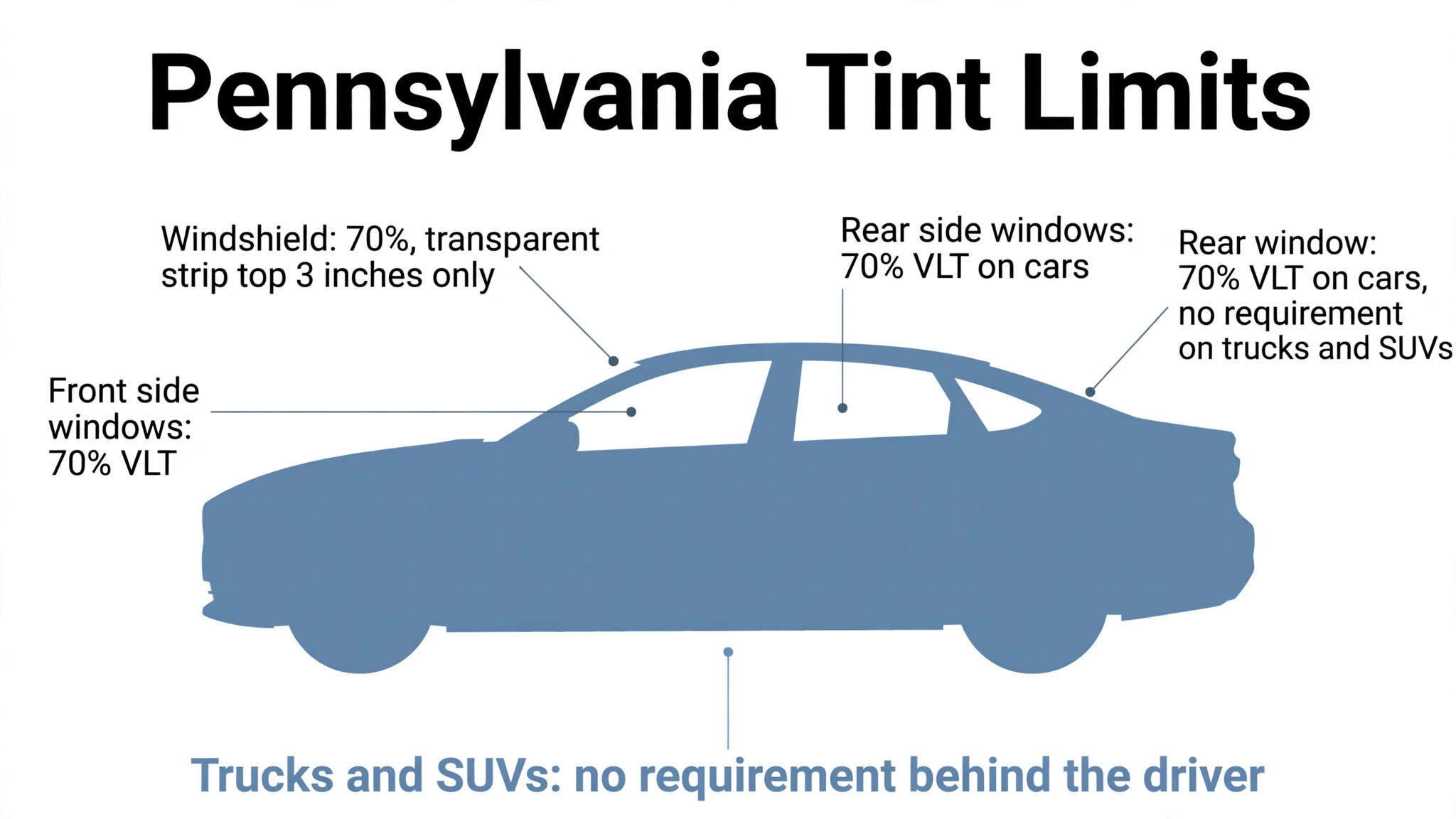
Under Pennsylvania tint laws, a passenger car (1998 or newer) must transmit at least 70% of light through the windshield, front side windows, rear side windows, and rear window alike, per Table X of 67 Pa. Code ch. 175 (levels assume ±3% accuracy), measured through glass and film together. Trucks and multipurpose vehicles — most SUVs, pickups, and vans — need 70% only at the windshield and front side windows; their rear glass carries no requirement. The windshield otherwise takes only a transparent strip within the top 3 inches, above the AS-1 area. The statute itself (§ 4524(e)) separately bans any material that stops a person seeing inside the vehicle. A violation is a summary offense: a $25 fine under § 6502, plus court costs that usually push the total past $100.
Two Laws in One: The Statute and Table X
Layer one — the statute. Section 4524(e)(1) of the Vehicle Code makes it an offense to drive a vehicle with “any sun screening device or other material which does not permit a person to see or view the inside of the vehicle through the windshield, side wing or side window.” That visibility test is the whole statute. It sets no percentage, names no meter, and draws no line between 35% film and 70% film.
Layer two — the table. PennDOT’s inspection regulations repeat the see-inside wording at § 175.67(d)(4) and then point to Table X, “Acceptable light transmittance levels for vehicle glazing” (adopted 1996), for the specific requirements. Table X is where 70% comes from — for cars, at every window. Section 4107(b)(2) closes the loop by making it unlawful to operate a vehicle that is not equipped as the department’s regulations require.
The courts keep the layers apart. In Commonwealth v. Brubaker (Pa. Super. 2010), the Superior Court held that the 70% figure, while real in the inspection rule, cannot be read into the statute: a roadside charge under § 4524(e)(1) asks only whether a person can see through the glass. So the same car can be outside Table X yet hard to charge at the roadside — and an officer who cannot see inside at all needs no meter reading to make the statutory case. Most tint pages print one number and one test; Pennsylvania genuinely has two of each. Our guide to how window tint percentages work explains the glass-plus-film multiplication that every Table X reading assumes.
Common mistake: Assuming a “legal in Ohio” 50% front window is merely a technicality in Pennsylvania. On a car, 50% fails Table X by twenty points at the front, the rear sides, and the back window — it is not close, and the ±3% accuracy allowance does not rescue it.
Pennsylvania Tint Limits by Window and Vehicle
| Window | Passenger car, 1998 or newer | Truck or multipurpose vehicle |
|---|---|---|
| Windshield | 70% (transparent strip only, top 3 inches) | 70% (same strip rule) |
| Front side windows and wings | 70% | 70% |
| Rear side windows and wings | 70% | No requirement |
| Rear window | 70% | No requirement |
| Accuracy | All Table X levels assume ±3% | Same |
Three rows of the full table deserve a footnote. Pre-1998 passenger cars match the 70% figures except at the rear window, where Table X asks for VESC-20 labelled material instead. Medium and heavy trucks, buses, and all other vehicles follow the truck pattern: 70% at the windshield and front sides, no requirement behind. And “multipurpose passenger vehicle” is a defined term — a vehicle built on a truck chassis or specifically designed for occasional off-road use — which is why most SUVs, pickups, and vans land in the open-rear column while a unibody crossover’s classification can be worth a question to PennDOT.
Windshield Rules: A Transparent 3 Inches
Pennsylvania’s windshield rule is the tightest strip allowance in this series. Under § 175.263(a), products or materials may sit along the top edge of the windshield only if they are transparent, do not encroach upon the AS-1 portion, and extend no more than 3 inches from the top. A tinted visor band — even a light one — is not a transparent product, so the strip that is routine in New York or Illinois is not available here in tinted form at all. Beyond the strip, the windshield is held to Table X’s 70% — which, as the next section shows, is roughly where factory glass already sits.
That last point governs the whole Pennsylvania system, so it is worth doing the arithmetic once. Federal standard FMVSS 205 requires new-car glazing to transmit at least 70% of visible light, and typical factory glass reads 75–88%. Table X measures the finished window. An 80% film over 85% glass reads 68% — already below the line before the ±3% allowance is argued about. On a Pennsylvania car, the practical effect is that side and rear film dark enough to notice is dark enough to fail, which is precisely why the state’s tint market runs on the truck and multipurpose column.
The Inspection Myth: What PennDOT Actually Says
Ask a search engine whether dark tint fails a Pennsylvania inspection and most pages will say yes. PennDOT’s own Vehicle Window Tint fact sheet (April 2025) says something narrower: the 1996 regulations that produced Table X “eliminated the requirement that window tint be checked at the time of inspection.” Inspection stations are not required to meter your windows, and a fresh inspection sticker is not a ruling that your tint is lawful.
Enforcement sits with the police instead. The same fact sheet warns that owners whose tint exceeds the levels “may be stopped and cited while operating their vehicle on the highway,” and departments treat a § 4524(e) violation as a primary offense — a lawful reason to stop the car on its own, with meters carried to make the measurement at the roadside. Pennsylvania is therefore the reverse of Massachusetts: there, the annual inspection is the enforcement; here, the inspection mostly looks the other way and the traffic stop does the work.
Exemptions: Factory Tint, Grandfathers, and Government Vehicles
Section 4524(e)(2) and § 175.265 carve four groups out of the sun-screening ban:
– Factory tint. Windows “of the type and specification that were installed by the manufacturer of the vehicle” are exempt — the dark rear glass an SUV wears from the factory is lawful as factory equipment, quite apart from Table X’s open rear column for multipurpose vehicles. – Hearses, ambulances, and government vehicles are exempt as classes. – Certificate holders. Any vehicle PennDOT has issued a certificate of exemption — the medical route below, and the grandfather route next. – The 1984 grandfather certificate. Under § 4524(e)(3)(i) and § 175.265(b)(1), a vehicle registered in Pennsylvania as of September 8, 1984 and fitted with prohibited material before September 9, 1984 could obtain a certificate of exemption, carried in the vehicle and shown to police and inspection stations. It is the oldest exemption in this series and, by construction, nearly extinct — but it remains in the text.
One equipment rule rides on all sun screening: a vehicle using it must carry outside rearview mirrors on both sides (the qualifying windshield strip excepted) — the same dual-mirror condition New Jersey and Maryland attach to dark rear glass.
Medical Certificates: Colorless Film Only
Pennsylvania’s medical route is real, formal — and much narrower than drivers expect. Under § 4524(e) and § 175.265, PennDOT issues a certificate of exemption where the owner or registrant, or a member of their household who regularly drives or rides in the vehicle, suffers from a physical condition that the department, in consultation with its Medical Advisory Board, determines justifies the exemption. The application is form MV-402 (Application for Sun Screening Certificate of Exemption), filed with PennDOT’s Vehicle Inspection Division, with the medical section certified by a licensed physician or optometrist. PennDOT’s Medical Unit fields questions at (717) 787-9662; the Vehicle Inspection Division at (717) 787-2895.
Then the limit that defines the whole route, § 175.265(d): the certificate authorizes only colorless sun screening material that filters ultraviolet light. It is not permission for dark privacy film at any percentage — a driver whose condition needs UV blocked gets clear UV film, and a driver who wants 20% tint for the same condition gets nothing from MV-402.
The certificate is carried in the vehicle and shown to police and inspection stations on request, and it dies with the sale: under § 4524(e)(5) and § 175.265(e), the certificate becomes void when the vehicle is sold to someone who does not qualify, and before the sale the owner must remove the material, destroy the certificate, and give the buyer a notarized statement describing the removal. No other state in this series makes a seller swear out paperwork over window film.
What if scenario: A Pittsburgh driver with a certified light-sensitivity condition fits dark 35% film and keeps the MV-402 certificate in the glovebox. At a stop, the certificate does not save the film — it never covered tinted material, only colorless UV film — and the 35% glass is measured against the ordinary rules.
Penalties: A $25 Fine With Real Costs
Section 4524 sets no fine of its own, so the Vehicle Code’s general penalty fills the gap. Under 75 Pa.C.S. § 6502(a), a violation is a summary offense with a fine of $25; violating PennDOT’s regulations lands on the same $25 through § 6502(b), and operating a vehicle that does not meet department regulations is separately unlawful under § 4107(b)(2). Three softeners and one hardener complete the picture:
– No jail. Section 6502(c) takes the Crimes Code’s summary-offense imprisonment off the table for Vehicle Code offenses. – No points. Neither § 4524 nor § 4107 appears on the point schedule at § 1535. – No written fix-it dismissal. Unlike Illinois, where a conviction carries a court order to bring the windows into compliance, Pennsylvania’s tint provisions write in no repair-and-dismiss route — the fine is the whole sentence, and the film question is left to the next stop. – The costs are the real price. Court costs and fees are added to the $25 fine on every citation, and real-world totals typically run past $100 — the fine is the smallest number on the ticket.
How Pennsylvania Compares With Other States
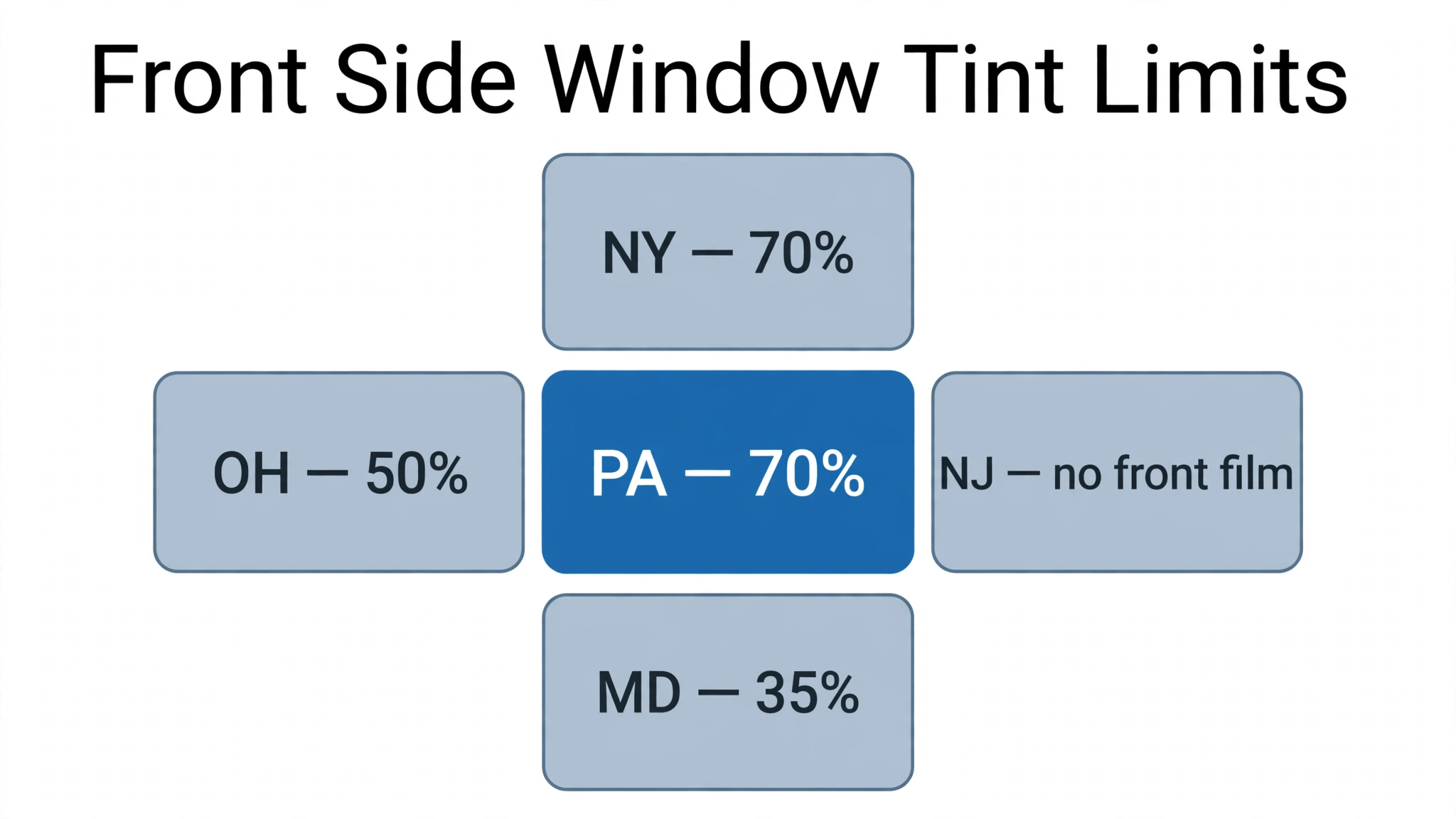
Pennsylvania’s 70% car rule is the strictest standard limit in its neighbourhood — matched only by New York’s 70% front rule, though New York lets a car’s rear side windows stay at 70% too while opening nothing behind the driver. New Jersey bans front film outright but frees the rear completely. Ohio allows 50% up front, Maryland 35%, and West Virginia 35%. Further afield, Minnesota’s uniform 50% and Washington’s 24% show the national spread — and Pennsylvania’s truck column, with no rear requirement at all, is as open as any state in the country once the vehicle qualifies.
Read also: Ohio tint laws, Virginia tint law, Georgia tint laws
How to Stay Legal
1. Driving a car? Treat 70% as “no visible film.” Factory glass already reads 75–88%, and Table X measures the finished window — film dark enough to see is dark enough to fail. 2. Know your column before you tint the rear. Trucks and true multipurpose vehicles (truck chassis or off-road design) have no rear requirement; cars are held to 70% at the back too. 3. Windshield: transparent, 3 inches, above AS-1. No tinted visor band exists in Pennsylvania law, with or without a medical certificate. 4. Carry both outside mirrors. Sun screening requires a mirror on each side of the vehicle. 5. Medical need means UV, not darkness. The MV-402 certificate covers colorless UV-filtering film only — file it with PennDOT, carry the certificate, and remember it voids on sale, with a notarized removal statement owed to the buyer. 6. Do not rely on your inspection sticker. Stations have not been required to check tint since 1996; a passed inspection proves nothing about your windows, and the roadside meter is the real test. 7. Remember Brubaker cuts both ways. The roadside charge turns on whether an officer can see inside — film that preserves a clear view of the cabin is the statute’s own standard, whatever the table says.
Frequently Asked Questions
What is the legal tint in Pennsylvania?
For a passenger car (1998 or newer), 70% light transmittance at the windshield, front side windows, rear side windows, and rear window, per Table X of 67 Pa. Code ch. 175, measured through glass and film together with a ±3% accuracy allowance. Trucks and multipurpose vehicles need 70% only at the windshield and front side windows; their rear glass has no requirement. The statute, 75 Pa.C.S. § 4524(e), separately bans any material that stops a person seeing inside the vehicle.
Is 35% tint legal in Pennsylvania?
Not on a car — 35% fails the 70% Table X level at every window by a wide margin. Behind the driver of a truck or multipurpose vehicle, where Table X sets no requirement, dark rear film is permitted, subject to the statute’s see-inside rule for side windows and the dual-mirror requirement.
Can I tint my windshield in Pennsylvania?
Only a transparent product along the top edge, extending no more than 3 inches from the top and staying above the AS-1 portion (§ 175.263(a)). A tinted strip is not allowed, and the rest of the windshield must meet the 70% level — roughly where factory glass already sits.
Does Pennsylvania check tint at inspection?
No. PennDOT’s April 2025 fact sheet confirms the 1996 regulations eliminated the requirement that window tint be checked at the time of inspection. Tint is enforced by police at traffic stops, where it is treated as a primary violation — a fresh inspection sticker does not make dark tint legal.
How do I get a medical tint exemption in Pennsylvania?
Apply to PennDOT on form MV-402 with a certification from a licensed physician or optometrist; PennDOT decides in consultation with its Medical Advisory Board, for the owner or a household member who regularly drives or rides in the vehicle. The certificate authorizes only colorless UV-filtering film, must be carried in the vehicle, and becomes void when the vehicle is sold.
How much is a tint ticket in Pennsylvania?
A summary offense with a $25 fine under 75 Pa.C.S. § 6502 — but court costs and fees are added to every citation and typically bring the real total past $100. No points attach, and no jail term is available for the offense.
Did Pennsylvania change its tint law in 2025 or 2026?
No change has taken effect. The governing rules remain § 4524(e) of the Vehicle Code and Table X, in place since 1996; PennDOT reissued its tint fact sheet in April 2025 restating the same 70% levels. Bills introduced to rewrite the rule remain proposals, not law.
My SUV came with dark rear glass. Is it legal?
Yes, on two independent grounds: manufacturer-installed tint of the factory type and specification is exempt under § 4524(e)(2), and Table X sets no requirement for the rear glass of multipurpose vehicles anyway. Adding aftermarket film to the front side windows is where the 70% rule bites.
Conclusion
Pennsylvania runs its tint law on two tracks that never quite merge: a visibility statute (§ 4524(e)) that asks whether a person can see inside the car, and a 1996 PennDOT table that prices every window of a car at 70% — a level factory glass nearly reaches on its own — while leaving truck and SUV rear glass wholly open. The medical certificate covers colorless UV film only, the fine is a modest $25 wrapped in real court costs, and enforcement lives at the traffic stop, not the inspection lane. The governing texts are 75 Pa.C.S. § 4524(e) together with 67 Pa. Code ch. 175, Table X, and the CarGlassFix Pennsylvania guide and Film Slingers’ Pennsylvania tint guide track both layers for drivers and shops.
Disclaimer: This article is general information about Pennsylvania tint laws, not legal advice. Tint statutes, regulations, and enforcement practice change, and how a rule applies depends on the vehicle and the facts. Confirm the current law in 75 Pa.C.S. § 4524 and 67 Pa. Code ch. 175, or speak with a Pennsylvania attorney or PennDOT, before tinting, buying, or contesting a citation.