



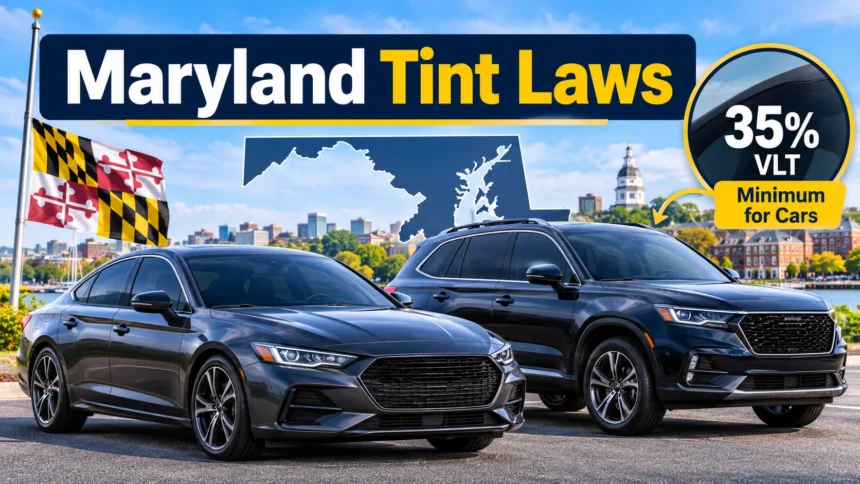
Maryland tint laws set one main number: 35%. On a passenger car, every window with tint added after the car was built must let at least 35% of light through. SUVs, vans, and light trucks follow the same 35% rule at the front, but their rear windows can go darker. The rules sit in Maryland Code, Transportation § 22-406, and a 2025 law (SB 707) changed how medical exemptions work from October 1, 2025.
- Quick Answer
- What Is VLT and Why Factory Glass Matters
- Maryland Tint Limits: Cars vs SUVs and Trucks
- Windshield Rules: The AS-1 Line and the 5-Inch Rule
- Tint Colors and Finishes Maryland Bans
- Medical Exemptions and the October 2025 Update
- Penalties: The Citation and the Repair Order
- How Police Enforce Maryland Tint Laws
- Tint and the Maryland Safety Inspection
- How Maryland Compares With Other States
- How to Stay Legal
- Frequently Asked Questions
- Is 20% tint legal in Maryland?
- Is 35% tint legal in Maryland?
- How much is a window tint ticket in Maryland?
- Can police pull you over for tint alone in Maryland?
- How do I get a medical exemption for window tint in Maryland?
- Can you tint your windshield in Maryland?
- Does Maryland tint law apply to out-of-state cars?
- Are factory-tinted windows legal in Maryland?
- Conclusion
This guide explains the limits for each vehicle type, the repair order that comes with a ticket, and the exemption update many sites have not caught up with yet.
Quick Answer
Under Maryland tint laws, tint added after manufacture must allow at least 35% light transmittance (VLT). On passenger cars, that 35% minimum covers every window. On SUVs, vans, and light trucks, it covers the front side windows, and the rear windows may be darker. The windshield may only carry tint above the AS-1 line or the top 5 inches. Mirrored finishes and red, yellow, or amber films are banned. A violation brings a citation plus a Safety Equipment Repair Order, and Maryland does offer a medical exemption with a doctor’s certification.
What Is VLT and Why Factory Glass Matters
VLT stands for Visible Light Transmission. It is the percentage of visible light that passes through a window. A 70% window looks almost clear. A 35% window is a medium tint. A 5% window is near-black “limo tint.”
Maryland’s 35% test measures the combined reading of your factory glass plus the film. Most factory glass already blocks some light, often reading around 75% to 80% on its own. So the math surprises people. A 45% film over 75% factory glass reads about 34% combined — and fails Maryland’s test, even though the film alone was “lighter than 35%.”
That is why installers who know Maryland work backwards from a meter reading, not from the number on the film box. If you want the full picture of how the percentages behave, our guide to how window tint percentages work walks through each common shade.
Common mistake: asking for “35% tint” and assuming the result is legal. In Maryland the legal question is what the window reads after the film goes on, not what the film was rated at in the shop.
Maryland Tint Limits: Cars vs SUVs and Trucks
Maryland’s statute does something most tint guides never explain. It does not split the rules by window first. It splits them by how your vehicle is registered.
Section 22-406(i)(1) names two groups:
– Vehicles registered under § 13-912 — passenger cars (sedans, coupes, convertibles, station wagons). For these, any window with aftermarket tint must allow at least 35% light through.
– Vehicles registered under §§ 13-913, 13-917, or 13-937 — multipurpose vehicles, trucks, and vans. For these, the statute holds only the windows to the immediate right and left of the driver to the 35% test.
In plain terms:
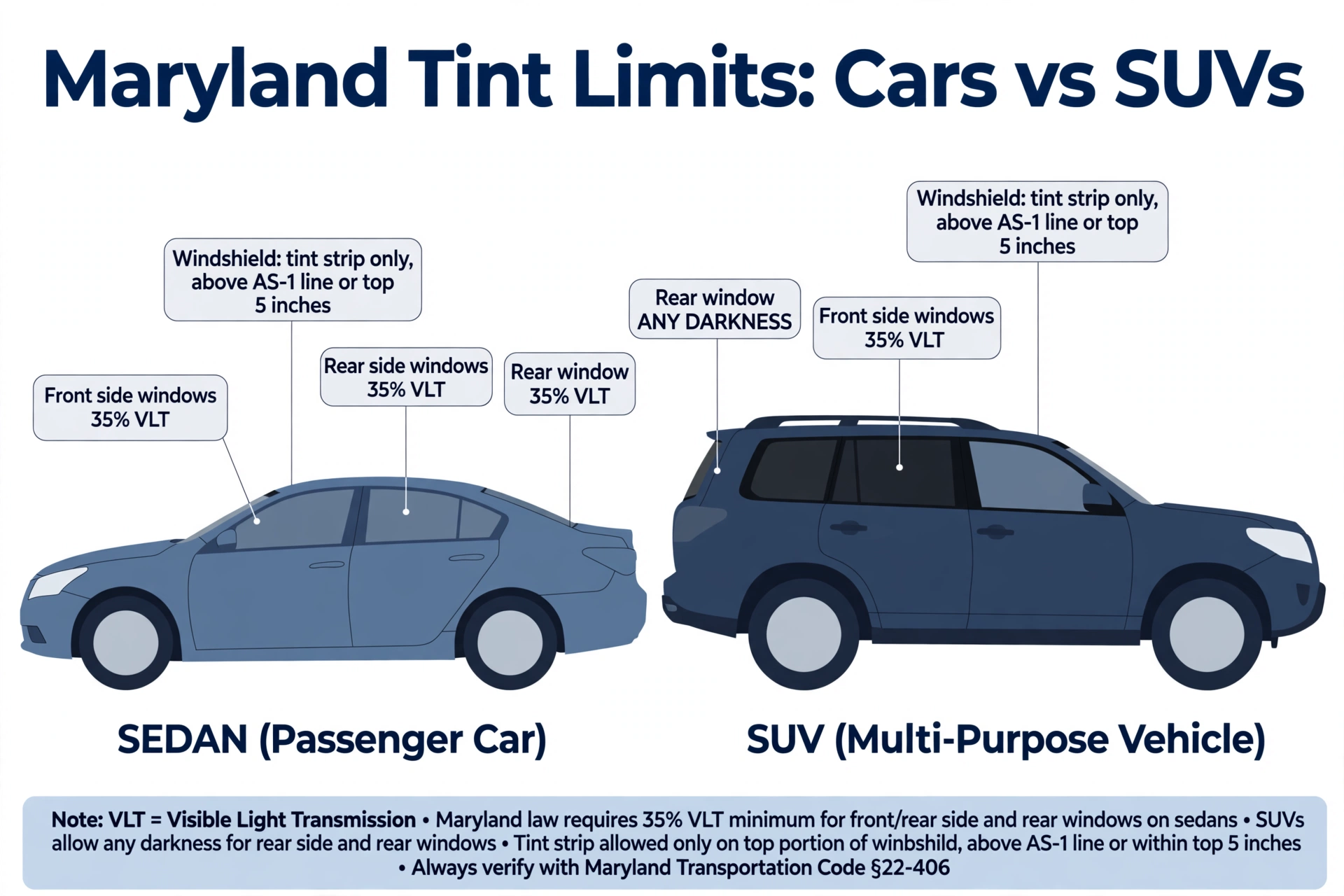
| Window | Passenger cars | SUVs, vans, light trucks |
|---|---|---|
| Windshield | Tint only above the AS-1 line or top 5 inches | Same |
| Front side windows | 35% VLT minimum | 35% VLT minimum |
| Rear side windows | 35% VLT minimum | Any darkness |
| Rear window | 35% VLT minimum | Any darkness |
Two points follow from the table. First, a sedan owner in Maryland cannot legally black out the rear windows the way an SUV owner can. The 35% floor follows a passenger car around the whole vehicle. Second, if you drive an SUV or truck with dark rear glass, Maryland State Police guidance expects working mirrors on both sides, because you can no longer rely on the rear window.
What if scenario: A Baltimore driver trades a sedan for an SUV and keeps the same 20% film all around. On the sedan, every window broke the law. On the SUV, the rear windows are now fine — but the front sides at 20% still fail the 35% test, and those are the windows an officer checks first.
One more boundary matters. The statute regulates tint “added to the window after manufacture.” Factory privacy glass is not aftermarket film, which is why a new SUV can roll off the lot with dark rear glass that would be illegal as a film job on a sedan.
Windshield Rules: The AS-1 Line and the 5-Inch Rule
No Maryland vehicle may have aftermarket tint on the windshield below the AS-1 line or below five inches from the top of the windshield — whichever leaves the smaller tinted area. The AS-1 line is a small mark the manufacturer etches into the glass near the top.
So the legal strip is the higher of the two boundaries. If your AS-1 line sits six inches down, the five-inch rule wins and the strip must stop at five inches. If the AS-1 line sits four inches down, the strip must stop there. The strip must also be non-reflective.
This windshield rule has no exceptions. Even a driver with a valid medical exemption, covered below, cannot tint the windshield below that line.
Tint Colors and Finishes Maryland Bans
Whatever your VLT reading, Maryland State Police rules ban three kinds of film on every window:
– Reflective or mirrored finishes. Film that makes a window look like a mirror is prohibited.
– Red, yellow, and amber films. These colors can be confused with signals and emergency lighting.
– Sparkling or glitter-effect films. Decorative sparkle films fail the equipment rules even at a legal darkness.
Neutral charcoal, smoke, and ceramic films are the safe ground. They change how much light passes through without changing the window’s color or reflectivity, which is exactly what the rules are aimed at.
Medical Exemptions and the October 2025 Update
Unlike some of its neighbours, Maryland does offer a medical exemption — and it changed recently, which is where older guides go stale.
Under § 22-406(i)(4), a person who must be protected from the sun for medical reasons is exempt from the 35% rule if the vehicle carries a written certification in the format set by the Automotive Safety Enforcement Division (ASED) of the Maryland State Police. The form is ASED 23-04B, the “Physician’s Written Certification of Necessity for Medical Exemption.” A Maryland-licensed physician signs it under penalty of perjury, detailing why you need tint darker than 35%. You keep the signed form in the vehicle at all times and show it if you are stopped. There is no mail-in approval step.
What changed on October 1, 2025: the General Assembly passed SB 707 (Chapter 453), which did two things:
1. It repealed the old 2-year time limit for permanent conditions. Your certification now lasts for the period your doctor sets — and if the condition is certified as permanent, the exemption is valid indefinitely.
2. Optometrists can certify too. Before the update, only physicians could sign. A Maryland-licensed optometrist can now complete the certification as well.
The conditions that qualify are serious light-sensitivity disorders. Maryland State Police guidance lists examples such as lupus, Cockayne syndrome, Bloom syndrome, solar urticaria, erythropoietic protoporphyria, and certain forms of skin cancer. A condition that ordinary sunglasses can manage will not qualify.
Three limits still apply with an exemption. It never covers the windshield below the AS-1 line or five-inch mark. It is tied to the named vehicle and owner on the form, so it does not transfer when you sell the car. And a bill in the 2026 session, HB 1507, proposes removing time limits for every exemption, not just permanent ones — but as of this writing it is a proposal, not law.
One carve-out surprises parents. Tinting material that is easily removable and used to protect a child under 10 years of age from the sun sits outside this part of the statute. The suction-cup sunshade on a rear window for a toddler is not what the 35% rule targets.
Penalties: The Citation and the Repair Order
A Maryland tint stop usually produces two documents, and the second one matters more than the first.
The citation. Illegal tint is a traffic violation, not a crime. The payable fine on a typical tint citation runs about $70 to $90. You may see higher figures quoted: Maryland’s penalty statute, § 27-101, sets a maximum fine of $1,000 on conviction for a § 22-406(i) violation. That ceiling is real, but it is not what an ordinary first tint ticket costs if you handle it properly.
The Safety Equipment Repair Order (SERO). Under § 22-406(i)(2) and § 23-105, the officer also issues a repair order. It works on deadlines:
1. Within 10 days, have the illegal tint removed or corrected.
2. Take the vehicle to an authorized Maryland inspection station and have the repair certified.
3. The certification must reach the State Police ASED within 30 days.
Ignore the repair order and the problem grows teeth: your registration can be suspended until the vehicle complies. Drivers who pay the fine and frame the ticket often miss that the repair order is still open — the fine and the SERO are separate tracks, and both have to close.
The same section also reaches the shop. Section 22-406(i)(3) says a person may not install tint that fails the 35% requirements, so a Maryland installer who knowingly applies illegal film is violating the statute too.
What if scenario: A driver in Silver Spring is cited for 15% front tint, pays the fine by mail, and throws the paperwork away. The unpaid document was the repair order. Months later her registration renewal is blocked because the SERO was never certified. The fix then costs the same film removal — plus the time to clear a suspended registration.
How Police Enforce Maryland Tint Laws
Maryland officers can stop you for tint alone. Section 22-406(i)(2) authorizes a stop when an officer observes a vehicle being operated in violation, so tint is a primary offense here — no speeding or broken taillight is needed first.
At the stop, the officer may test the window with a handheld tint meter that reads the combined light transmission of glass plus film. Maryland appellate courts have dealt with tint stops for years; in Baez v. State (2018), the court described the 35% rule and the repair-order process as the framework officers work under. The practical takeaway is simple: if your windows meter below 35% where the rule applies, the citation and repair order follow from that reading.
Tint and the Maryland Safety Inspection
Tint is also an inspection item. Maryland’s safety standards (COMAR 11.14.02.14) make post-manufacture tint part of the vehicle glazing check, and a tint failure is recorded as defect #61, “TINT.”
This matters most when a car changes hands. Maryland requires a safety inspection to register a vehicle you have bought. If the previous owner tinted a sedan to 20%, the car can fail inspection until the film comes off or is replaced with legal film — a cost worth negotiating before you buy, not after. Vehicles referred over a tint question, including medical exemption claims during inspection, go to the ASED for review.
How Maryland Compares With Other States
Maryland’s flat 35% for cars is stricter than some neighbours and looser than others:
– Virginia’s tint law splits its limits — 50% on the front side windows and 35% on the rear for cars — so a setup that is legal in Maryland can fail at the front in Virginia.
– North Carolina’s window tint law also uses 35% for cars, the closest match to Maryland, though its inspection and recent law changes differ.
– Colorado’s tint laws set a 27% floor on every window, darker than Maryland allows, but Colorado offers no medical exemption at all.
– Florida’s window tint law allows 28% at the front and 15% at the rear for cars — darker than Maryland on both ends.
– New York’s tint laws are far stricter, requiring 70% on the side windows of most cars and checking tint at the annual inspection.
– Texas tint laws allow 25% on the front side windows, while California’s tint law effectively keeps front windows near 70% once factory glass is counted.
– Ohio’s tint laws set 50% at the front, and Georgia’s tint laws use a flat 32% on side and rear windows.
If you are moving to Maryland, assume your current tint needs a meter check before registration. The states around Maryland simply do not share one rulebook.

How to Stay Legal
1. Know your registration class. Passenger car (§ 13-912) means 35% on every window. Multipurpose vehicle means 35% at the front and freedom at the rear.
2. Meter the finished window. Ask the installer to confirm the glass-plus-film reading stays at or above 35%, with a small margin.
3. Respect the windshield line. Tint strip only above the AS-1 line or the top five inches, whichever is higher, and never reflective.
4. Skip banned films. No mirrored finishes, no red, yellow, or amber, no sparkle effects — at any darkness.
5. Handle a repair order immediately. The 10-day repair and 30-day certification clocks start at the stop, and your registration is the hostage.
6. Carry exemption paperwork in the car. If you hold an ASED 23-04B certification, it only protects you when it is in the vehicle to show.
Frequently Asked Questions
Is 20% tint legal in Maryland?
On a passenger car, no — every window must read at least 35%. On an SUV, van, or light truck, 20% is legal on the rear side windows and rear window, but the front side windows must still meet the 35% minimum.
Is 35% tint legal in Maryland?
Yes, 35% is the legal standard. Just make sure the combined reading of your factory glass plus the film is at least 35%. A film rated exactly 35% can meter below 35% once it sits on factory glass, so a slightly lighter film is the safer buy.
How much is a window tint ticket in Maryland?
A typical tint citation carries a payable fine of about $70 to $90, and it usually comes with a Safety Equipment Repair Order requiring you to fix the tint within 10 days and certify the repair within 30 days. The statutory maximum fine on conviction is $1,000, and ignoring the repair order can suspend your registration.
Can police pull you over for tint alone in Maryland?
Yes. Window tint is a primary offense in Maryland. Section 22-406(i)(2) lets an officer stop a vehicle observed in violation and issue both the citation and the repair order at that stop.
How do I get a medical exemption for window tint in Maryland?
Ask a Maryland-licensed physician or optometrist to complete form ASED 23-04B, certifying that you must be protected from the sun for medical reasons. Keep the signed form in the vehicle at all times. Since October 1, 2025, a certification for a permanent condition can be valid indefinitely under SB 707.
Can you tint your windshield in Maryland?
Only a strip at the top — above the AS-1 line or within the top five inches, whichever leaves less tint — and it must be non-reflective. No exemption, medical or otherwise, allows tint below that line.
Does Maryland tint law apply to out-of-state cars?
The tint subsection is written around vehicles registered in Maryland under the classes it names. A car visiting from another state is in a different position, but once you register the vehicle in Maryland, the 35% rules and the safety inspection apply in full.
Are factory-tinted windows legal in Maryland?
Yes. Section 22-406(i) regulates tint added after manufacture. Factory glass, including the dark privacy glass fitted to many new SUVs at the rear, is not aftermarket film and is not what the 35% film rule targets.
Conclusion
Maryland tint laws turn on one number and one question. The number is 35%: the least light any regulated window may pass after film is applied. The question is how your vehicle is registered — a passenger car carries the 35% rule on every window, while an SUV or truck carries it only at the front. Add the repair order that rides along with every citation, and the October 2025 medical exemption update, and you have the full picture. The law itself is Maryland Code, Transportation § 22-406, also published by Justia’s Maryland Code library, and the 2025 exemption change is in the official text of SB 707, Chapter 453.
If you are facing a citation or a repair order you believe was issued in error, speak with a Maryland traffic attorney before the 10-day repair clock runs out. On tint cases, the deadline is usually the most expensive part to get wrong.
Disclaimer: This article is general information about Maryland law, not legal advice. It is not a substitute for advice from a qualified attorney licensed in Maryland. Laws and enforcement practice can change, so check the current statute or speak to a lawyer about your situation.