




What is alimony? Alimony is money one former spouse pays the other after a divorce or legal separation. A court can order it, or the spouses can agree to it in a settlement. It is also called spousal support or spousal maintenance.
- Quick Answer: Alimony in 60 Seconds
- What Is Alimony?
- Alimony vs Child Support vs Property Division
- Who Can Get Alimony?
- Types of Alimony
- How Courts Decide Alimony
- How Is Alimony Calculated?
- How Long Does Alimony Last?
- Is Alimony Taxable in 2026?
- How the Process Works, Step by Step
- Court Order vs Agreement
- When Alimony Stops or Changes
- What If Someone Stops Paying?
- Common Myths About Alimony
- Mistakes to Avoid
- When to Talk to a Lawyer
- FAQ
- What is alimony in simple terms?
- Who pays alimony?
- How much is alimony?
- How long does alimony last?
- Is alimony taxable?
- Can alimony be changed after the divorce?
- Does alimony end if the receiver remarries?
- Can alimony be discharged in bankruptcy?
- Conclusion
The goal is simple. Alimony helps a spouse who earns less, or gave up a career for the family, stay on their feet after the marriage ends. It is not automatic, and it is not the same as child support.
Alimony law is made by each state, so the rules change a lot from place to place. A Texas judge, a New York judge, and a Florida judge can look at the same facts and reach very different results. This guide explains the big ideas first, then shows how several states handle them.
Quick Answer: Alimony in 60 Seconds
- Who pays: The spouse with more income or assets may be ordered to pay the other.
- Who can get it: Either spouse. Men and women both qualify under the law.
- How long: From a few months to many years. A few states still allow lifetime support.
- Taxes: For divorces finalized after December 31, 2018, the payer cannot deduct it and the receiver does not report it as income.
- When it ends: Usually on a set date, on death, or on the receiver’s remarriage. Many orders can also be changed if life changes a lot
What Is Alimony?
Alimony is financial support paid from one spouse to the other after a separation or divorce. The word comes from the Latin alimonia, which means nourishment or support. Legal sources such as the Cornell Legal Information Institute describe it as money meant to ease the unfair money effects of divorce.
Courts do not hand it out to every divorcing couple. Judges usually ask two questions. Does one spouse need help, and can the other spouse pay?
Alimony used to be seen as a payment from husbands to wives. That changed in 1979 in Orr v. Orr, when the U.S. Supreme Court struck down an Alabama law that let only wives receive alimony. Today the law looks at need and ability to pay, not gender.
Alimony is also less common than people think. Studies going back decades suggest it appears in about 15 percent or fewer of divorces. Still, the total money involved is large. In 2016, the last year before the big tax change, taxpayers deducted more than $12 billion in alimony on their federal returns, according to IRS statistics.
Alimony vs Child Support vs Property Division
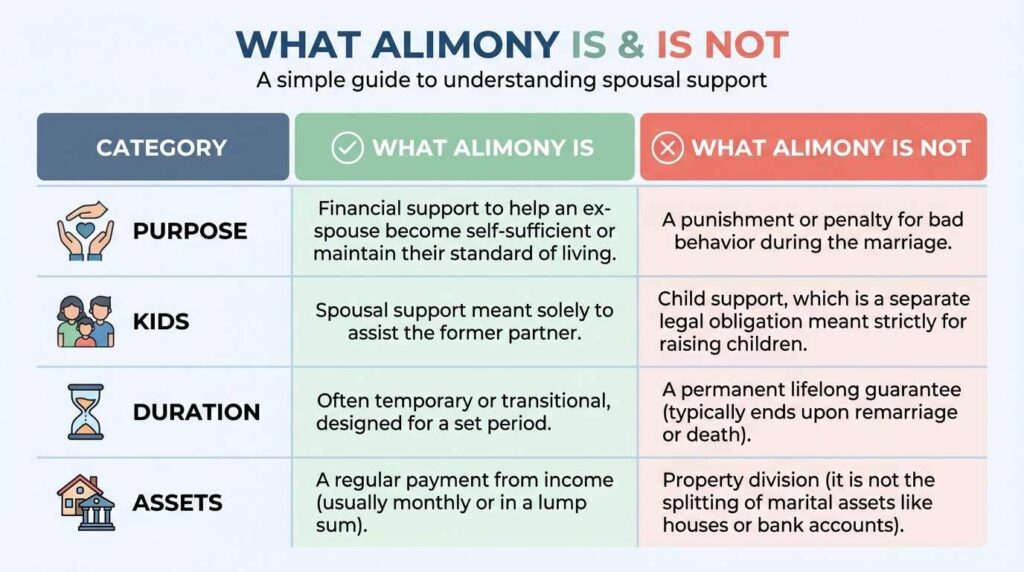
People mix these three up all the time. They are separate parts of a divorce, and each has its own rules.
| Feature | Alimony | Child Support | Property Division |
|---|---|---|---|
| Paid to | A former spouse | A parent for a child’s needs | Each spouse gets a share of assets |
| Based on | Need, income, marriage length | Parents’ income and parenting time | Marital property and debts |
| Taxable (after 2018)? | No, for the receiver or payer | No | Usually no tax at transfer |
| Can it change later? | Often, if the order allows it | Often, if life changes | Usually final |
| Ends when | Set date, death, remarriage, court order | Child reaches adulthood, often 18 | One time split |
A court can order all three in one case. A spouse who gets a bigger share of property may be awarded less alimony. A spouse who gets less property may be awarded more.
Alimony does not depend on whether there are children. Child support always follows the child’s needs. When both exist, many courts set child support first.
Who Can Get Alimony?
Either spouse can ask for it. A husband can receive alimony from a wife, a wife from a husband, and same-sex spouses are treated the same way. There is no right to alimony just because you are married.
Courts often look for these signs:
- One spouse earns much less than the other.
- One spouse stayed home or cut back work to raise children.
- The marriage lasted a long time, often 10 years or more.
- One spouse is older, ill, or disabled and cannot easily work.
- One spouse paid for the other’s school or training.
A very short marriage rarely leads to long term support. In many states a judge will not award alimony after a marriage of one or two years.
Example: Maria and Daniel were married for 18 years. Maria left her nursing job to raise two children while Daniel built a sales career. After the divorce, Maria needs a refresher course to get her license back. A judge may order Daniel to pay her support for a set time while she retrains. (This is a made up example for teaching only.)
Unmarried partners are different. Alimony is for spouses only. Some states allow “palimony” claims based on a written or implied deal, as in the California case Marvin v. Marvin, but many states do not.
Types of Alimony
Names change from state to state. These are the main forms you will see.
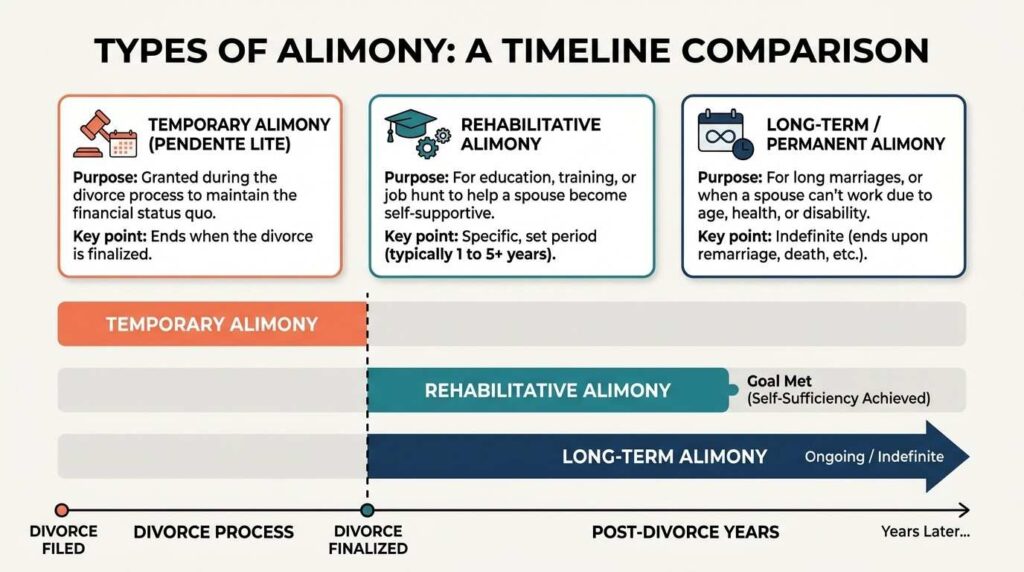
Temporary alimony. This is also called pendente lite support. It is paid while the divorce is pending and ends when the judge signs the final decree.
Rehabilitative alimony. This is support for a limited time so a spouse can get training, finish school, or find work. It usually has a clear end date.
Permanent or indefinite alimony. This has no fixed end date. It is paid until a legal event ends it, such as death or the receiver’s remarriage. Many states now use it rarely.
Reimbursement alimony. This pays one spouse back for money they put into the other’s education or career. A common case is a spouse who paid for a partner’s degree and then the marriage ended soon after.
Lump sum alimony. This is one payment, or a fixed total paid in installments. It is often treated as final, so it may not stop if the receiver remarries.
Contractual alimony. The spouses agree to it in a settlement or marital agreement. Courts usually enforce the contract terms.
Some states use their own labels. Florida, for example, uses temporary, bridge-the-gap, rehabilitative, and durational alimony. Massachusetts uses general term, rehabilitative, reimbursement, and transitional alimony.
How Courts Decide Alimony
Judges follow state law, and most states give them wide freedom. They weigh a list of factors and look at the whole picture.
Common factors include:
- Length of the marriage
- Each spouse’s income and earning ability
- Age and health of both spouses
- Standard of living during the marriage
- Time needed for education or job training
- Contributions to the household, including unpaid work at home
- Child care duties
- Property each spouse receives in the divorce
Fault is a special case. Many states ignore who caused the breakup. Georgia is different. Under Georgia Code section 19-6-1, a spouse can be barred from alimony if their adultery or desertion caused the separation. Florida’s 2023 reform also lets judges weigh the money impact of adultery.
A spouse also has to show real need. If someone already earns enough to live well, a judge may deny alimony even in a long marriage.
How Is Alimony Calculated?
There is no national formula. Some states use math. Others leave the number to the judge. That is why online calculators give only rough estimates.
| State | Method | Key limit to know |
|---|---|---|
| New York | Two part formula with an income cap | $241,000 cap for 2026, advisory duration of 15% to 50% of marriage length |
| Texas | Statutory cap | Lesser of $5,000 or 20% of gross monthly income |
| Florida | Court discretion with caps on some types | No permanent alimony for judgments on or after July 1, 2023 |
| Massachusetts | Duration limits based on marriage length | Typical cap of 30% to 35% of the income gap |
| California | County formula for temporary support, factors for long term | Court uses Family Code section 4320 factors |
| Georgia | No formula | Judge weighs statutory factors, and fault can matter |
Always check your own state’s rules and current numbers. Caps and cutoffs change.
Worked Example 1: New York
Here is a made up case to show the math. Priya earns $150,000 a year and her spouse, Sam, earns $45,000. There is no child support. The marriage lasted 12 years.
New York uses two tests and picks the lower result:
- 30% of the payer’s income minus 20% of the other spouse’s income. That is $45,000 minus $9,000, or $36,000 a year.
- 40% of combined income minus the lower earner’s income. That is $78,000 minus $45,000, or $33,000 a year.
The lower number is $33,000, or about $2,750 a month. For a 12 year marriage, the advisory schedule suggests support for 15% to 30% of the marriage length. That is about 1.8 to 3.6 years. Judges can go above or below these guides.
Worked Example 2: Texas
Texas calls alimony spousal maintenance, and it is harder to get. Under Texas Family Code sections 8.051 and 8.055, the requesting spouse must meet strict conditions. A common one is a marriage of 10 years or more plus a lack of enough property to meet minimum needs.
Say one spouse earns $18,000 a month before taxes. Twenty percent is $3,600, which is under the $5,000 dollar cap. The most a court could order is $3,600 a month.
One detail trips people up. Some older web guides say Texas uses the greater of the two numbers. The statute says the lesser of the two.
Worked Example 3: Florida
Florida’s 2023 law, Senate Bill 1416, changed alimony for final judgments entered on or after July 1, 2023. The Florida Senate summary says it removed permanent alimony and left bridge-the-gap, rehabilitative, and durational alimony. Rehabilitative alimony is limited to five years.
Durational alimony now has a cap tied to income. It cannot be more than the receiver’s reasonable need, and it cannot be more than 35 percent of the difference in the spouses’ net incomes, whichever is less. If one spouse nets $9,000 a month and the other nets $3,000, the gap is $6,000. Thirty-five percent of that is $2,100.
How Long Does Alimony Last?
It depends on the state, the type, and the marriage. Longer marriages usually mean longer support. Many states now prefer time limited awards over lifetime ones.
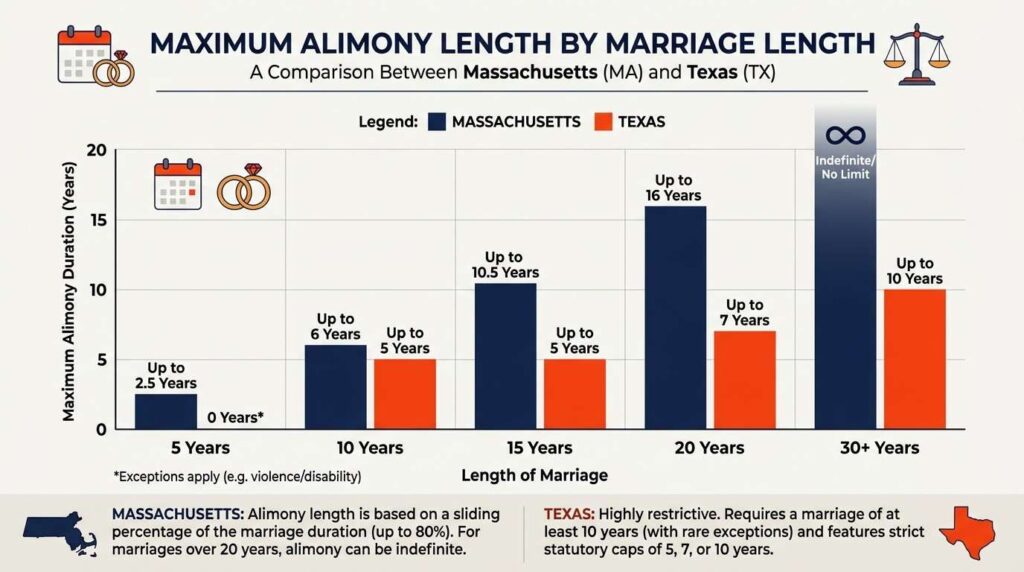
Massachusetts uses clear limits under its Alimony Reform Act, found in Chapter 208, Section 49 of the state’s General Laws. General term alimony cannot run longer than a share of the marriage:
| Length of marriage | Longest general term alimony |
|---|---|
| 5 years or less | 50% of the months married |
| More than 5, up to 10 years | 60% |
| More than 10, up to 15 years | 70% |
| More than 15, up to 20 years | 80% |
| More than 20 years | No fixed limit |
An 18 year marriage, for example, could lead to up to about 14.4 years of support. A judge can still go beyond the limits with written findings.
Texas caps maintenance at five years for a 10 to 20 year marriage, seven years for 20 to 30 years, and ten years for 30 years or more. Longer support can apply when a spouse has a serious disability.
Florida no longer allows permanent alimony for new judgments. Georgia has no fixed time limits, but its courts often favor rehabilitative support.
Remember that “permanent” alimony does not always last forever. It can still end on death, remarriage, or a court change.
Is Alimony Taxable in 2026?
For most new divorces, no. The Tax Cuts and Jobs Act of 2017 changed the rules. For a divorce or separation instrument signed after December 31, 2018, the payer cannot deduct alimony and the receiver does not count it as income. This change has no expiration date, unlike many other parts of that law.
Older orders are different. Alimony under a divorce instrument signed on or before December 31, 2018 keeps the old rules, where the payer deducts and the receiver reports. That stays true unless the order is later changed in a way that clearly says the new rules apply.
Here are a few more points:
- Payments must be made under a divorce or separation instrument to count as alimony. Gifts and voluntary payments do not.
- Child support is never taxable to the receiver and never deductible by the payer.
- State income tax rules can differ from federal rules, so check your state.
The IRS explains the details in Publication 504, Divorced or Separated Individuals. A tax professional can tell you how this affects your own return.
How the Process Works, Step by Step
- Divorce or separation case is filed. One spouse asks the court to end the marriage, and the request can include alimony.
- Temporary support may be set. A judge can order support while the case is pending.
- Both sides share financial details. This usually includes pay stubs, tax returns, bank records, and a list of expenses.
- The spouses try to settle. Many cases settle through talks or mediation.
- A judge decides if no deal is reached. The judge weighs the state’s factors and issues an order.
- The final order spells out the terms. It states the amount, the start date, the end date, and what events change it.
Timing matters. In some states, such as Maryland, the court says you must ask for alimony before the final divorce decree is entered. Waiting until after the divorce can mean losing the chance.
Divorce filings are usually public court records. That is how reporters and the public check what is real. For an example of how records can answer a rumor, see our report on what court records show in the Travis Hunter divorce story.
Court Order vs Agreement
Spouses can settle alimony on their own, and a judge usually approves a fair deal. A written agreement can set an amount, an end date, and rules for changes. Agreements often give more control than a court order, and the terms can differ from state limits.
That is useful, but it also carries risk. Contract terms may override the normal rules. A clause that says alimony is “non-modifiable” can limit your ability to ask for a change later.
Prenuptial and postnuptial agreements can also address alimony. Some states add extra rules to make sure a waiver is fair and was signed with proper advice.
Negotiated deals can end big money fights without a trial. For a real world example of a long legal fight over retirement pay that ended in an agreement, read our report on Robert Morris and Gateway Church.
Example: Lena and Marcus agree that Marcus will pay $2,000 a month for six years. They also agree that payments end if Lena remarries. The judge signs the agreement, and it becomes an enforceable order.
When Alimony Stops or Changes
Alimony can end in several ways. The order itself and your state’s law decide which ones apply.
Common end points:
- The end date arrives. Time limited alimony simply stops.
- Death of either spouse. Most periodic alimony ends, though a judge may require life insurance to protect payments.
- Remarriage of the receiver. Many states end alimony automatically. Georgia law, for example, ends periodic alimony on remarriage unless the agreement says otherwise.
- Living with a partner. Some states let the payer ask a court to reduce or end alimony. Georgia has a rule on this, in Code section 19-6-19.
- Court order. A judge can end or lower alimony after a major change in circumstances.
What counts as a major change? Courts often look at job loss, serious illness, a large raise, or retirement. The change must usually be real, lasting, and not caused by bad faith. Judges decide each case on its own facts.
Retirement is not automatic. Some states set rules. In Massachusetts, general term alimony usually ends when the payer reaches full Social Security retirement age, unless a judge finds a reason to keep it going. Florida’s 2023 law also set clearer steps for retirement requests.
Lump sum alimony is different. Because it is a fixed total, it often survives remarriage and cannot be easily changed.
You must ask the court for a change. Stopping payments on your own is risky, as the next section explains.
What If Someone Stops Paying?
Missing payments can bring real consequences. An alimony order is a court order, and courts can enforce it.
Common tools include:
- Contempt of court, which can lead to fines or jail time in some cases
- Wage garnishment, where money is taken from a paycheck
- Liens on property
- Bank account levies
- An order to pay the other side’s lawyer fees
Back payments usually stay owed even if the payer’s job changes.
Bankruptcy does not erase alimony. Federal law treats alimony as a domestic support obligation. Under 11 U.S.C. section 523(a)(5), these debts are not discharged in bankruptcy. A person in Chapter 13 usually has to stay current on support payments to complete the plan.
If you want to understand how bankruptcy works more broadly, see our guide to what a bankruptcy is and which debts it can and cannot erase.
If you are owed alimony, keep records of every missed payment. If you cannot pay, ask the court to change the order before you fall behind. Courts treat early requests far better than late ones.
Common Myths About Alimony
Myth: Only women get alimony. Not true. Either spouse can receive it, and the law looks at income and need.
Myth: Alimony lasts forever. Most awards today have an end date. Even “permanent” alimony can end on death, remarriage, or a court change.
Myth: You always owe alimony if you earn more. Courts want proof of need. Many divorces end with no alimony at all.
Myth: Cheating always decides alimony. In many states, fault plays little role. Georgia is one of the places where it can matter a lot.
Myth: A rumor means a divorce is happening. Social media can make a story look real before any court paper exists. Our legal guide on the resurfaced Ranveer Singh and Deepika Padukone divorce rumors shows why a rumor is not a filing and not a court order.
Myth: Alimony is always taxable. Not for new divorces. The 2018 cutoff date matters.
Mistakes to Avoid
- Waiting too long to ask. Some states close the door once the divorce is final.
- Hiding income or assets. Judges can punish this, and it can cost you far more than the truth.
- Stopping payments without a court order. Debts can build up, and interest and penalties may follow.
- Signing without reading. Terms about taxes, end dates, and changes matter for years.
- Ignoring tax effects. The date of your divorce papers can change who pays tax on what.
- Using a calculator as a promise. Online tools are estimates only.
- Moving in with a partner without checking the order. Some orders and state laws treat this as a reason to cut support.
When to Talk to a Lawyer
You do not need a lawyer to read about alimony. You should talk to one before you sign anything that sets support, or if your spouse already has counsel. Rules are tied to your state, and small wording choices can have big money effects.
Think about getting advice if:
- Your marriage was long and one income is much higher
- You or your spouse plans to retire soon
- A business, a pension, or other complex assets are involved
- You are asked to sign a non-modifiable agreement
- Payments have stopped, or you cannot keep up
- You live in a state with caps, such as Texas or Florida
If you are not sure who to look for, our explainer on the difference between an attorney and a lawyer can help. Look for a family law attorney licensed in the state where your divorce is filed. Many offer a short first meeting.
If cost is a worry, legal aid groups and court self-help centers can often point you to free or low cost help. The FindLaw spousal support overview is another place to learn how courts treat enforcement and common claims.
FAQ
What is alimony in simple terms?
Alimony is money a person pays a former spouse after a divorce or separation. A court can order it, or the spouses can agree to it. It is meant to help a lower earning spouse stay financially steady.
Who pays alimony?
Usually the spouse with more income or assets. It can be a husband or a wife. The court looks at need and ability to pay, not gender.
How much is alimony?
There is no standard amount. Some states use formulas and caps, and others leave it to the judge. A New York style formula can produce a set number, while Georgia has none.
How long does alimony last?
It depends on the state, the type, and the length of the marriage. Some awards last months, and some last many years. A few states still allow lifetime alimony, but many now cap it.
Is alimony taxable?
For divorce papers signed after December 31, 2018, the payer cannot deduct it and the receiver does not report it as federal income. Older orders keep the old rules unless they are changed to adopt the new ones. State rules may differ.
Can alimony be changed after the divorce?
Often yes, if the order allows it and there is a major change, such as job loss or illness. You must ask the court. Some orders and some types, such as lump sum alimony, cannot be changed.
Does alimony end if the receiver remarries?
In many states, yes. Some states end it automatically, while others require a court order. The wording in your agreement may change the result.
Can alimony be discharged in bankruptcy?
No. Federal law treats alimony as a domestic support obligation, and these debts are not erased in bankruptcy. The payer can still be pursued after the case ends.
Conclusion
So, what is alimony? It is court ordered or agreed support from one former spouse to the other, based on need, ability to pay, and the facts of the marriage. It comes in many forms, from short term support during a divorce to longer awards after a long marriage.
The big points are easy to remember. Rules vary by state, awards are not automatic, taxes changed for divorces after 2018, and a court order is a promise you have to keep. Good records and early legal advice can prevent most costly mistakes.
If alimony may be part of your divorce, talk with a licensed family law attorney in your state before you decide anything. You can also keep learning with more of our divorce and family law guides.