


In New York, your front side windows and windshield must let in at least 70% of light. New York Vehicle and Traffic Law Section 375 (12-a) sets 70 percent VLT as the legal minimum for every window on a passenger car, one of the strictest standards in the country. This guide breaks down the exact limits, fines, medical exemptions, and the 2026 point confusion, so you understand the New York tint laws before you spend money or risk a ticket.
- Quick Summary: New York Tint Rules at a Glance
- What Is VLT and How New York Measures Tint
- New York Legal Tint Limits by Window and Vehicle Type
- Reflectivity, Colors, and Other Tint Rules
- Medical Exemptions for Window Tint in New York
- Penalties, Fines, and the Annual Inspection
- The 2026 Point System Change: Does Tint Now Cost You a License Point?
- Could the 70% Rule Change? Pending Legislation to Watch
- How New York Compares to Other States
- What To Do Next
- FAQ
- Is 35% tint legal in New York?
- What is the darkest legal tint in New York?
- Does a tint ticket add points to your license in New York?
- How much is a window tint ticket in New York?
- Can you get a medical exemption for tint in New York?
- Will illegal tint fail a New York inspection?
- Is ceramic tint legal in New York?
- Are SUV and truck rear windows allowed to be dark?
For your specific situation, talk to a qualified New York attorney.
Quick Summary: New York Tint Rules at a Glance
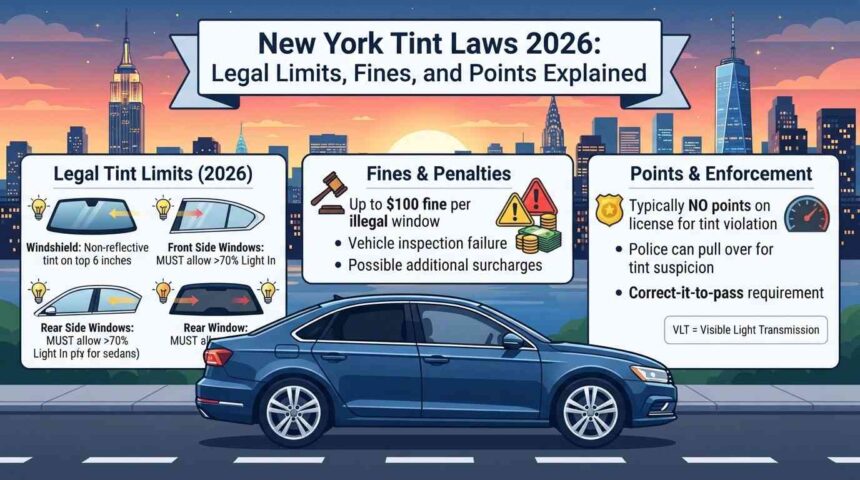
- The 70% rule – Front side windows and the windshield (below the top 6 inches) must let through at least 70% of light on every passenger vehicle.
- Sedans vs. SUVs – Sedans need 70% VLT on all windows, while SUVs, vans, and pickups can have any darkness on rear side and rear windows.
- Fines – A violation under VTL 375(12-a) carries a fine of $50 to $150 plus mandatory surcharges. The surcharges typically add $88 to $93 on top of the base fine.
- Inspection – Illegal tint fails the mandatory annual safety inspection, which can block your registration until you fix it.
- Medical exemption – Form MV-80W lets qualifying drivers run darker front tint, often around 20% VLT.
- 2026 points – There is a real dispute over whether tint now costs a license point. Verify with the DMV before assuming.
What Is VLT and How New York Measures Tint
VLT stands for Visible Light Transmission, the percentage of light that passes through your glass and film combined. A lower number means darker tint.
The point most drivers miss is how it is measured. VLT is measured through the glass and the film combined, not the film by itself. Most factory glass already blocks 10 to 25% of light on its own, so a “20% film” applied to glass that already has factory shading produces a measured VLT well below 20%.
This is why buying a glass-plus-film ** combo that measures exactly70% VLT** or lighter is the safe play. Aim for the legal number, not just below it.
New York does allow a small measurement cushion. Because of the plus-or-minus 7% tolerance, a meter reading of 63% or above is considered compliant. Do not treat that 7% as a shopping buffer, though. Purchasing film rated at exactly 70% or higher gives the most protection against a citation.
Here is a quick example. A driver installs film sold as “70%” on glass that already blocks 15% of light. The meter at inspection reads in the low 60s, the car fails, and the film has to come off.
New York Legal Tint Limits by Window and Vehicle Type
The direct answer: 70% VLT is the legal minimum on the front side windows of every passenger vehicle in New York. That part is the same whether you drive a sedan or a truck.
The difference shows up in the back. Sedans need 70 percent VLT on the windshield, both front side windows, both rear side windows, and the rear window. SUVs, vans, station wagons, and pickups need 70 percent VLT on the windshield and both front side windows, while rear side windows and the rear window can be any darkness.
For the windshield, tint is limited to the very top. The windshield may carry non-transparent material only on the uppermost 6 inches. Below that strip, the windshield must remain completely clear of any tint or film. That top strip sits above the AS-1 line marked on most windshields.
This is also why factory privacy glass is fine on many SUVs and trucks. Because the rear rules allow any darkness on those vehicles, the roughly 20% VLT dark glass they come with from the factory stays legal.
| Window Location | Sedans / Passenger Cars | SUVs, Vans & Pickups (MPVs) |
|---|---|---|
| Windshield | Non-reflective tint on top 6 inches only | Non-reflective tint on top 6 inches only |
| Front Side Windows | 70% VLT minimum | 70% VLT minimum |
| Rear Side Windows | 70% VLT minimum | Any darkness allowed |
| Rear Window | 70% VLT minimum | Any darkness allowed |
Sedans get one narrow break on the rear window. The rear window must meet 70% VLT unless the vehicle has dual outside mirrors. If both side mirrors work, a sedan may run darker rear glass.
Reflectivity, Colors, and Other Tint Rules
New York enforcement centers on how much light gets through, not how shiny the film looks. Mirrored and metallic films create glare that bothers other drivers, so most reputable installers avoid them on side windows.
Color matters too. The windshield rule effectively bars dark or colored strips from your line of sight. Windshield tint cannot be red, yellow, or amber.
For enforcement, officers rely on the meter. Officers enforcing the law focus on visible light transmission rather than reflectance. If the reading is too low, the vehicle is out of compliance regardless of the film’s brand or marketing.
One responsibility falls on you, not the shop. New York does not require installers to certify film, so the driver is legally responsible for compliance. Ask your installer to measure and write down the final glass-plus-film VLT before you drive off.
Medical Exemptions for Window Tint in New York
Drivers with qualifying medical conditions can apply for darker tint using Form MV-80W. New York’s non-medical rule is 70% on the front sides. With a valid medical exemption, drivers typically run much darker tint, commonly 20% to 35% on the front sides, depending on the physician’s recommendation.
The state lists specific conditions that may qualify. You may submit an Application for Tinted Window Exemption (MV-80W) for conditions such as severe drug photosensitivity where the treatment is expected to be of prolonged duration, photophobia associated with an ophthalmic or neurological disorder, and any other condition causing severe photosensitivity where you must be shielded from the sun’s direct rays. Commonly certified conditions include:
- Albinism
- Lupus erythematosus
- Porphyria
- Xeroderma pigmentosum
- Dermatomyositis
- Chronic actinic dermatitis
- Severe drug photosensitivity
- Photophobia from an eye or neurological disorder
The process is short but strict:
- A licensed physician or optometrist certifies your condition.
- You submit the completed Form MV-80W to the New York DMV.
- Once approved, the DMV Commissioner issues a sticker that is affixed to each exempt window, and the sticker must be visible and in place on every covered window.
Keep a copy of your approval in the car. Without the Commissioner-issued sticker, a window with tint darker than 70% VLT is subject to the standard penalty.
Even with an exemption, the windshield rule still applies below the top 6 inches. Because the gap between the 70% standard and a 20% exemption is large, this exemption is meaningful for people who truly need it.
Penalties, Fines, and the Annual Inspection
The base fine is modest, but the surcharges are what sting. A violation under VTL 375(12-a) carries a fine of $50 to $150 plus mandatory surcharges, which typically add $88 to $93 on top of the base fine. That pushes the real cost into the low hundreds.
Tickets tend to run higher in the city. Reported New York City totals reach the $150 to $300 range, and repeat offenses climb further. A second offense within 18 months can run $250 to $500.
Inspection is where many drivers get caught. Since 2017, vehicles are tested for window tint as part of the annual inspection process, and cars below the 70 percent threshold will not pass. A failed inspection can block your registration renewal until you fix the tint or show an exemption.
Enforcement is active statewide. NYPD, New York State Police, Nassau County PD, Suffolk County PD, and local agencies can pull you over solely for dark tint, since any visible aftermarket tint is grounds for a stop. NYPD also conducts targeted tint enforcement checkpoints in certain precincts.
If you get a tint ticket, here is a practical checklist:
- Keep any installer receipt showing the film’s VLT rating.
- Remember that meter readings can vary, so calibration matters.
- Decide whether to remove or lighten the tint, or contest the ticket.
- Consult a local attorney about your specific case.
Fines and enforcement vary by county, and none of this is legal advice.
The 2026 Point System Change: Does Tint Now Cost You a License Point?
The honest answer as of mid-2026 is that there is a genuine dispute. Do not assume tint is point-free.
The confusion comes from a broad DMV overhaul. The timeframe the DMV uses to calculate your point total was extended from 18 months to 24 months, and the number of points required to trigger a possible license suspension was lowered from 11 points to 10 points. These changes took effect February 16, 2026, so every point now matters more.
Both sides make a case. On the official side, the New York DMV’s February 5 announcement stated that many existing point assignments, such as the five points for a mobile phone violation or zero points for equipment violations, will remain as they are with no additional changes. Tint has historically been an equipment violation, which points to zero points.
On the other side, reporting compiled by Rvinyl notes that this official communication stands in contrast to a wave of information from news outlets, traffic attorneys, and forums reporting that starting in February 2026, illegal window tint will no longer be a simple equipment ticket.
There is also a per-window theory. Some suggest officers could issue a separate ticket for each window in violation, and if each ticket carries one point, a driver with illegally tinted front windows and a rear window could face three points from a single stop. This is disputed and not confirmed by the DMV.
Treat it cautiously and verify current point values directly with the NY DMV, since this detail can change.
Could the 70% Rule Change? Pending Legislation to Watch
Lawmakers keep trying to loosen New York’s strict standard. The most recent push would set a uniform 50% VLT on all windows except the front windshield.
An earlier version came from Senator Salazar as Senate Bill S4572. A newer version followed from Senator Cooney. Senate Bill S9226, introduced February 18, 2026, would allow all windows except the front windshield to have a fifty percent visible light transmittance standard in New York State.
The bill has moved, but it is not law. According to bill tracking, S9226 was advanced to third reading on April 27, 2026. The 70% rule remains fully in effect today. Check the New York State Senate site for the current status before relying on any change.
How New York Compares to Other States
New York’s 70% front-window rule is among the strictest in the nation, roughly tied with California, and far tighter than states that allow 30% to 35% on front windows. Many states also permit much darker rear tint than New York allows on sedans.
If you are comparing states or recently moved, these guides help:
One reminder for visitors: New York enforces its 70% rule against out-of-state vehicles driven within the state, so an exemption from your home state may not shield you here.
What To Do Next
Measure before you spend. If you already have tint, get the glass-plus-film VLT metered now so you know whether you will pass inspection, and if you are shopping for film, buy a 70% or lighter combo (or apply for an MV-80W exemption if you qualify).
The single clearest next step is to have an installer measure your current front windows and hand you the reading in writing. If the number is below the legal line and you got a ticket or a suspension worry, talk with a New York traffic attorney about your options. For plain-English explainers on tint rules in other states, browse our related guides on Legal Expertise.
FAQ
Is 35% tint legal in New York?
No, not on front side windows. Those must let through at least 70% of light. Most commercially available tint shades marketed as 35%, 20%, or 15% are not legal on any side window in New York. It can be legal on the rear side and rear windows of SUVs, vans, and pickups, which allow any darkness.
What is the darkest legal tint in New York?
Without an exemption, 70% VLT is the darkest legal tint on front side windows. With an approved medical exemption, drivers can go much darker. Drivers typically run tint commonly in the 20% to 35% range on the front sides, depending on the physician’s recommendation.
Does a tint ticket add points to your license in New York?
It is disputed as of 2026. The DMV’s February 5 announcement kept zero points for equipment violations, which have historically included window tint. But many attorneys and news outlets report tint now carries a point per window. Verify current point values directly with the NY DMV before assuming.
How much is a window tint ticket in New York?
Expect a low-hundreds total. The base fine runs $50 to $150 plus mandatory surcharges that typically add $88 to $93. Tickets tend to run higher in New York City, and repeat offenses cost more.
Can you get a medical exemption for tint in New York?
Yes. You apply using Form MV-80W, which must be signed by a licensed physician or optometrist and submitted to the DMV. Once approved, the DMV Commissioner issues a sticker affixed to each exempt window. Qualifying drivers can then run darker front side tint.
Will illegal tint fail a New York inspection?
Yes. Since 2017, vehicles are tested for tint at the annual inspection, and cars below the 70 percent threshold will not pass. A failed inspection can block your registration renewal until you remove the tint or show a valid exemption.
Is ceramic tint legal in New York?
Yes, if the final glass-plus-film measures at least 70% VLT. Ceramic film blocks heat and UV rays without needing to be dark, so a 70% ceramic film can stay legal while still cutting glare and heat. The material is fine; the darkness is what the law measures.
Are SUV and truck rear windows allowed to be dark?
Yes. On SUVs, vans, station wagons, and pickups, the rear side windows and rear window can be any darkness. This is why factory privacy glass on these vehicles is legal, while the windshield and front side windows still need 70% VLT.