



If you have submitted an application or petition to USCIS, it is important to know the current status of your case. Your USCIS case status tells you what stage your application is currently in and whether there have been any updates.
- Why Is the Current Status of Your Case Important?
- How to Check Your USCIS Case Status Online
- Receipt Number vs. A-Number vs. DOS Case ID
- How to Check Your Case Status Through myUSCIS
- What Does Each USCIS Case Status Message Mean?
- Checking Status by Case Type
- USCIS Case Status en Español
- Does USCIS Update Case Status on Weekends?
- How Often Does USCIS Update Case Status?
- Why Is My Case Taking So Long?
- What to Do: “Error Retrieving Case Status”
- A Word of Caution: Third-Party “Case Tracker” Sites
- What to Do If Your Case Is Taking Longer Than Normal
- What Happens After Approval?
- Common Mistakes People Make When Checking Their Case Status
- Glossary
- FAQ
- Q1. How do I check my case status without a receipt number?
- Q2. Can I check someone else’s case status?
- Q3. What does “error retrieving case status” mean?
- Q4. How long after “Approved” will I get my card?
- Q5. Does USCIS update on weekends?
- Q6. Is there a USCIS app?
- Q7. Can I call USCIS about my case?
- Q8. Why hasn’t my status changed in months?
- Q9. Does premium processing guarantee approval?
- Q10. What should I do if I suspect a scam text or call about my case?
- Conclusion
- Links for Your Use
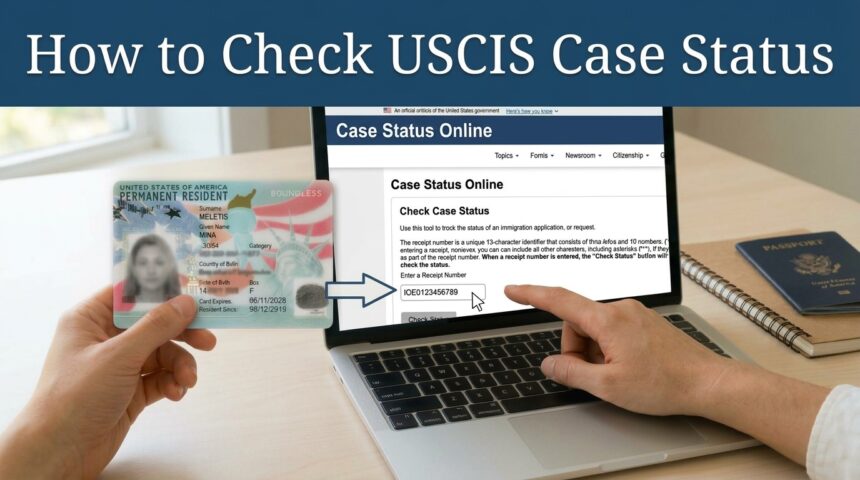
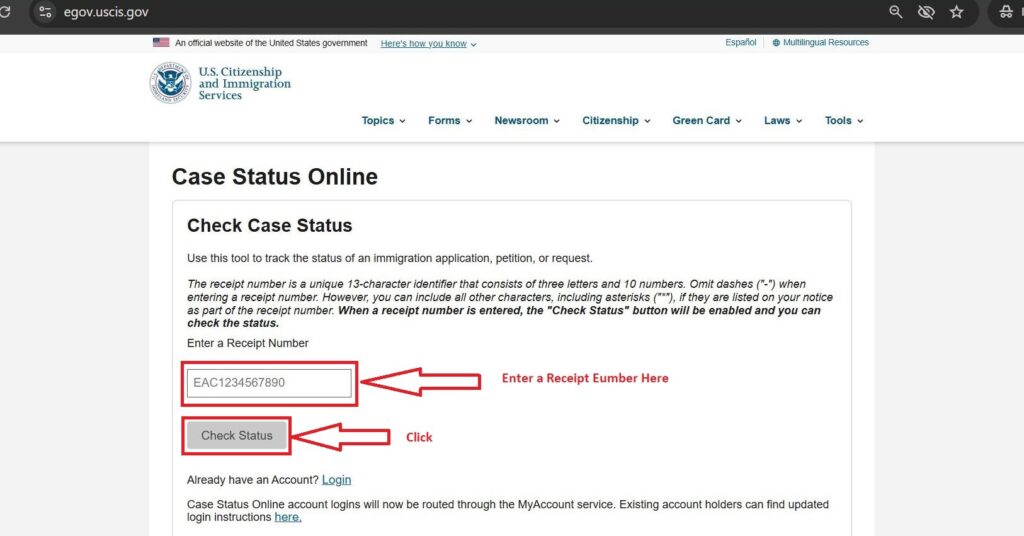
To check your case status, go to egov.uscis.gov/casestatus. Enter your 13-character receipt number in the case status field and click “Check Status.”
USCIS regularly updates case information as your application moves through the process. Sometimes, you may not see any new update for several days or even longer. This does not always mean there is a problem with your case.
If there is no change in your case status, do not worry. Check the status again after a few days to see if USCIS has posted a new update.
Why Is the Current Status of Your Case Important?
Your case status is not just a number on a screen. It tells you what is happening with your case and whether you need to take any action.
By checking your case status regularly, you can know when to check your mailbox for a letter from USCIS, when you need to submit additional documents, and when your case needs your immediate attention.
It is important to keep track of any changes in your case status because you could miss an important deadline. For example, USCIS may give you a specific deadline to provide evidence or additional documents. If you have a biometrics appointment, you also need to attend it at the scheduled time. If you miss the appointment or do not take the required action on time, it could affect the processing of your case.
For this reason, you should check your USCIS case status regularly. This helps you stay updated and take the necessary action on time.
How to Check Your USCIS Case Status Online
Go to the official case status page. Type in your receipt number exactly as it’s printed. Click “Check Status.” That’s it.
1. Find your receipt number (see below for where to look).
2. Go to egov.uscis.gov/casestatus.
3. Type in the number. No dashes. Keep any asterisks.
4. Click “Check Status.”
You’ll see your latest update, the date it posted, and a short line about what it means. You can check another case right after, using the same page — handy if you’re tracking a spouse’s or child’s case too.
Can’t get online? USCIS still mails a paper notice at every major step. So if you’re not near a computer, keep an eye on your mailbox too.
How to Read Your Form I-797, Notice of Action
Your I-797 is more than just a receipt. It is an important document that shows USCIS has received and is processing your case. Learn how to read it once, and you will be able to understand your case information more easily in the future.
Your receipt number is usually shown in the box at the top left of the notice. Your name and address are listed below it. The middle part of the notice explains what type of notice it is. For example, it may be a receipt notice, biometrics appointment notice, approval notice, or a request for additional evidence. You may also see a priority date near the bottom of the notice. This date is very important in some green card cases, especially when the number of available visas is limited.
Check every field the day it arrives. A misspelled name or wrong birthdate on this notice can cause real problems later, especially at a green card interview or a citizenship interview.
Finding Your Receipt Number
Your receipt number is on your Form I-797, top left corner. It’s a total of 13 characters: three letters, then ten numbers. For example, a number might look like this: IOE0926015678. The letters tell you which office is handling your case.
| Letters | Office |
| EAC | Vermont Service Center |
| WAC | California Service Center |
| LIN | Nebraska Service Center |
| SRC | Texas Service Center |
| MSC | National Benefits Center |
| IOE | Filed online |
Lost your receipt number? Check your myUSCIS account first — it’s saved there. No account? Check old emails from USCIS, or ask your lawyer’s office if one filed for you. If you truly can’t find it anywhere, you can ask USCIS for a replacement notice using Form I-824.
Receipt Number vs. A-Number vs. DOS Case ID
These three numbers get mixed up a lot. Here’s the difference.
Your receipt number tracks one filing. File three forms, and you’ll have three receipt numbers. Your Alien Registration Number (A-Number) stays with you for life, across every filing you ever make, from your first work permit to your citizenship application years later. Your DOS Case ID only shows up once your case moves to a U.S. embassy or consulate — it’s a State Department number, not a USCIS one, and it won’t work in the USCIS case status tool at all.
| Number | Who uses it | Where you find it |
| Receipt number | USCIS, for one filing | Form I-797 |
| A-Number | USCIS, tied to you personally | Green card, past notices |
| DOS Case ID | State Department, for visa interviews | NVC emails/letters |
Mixing these up is one of the most common reasons people think a lookup “isn’t working.” It usually isn’t broken — it’s just the wrong number in the wrong box.
How to Check Your Case Status Through myUSCIS
Setting up a free account at myaccount.uscis.gov does more than a one-time check. Once you’re signed in, you can see every case tied to your name, get texts or emails the second something changes, and in many cases upload documents straight to USCIS instead of mailing them.
If you filed on paper, you can usually link that paper case to a new online account after you sign up. If a lawyer represents you, they can also file a Form G-28 so they show up as your representative and receive copies of your notices too.
The account works fine from a phone. You don’t need a computer, just a browser and your receipt number the first time you link a case.
What Does Each USCIS Case Status Message Mean?
USCIS uses the same set of phrases across almost every form type. Here’s what the most common ones mean.
| Status | What it means | What happens next |
| Case Was Received | USCIS has your filing and opened a case | Wait — nothing to do yet |
| Case Was Received and a Receipt Notice Was Sent | Your I-797C is on its way | Save the receipt number |
| Case Was Updated to Show Fingerprints Were Taken | Biometrics are done | Wait for the next update |
| Case Was Updated to Show All Fees Were Paid | Payment cleared | Wait for the next update |
| We Have Taken an Action on Your Case | An officer did something on your file | Watch for the follow-up status |
| Request for Evidence Was Sent | USCIS needs more documents | Reply by the deadline on the notice |
| Response to RFE Was Received | USCIS has your reply and will keep reviewing | Wait for a decision |
| Case Was Transferred | Your file moved to a different office | No action needed |
| Interview Was Scheduled | You have an interview coming | Watch your mail for the notice |
| Card Is Being Produced | Case approved, card is being made | Card should follow soon |
| Case Was Approved | USCIS said yes | Approval notice (and card, if any) follows by mail |
| Case Was Denied | USCIS said no | Read the denial notice for your options |
| Case Was Reopened | USCIS is looking at your case again | Wait for a new decision |
One more thing worth knowing: the mailed paper notice is the only one that counts legally. If the website ever says something different from your mailed letter, trust the letter.
What’s the Difference? “Case Is Still Being Processed” vs. “Case Is Being Actively Reviewed”
Short answer: “Still Being Processed” means your file is waiting in line. Nobody has picked it up yet. “Actively Reviewed” means an officer has it open and is going through it right now.
Both are normal. The second one just means you moved one step closer. Applicants often see “Still Being Processed” for weeks, sometimes months, before the status changes again. That gap is not a sign of a problem by itself.
Checking Status by Case Type
Not every case moves through the same steps. Here’s what’s different for a few common ones.
H-1B petitions. Your status will move through registration, then filing, then review. If your employer amends the petition, or if you change employers mid-process, don’t be surprised if the status resets to “Received” again on the new filing — that’s normal, not a mistake. During cap season, high volume can also mean slower movement between statuses than you’d see the rest of the year.
Form I-130 (petition for a relative). An “approved” status here only means the petition is done. Your relative still has to go through a visa interview at a consulate or a green card application inside the U.S. after that. Approval here is step one, not the finish line — a lot of applicants assume it means their relative can travel right away, and that’s not accurate.
Green card cases (Form I-485). Most people file an I-485 along with a work permit (I-765) and a travel document (I-131) at the same time. Each one gets its own receipt number and its own status. Don’t check just one and assume the others match — it’s common for the work permit to approve months before the green card itself does.
Citizenship (Form N-400). This one usually moves through biometrics, then an interview notice, then the interview, then an oath ceremony notice. Each step shows up as its own status, and the gap between interview and oath ceremony can itself take a few weeks depending on the local office’s schedule.
K-1 fiancé visa. USCIS handles the first part (Form I-129F). Once that’s approved, your case moves to the State Department, and from then on you’re tracking a DOS Case ID at the National Visa Center and, eventually, a specific U.S. embassy — not your original USCIS receipt number.
See also: Homeland Security student visa lawsuit — how policy changes affect pending cases
USCIS Case Status en Español
USCIS’s tools work in Spanish too. Pick the Spanish option on the case status page, or switch your myUSCIS account language setting to see your notices en español. This matters for a lot of applicants — many people search for exactly this option because their notices arrived in English only, and they weren’t sure a Spanish version even existed.
Does USCIS Update Case Status on Weekends?
Short answer: Yes, the system can show an update any day. But most changes happen on business days, since that’s when officers are actually working the files.
A weekend change usually means a batch update ran, not that someone worked your case on a Saturday. Don’t read extra meaning into the exact day a status changes — the date matters far less than the message itself.
How Often Does USCIS Update Case Status?
Short answer: There’s no fixed schedule. Some cases get several updates in one week. Others sit unchanged for months while still moving normally behind the scenes.
Turning on email or text alerts is the best way to catch a change the moment it happens, rather than refreshing the page every day. Constant checking won’t make USCIS move faster, and it can add stress for no real benefit.
Why Is My Case Taking So Long?
A few things slow cases down, and none of them mean something went wrong:
- Backlog. Some offices simply have more cases than staff to review them quickly.
- Background checks. Every case goes through a security and background check, and some names or histories take longer to clear than others.
- A Request for Evidence. Once USCIS asks for more documents, the clock effectively resets until you respond.
- Case complexity. A straightforward renewal moves faster than a case with a prior denial, a criminal record question, or unusual travel history.
- Staffing and funding changes. Government staffing levels shift over time, and that affects how fast every office can move.
None of these are permanent problems. They’re just part of how a large government agency processes millions of cases every year.
Can You Speed Up USCIS Processing? (Premium Processing)
Short answer: Yes, for some forms. Premium processing is a paid option where USCIS guarantees to act on your case within a set number of business days.
As of March 1, 2026, the fee is $2,965 for most Form I-129 (H-1B, L-1, O-1, and similar) and Form I-140 petitions, with a 15-business-day guarantee. Some I-140 categories, like EB-1C and the National Interest Waiver, get 45 business days instead. Certain I-765 (OPT/STEM OPT) and I-539 filings qualify for a 30-business-day option at a lower fee.
Premium processing is requested on its own form, Form I-907, filed and paid separately from your main petition. If USCIS misses its own deadline, it refunds the premium processing fee and keeps working your case on an expedited basis anyway — so you don’t lose out even if the guarantee slips. Not every form qualifies, so check the current eligibility list on USCIS’s site before you pay.
What to Do: “Error Retrieving Case Status”
1. Check the receipt number again. “O” and “0” get mixed up a lot, and so do “I” and “1.”
2. Just filed? It can take a few business days to show up in the system.
3. Check your actual notice for typos — sometimes USCIS prints the wrong name or address, and that’s worth a call, not just a re-check.
4. Try again in 24 hours. The site does go down for maintenance sometimes.
5. Still stuck? Call the USCIS Contact Center.
A Word of Caution: Third-Party “Case Tracker” Sites
Stick to the real USCIS site and your own myUSCIS account. Some third-party apps and websites copy USCIS’s look to collect your personal information, sometimes even charging a fee to “check your status” for you — something USCIS itself does for free.
A few warning signs worth knowing: a site asking for your Social Security number just to look up a status, a web address that isn’t ending in .gov, or a text message claiming to be from USCIS asking you to click a link and pay a fee. USCIS does not request payment by gift card, wire transfer, or over text message. If a site or message asks for that, it’s not really USCIS.
What to Do If Your Case Is Taking Longer Than Normal
First, check your form against the official Processing Times tool. If your wait is genuinely past that window, here’s the order to try things:
1. File a case inquiry (e-Request) online.
2. Call the USCIS Contact Center.
3. Moved recently? File Form AR-11 within 10 days — a missed notice is one of the most common reasons a case looks stuck.
4. Contact the DHS Ombudsman for independent help.
5. Ask your local congressional representative’s office — many have staff who help with stuck immigration cases, though you’ll usually need to sign a privacy release form first.
When it’s time to call a lawyer: if you got an RFE and aren’t sure how to answer it, if your case was denied, if you’re in removal proceedings, or if your case is well past the normal wait and nothing above has worked.
See also: Why a case may not appear in an official case-lookup system
What Happens After Approval?
Once your case says “Approved,” a physical notice follows by mail. If your case involves a card — a green card or work permit — that card gets made and mailed separately, and its own status will usually update to “Card Is Being Produced” before it ships.
Card never showed up? Don’t assume it’s lost right away. Give it a reasonable amount of time first, then file a non-delivery request through USCIS rather than guessing. Keep your approval notice safe in the meantime — it’s proof of your status even before the physical card arrives.
Common Mistakes People Make When Checking Their Case Status
A few small habits cause most of the confusion applicants run into:
- Typing the receipt number from memory instead of copying it straight from the notice.
- Ignoring email or text alerts after signing up for them, then missing a real update for weeks.
- Checking only one case when several related forms were filed together.
- Assuming “no change” means a problem, when it usually just means normal processing.
- Trusting a third-party app over the actual USCIS website or account.
Fixing these habits solves most of the frustration people feel with the process — the system itself is usually working as intended.
Glossary
| Term | Meaning |
| Receipt number | 13-character code for one filing |
| A-Number | Number tied to you personally, across all filings |
| RFE | Request for Evidence — USCIS wants more documents |
| Service center | The USCIS office handling your case |
| Ombudsman | Independent DHS office that helps with stuck cases |
| AR-11 | Form to report a change of address |
| Premium processing | Paid option for a faster, guaranteed decision |
| DOS Case ID | State Department number, used once your case reaches a consulate |
| Form G-28 | Form that adds a lawyer as your official representative |
| Biometrics | Fingerprints, photo, and signature taken for background checks |
FAQ
Q1. How do I check my case status without a receipt number?
Try your myUSCIS account first — it’s saved there. No account? Ask your lawyer’s office, or call the USCIS Contact Center for help finding it.
Q2. Can I check someone else’s case status?
Yes, if you have their receipt number. The tool doesn’t check who’s asking.
Q3. What does “error retrieving case status” mean?
Usually a typo in the receipt number, a case that’s too new to show up yet, or short site maintenance.
Q4. How long after “Approved” will I get my card?
It varies by form type. A card is made and mailed after approval — give it time before assuming something’s wrong.
Q5. Does USCIS update on weekends?
Yes, but most updates post on business days.
Q6. Is there a USCIS app?
No official app. The website and myUSCIS account both work fine on a phone browser.
Q7. Can I call USCIS about my case?
Yes, the Contact Center can help, especially if your case is genuinely past normal processing time.
Q8. Why hasn’t my status changed in months?
Usually just a long queue, not a mistake. Check the official processing times for your form before worrying.
Q9. Does premium processing guarantee approval?
No. It only guarantees a decision within a set number of business days — that decision could still be an RFE or a denial.
Q10. What should I do if I suspect a scam text or call about my case?
Don’t click any links or pay anything. Go straight to the official USCIS site yourself and check your status there instead.
Conclusion
Checking your USCIS case status is simple once you know where to look and what the messages mean. Most delays are normal, not signs of trouble. If your case is genuinely stuck, work through the steps above in order, and talk to a licensed immigration attorney if you’re unsure what to do next.
Legal Disclaimer: This is general information only and not a substitute for advice from a qualified attorney licensed in your jurisdiction.
Links for Your Use
| Resource | Link |
| USCIS Case Status Tool | https://egov.uscis.gov/casestatus/landing.do |
| USCIS Processing Times | https://egov.uscis.gov/processing-times/ |
| USCIS Case Inquiry (e-Request) | https://egov.uscis.gov/e-request/Intro.do |
| myUSCIS Account | https://myaccount.uscis.gov/ |
| USCIS Contact Center | https://www.uscis.gov/contactcenter |
| USCIS Ombudsman | https://www.dhs.gov/case-assistance |
| File Form AR-11 | https://www.uscis.gov/ar-11 |