



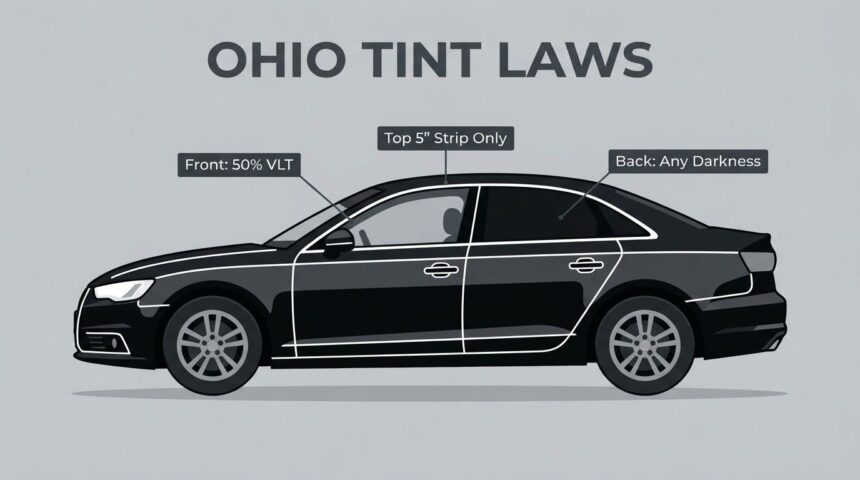
In Ohio, your front side windows must let at least 50% of light through (50% VLT), while your back side windows and rear window can be any darkness you want. That one rule covers most of what drivers need to know about Ohio tint laws before they buy or install film.
- Key Takeaways
- Ohio Window Tint Limits by Window (VLT Explained)
- Ohio Window Tint Laws for the Windshield
- Color, Reflectivity, and Label Rules
- Do SUVs, Trucks, and Vans Follow Different Rules?
- Medical Exemptions for Darker Tint
- Penalties for Illegal Tint in Ohio
- The Law Behind the Rules (Official Sources)
- How to Stay Compliant Before You Tint
- The Bottom Line
- FAQ
- What is the legal tint limit in Ohio?
- Is 35% tint legal in Ohio?
- Is 20% or 5% tint legal in Ohio?
- Does Ohio allow a windshield tint strip?
- Are SUVs and trucks tinted differently than cars in Ohio?
- Does Ohio require a tint sticker or label?
- Does Ohio allow medical exemptions for tint?
- What happens if I get caught with illegal tint in Ohio?
Getting the numbers wrong matters. Too-dark film on the wrong window can mean a traffic citation, a failed compliance check, or paying a shop to peel off tint you just paid to install.
This article is general information only. It is not a substitute for advice from a qualified attorney licensed in Ohio. Tint laws can change over time, and local police departments and courts may enforce them a little differently, so always confirm current rules before you commit.
Key Takeaways
- Front side windows – Must allow at least 50% VLT for every vehicle type, sedan or SUV.
- Back and rear windows – Any darkness is allowed, but a rear window under 50% VLT needs dual outside mirrors.
- Windshield – Only a non-reflective strip above the AS-1 line (or top 5 inches) is allowed; the rest must pass 70% VLT.
- Reflective and mirrored tint – Banned on every window, along with red and yellow film.
- Labels – Each tinted window needs a small manufacturer label showing the name and VLT percentage.
- Same rules for all vehicles – Ohio treats sedans, SUVs, vans, and trucks the same.
- Penalties – Illegal tint is a minor misdemeanor that can bring a fine or a fix-it ticket.
Ohio Window Tint Limits by Window (VLT Explained)
Ohio measures legal tint by Visible Light Transmission (VLT), the percentage of light that passes through the glass and film together. A lower VLT number means darker tint.
Here is the plain version: VLT is how much light gets through your window. A lower VLT number means darker tint. For example, 20% VLT is darker than 35% VLT because less visible light passes through the window.
The reading is based on the film plus your factory glass combined, not the number on the film box. The legal reading usually depends on the glass and film together, not just the film box. That is why a film sold as 35% can test lower after it is installed on factory-tinted glass.
Here are the legal limits for each window.
| Window Location | Sedans (Cars) | SUVs / Vans / Trucks | Legal Rule Notes |
|---|---|---|---|
| Windshield | Non-reflective tint only above the AS-1 line or top 5 inches | Same | Rest of windshield must allow 70% VLT and cannot be reflective |
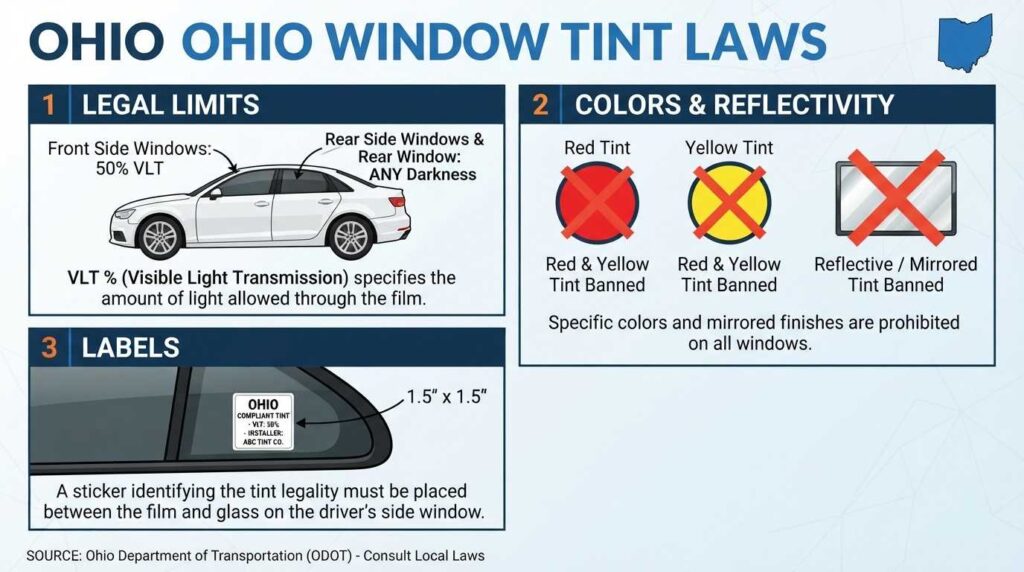
| Front Side Windows | At least 50% VLT | At least 50% VLT | Same for both vehicle types; no red or yellow |
| Back Side Windows | Any darkness | Any darkness | No reflective film |
| Rear Window | Any darkness | Any darkness | Dual outside mirrors required if below 50% VLT |
The administrative code builds in a small measurement tolerance. Side windows next to the driver must have a light transmittance of not less than fifty per cent plus or minus three per cent and cannot be red or yellow. That 3% tolerance gives a small cushion for measurement variability, but it’s not a license to push the limits.
Ohio Window Tint Laws for the Windshield
You can only put non-reflective tint on the top of your windshield, above the AS-1 line or the top 5 inches, whichever is closer to the top. Any sunscreening material applied along the top of the windshield that does not extend downward beyond the AS-1 line or five inches from the top of the windshield, whichever is closer to the top, is not regulated by this rule.
The AS-1 line is a small marking the manufacturer places near the top of the windshield. The top strip is legal because it cuts sun glare during sunrise and sunset without blocking the driver’s main view of the road.
The rest of the windshield is different. Any tint applied to the rest of the windshield must still allow at least 70% VLT, with a tolerance of plus or minus 3%. It also cannot be reflective.
Here is a common, avoidable mistake. A driver installs a dark “sun strip” that dips below the AS-1 line and gets cited during a routine stop. Keeping the strip above that line keeps you clear.
[Guide Image: Diagram of a windshield showing the AS-1 line and the legal top-5-inch tint strip]
Color, Reflectivity, and Label Rules
Many drivers miss this rule: Ohio bans reflective ** andmirrored** (metallic) tint on every window. No reflectorized materials shall be permitted upon or in any front windshield, side windows, sidewings or rear window. This is a flat prohibition, not just a darkness limit.
The reason is simple. Shiny, mirror-like windows bounce glare into other drivers’ eyes.
Color is restricted too. Red and yellow (amber) tints are prohibited, while neutral charcoal and gray tones are generally fine if they meet the VLT limits. Red and amber tints are prohibited. Charcoal and gray are typically allowed if tested for compliance.
Every aftermarket-tinted window also needs a manufacturer label. All sunscreening material must indicate the manufacturer’s name and the percentage level of light transmission, permanently installed between the material and the surface to which it is applied. Such label must be legible and placed in the lower left-hand corner of the vehicle window when viewed from the outside. The rule sets a size limit too: each manufacturer shall provide a label no larger than one and one-half inches by one and one-half inches for installation between the material and each glazing surface.
One quick tip: keep your installer’s receipt showing the film brand and rated VLT. It’s useful proof if you’re ever stopped.
Do SUVs, Trucks, and Vans Follow Different Rules?
No. Ohio applies the same tint rules to sedans, SUVs, vans, and trucks, which is simpler than many other states. One common misconception is that SUVs and vans have different tint laws than sedans. Ohio applies identical window tint regulations to all passenger vehicles, regardless of vehicle type.
There is one practical wrinkle. Larger vehicles often come with factory “privacy glass” on the rear windows, but the front side windows still need to hit 50% VLT no matter the vehicle type.
Factory privacy glass, where pigment is mixed into the glass itself, is legal. Adding aftermarket film over it on the front side windows can push the combined VLT below the limit, so those front doors need care.
Here’s a simple example. An SUV owner has 5% factory privacy glass on the rear and adds a 50% film to the front doors. The rear stays legal, the front stays at the 50% minimum, and the whole vehicle is compliant.
If you drive across state lines, rules change fast. Compare Ohio with our guides to Texas tint laws, Florida window tint law, and the New York tint laws.
Medical Exemptions for Darker Tint
Ohio allows a medical exemption for darker tint when a licensed physician or optometrist certifies a real medical need, such as strong light sensitivity. The chapter does not apply to a vehicle registered in the name of a person who has an affidavit signed by a physician licensed under Chapter 4731, or an optometrist licensed under Chapter 4725, stating that the person has a physical condition that makes darker sunscreening material necessary.
Sources describe the exact process differently, so confirm current steps with the Ohio BMV before you rely on it. In general, the process involves these steps:
- Get a signed physician or optometrist statement identifying the qualifying condition.
- Follow the current documentation steps set by the Ohio BMV or Department of Public Safety.
- Keep the approved documentation in the vehicle at all times.
That last step matters. The affidavit must be in the possession of the person so afflicted, or the driver, at all times while in the motor vehicle. Carry the original, not a photocopy, since some officers won’t accept copies.
Form names and steps can change, so verify with the Ohio BMV or a qualified professional before you apply. The authority for these exemptions traces back to Ohio Revised Code 4513.241 and the rules adopted under it.
Penalties for Illegal Tint in Ohio
Illegal tint in Ohio is a traffic violation. It can lead to a citation, a “fix-it” ticket, a fine, a failed compliance check, or a required removal of the film. Under the statute, whoever violates the tint provisions of this section is guilty of a minor misdemeanor.
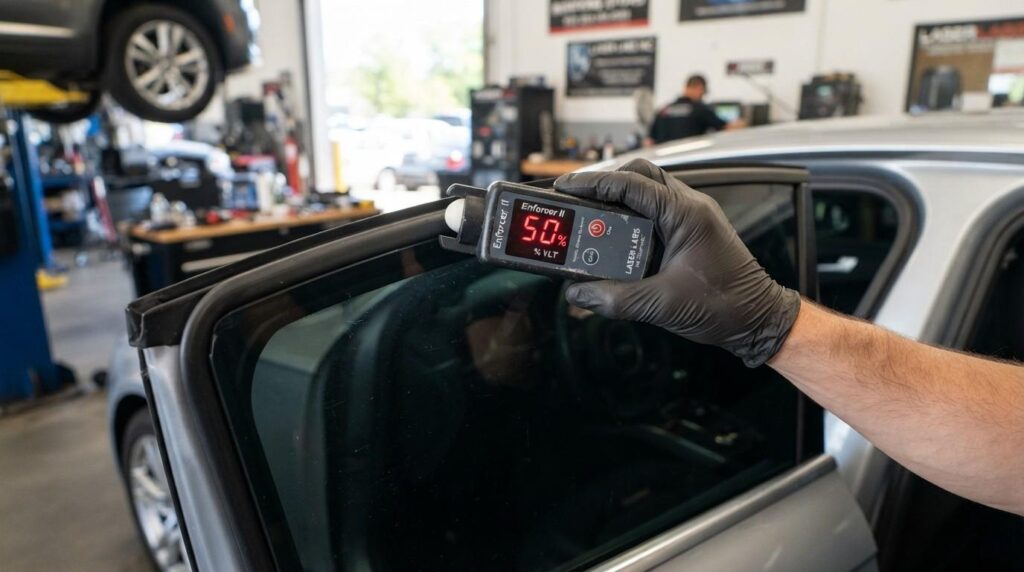
Enforcement is straightforward. Officers use a handheld tint meter during a stop. The officer places the two-piece tint meter on either side of your window glass, and the device sends a beam of light from one side to the other, instantly calculating the exact percentage of light passing through.
Exact fine amounts and whether repeat offenses carry more vary by court and location. Rather than trust a fixed figure, verify current penalties with your local court or the Ohio State Highway Patrol.
A fix-it ticket is often the fastest path. Correcting the tint and showing proof of compliance usually resolves the citation. Because penalties are handled case by case, an attorney can advise on your specific ticket.
The Law Behind the Rules (Official Sources)
Ohio’s tint rules come from two places. The statute is Ohio Revised Code Section 4513.241, and the detailed specifications sit in Ohio Administrative Code Chapter 4501-41, especially Rule 4501-41-03. That chapter is adopted pursuant to section 4513.241, which provides that the director of public safety shall adopt rules governing the materials on motor vehicle windshields, side windows, sidewings, and rear windows.
Ohio’s current tint standards trace back to the early 2000s. The rule lists prior effective dates of 11/17/1988 and 4/8/2004, which is part of why some newer film types can be harder to certify.
The rules lean on a federal standard too. The federal windshield standard is FMVSS 205, which defines the AS-1 line that Ohio references. You can read the primary text yourself at the links above, and confirm enforcement details with the Ohio BMV and the Ohio State Highway Patrol.
How to Stay Compliant Before You Tint
A short checklist keeps you on the right side of the law:
- Confirm your vehicle class (car, SUV, van, or truck).
- Check the legal VLT limit for each window, not just the fronts.
- Ask the installer to meter the final VLT through glass and film together.
- Confirm the manufacturer label is applied to each tinted window.
- Keep your receipt and any medical documentation in the vehicle.
Buying a used car with existing tint? You are responsible for compliance, so have a shop measure all the windows before you trust it. Have your installer check annually or after any glass replacement, and maintain receipts and original compliance documents.
Also recheck your tint after any windshield or window glass replacement, since new glass can change the combined reading.
The Bottom Line
Aim for 50% VLT or a touch higher on your front side windows, keep reflective and red or yellow film off the car entirely, and you’ll clear almost every Ohio tint check without stress.
The single best move right now is to have a professional installer meter your final VLT through the glass and film together before you drive off the lot, and to keep that receipt in your glovebox. If you already have a citation or a tricky medical-exemption question, talk with a qualified Ohio attorney. For more state-by-state guidance, read our related breakdowns of California tint law and the recent North Carolina window tint law changes.
FAQ
What is the legal tint limit in Ohio?
Front side windows must allow at least 50% VLT, while back side windows and the rear window can be any darkness. The regulations require front side windows to maintain at least 50% VLT, while rear windows can be any darkness as long as you meet the mirror requirements. A rear window under 50% VLT triggers the dual outside mirror rule.
Is 35% tint legal in Ohio?
Not on the front side windows, since those need to allow 50% or more light. It is fine on any window behind the driver. Popular darker shades like 35% or 20% tint are illegal on front side windows but perfectly legal on rear windows.
Is 20% or 5% tint legal in Ohio?
On the front side windows, no, unless you have a medical exemption. On the back side windows and rear window, yes. Ohio allows any darkness, including 5% VLT, on back side and rear windows of vehicles whose rule is “any darkness.”
Does Ohio allow a windshield tint strip?
Yes. You can apply non-reflective tint above the AS-1 line or the top 5 inches, whichever is closer to the top. A non-reflective tint strip is permitted on the top five inches or above the AS-1 line, whichever is greater. The rest of the windshield must still pass 70% VLT.
Are SUVs and trucks tinted differently than cars in Ohio?
No, the rules are the same for all vehicle types. In Ohio, SUVs and trucks follow the same tint laws as sedans: front side windows require 50% VLT, and back side and rear windows allow any darkness. Factory privacy glass on larger vehicles is legal, but the front doors still need 50% VLT.
Does Ohio require a tint sticker or label?
Yes. Each aftermarket-tinted window needs a manufacturer label placed between the film and the glass. The sticker to indicate the manufacturer’s name and VLT is required between the film and glass on the lower left corner of each tinted window.
Does Ohio allow medical exemptions for tint?
Yes, with proper documentation. A physician or optometrist signs an affidavit about your qualifying condition, and you keep it in the vehicle. The affidavit must be in the possession of the afflicted person, or the driver, at all times while in the motor vehicle. Verify the current process with the Ohio BMV before applying.
What happens if I get caught with illegal tint in Ohio?
An officer measures your VLT with a tint meter and can issue a citation. To clear the citation, you typically remove the non-compliant film, have your glass retested, and provide proof of compliance to authorities. Fine amounts vary by court, so confirm current penalties locally.