


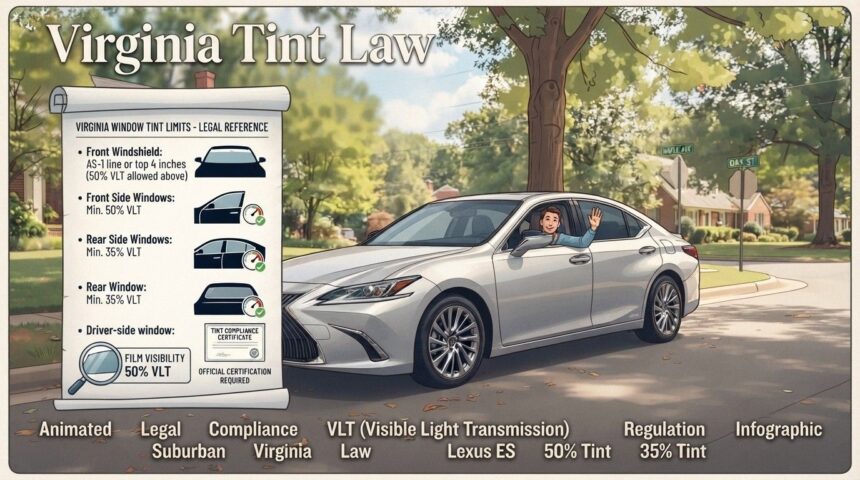
Virginia tint law sets exact limits on how dark and how reflective your car windows can be. Front windows must let in more than 50% of light. Rear windows on a car must let in more than 35%. SUVs, vans, and trucks get more freedom in the back seats.
- Understanding Virginia Tint Law: The Quick Answer
- Windshield Tint Rules in Virginia
- Front and Rear Side Window Rules by Vehicle Type
- Reflectivity Limits and Prohibited Tint Types
- Sticker and Certification Requirements
- Medical Exemptions for Darker Tint
- Special Vehicle Exemptions
- Can Police Stop You for Tint in Virginia?
- Penalties for Illegal Window Tint in Virginia
- Virginia Tint Laws: Timeline of Changes
- What About Tint Installed Before 1987?
- Virginia vs. West Virginia Tint Laws: Don’t Mix Them Up
- Is My Tint Legal? Quick Scenarios
- Scenario 1: 20% tint on a sedan’s front windows
- Scenario 2: 20% tint on an SUV’s rear windows
- Scenario 3: Moving to Virginia with 5% tint from another state
- Choosing Legal Tint: A Pre-Installation Checklist
- Frequently Asked Questions
- Conclusion
That sounds simple. But most drivers get tripped up by the details, like reflectivity limits, medical exemptions, and a 2020 rule change that limits when police can even stop you for tint at all. This guide covers every part of Virginia window tint law, straight from the Code of Virginia, with real examples so you know exactly where you stand.
Understanding Virginia Tint Law: The Quick Answer
Here’s the one-sentence version: front side windows need to stay above 50% VLT, rear windows need to stay above 35% VLT on cars, and no tint anywhere can be more than 20% reflective.
VLT stands for visible light transmission. It’s the percentage of light that passes through your glass and film together. A lower number means darker glass. A 5% tint is nearly black. A 50% tint still looks fairly clear.
This same VLT system is used across the country, though the exact cutoffs shift from state to state — Texas tint laws, for example, set a different front-window minimum than Virginia does.
Here’s how the rules break down by window and vehicle type under Code of Virginia § 46.2-1052, the statute that governs tint statewide:
| Window | Cars & Sedans | SUVs, Vans & Trucks | Reflectivity Limit |
| Windshield | Clear tint only, except top 5 in. (AS-1 line) | Clear tint only, except top 5 in. (AS-1 line) | N/A |
| Front side windows | More than 50% light in | More than 50% light in | 20% max |
| Rear side windows | More than 35% light in | Any darkness allowed | 20% max |
| Rear window | More than 35% light in | Any darkness allowed | 20% max |
Virginia also gives a 7-percentage-point tolerance when officers measure your tint with a meter. A front window reading 43% is usually treated as meeting the 50% rule, since the tolerance covers the gap.
Windshield Tint Rules in Virginia
You can only tint the very top of your windshield. The rule allows clear, non-reflective film above the manufacturer’s AS-1 line — a mark etched into the glass — or, if there’s no line, within the top 5 inches.
Picture Maria, who just bought a used sedan in Richmond. The previous owner tinted the whole windshield to cut glare on long highway drives. That’s a problem: only the strip above the AS-1 line is legal, no matter how much sun bothers you on I-95.
This rule is the same for cars, SUVs, vans, and trucks. There’s no exception based on vehicle size for the windshield itself.
Front and Rear Side Window Rules by Vehicle Type
Cars follow one set of rules. SUVs, vans, and trucks follow another. The law calls these bigger vehicles multipurpose passenger vehicles, or MPVs.
On a car, front side windows must let in more than 50% of light, and rear side windows must let in more than 35%. On an MPV, the front side window rule is identical. But the rear side windows and rear window can be as dark as you want, including full blackout film.
Why the difference? Larger vehicles often carry cargo, kids, or work equipment in back. Lawmakers gave those vehicles more privacy and heat control where it doesn’t block the driver’s main view.
Common mistake: buying a minivan and assuming the front windows can be as dark as the back ones. They can’t. The 50% front-window rule applies no matter what you drive.
If you go dark in the back, you also need dual outside mirrors that show the road at least 200 feet behind you. That’s the safety trade-off written into the statute.
| See also California Tint Law |
Reflectivity Limits and Prohibited Tint Types
No window tint in Virginia can be more than 20% reflective. That covers the mirrored, chrome-like look some films have, which can blind other drivers in bright sun.
The law also bans two specific effects. A holographic effect is an image that shifts as you look at it from different angles. A prism effect splits light into rainbow colors. Neither is legal on any vehicle window in the Commonwealth.
Color matters too. Red, amber, and yellow tints are not allowed, since they can be confused with signal lights or emergency vehicle equipment.
Sticker and Certification Requirements
Here’s a fact most tint guides skip. Virginia requires a compliance sticker placed between the film and the glass on each tinted window, so an officer or inspector can quickly confirm the film is legal.
Film manufacturers are not required to certify their product for Virginia before selling it here. That means the burden falls on you and your installer to make sure the film you choose actually meets the VLT numbers in the table above.
Practical tip: ask your installer for the film’s documented VLT rating in writing before it goes on your car. Keep that paperwork in your glove box alongside your registration.
Don’t confuse this with a separate, narrower rule: Virginia also allows a single non-tint sticker or decal, up to 20 square inches, on the lower five inches of the rear window without it counting as an obstruction violation. Think of a parking permit or dealer decal, not window film. That exception has nothing to do with the compliance sticker your tint installer applies.
Medical Exemptions for Darker Tint
Virginia does allow darker tint for a documented medical need — but the process is more specific than most sites describe it.
Under Code of Virginia § 46.2-1053, a driver or passenger with a light-sensitivity condition can get film that reduces light to not less than 35% on most windows. On the windshield itself, though, the law is stricter: total light transmittance can’t drop below 70%, except for that same top strip above the AS-1 line, which can go down to 35%.
The statute’s own words: a vehicle “may be equipped … with sun-shading or tinting films or applications which reduce the transmission of light into the vehicle to levels not less than 35 percent,” while the windshield itself “shall not cause the total light transmittance to be reduced to any level less than 70 percent,” except for the top strip.
Getting the exemption isn’t automatic. A licensed physician or optometrist has to sign a statement identifying the person and confirming the medical need. The Virginia DMV Commissioner then issues a written authorization, which stays valid as long as the condition lasts, or until the car is sold.
Real scenario: James has a skin condition that makes sunlight painful. He gets a signed statement from his dermatologist, sends it to the DMV, and receives written authorization for darker film. He keeps a copy of that authorization in the car at all times — without it, the darker tint alone can still get him a ticket.
You can review the current application requirements directly on the Virginia DMV’s Vehicle Sun-Shading Medical Authorization page, including the physician certification form and where to mail it.
| See also New York Tint Laws |
Special Vehicle Exemptions
A handful of vehicles get their own carve-outs under Virginia law, and they rarely show up in tint guides:
- Law-enforcement vehicles are not subject to these tint rules at all.
- Emergency medical services vehicles are exempt on rear windows and rear side windows, since patient privacy matters during transport.
- Licensed security canine handlers performing private security duties are exempt from the standard VLT limits.
- Certain sight-seeing and contract passenger carriers get separate treatment on windshield tint rules.
These exceptions are narrow. If you’re not driving one of these vehicle types for its specific purpose, the standard rules in the table above still apply to you.
| See also Florida Window Tint Law |
Can Police Stop You for Tint in Virginia?
No — not for tint alone. Since a 2020 change to § 46.2-1052, an officer cannot pull you over just because your windows look tinted.
The statute says it plainly: “No law-enforcement officer shall stop a motor vehicle for a violation of this section.”
If a stop happens anyway, based only on suspected tint, anything found during that stop — even something the driver agreed to, like a search — generally can’t be used against them in court.
This doesn’t make illegal tint risk-free. If you’re stopped for speeding, a broken taillight, or any other valid reason, and the officer notices your tint is too dark, you can still be cited for that on top of everything else.
What if you get a summons anyway? The law gives courts room to work with you. If you remove the illegal tint and show proof before your court date, a judge may dismiss the summons entirely.
Penalties for Illegal Window Tint in Virginia
A first tint violation is a Class 3 misdemeanor. There’s no jail time, but the fine can run up to $500.
A second violation on the same vehicle is more serious. That becomes a Class 2 misdemeanor, which can mean up to six months in jail, a fine up to $1,000, or both.
| Offense | Charge | Possible Jail Time | Possible Fine |
| First offense | Class 3 misdemeanor | None | Up to $500 |
| Second or later offense (same vehicle) | Class 2 misdemeanor | Up to 6 months | Up to $1,000 |
There’s one more twist worth knowing. If someone is convicted twice within a year for the same vehicle’s tinted or smoked windshield, a judge can order that tint physically removed, on top of any fine.
| See also Texas Tint Laws |
Virginia Tint Laws: Timeline of Changes
Virginia’s tint statute goes back further than most drivers realize, and the core VLT numbers have stayed remarkably stable. Here’s what actually changed, and when:
- 1999: Virginia’s original window tint statute sets the basic VLT and reflectance limits still used today.
- 2015–2019: Lawmakers add clearer definitions for terms like holographic effect, prism effect, and multipurpose passenger vehicle.
- 2020: The General Assembly adds the rule barring stops based solely on suspected tint — the biggest procedural change in the law’s history.
- 2023–2026: The core numbers (50% front, 35% rear for cars) haven’t moved. Searches for new Virginia tint laws in recent years mostly reflect renewed attention, not new statutory changes.
If you want to double-check that nothing has shifted since this guide was last reviewed, the Code of Virginia’s official site and the Virginia DMV are the two sources to check directly.
What About Tint Installed Before 1987?
Older sun-shading material can still be legal today, but only under a narrow grandfather rule. If film was applied before July 1, 1987, and it didn’t violate the law in place at that time, it can stay on the vehicle.
The catch: you need proof. The law requires appropriate receipts showing the material was installed before that date. Without that paperwork, an officer or inspector has no way to know your tint qualifies for this exception, and it will likely be treated as a standard violation.
Real scenario: Tom inherited his grandfather’s 1985 pickup truck, tint and all. The rear windows are darker than today’s rules allow. As long as he can produce a receipt or documentation showing the film went on before July 1, 1987, that older tint is still lawful. If he can’t find that paperwork, he’s treated the same as anyone with illegal tint today.
Virginia vs. West Virginia Tint Laws: Don’t Mix Them Up
Virginia and West Virginia are two separate states with two separate tint statutes. That sounds obvious, but the search terms overlap constantly, and the actual VLT numbers are different.
If your car is registered in West Virginia, or you’re moving a vehicle across the state line, check the law where the vehicle is titled and registered — not just where you happen to be driving that day.
This kind of neighboring-state mix-up isn’t unique to Virginia and West Virginia, either — drivers moving between Ohio and Virginia run into the same confusion, since each state sets its own numbers independently.
Is My Tint Legal? Quick Scenarios
A few real-world examples make this easier to apply than reading percentages alone:
Scenario 1: 20% tint on a sedan’s front windows
Not legal. Front side windows on any car need to stay above 50%. A 20% film is far too dark for that window, full stop.
Scenario 2: 20% tint on an SUV’s rear windows
Legal. Rear side windows and the rear window on an SUV have no minimum VLT, as long as the front stays above 50% and you have working dual mirrors. Florida window tint law draws a similar line between sedans and larger vehicles, so this pattern isn’t unique to Virginia.
Scenario 3: Moving to Virginia with 5% tint from another state
Virginia doesn’t automatically honor tint that was legal somewhere else. Your car has to meet Virginia’s own limits once it’s registered here, regardless of what was legal in your old state.
Choosing Legal Tint: A Pre-Installation Checklist
Here’s something worth knowing before you assume darker is better: even a lighter, nearly clear film still blocks a meaningful amount of UV rays and heat. You don’t need privacy-level darkness to protect your dashboard and upholstery from sun damage or to keep the car cooler. A fully legal 50% front / 35% rear setup still delivers real protection.
A little preparation before you visit a tint shop saves you a ticket later. Run through these steps first:
- Confirm the film’s documented VLT rating in writing before installation.
- Ask your installer to place the required compliance sticker between the film and the glass.
- Check that your side mirrors work well if you’re going dark on the rear windows.
- Keep your receipt and documentation in the vehicle, especially if you have a medical exemption.
- Re-check the rules if you move to Virginia with tint installed in another state.
| See also Ohio Tint Laws |
Frequently Asked Questions
What is the darkest legal tint in Virginia for a car’s front windows?
Front side windows on any car, SUV, van, or truck must let in more than 50% of light. Nothing darker is legal there without a medical exemption.
Can I get 20% tint in Virginia?
Only on the rear side windows and rear window of an SUV, van, or truck, since those windows have no minimum. On a car’s rear windows, 35% is the legal floor.
Can police stop me in Virginia just because my windows look tinted?
No. Since a 2020 change to the law, tint alone can’t be the reason for a stop, and evidence from a stop made only for that reason usually can’t be used in court.
Is there a tint tolerance or variance allowed in Virginia?
Yes. Officers apply a 7-percentage-point tolerance when measuring VLT, so film reading slightly under the legal number is often still treated as compliant.
Do I need a sticker for legal window tint in Virginia?
Yes. A compliance sticker goes between the film and the glass on each tinted window, and drivers with a medical exemption must also carry their DMV authorization in the car.
What’s the penalty for illegal window tint in Virginia?
A first offense is a Class 3 misdemeanor with a fine up to $500. A repeat offense on the same vehicle becomes a Class 2 misdemeanor, with up to six months in jail, a fine up to $1,000, or both.
Does Virginia tint law apply the same way to SUVs and trucks?
Not entirely. Front windows follow the same 50% rule as cars, but the rear side windows and rear window on SUVs, vans, and trucks can be any darkness at all.
Are West Virginia’s tint laws the same as Virginia’s?
No. They’re two separate statutes with different limits. Always check the law for the state where your vehicle is registered and titled.
Conclusion
Virginia tint law isn’t complicated once you know the numbers: 50% up front, 35% in back for cars, wide open in back for SUVs and trucks, and never more than 20% reflective anywhere.
The part most drivers miss is the 2020 change limiting when police can even stop you for tint in the first place — and the fact that a medical exemption has real limits of its own.
If you’re about to tint your car, get your film’s VLT rating in writing, ask for the sticker, and keep your paperwork in the glove box. If you’ve already been cited, talk to a licensed Virginia attorney about your specific situation before your court date.