



Hawaii tint laws changed more in 2025 than in the previous forty years combined. The statute, Hawaii Revised Statutes § 291-21.5, was first enacted in 1983 and left the rear windows of a sedan capped at 35% while trucks and vans went as dark as they liked. Act 129 — House Bill 226, signed by Governor Josh Green on May 29, 2025 — swept that split away: the rear side windows and rear window of every vehicle now sit outside the tint rules entirely, provided the car carries mirrors on both sides. What did not move is the front: 35% light transmittance, plus or minus 6%, the widest tolerance written into any state tint law.
- Quick Answer
- What Act 129 Changed in 2025
- Hawaii Tint Limits by Window
- The 6% Variance: The Widest Tolerance in America
- Windshield Rules: AS-1 or Four Inches
- The Roll-Down Rule and the Installer Certificate
- Penalties: Owners, Installers, and Removal
- No Medical Exemption — and What Else Is Exempt
- How Hawaii Compares With Mainland States
- How to Stay Legal
- Frequently Asked Questions
- What is the legal tint in Hawaii?
- Did Hawaii change its tint law in 2025?
- Is 35% tint legal in Hawaii?
- Can I get a medical exemption for tint in Hawaii?
- How much is a tint ticket in Hawaii?
- Do I really have to roll my windows down at a traffic stop?
- Can I be cited for tint on a parked car?
- Is Hawaii’s 6% variance the widest in the country?
- Conclusion
The same Act raised the fines, made every driver with applied tint roll all windows fully down at a traffic stop, and turned a missing installer certificate into evidence against the shop. This guide explains the current law window by window.
Quick Answer
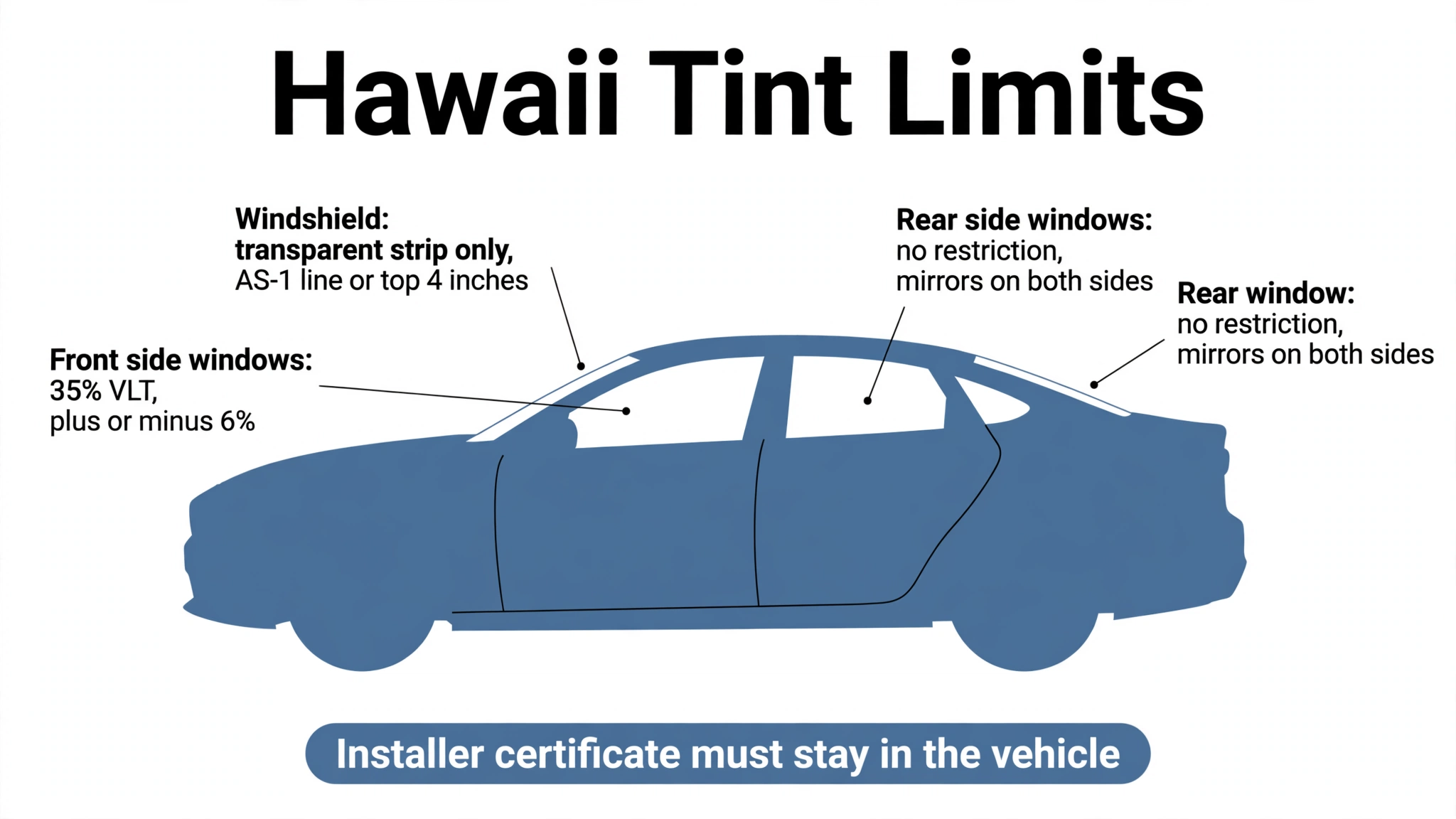
Under Hawaii tint laws, the front side windows and front side wing vents must transmit at least 35% of light, plus or minus 6%, measured through glass and film together — the meter floor is 29%. Since Act 129 (May 29, 2025), the side windows behind the driver and the rear window carry no tint restriction on any vehicle, sedans included, as long as the vehicle has rearview mirrors on both sides. The windshield takes only transparent film along the top edge, no lower than the AS-1 line or four inches from the top. An owner violation costs $300–$550 per offense; an installer violation $700–$1,200. Hawaii offers no medical exemption.
What Act 129 Changed in 2025
The legislature said its reasons out loud in the bill’s findings: darker tint measurably reduces the heat trapped in a car’s interior, and the old 35% limit was, in its words, inadequate against rising temperatures. Act 129 (HB 226) then rewrote § 291-21.5 in five moves:
1. Rear glass freed for everyone. Subsection (e)(9) now exempts rear windows — including the rear windshield — and side windows to the rear of the driver on sedans, vans, minivans, trucks, buses, and other motor vehicles alike, provided the vehicle has rearview mirrors on both sides. Before May 29, 2025, a sedan’s rear glass answered to the same 35% as its front; only the truck classes were free. 2. Fines raised. Owners: $300–$550 per offense, up from $250–$500. Installers: $700–$1,200, up from $500–$1,000. 3. A roll-down duty. New subsection (d): all drivers and passengers of vehicles with applied tint must fully roll down their windows when stopped by a law enforcement officer, with exceptions for a person whose physical disability or a mechanical failure prevents it and who communicates or cooperates by other reasonably available means. 4. The certificate became evidence. An installer’s failure to issue the required compliance certificate is itself a violation — and the absence of the certificate in a vehicle is prima facie evidence that the installer is noncompliant. 5. Reflective color finishes banned. Installing or using a device with mirrored or high reflective finishes that produce a red, yellow, amber, or blue appearance from outside the vehicle is prohibited — a narrower rule than the bill’s first draft, which would have banned those tint colors themselves.
The front-window figure was clarified but not changed: 35% ±6%, where it has stood for decades. One more piece of the section deserves note before the numbers: subsection (a) reaches a vehicle that is merely parked on a public highway, not only one being driven.
Hawaii Tint Limits by Window
| Window | Hawaii rule (all vehicles) |
|---|---|
| Windshield | Transparent film along the top edge only; not into the AS-1 portion; no lower than 4 inches below the top |
| Front side windows and wing vents | 35% light transmittance (±6%), glass and film together |
| Side windows behind the driver | No restriction (since Act 129) — rearview mirrors required on both sides |
| Rear window | No restriction (since Act 129) — rearview mirrors required on both sides |
| Reflective finishes | Mirrored or high reflective finishes producing a red, yellow, amber, or blue appearance are banned |
| Medical exemption | None |
The 6% Variance: The Widest Tolerance in America
Hawaii’s front-window clause, subsection (e)(7)–(8), exempts devices for front side wing vents and front side windows that, used with the glazing material, have “a light transmittance of no less than thirty-five per cent plus or minus six per cent.” The tolerance is not an officer’s courtesy — it is inside the number the statute prints, the same drafting style Arizona uses at ±3% and Minnesota at ±3%, doubled. The meter floor on a Hawaii front window is therefore 29%.
The width cuts both ways, and honest installers say so. A window aimed at 35% that meters at 30% is inside the written allowance; a window aimed at 29% to exploit the band has no margin left for a second meter, an aging film, or the safety inspection — Hawaii’s periodic inspection includes a tint check with a light meter, and a reading below the threshold fails the vehicle until the tint is corrected. Our guide to how window tint percentages work shows why the combined glass-plus-film reading, not the film’s box rating, is the number both the officer and the inspector will see.
Common mistake: Reading pre-2025 advice that a sedan needs 35% on the rear windows too, and paying to lighten rear glass the law no longer reaches. Since May 29, 2025, the only metered windows on a Hawaii car are the two beside the driver (and their wing vents).
Windshield Rules: AS-1 or Four Inches
Subsection (e)(6) allows transparent sun screening film along the top edge of the windshield under two ceilings, whichever the glass gives you: the film may not encroach upon the AS-1 portion of the windshield under Federal Motor Vehicle Safety Standard 205, and it may go no lower than four inches below the top of the windshield. Where no AS-1 markings can be found, the four inches are measured from the middle point of the bottom edge of the top windshield moulding — a fallback measurement no other state in this series bothers to write down.
Everything else about the windshield is the federal baseline: subsection (a)(1) requires the glazing itself to meet FMVSS 205 as manufactured, which is why the strip is the only film a Hawaii windshield ever lawfully wears. The small print of the exemption list also lives here — signs and stickers are spared only inside a seven-inch square in the lower corner farthest from the driver, or a five-inch square in the corner nearest the driver.
The Roll-Down Rule and the Installer Certificate
Act 129 added two duties that exist nowhere else in this series:
– Roll down at a stop. Subsection (d) provides that, notwithstanding the exemptions, all drivers and passengers of motor vehicles with applied tint shall fully roll down their windows when stopped by a law enforcement officer at a traffic stop. The exception is practical, not medical: a person prevented by a physical disability or mechanical failure complies by communicating or cooperating through other reasonably available means. Hawaii is the first state covered here to write the officer-safety ritual into the tint statute itself. – The certificate rides in the car. An installer must issue the vehicle owner a certificate stating that the installed device complies with the law, and the certificate must remain in the vehicle. Act 129 then gave the paper teeth: failing to issue it is a violation, and its absence from the vehicle is prima facie evidence that the installer is noncompliant — the missing document itself builds the state’s case against the shop. A violator is also liable for the removal of any device applied contrary to the section, and installers carry correction and reimbursement obligations on top of their fines.
What if scenario: A Honolulu driver is stopped in a car tinted two years ago by a shop that has since closed, and no certificate is in the glovebox. The driver’s own tint may meter perfectly legal — but the missing certificate is, by statute, evidence in the case against the installer, which is why Hawaii shops now hand over the paper as carefully as the keys.
Penalties: Owners, Installers, and Removal
Act 129 repriced every seat at the table:
– Vehicle owners: $300 to $550 per offense (raised from $250–$500). – Installers: $700 to $1,200 per offense (raised from $500–$1,000) — plus liability for removal of a device applied contrary to the section, and correction or reimbursement obligations to the customer. – The certificate counts as its own offense: an installer who fails to issue it has violated the section, and its absence from the vehicle is prima facie evidence of the installer’s noncompliance.
The ladder is the steepest in this series for shops — Louisiana’s $1,000 first-offense installer fine is the only comparable figure — and it is paired with the safety inspection, where a sub-threshold front window fails the vehicle outright. Hawaii enforces tint in the inspection lane, at the traffic stop, and, because subsection (a) covers parked vehicles, at the curb.
No Medical Exemption — and What Else Is Exempt
Hawaii is one of the few states in this series with no medical exemption at all: § 291-21.5 contains no physician route, no permit, and no certificate that lets a driver run darker front windows for a light-sensitive condition. A driver whose condition demands shielding gets the same 35% ±6% as everyone else — the statute’s only answers are compliant film and the windshield strip.
The exemption list in subsection (e) is otherwise mechanical: rearview mirrors; adjustable nontransparent sun visors mounted forward of the side windows and not attached to the glass; the sticker squares described above; the windshield strip; the front-window devices at 35% ±6%; the rear glass freed by Act 129; and privacy drapes, curtains, or blinds installed in motor homes.
How Hawaii Compares With Mainland States
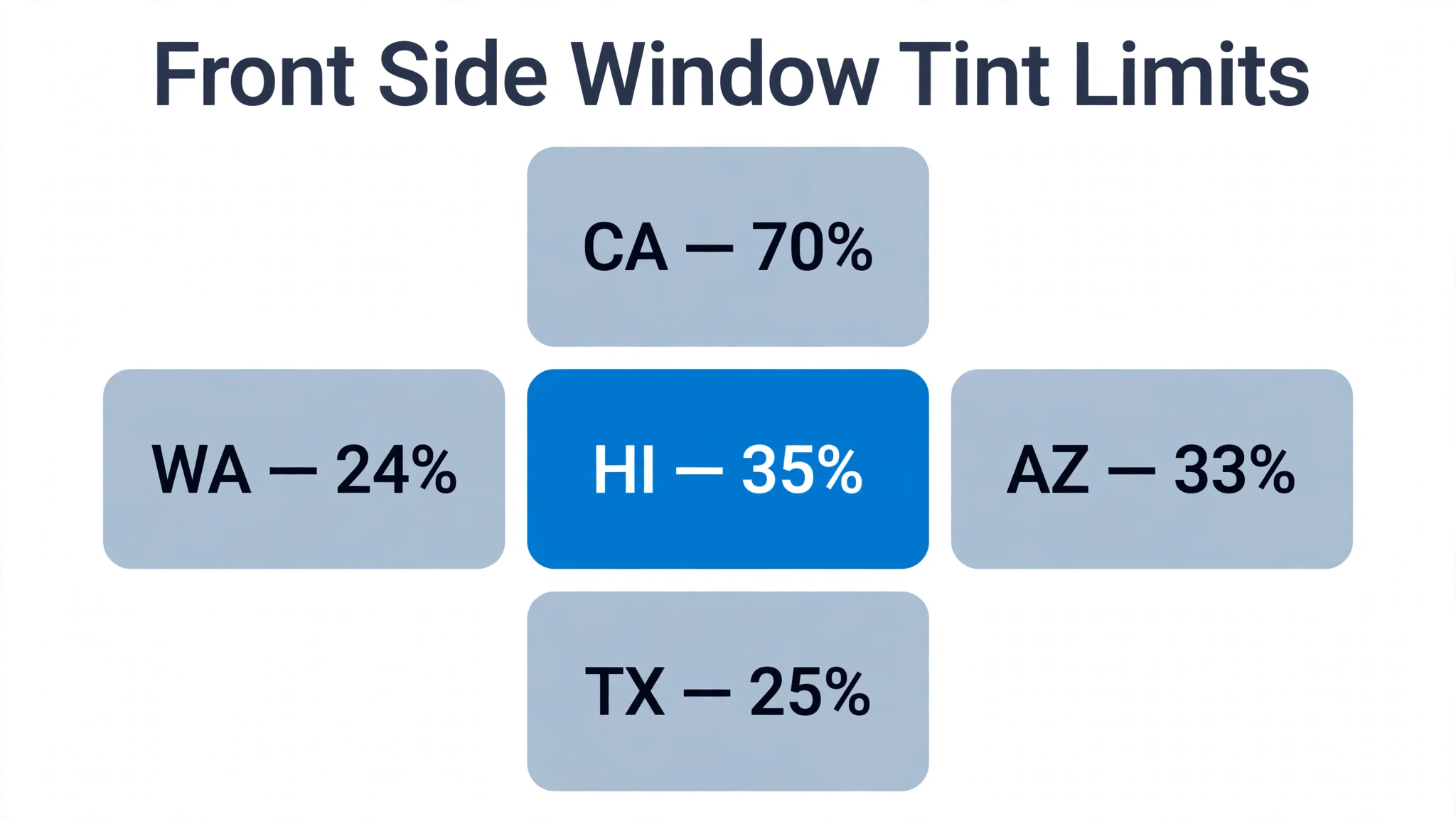
An island state has no neighbours to meter against, so the comparison is with the mainland spread Hawaii drivers ship cars to and from. Its 35% front figure matches the most common state number, but the ±6% tolerance is unmatched — California’s 70% front rule is twice as strict on its face, Washington’s 24% is darker but written without a tolerance band, and no mainland state pairs an open rear with a statutory roll-down duty at traffic stops. Hawaii’s installer fines, at up to $1,200, are also the highest in this comparison.
Read also: Texas tint laws, Florida window tint law, Illinois tint laws
How to Stay Legal
1. Meter the front pair, forget the rest. Since Act 129, only the front side windows and wing vents carry a number: 35% ±6% through the glass. Aim for a finished reading at or above 35% rather than living in the tolerance. 2. Rear glass is free — keep both mirrors. The exemption for rear side windows and the rear window is conditioned on rearview mirrors on both sides of the vehicle. 3. Windshield: transparent strip only. Top edge, above the AS-1 portion, never lower than four inches from the top. 4. No reflective color finishes. Mirrored or high reflective film that throws a red, yellow, amber, or blue appearance is banned outright. 5. Get the certificate and keep it in the car. The installer’s compliance certificate must remain in the vehicle; its absence is evidence against the installer, and you will want it at inspection. 6. Roll every window down at a stop. It is a statutory duty for driver and passengers alike, not a courtesy. 7. Do not shop for a medical exemption. Hawaii has none — any shop selling one is selling paper the statute does not recognize.
Frequently Asked Questions
What is the legal tint in Hawaii?
The front side windows and wing vents must transmit at least 35% of light, plus or minus 6%, through glass and film together, under HRS § 291-21.5. The rear side windows and rear window have no restriction since Act 129 (May 29, 2025), provided the vehicle has mirrors on both sides. The windshield allows only a transparent strip at the top, above the AS-1 line and within four inches of the top.
Did Hawaii change its tint law in 2025?
Yes — the biggest change in the law’s history. Act 129 (HB 226), signed May 29, 2025, freed the rear glass on all vehicles (sedans had been held to 35%), raised owner fines to $300–$550 and installer fines to $700–$1,200, added the duty to roll all windows down at a traffic stop, banned reflective finishes that appear red, yellow, amber, or blue, and made a missing installer certificate evidence against the installer. The front limit stayed 35% ±6%.
Is 35% tint legal in Hawaii?
On the front side windows, it is the standard itself — 35% with the ±6% variance, so a finished reading down to 29% sits inside the written allowance. Behind the driver, the question no longer applies: any darkness is lawful with mirrors on both sides.
Can I get a medical exemption for tint in Hawaii?
No. Section 291-21.5 contains no medical exemption — no physician statement, permit, or certificate authorizes darker front windows for a medical condition. The installer compliance certificate is a different document: it certifies that a lawful install complies, and it must be kept in the vehicle.
How much is a tint ticket in Hawaii?
An owner faces $300 to $550 per offense; an installer faces $700 to $1,200 per offense, plus removal liability and correction or reimbursement obligations. Sub-threshold tint also fails the safety inspection, which blocks registration renewal until corrected.
Do I really have to roll my windows down at a traffic stop?
Yes. Subsection (d) requires all drivers and passengers in a vehicle with applied tint to fully roll down their windows when stopped by a law enforcement officer — with an exception only where a physical disability or mechanical failure prevents it and the person communicates or cooperates by other reasonably available means.
Can I be cited for tint on a parked car?
Yes. Subsection (a) covers operating, permitting, causing to be operated, or parking a vehicle on a public highway with non-exempt sun screening devices — the violation does not require the car to be moving.
Is Hawaii’s 6% variance the widest in the country?
Among the states in this series, yes — it is double the ±3% bands written into the Arizona, Minnesota, Illinois, and Pennsylvania rules, and it is printed in the statute itself rather than left to enforcement practice.
Conclusion
Hawaii’s tint law is now two laws in one timeline: a 1983 statute that still fixes the front windows at 35% ±6% with a metered safety inspection behind it, and a 2025 Act that freed every rear window in the state, priced installer violations up to $1,200, wrote a roll-down duty into traffic stops, and made a missing certificate speak for itself. The controlling text is HRS § 291-21.5, and Film Slingers’ Hawaii tint guide tracks the post-Act 129 figures for drivers and shops.
Disclaimer: This article is general information about Hawaii tint laws, not legal advice. Tint statutes and enforcement practice change, and how a rule applies depends on the vehicle and the facts. Confirm the current law in Hawaii Revised Statutes § 291-21.5, or speak with a Hawaii attorney or the Department of Transportation, before tinting, buying, or contesting a citation.