



Louisiana tint laws changed recently, and the change is the story. On August 1, 2025, Act 143 cut the front side window limit from 40% to 25% VLT — Louisiana drivers may now legally run noticeably darker front tint than they could before. The rest of the system stayed in place: 25% on the rear side windows of a car, 12% on the rear window, a 20% cap on reflectance, and an installer label sealed into the driver’s window. The rules sit in La. R.S. 32:361.1, with medical exemptions under R.S. 32:361.2.
- Quick Answer
- What Changed in 2025 — and What Did Not
- Louisiana Tint Limits by Window
- Windshield Rules: 5 Inches, Measured From the Top
- The Installer Label in Your Driver’s Window
- Medical Exemptions: Affidavit, Decal, and Three-Year Reviews
- Security Exemptions
- Penalties: Drivers Pay $150–$350, Installers Pay Far More
- How Louisiana Compares With Other States
- How to Stay Legal
- Frequently Asked Questions
- What is the legal tint in Louisiana in 2026?
- Did Louisiana’s tint law change in 2025?
- Is 20% tint legal in Louisiana?
- What is the darkest legal tint in Louisiana?
- How much is a tint ticket in Louisiana?
- How do I get a medical tint exemption in Louisiana?
- Can you tint your windshield in Louisiana?
- Does Louisiana require a tint label?
- Conclusion
This guide explains the new limits, what did not change, the fines for drivers and installers, and how Louisiana’s medical exemption — affidavit, decal, and all — actually works.
Quick Answer
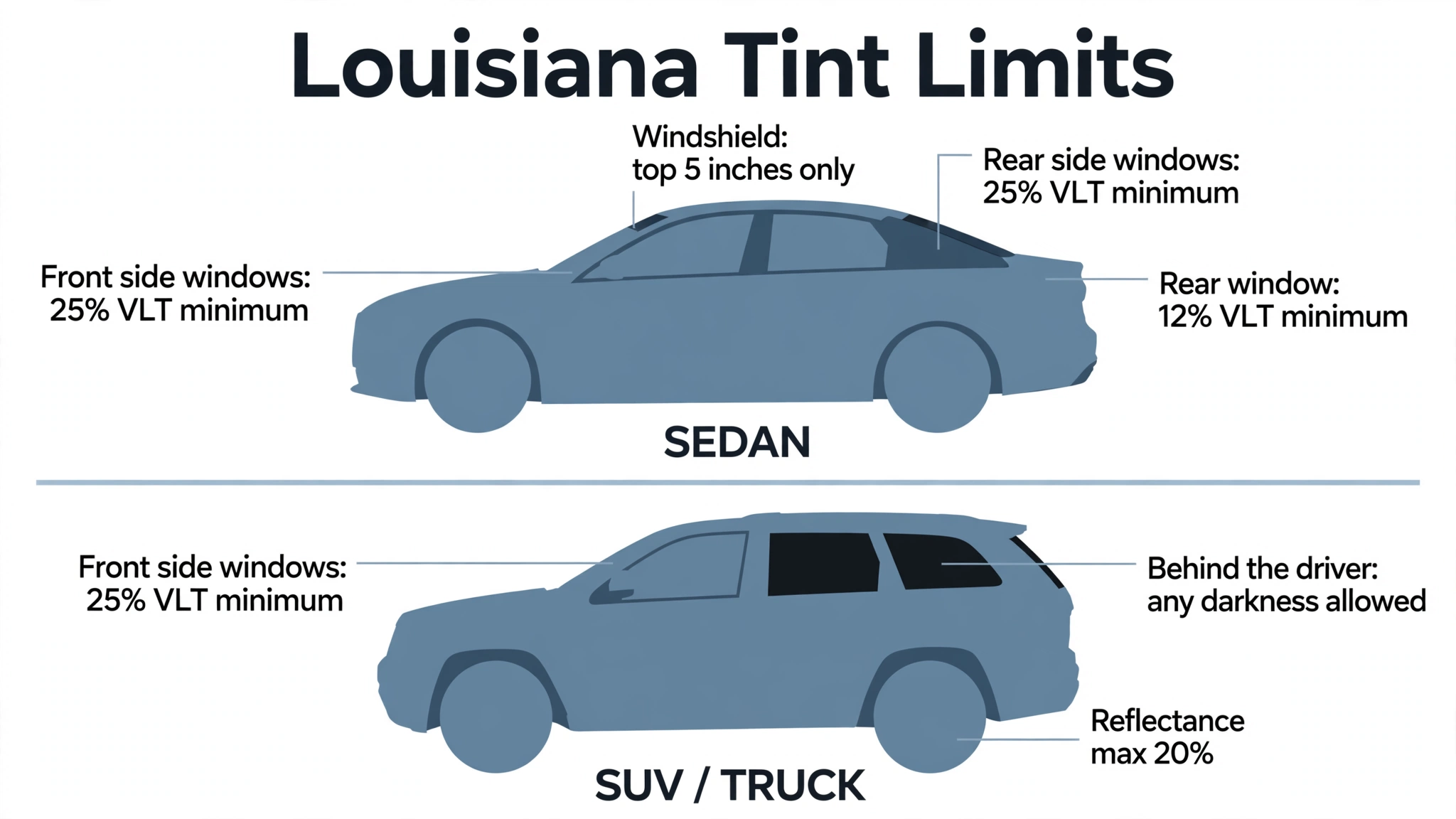
Under current Louisiana tint laws, a passenger car’s front side windows must transmit at least 25% of light (down from 40% since August 1, 2025), the rear side windows at least 25%, and the rear window at least 12%, with reflectance at or under 20% on every sun screening device. On trucks, SUVs, vans, and motor homes, windows behind the driver may be any darkness. The windshield takes only a transparent strip in the top 5 inches, never red or amber. Driver fines run $150, $250, and $350 for repeat offenses.
What Changed in 2025 — and What Did Not
For decades, Louisiana held front side windows to 40% light transmission — one of the lighter front limits in the South. Act 143 of 2025 (House Bill 119) amended R.S. 32:361.1(C)(1) and lowered that floor to 25%, effective August 1, 2025. Nothing else in the percentage table moved: the rear side windows of a car were already 25%, the rear window was already 12%, and the 20% reflectance cap is untouched.
Two practical consequences follow:
– Tint installed legally before the change is still legal — a 40% front window passes a 25% test with room to spare. Nobody had to strip anything. – Old information is now a trap in both directions. Pages still quoting 40% are describing a repealed limit, and drivers who held off tinting because 40% looked too light can now go darker. If a source cannot tell you about Act 143, it is not describing current Louisiana law.
One more piece of the statute’s wording matters at a traffic stop. Each percentage in (C)(1) is stated “all tolerances included.” The printed number is the floor as measured — there is no extra cushion added on top of 25% the way some states describe their limits. Our guide to how window tint percentages work explains how the combined glass-and-film reading is taken, and Louisiana’s definition of light transmission counts the glazing material in, so the meter reads the finished window, not the film alone.
Louisiana Tint Limits by Window
| Window | Passenger cars | Trucks, SUVs, vans, motor homes |
|---|---|---|
| Windshield | Transparent strip only — top 5 inches, not red or amber | Same |
| Front side windows | 25% VLT minimum (40% before Aug. 1, 2025) | 25% VLT minimum |
| Rear side windows | 25% VLT minimum | Any darkness |
| Rear window | 12% VLT minimum | Any darkness |
| Reflectance (all devices) | 20% maximum | 20% maximum |
The split mirrors the statute. Subsection (C)(1) sets the three percentages for the vehicle generally, and subsection (D)(4) then lifts the light-transmittance requirement from windows behind the driver on trucks, buses, trailers, motor homes, and multipurpose passenger vehicles — the class that includes SUVs and vans. On those vehicles the rear glass may go to any darkness, including full blackout, though the 20% reflectance cap still applies to the film itself.
On a passenger car, note what Louisiana does not do: it sets no dual-mirror condition for a dark rear window, and its 12% rear floor is the darkest standard rear-window limit in the region — darker than what the same car could wear in most neighbouring states.
What if scenario: A Baton Rouge driver tinted her sedan’s front windows to 35% in 2024, knowing it was under the old 40% floor and accepting the risk. Since August 1, 2025, that same film is simply legal — Act 143 moved the line past her windows without her changing a thing. Her neighbour’s 20% front film, bought the same week, is still illegal: the line moved to 25%, not to zero.
Windshield Rules: 5 Inches, Measured From the Top
Subsection (C)(2) allows exactly one thing on the windshield: a transparent material, not red or amber in color, affixed to the topmost portion, extending no more than five inches down from the top. Everything else on the front glass — any material that obstructs the view or alters the color or light transmission of the windshield — is prohibited by subsection (B).
Louisiana’s measure is worth stating plainly because out-of-state guides get it wrong: the statute works in inches from the top, and does not use the AS-1 line etched into most windshields. Where the AS-1 mark falls on your particular car is legally irrelevant here. Five inches is the rule, red and amber are banned in the strip, and the strip must stay transparent rather than mirrored — the 20% reflectance cap sees to that as well.
The Installer Label in Your Driver’s Window
Louisiana is one of the few states that builds the proof of a legal install into the glass. Under subsections (D)(2) and (D)(3), every installer must provide a label no larger than one and one-half square inches, installed permanently and legibly between the sun screening material and the glass, showing the installer’s name and the city where the business is located. The person applying the film must affix it to the lower right corner of the driver’s side window.
Manufacturers sit under a matching duty: before a sun screening device is marketed in Louisiana, its maker must certify to the Department of Public Safety and Corrections, Office of Motor Vehicles, with independent laboratory data, that the product meets the light transmission and reflectance requirements.
For a driver, the label is a quick audit. A tinted driver’s window with no label in the lower right corner means the job either was not done by a Louisiana installer working under the statute, or was done carelessly — either way, it is the first thing to check before paying for a used car’s “legal tint” or choosing a shop.
Medical Exemptions: Affidavit, Decal, and Three-Year Reviews
Louisiana’s medical exemption, R.S. 32:361.2, is the most formal in the region — nothing like the simple doctor’s letter some states accept. It works like this:
1. Get the affidavit signed. The exemption rests on an affidavit on a form prepared by the Office of State Police, signed by a Louisiana-licensed optometrist or physician — including an ophthalmologist or dermatologist — stating that a medical condition involving the effects of the sun makes darker tint necessary. The form lists conditions such as albinism, lupus, and porphyria. For photophobia, the signer must explain in detail why a good pair of sunglasses would not be enough, and address night driving. 2. Submit it and accept the checks. Applicants consent to a criminal background check and a release of medical records as part of the State Police process. 3. Display the decal, carry the affidavit. The Department issues a decal for the exempt vehicle that must be displayed on it, and a copy of the affidavit stays in the vehicle at all times. 4. Renew on the state’s clock. Exemptions are reviewed every three years. The exception is light-sensitive porphyria, whose exemption lasts for the duration of vehicle ownership — and porphyria is also the one condition for which tint may extend below the top six inches of the windshield, when the treating physician specifically authorizes it.
The exemption covers the registered owner, a spouse, and family members authorized to operate the vehicle, and it does not transfer to a new owner. It is tied to a described vehicle, so a replacement car means a new process, not a moved decal.
Common mistake: assuming a doctor’s note in the glovebox works in Louisiana the way a letter works elsewhere. Without the State Police affidavit on file and the decal on the vehicle, darker-than-legal tint is just darker-than-legal tint at a traffic stop.
Security Exemptions
Louisiana also exempts tint for security reasons under R.S. 32:361.3. Vehicles owned, leased, or operated by governmental and law enforcement agencies for official business qualify automatically — subsection (C)(4) of the tint statute separately exempts publicly owned law enforcement vehicles, a category a 2024 amendment (Act 268) confirmed includes Department of Wildlife and Fisheries enforcement vehicles. The exemption belongs to the agency’s vehicles, not to an officer’s private car.
Private individuals with a genuine security need follow an application path instead: an affidavit from the Department of Public Safety and Corrections stating that legitimate security reasons justify the darker tint, describing the vehicle, and kept in the vehicle at all times.
Penalties: Drivers Pay $150–$350, Installers Pay Far More
Louisiana fines the person behind the wheel on an escalating scale. Under subsection (E), operating a Louisiana-registered vehicle in violation of the tint statute brings a fine of up to:
– $150 for a first offense – $250 for a second offense – $350 for a third or later offense
The business side is punished much harder. Under subsection (G), a seller, installer, manufacturer, or distributor who violates the statute faces up to $1,000 for a first offense and $2,000 for a second — and a third conviction bars them from the business. That structure is deliberate: the state expects shops to refuse illegal jobs, which is why a reputable Louisiana installer will meter your glass and decline film that cannot pass, rather than sell it and let you carry the risk.
What if scenario: A driver asks a shop for 15% film on the front windows “just this once.” The driver risks at most $150 on a first ticket. The shop risks a $1,000 fine and a strike toward losing the business entirely. When the shop says no, it is not being difficult — the statute prices the two risks very differently.
How Louisiana Compares With Other States
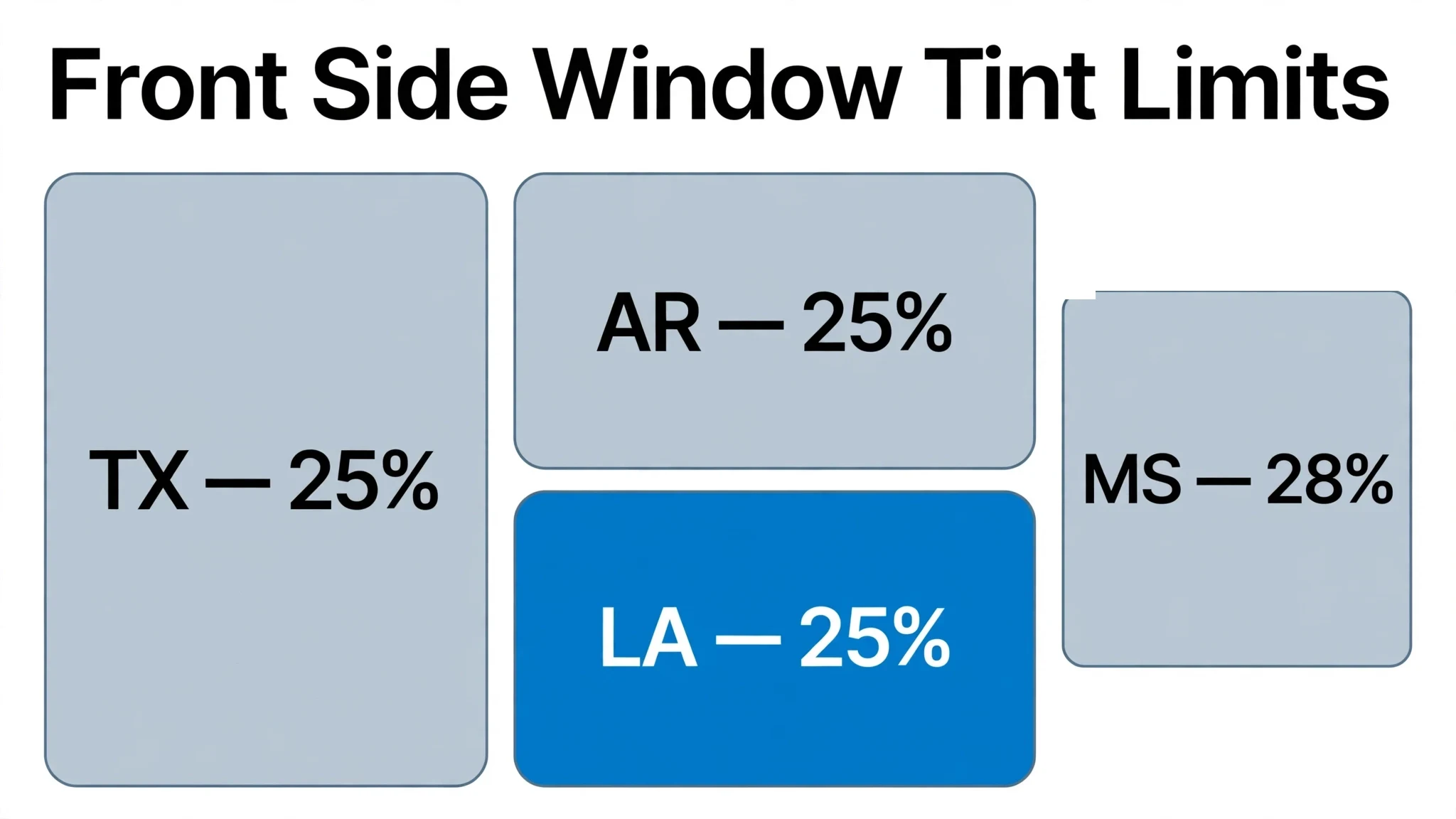
Louisiana’s 2025 change moved it from the strict end of the South to the middle of the pack:
– Texas tint laws also set 25% on front side windows — the same headline number — but Texas holds a car’s rear side windows to 25% and its rear window to 25% as well, where Louisiana lets the rear window go to 12%. – Florida’s window tint law allows 28% front and 15% rear on cars — close to Louisiana now, though Florida’s front limit is still slightly lighter. – Washington state tint laws pair a similar 24% floor with their own installer door-post sticker; Louisiana’s label sits inside the glass instead, and its medical route (affidavit, decal, background check) is far heavier than Washington’s physician verification. – Maryland’s tint laws hold cars to 35% on every window — the old Louisiana approach, and now clearly stricter than Louisiana’s new front limit. – Colorado’s tint laws set 27% everywhere and offer no medical exemption at all, where Louisiana built a full exemption system. – Read also: Georgia’s tint laws (32% on all windows) and New York’s tint laws (70%, checked at inspection), plus Michigan’s tint laws, which ban front film outright — a reminder of how different “tint law” can mean two states apart.
How to Stay Legal
1. Use the new number. Front side windows: 25% or lighter since August 1, 2025. Any source still saying 40% is out of date. 2. Meter the finished window. Louisiana’s percentages count the glass and film together, “all tolerances included” — the printed floor is the measured floor. 3. Mind the rear split. Cars: rear sides 25%, rear window 12%. Trucks, SUVs, vans, and motor homes: anything goes behind the driver, within the 20% reflectance cap. 4. Check for the label. A legal Louisiana install leaves the installer’s name-and-city label in the lower right corner of the driver’s window, sealed under the film. 5. Windshield: 5 inches, transparent, no red or amber. Louisiana measures from the top edge; the AS-1 line does not set the limit here. 6. Do medical properly. State Police affidavit, decal displayed, affidavit copy in the car, three-year reviews. A bare doctor’s note is not the Louisiana exemption.
Frequently Asked Questions
What is the legal tint in Louisiana in 2026?
For a passenger car: 25% VLT or more on the front side windows, 25% on the rear side windows, and 12% on the rear window, with reflectance no higher than 20%. The front limit dropped from 40% to 25% on August 1, 2025 under Act 143. On trucks, SUVs, vans, and motor homes, windows behind the driver may be any darkness.
Did Louisiana’s tint law change in 2025?
Yes. Act 143 of 2025 (HB 119) lowered the front side window minimum light transmission from 40% to 25%, effective August 1, 2025. The rear side (25%), rear window (12%), and reflectance (20%) limits did not change, and no 2026 law has changed them further.
Is 20% tint legal in Louisiana?
On a car’s front or rear side windows, no — the floor is 25%. On the rear window of a car, yes — the floor there is 12%, so a 20% film passes. Behind the driver on a truck, SUV, van, or motor home, 20% is legal on any rear window.
What is the darkest legal tint in Louisiana?
On a passenger car, the rear window at 12% VLT is the darkest standard tint. On trucks, SUVs, vans, and motor homes, windows behind the driver have no darkness floor at all. With a medical exemption, darker tint is possible under the State Police affidavit system.
How much is a tint ticket in Louisiana?
For the driver of a Louisiana-registered vehicle: up to $150 for a first offense, $250 for a second, and $350 for a third or later offense. Sellers and installers face up to $1,000 and $2,000, and a third conviction bars them from the business.
How do I get a medical tint exemption in Louisiana?
Have a Louisiana-licensed optometrist or physician sign the Office of State Police affidavit for a sun-related medical condition, submit it (with a background-check consent), display the issued decal on the vehicle, and keep a copy of the affidavit in the car. Most exemptions are reviewed every three years; light-sensitive porphyria lasts for the duration of ownership.
Can you tint your windshield in Louisiana?
Only a transparent strip across the topmost portion, extending no more than five inches from the top, and it may not be red or amber. Louisiana measures in inches from the top edge and does not use the AS-1 line. One exception: porphyria patients with a medical exemption and their physician’s authorization may have tint below the top six inches.
Does Louisiana require a tint label?
Yes. Every installer must place a label of 1.5 square inches or less permanently between the film and the glass in the lower right corner of the driver’s side window, showing the installer’s name and city. A tinted driver’s window without that label was not installed under the statute’s rules.
Conclusion
Louisiana tint laws are now a story of one number moving. Act 143 took the front side windows from 40% to 25% on August 1, 2025, and left everything else standing: 25% rear sides and 12% rear window on cars, any darkness behind the driver on trucks and SUVs, a 20% reflectance cap, a five-inch windshield strip, and the installer label sealed into the driver’s window. The full system is written in R.S. 32:361.1, with the medical exemption in R.S. 32:361.2 and Act 143’s own summary in the Legislature’s résumé digest.
If you are cited under the old assumptions — yours or the officer’s — the effective date is the fact that matters most: film that was illegal at 35% in July 2025 is legal now, and a Louisiana traffic attorney can resolve a stale-limit ticket quickly.
Disclaimer: This article is general information about Louisiana law, not legal advice. It is not a substitute for advice from a qualified attorney licensed in Louisiana. Laws and court practice can change, so check the current statute or speak to a lawyer about your situation.