



Massachusetts tint laws run on a single pair of numbers: 35% and 35%. Every side window and the rear window must let at least 35% of light through and reflect no more than 35%, measured through the glass and film together. There is no separate rule for SUVs, no darker rear window, and no vehicle class that escapes the floor. The law is Massachusetts General Laws chapter 90, section 9D, and it is enforced twice over — at traffic stops and at the annual safety inspection, where illegal tint earns a rejection certificate.
- Quick Answer
- One Rule for Every Window: The 35/35 Standard
- Massachusetts Tint Limits by Window
- Windshield Rules: The Top 6 Inches
- The Mirror Condition and Other Fine Print
- Enforcement at the Annual Inspection
- Medical Waivers: The Board, the Doctor, and the Sticker
- Who Else Is Exempt
- Penalties: $250 Fines and a 90-Day Suspension
- How Massachusetts Compares With Other States
- How to Stay Legal
- Frequently Asked Questions
- What is the legal tint limit in Massachusetts?
- Is 35% tint legal in Massachusetts?
- Can SUVs and trucks have darker rear tint in Massachusetts?
- What is the windshield tint rule in Massachusetts?
- Does Massachusetts check tint at inspection?
- How do I get a medical tint exemption in Massachusetts?
- What is the fine for illegal tint in Massachusetts?
- I am visiting from another state. Does Massachusetts tint law apply to my car?
- Conclusion
This guide explains the 35% rule, the windshield strip, the mirror condition on the rear window, the medical waiver with its Registrar’s sticker, and what a violation actually costs.
Quick Answer
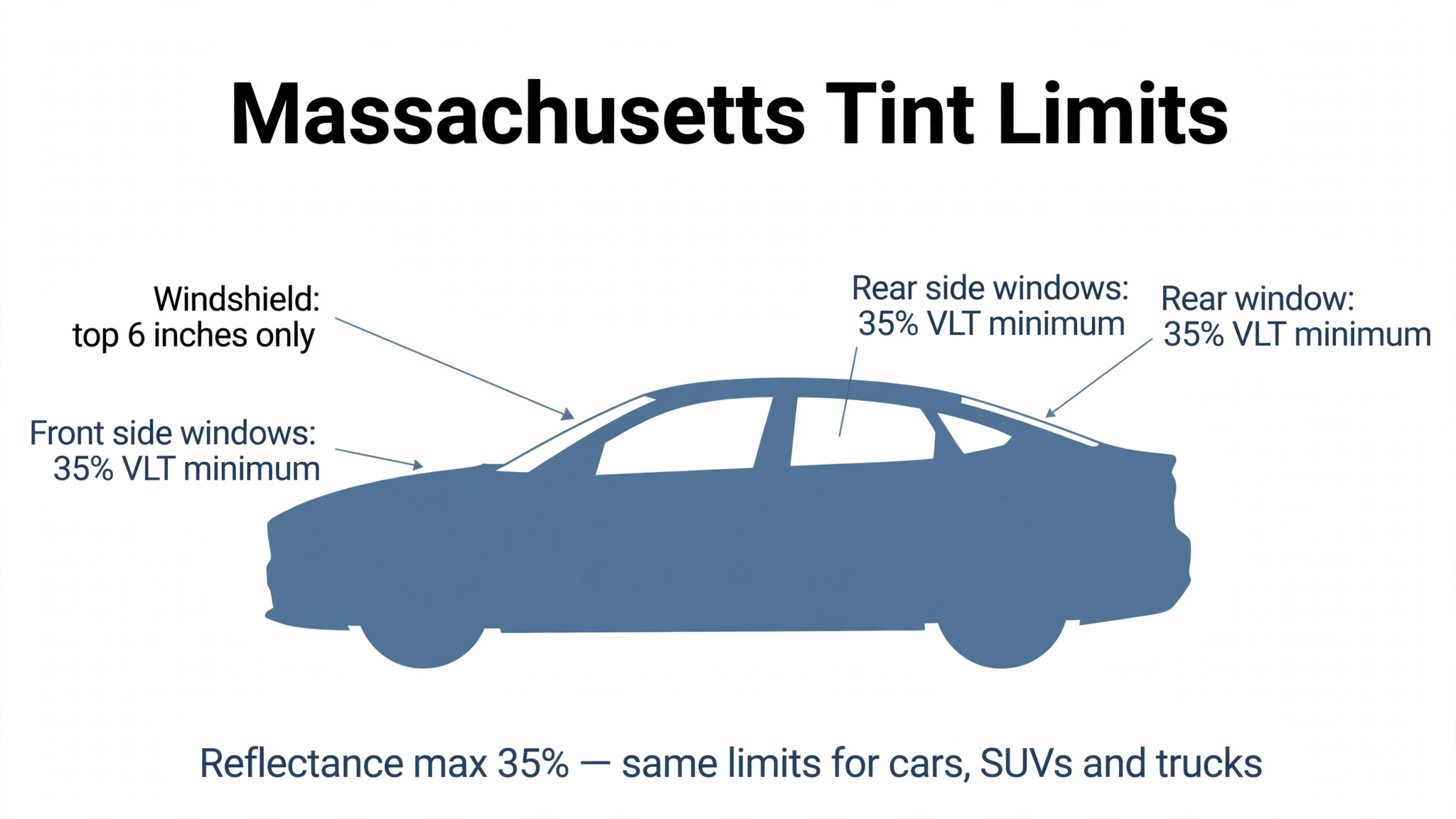
Under Massachusetts tint laws, aftermarket tint on the front side windows, rear side windows, and rear window must keep visible light transmittance at 35% or more and reflectance at 35% or less, with two outside mirrors required when the rear window is treated. The same limits apply to cars, SUVs, vans, and trucks alike. The windshield may carry transparent material in the top 6 inches only. A medical waiver exists through the RMV’s Medical Advisory Board. Violations draw a fine of up to $250, and a third conviction can cost the driver their license for up to 90 days.
One Rule for Every Window: The 35/35 Standard
Section 9D is written backwards compared with most states. It starts with a ban: no nontransparent or sunscreen material on the windshield, the front side windows, the rear side windows, or the rear window at all. Permission then arrives as an exemption — subsection (4) allows sunscreen material that has a total visible light reflectance of not more than thirty-five per cent or a visible light transmittance of not less than thirty-five per cent on the side and rear windows.
Two things in that sentence deserve care:
– The statute joins its two tests with “or.” Read literally, the exemption names a reflectance cap or a transmittance floor. In practice, the Registrar’s measurement standards and the annual inspection apply the pair together as the working rule everyone is held to: at least 35% of light through, no more than 35% reflected. No Massachusetts shop plans an install around the “or,” and neither should you. – The measurement is net. Transmittance is read through the glazing as treated — factory glass plus film. A 35% film over typical 75% factory glass finishes near 26%, which fails. Installers who meter the finished window are following the statute, not padding the job. Our guide to how window tint percentages work walks through the multiplication for common film shades.
And the point national tint pages most often get wrong: Massachusetts draws no line between cars and multipurpose vehicles. The dark factory privacy glass on an SUV is lawful because the statute exempts glazing manufactured to the federal standard — but the moment aftermarket film goes on that same SUV, the 35% floor applies to it exactly as it does to a sedan. There is no darker-rear allowance to claim.
What if scenario: A Worcester family moves their sedan’s legal 35% setup across to a new SUV, asking the shop to “match the dark factory rear glass with film.” The factory glass is exempt; the film is not. Filming the SUV’s rear windows to match would put them far below 35% — and the car would fail its next inspection.
Massachusetts Tint Limits by Window
| Window | Massachusetts rule |
|---|---|
| Windshield | Transparent material only, uppermost 6 inches, clear of the driver’s forward viewing area |
| Front side windows | 35% VLT minimum, 35% reflectance maximum |
| Rear side windows | 35% VLT minimum, 35% reflectance maximum |
| Rear window | 35% VLT minimum, 35% reflectance maximum — and two outside mirrors required |
| Vehicle classes | Same limits for cars, SUVs, vans, and trucks — no split |
Windshield Rules: The Top 6 Inches
Subsection (5) allows transparent material limited to the uppermost 6 inches along the top of the windshield, provided the strip does not encroach upon the driver’s direct forward viewing area as defined in the Federal Motor Vehicle Safety Standards. The inspection regulation, 540 CMR 4.04, states the same boundary from the other side: tinting or reflective material below the uppermost six inches of the windshield — the area around the AS-1 line — is a rejection item.
So the windshield rule has two edges, not one: the strip must sit within the top six inches and stay out of the driver’s forward view. A strip that satisfies the tape measure but droops into the viewing area on a short windshield still fails. Anything tinted below the strip — a full-windshield film of any shade — is outside the exemption entirely, medical waivers included: even an approved waiver leaves the windshield at the top six inches.
The Mirror Condition and Other Fine Print
The rear window carries the statute’s one equipment condition: the 35% permission applies to it only if the vehicle is equipped with two outside mirrors, one on each side, adjusted so the driver has a clear view of the highway behind. The inspection rules repeat the requirement for any rear window carrying aftermarket tint. A car with a missing or folded-away passenger mirror and a tinted rear window is out of compliance on the mirror alone.
Three more pieces of fine print matter in practice:
– No tolerance is written into the statute. Section 9D contains no plus-or-minus band. The Registrar of Motor Vehicles sets the rules and standards for measuring transmittance and reflectance and provides for testing of glazing alleged to be in violation. – The Registrar’s word carries weight in court. A statement from the Registrar that treated glazing complies with the section is prima facie evidence of compliance in any prosecution — the closest thing Massachusetts has to an official certificate for a borderline window. – Shops are inside the law too. Section 9D forbids manufacturing, selling, offering for sale, or equipping a vehicle in violation of it. There is no Massachusetts installer label for ordinary legal tint — unlike states that seal a compliance sticker into the film, here the only sticker in the whole system belongs to the medical waiver below.
Enforcement at the Annual Inspection
Most states enforce tint only when an officer decides to. Massachusetts also enforces it on a schedule: tint is an item in the annual safety inspection every registered vehicle must pass. Under 540 CMR 4.04(8)(g), aftermarket tinting on the side windows and rear window is accepted only within the section 9D standards, the two-mirror rule applies to treated rear windows, and windshield tint below the top six inches is rejected.
A vehicle that misses the standard receives a Certificate of Rejection — the red R sticker — and must be repaired and return for re-inspection. That changes the economics of borderline tint completely. A 30% window might never draw a second look on the road, but it faces a meter and a checklist every single year, and each failure means film removal or replacement at the owner’s cost before the car is legal again.
Common mistake: Assuming a passed inspection last year protects the car this year. Film darkens as it ages and cheap film drifts darker still; a window that metered 36% at install can read below the line two inspections later. Owners who keep the installer’s paperwork — film model and rated VLT — resolve disputes at the inspection lane far faster than owners arguing from memory.
Medical Waivers: The Board, the Doctor, and the Sticker
Subsection (8) allows special window treatment determined necessary by a licensed physician for the protection of an owner or operator who is light sensitive or photosensitive. Massachusetts runs this exemption through a board, not a glovebox letter:
1. The owner or operator applies in writing to the Medical Advisory Board — the board established under chapter 90, section 8C — using the RMV’s tinted glass waiver process through RMV Medical Affairs. 2. The application must be supported by the written attestation of a physician licensed to practice in Massachusetts that the treatment is necessary. 3. If the Board grants the exemption, the Registrar issues a sufficiently noticeable sticker, which is affixed to the side window immediately adjacent to the operator. 4. The Registrar keeps a record of every exemption sticker issued.
The sticker is the design’s whole point: the exemption is visible on the glass, so an officer or inspector can see the authority for dark tint without a document hunt. It also means the waiver travels with a specific vehicle and its sticker, not with a person and a letter. Two limits survive every waiver: the windshield stays at the top six inches, and the treatment covers the vehicle the waiver was granted for — a second family car needs its own application.
What if scenario: A Springfield driver with lupus and documented photosensitivity keeps a dermatologist’s note in the glovebox and tints to 20%. At inspection the car is rejected anyway — a note is not the exemption. The Board application, the Massachusetts physician’s attestation, and the Registrar’s sticker are.
Who Else Is Exempt
Section 9D’s other exemptions are specific, and one of them surprises visitors:
– Vehicles registered in another state, territory, country, or province are excepted from the section entirely. A car lawfully tinted under its home state’s rules does not become illegal by crossing into Massachusetts — the opposite of the approach in states like Washington, where visiting cars are held to local numbers. – Public livery vehicles — private passenger vehicles registered for public livery and hired for that purpose, excluding taxicabs — may run nontransparent treatment on the rear side windows and rear window. The taxi exclusion is deliberate and easy to miss. – Law-enforcement, patrol, and K-9 vehicles fall outside the ban for their official glass. – Factory glazing manufactured to the cited federal standard is exempt — the basis for dark SUV privacy glass discussed above. – Draperies, louvers, and similar treatments are permitted on the rear window and rear side windows, again conditioned on the two outside mirrors.
Penalties: $250 Fines and a 90-Day Suspension
A violation of section 9D is punishable by a fine of up to $250. The statute then adds the consequence most summaries bury: on a third or subsequent conviction, the Registrar suspends the operator’s license for up to 90 days. Tint stops being a cheap, repeatable ticket at the third strike — it becomes a driving-privilege problem.
Stacked on top of the fine is the inspection system. A cited driver can pay the ticket and still face a rejection certificate at the next annual inspection until the film comes into line, so the real cost of illegal tint in Massachusetts is usually the fine plus removal or replacement of the film. Drivers comparing regimes will find the pattern familiar from Maryland’s repair-order system, but Massachusetts adds the annual meter reading Maryland lacks.
How Massachusetts Compares With Other States
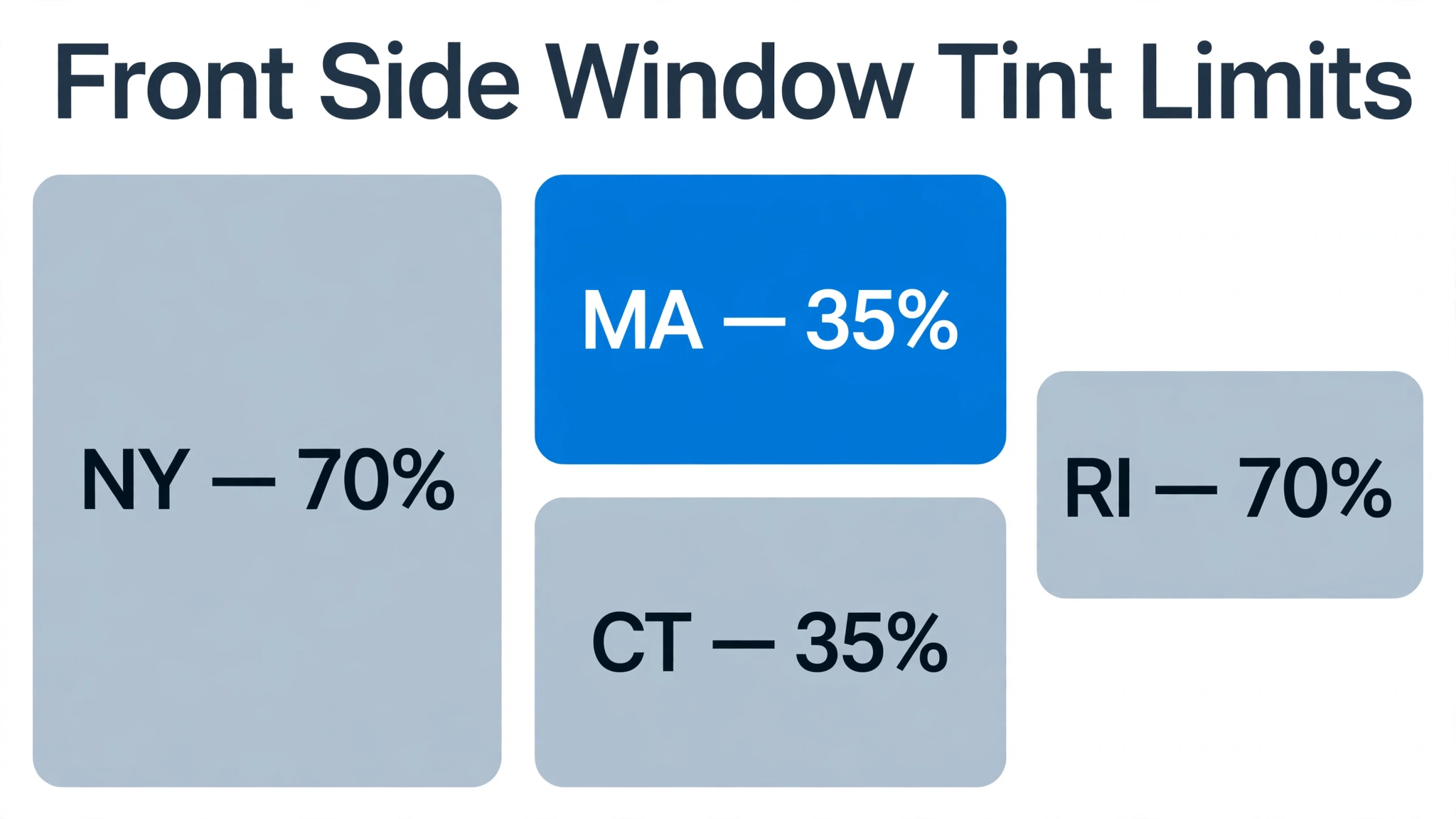
Massachusetts’ 35% floor sits in the middle of the national range, but its uniformity is the story. New York’s 70% front-window rule is far stricter and, like Massachusetts, is checked at an annual inspection — the two strictest inspection regimes in the region. Colorado allows 27% but bans red and amber film outright and offers no medical exemption at all. Michigan goes the other way entirely: no VLT percentage, only a four-inch strip rule on the front glass. And California demands 70% on front side windows while leaving rear glass almost free — the car/SUV-style split Massachusetts refuses to make.
Read also: Texas tint laws, Florida window tint law, Ohio tint laws
How to Stay Legal
1. Target a finished 35%, not a 35% film. Have the shop meter the glass and choose film so the combined reading lands at or above 35% — on most factory glass that means a film rated around 45–50%. 2. Keep reflectance under 35% too. Mirror-style films fail the second number even when the first one passes. 3. Check both mirrors before tinting the rear window. The mirror condition is part of the permission, and inspectors look for it. 4. Treat the windshield as strip-only. Transparent material, top six inches, out of the forward viewing area — nothing below, waiver or not. 5. Plan for the annual meter. Keep the installer’s invoice with the film model and rated VLT in the car; it settles most inspection-lane questions on the spot. 6. Out-of-state drivers: your home registration carries the exemption with you — but if you move to Massachusetts and register here, the 35% rule and the inspection arrive with the new plates. 7. Need darker tint for a medical condition? Start with a Massachusetts-licensed physician and the Medical Advisory Board application — before the film goes on, not after a rejection.
Frequently Asked Questions
What is the legal tint limit in Massachusetts?
35% visible light transmittance on the front side windows, rear side windows, and rear window, with reflectance capped at 35% — the same numbers for every vehicle, measured through glass and film together under chapter 90, section 9D.
Is 35% tint legal in Massachusetts?
Yes — 35% is exactly the floor. The finished window must transmit at least 35% of light, so a film rated 35% installed over factory glass usually finishes below the line and fails. Legal installs aim the combined reading at 35% or higher.
Can SUVs and trucks have darker rear tint in Massachusetts?
No. Massachusetts has no car-versus-SUV split. Dark factory privacy glass is lawful because factory glazing meeting the federal standard is exempt; aftermarket film on an SUV’s rear windows is held to the same 35% as a sedan’s.
What is the windshield tint rule in Massachusetts?
Transparent material in the uppermost 6 inches only, and the strip may not encroach on the driver’s direct forward viewing area. Inspection rules reject tint below that line, around the AS-1 mark. Full-windshield tint is not allowed at any shade.
Does Massachusetts check tint at inspection?
Yes. Tint is part of the annual safety inspection under 540 CMR 4.04. Windows outside the section 9D standards, a treated rear window without two outside mirrors, or windshield tint below the top six inches earn a Certificate of Rejection until repaired.
How do I get a medical tint exemption in Massachusetts?
Apply in writing to the Medical Advisory Board through RMV Medical Affairs, supported by the written attestation of a physician licensed in Massachusetts that special treatment is necessary for light sensitivity or photosensitivity. If granted, the Registrar issues a sticker for the driver’s side window and keeps a record of it.
What is the fine for illegal tint in Massachusetts?
Up to $250 per violation. On a third or subsequent conviction, the Registrar also suspends the operator’s license for up to 90 days — and the car still has to pass inspection, which usually means paying for removal or lighter film as well.
I am visiting from another state. Does Massachusetts tint law apply to my car?
No. Section 9D excepts vehicles registered in another state, territory, country, or province, so a car that is legal at home stays legal while visiting. The exemption ends if the vehicle is registered in Massachusetts.
Conclusion
Massachusetts keeps tint simple to state and strict to live with: 35% through, no more than 35% reflected, on every side and rear window of every vehicle, a six-inch transparent strip on the windshield, two mirrors behind any treated rear window, and an annual inspection that meters the result. The medical waiver — a Board decision and a Registrar’s sticker on the glass — is the only route darker, and repeat violations escalate from a $250 fine to a 90-day license suspension. The controlling text is Massachusetts General Laws chapter 90, section 9D, and Film Slingers’ inspection-focused Massachusetts guide tracks how the rules are applied at the inspection lane.
Disclaimer: This article is general information about Massachusetts tint laws, not legal advice. Tint statutes, regulations, and enforcement practice change, and how a rule applies depends on the vehicle and the facts. Confirm the current law in Massachusetts General Laws chapter 90, section 9D and the inspection rules at 540 CMR 4.04, or speak with a Massachusetts attorney or the RMV, before tinting, buying, or contesting a citation.