



New Jersey tint laws are the simplest in America to state and the most misreported. There is no legal tint percentage for ordinary drivers — none. Under N.J.S.A. 39:3-74, a statute written in 1937 about signs and posters, no “non-transparent material” may sit on the front windshield or the front side windows, and courts read that ban to cover aftermarket tint film. The same statute never mentions the windows behind the driver — so rear side windows and the rear window may be any darkness at all, on any vehicle.
- Quick Answer
- There Is No Percentage: The 1937 Statute
- New Jersey Tint Limits by Window
- State v. Smith: What an Officer Must Actually See
- Medical Sunscreening: The Only Way Through the Front Ban
- Penalties and the $1,000 Fine Myth
- Mirrors, Inspection, and Other Fine Print
- How New Jersey Compares With Other States
- How to Stay Legal
- Frequently Asked Questions
- What is the legal tint in New Jersey?
- Is 35% tint legal in New Jersey?
- Can police stop me for tinted rear windows in New Jersey?
- How dark can front window tint be before police can stop me?
- How do I get a medical tint exemption in New Jersey?
- How much is a tint ticket in New Jersey?
- Did New Jersey change its tint law in 2025 or 2026?
- Does New Jersey tint law differ for SUVs and trucks?
- Conclusion
This guide explains the front ban, the wide-open rear, what the New Jersey Supreme Court changed in State v. Smith (2022), the medical sunscreening permit with its very specific film limits, and why the famous $1,000 fine is not what most articles say it is.
Quick Answer
Under New Jersey tint laws, no aftermarket film is allowed on the windshield or front side windows of any vehicle — there is no percentage that makes front tint legal. The rear side windows and rear window may be any darkness, including full blackout, on cars, SUVs, vans, and pickups alike. The only route to front glass treatment is an MVC medical sunscreening exemption for documented photosensitivity, with its own strict film limits and a 48-month certificate. A plain front-tint violation is a small fine-only equipment violation; the $1,000 and $5,000 penalties belong to violations of the medical sunscreening program, not to ordinary tickets.
There Is No Percentage: The 1937 Statute
Section 39:3-74 provides that no person shall drive a motor vehicle with “any sign, poster, sticker or other non-transparent material upon the front windshield” or the front side windows, apart from certificates the law itself requires. The Legislature last amended the section in 1937 — decades before window film existed — and New Jersey courts have read “non-transparent material” to include aftermarket tint applied to the front glass.
That origin explains everything unusual about New Jersey’s regime:
– No VLT number exists for ordinary drivers. Every percentage published for New Jersey is either borrowed from the medical exemption rules or simply invented. A shop quoting you a “legal 35%” for front windows is quoting another state’s law. – The ban is by position, not darkness. A barely-there 70% film on a front side window is the same violation as a 5% limo film — the statute bans the material, not a shade of it. Our guide to how window tint percentages work covers the states that do use numbers; New Jersey is the exception that proves the framework. – The statute says “any motor vehicle.” There is no car-versus-SUV split because the 1937 text predates the categories. The same front ban and the same open rear apply to a sedan, an SUV, a van, and a pickup.
Factory glass is a separate matter: the ban targets material placed upon the glass, and the dark privacy glass manufacturers build into rear windows is part of the glazing itself, manufactured to federal standards.
New Jersey Tint Limits by Window
| Window | Ordinary drivers | With an MVC medical exemption |
|---|---|---|
| Windshield | No aftermarket film at all | Clear film only, 70% VLT or lighter below the AS-1 line |
| Front side windows | No aftermarket film at all | 60% VLT or lighter; removable top strip to 35% in daylight |
| Rear side windows | Any darkness | Any darkness |
| Rear window | Any darkness | Any darkness |
| Reflectance | No statutory cap for ordinary cars | 8% maximum on windshield and front side film |
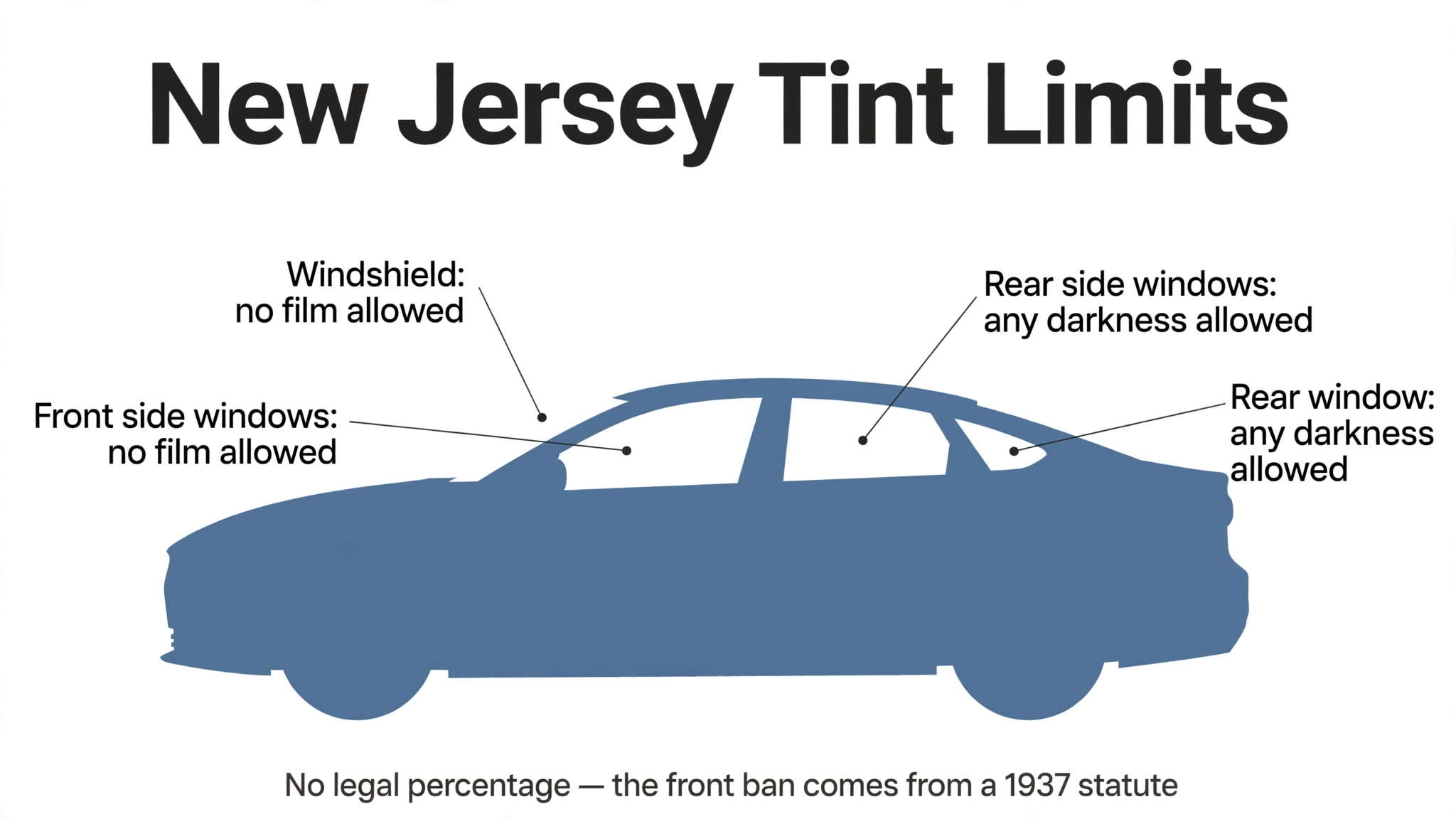
Behind the driver, the freedom is total: rear side windows and the rear window may be blacked out completely, and tinting them triggers no mirror requirement — New Jersey’s mirror statute, 39:3-71, requires an interior mirror and a driver’s-side exterior mirror on passenger cars built after 1965 whether or not the rear glass is tinted. Compare Michigan, the other no-percentage state: Michigan bans front film beyond a four-inch strip but at least writes the strip down. New Jersey allows not even that.
State v. Smith: What an Officer Must Actually See
For years, New Jersey drivers were stopped for dark rear windows — glass the statute does not regulate. The New Jersey Supreme Court ended that in State v. Smith, 251 N.J. 244 (2022). The case began with a Trenton traffic stop based on a tinted rear window, which led to a gun charge; the Court used it to define what section 39:3-74 actually prohibits.
The holdings matter to every New Jersey driver:
– A tinted rear window cannot violate 39:3-74 — the section does not reach the rear glass — so rear tint cannot justify a traffic stop. – Reasonable suspicion of a front-glass violation “arises only when a vehicle’s front windshield or front side windows are so darkly tinted that police cannot clearly see people or articles within the car.” The test is the officer’s actual view, not a percentage — fitting, in a state whose statute has none. – The safety-glazing statute, 39:3-75, governs the condition of the glass and “has no bearing” on aftermarket film; and the tint standard in the inspection code does not supply a rule for private cars.
A September 2026 report of the New Jersey Law Revision Commission records how courts now apply Smith: it is treated as a rule that the State must show the tint actually blocked the officer’s view. Practically, a stop for light or moderate front tint — tint an officer can plainly see through — rests on ground Smith removed. Dark front tint remains a violation and a valid stop; the case changed the proof, not the ban.
Medical Sunscreening: The Only Way Through the Front Ban
The single legal route to treated front glass is the sunscreening exemption in N.J.S.A. 39:3-75.1 et seq., run by the Motor Vehicle Commission. It is a permit system, not a doctor’s-note system:
1. Qualify. The exemption serves a vehicle driven by, or regularly used to transport, a person with a medical condition involving ophthalmic or dermatologic photosensitivity. The statute names the conditions: polymorphous light eruption, persistent light reactivity, actinic reticuloid, porphyrins, solar urticaria, and lupus erythematosus, plus other photosensitive disorders the MVC’s director determines. 2. Get certified. A certified ophthalmologist, or a physician holding a plenary license to practice medicine and surgery in New Jersey or a bordering state, must certify the need in writing on the MVC application. 3. Win approval before any film is touched. The MVC approves the vehicle first; the film may not be installed until the approval arrives, and the work must be done by an MVC-approved licensed installer. 4. Carry the certificate. The exemption issues per vehicle as a certificate valid for 48 months, kept in the car and shown to law enforcement and inspection examiners on request.
Even approved, the film itself is tightly specified by regulation (N.J.A.C. 13:20-1.2 to 1.3):
– Windshield: clear film only; below the AS-1 line it may not reduce light transmission below 70%; above the AS-1 line it is unrestricted. – Front side windows: film may not reduce light transmission below 60%. – The daylight strip: a readily removable strip on the uppermost six inches of the front side windows may go as dark as 35% — but only between sunrise and sunset. It is the only provision of its kind in the country: tint whose legality changes with the clock. – Reflectance: no more than 8% on windshield and front side film, and all sunscreening material must be transparent film.
Common mistake: Tinting first and applying later, or treating a dermatologist’s letter as the permit. Unauthorized sunscreening material is subject to removal and fines, and an exempt vehicle driven without its certificate invites a ticket of its own — the approval, the approved installer, and the certificate are the exemption, in that order.
Penalties and the $1,000 Fine Myth
Search New Jersey tint fines and you will meet two numbers everywhere: $1,000 for a first offense and $5,000 for a second, repeated by national outlets as the price of a tint ticket. They are real numbers attached to the wrong offense.
The ordinary violation — driving with film on the front glass in breach of 39:3-74 — is a fine-only equipment violation with no points, under the general Title 39 penalty provision, 39:3-79, which caps the fine at $25. It is among the cheapest equipment tickets in the state.
The $1,000 and $5,000 figures live in 39:3-75.3, the penalty section of the medical sunscreening program. They punish violations of that program — an installer applying sunscreening without approval, film outside the exemption’s limits, a certificate misused. Driving an exempt vehicle without carrying the certificate can draw up to $100. So the penalty map is almost the reverse of the headlines: the casual front-tint ticket is small, while abusing the one legal pathway through the ban is punished severely — the same driver-versus-business pricing logic as Massachusetts’ $250 fine and suspension ladder, pointed at a different target.
Mirrors, Inspection, and Other Fine Print
– No inspection metering. New Jersey’s inspection program does not give private cars a tint test, and after Smith the inspection-code tint standard cannot be borrowed for roadside enforcement either. Enforcement is by observation at stops — which is why the Smith “cannot clearly see” test does so much work. – No dual-mirror rule. Rear tint at any darkness requires nothing extra; the mirror duties in 39:3-71 apply to the car as built. – No color list. The statute singles out no film colors for ordinary cars; the front ban makes the question moot up front, and the rear is unregulated. Mirrored or metallic finishes are not a safe choice anywhere on the car — up front they are non-transparent material by any reading. – Reform bills are not law. Bills introduced in recent sessions, including 2026 proposals, would write a front-window percentage and a windshield strip into 39:3-74 for the first time. None has passed. Until one does, “New Jersey tint law 2025” and “2026” describe the same 1937 rule.
How New Jersey Compares With Other States
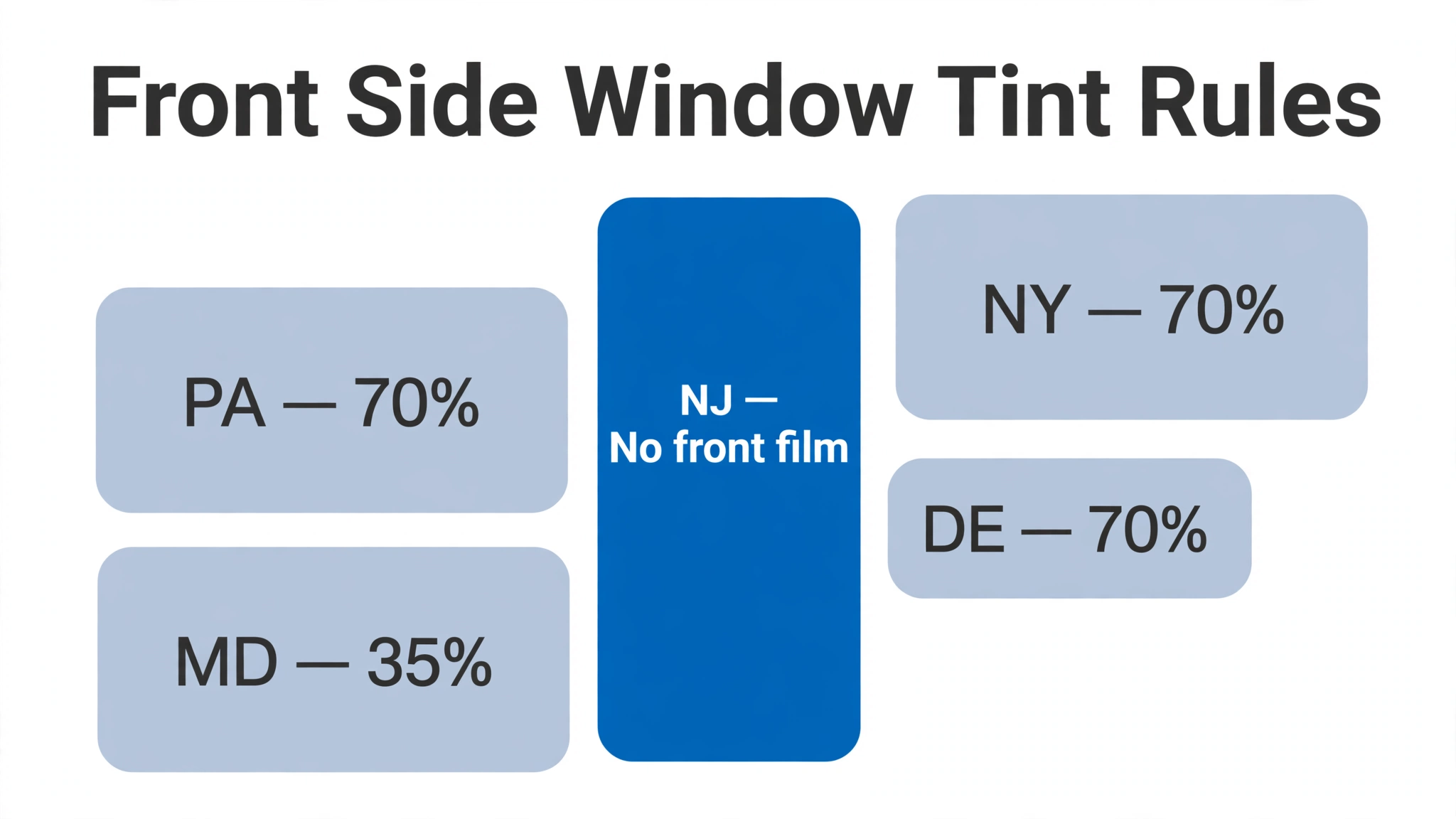
New Jersey’s neighbours regulate by number, which makes crossing a bridge a legal event. New York requires 70% VLT on front side windows and checks it at the annual inspection — a car with New Jersey’s (nonexistent) front film problem becomes a New York inspection failure the moment film appears. Washington allows 24% up front, the most permissive numbered front limit in the country, while Colorado sits at 27% with banned colors. New Jersey and Michigan remain the only states whose front rule is not a number at all — and of the two, only New Jersey pairs a total front ban with a totally open rear.
Read also: Texas tint laws, Florida window tint law, Maryland tint laws
How to Stay Legal
1. Keep film off the front glass entirely. Windshield and front side windows: nothing applied, at any shade, however light. There is no legal front percentage to aim at. 2. Go as dark as you like behind the driver. Rear side windows and the rear window are unregulated for darkness on every vehicle type. 3. Do not rely on a percentage a shop quotes for the front. If the number did not come from the MVC sunscreening rules, it is not New Jersey law. 4. Know your rights at a stop. After State v. Smith, rear tint alone cannot justify a stop, and a front-tint stop needs tint dark enough that the officer could not clearly see people or articles inside. 5. Medical need? Apply first. MVC approval, an approved installer, the film limits (70% windshield, 60% front sides, 8% reflectance), and the 48-month certificate in the car — in that order. 6. Watch the bills, not the headlines. A front percentage for New Jersey exists only in unpassed proposals; the 1937 ban is still the law today.
Frequently Asked Questions
What is the legal tint in New Jersey?
There is no legal percentage for ordinary drivers. Aftermarket film is prohibited on the windshield and front side windows at any darkness under N.J.S.A. 39:3-74, while the rear side windows and rear window may be any darkness on any vehicle.
Is 35% tint legal in New Jersey?
On the rear side windows and rear window, yes — any darkness is legal there. On the front side windows, no: 35%, 50%, even 70% film is prohibited, because the ban covers the material itself, not a shade. The only 35% in New Jersey law is the medical exemption’s removable daylight strip.
Can police stop me for tinted rear windows in New Jersey?
No. In State v. Smith (2022), the New Jersey Supreme Court held that a tinted rear window cannot violate 39:3-74 and cannot justify a stop, because the statute reaches only the front windshield and front side windows.
How dark can front window tint be before police can stop me?
A stop needs reasonable suspicion, which after Smith arises only when the front windshield or front side windows are so dark that the officer cannot clearly see people or articles inside the car. The tint is still a violation — Smith sets the proof for the stop, it does not legalize front film.
How do I get a medical tint exemption in New Jersey?
Apply to the MVC under the sunscreening program (N.J.S.A. 39:3-75.1) with written certification from a certified ophthalmologist or a plenary-licensed physician in New Jersey or a bordering state, for a named photosensitivity condition such as lupus or solar urticaria. Approval comes before installation, the film must be fitted by an MVC-approved installer within the regulation limits, and the 48-month certificate stays in the vehicle.
How much is a tint ticket in New Jersey?
A plain front-tint violation is a fine-only equipment violation with no points — capped at $25 under the general penalty section, 39:3-79. The widely quoted $1,000 and $5,000 fines are in 39:3-75.3 and punish violations of the medical sunscreening program, not ordinary tickets; driving an exempt vehicle without its certificate can cost up to $100.
Did New Jersey change its tint law in 2025 or 2026?
No. Bills proposing a front-window percentage and a windshield strip have been introduced, including in 2026, but none has passed. The governing rule remains the 1937 text of 39:3-74 as read by State v. Smith.
Does New Jersey tint law differ for SUVs and trucks?
No. The statute speaks of any motor vehicle: the front ban and the unrestricted rear apply identically to sedans, SUVs, vans, and pickup trucks, with no separate multipurpose-vehicle rule.
Conclusion
New Jersey’s tint regime is a study in extremes: a total ban on front glass film inherited from a 1937 signs-and-posters statute, no regulation at all behind the driver, a Supreme Court decision that ties enforcement to what an officer can actually see, and a medical sunscreening program with the most specified film limits in America — down to a strip that is legal only in daylight. The controlling texts are N.J.S.A. 39:3-74 and the sunscreening sections, 39:3-75.1 et seq., as tracked in RecordingLaw’s New Jersey guide, and CarGlassFix’s New Jersey tint law breakdown follows the Smith case law closely.
Disclaimer: This article is general information about New Jersey tint laws, not legal advice. Tint statutes, regulations, and enforcement practice change, and how a rule applies depends on the vehicle and the facts. Confirm the current law in N.J.S.A. 39:3-74 and 39:3-75.1 et seq., or speak with a New Jersey attorney or the Motor Vehicle Commission, before tinting, buying, or contesting a citation.