



South Carolina tint laws run on one number and one sticker. The number is 27%: under S.C. Code § 56-5-5015, the combined light transmission of film and factory glass must be not less than 27% on the side windows and the rear window alike. The sticker is the certificate of compliance the same section demands on every window carrying aftermarket film — showing the film’s transmission percentage, the installer’s name, address, and phone number, and the date it went on.
- Quick Answer
- One Number for Almost Every Window
- South Carolina Tint Limits by Window
- The Windshield: The AS-1 Line, or Nothing
- Behind the Driver: Where Vehicle Class Matters
- The Certificate of Compliance: A Sticker on Every Window
- The Medical Exemption: An Affidavit, Not a DMV Form
- Penalties: A Cap for Drivers, a Floor for Installers
- How South Carolina Compares With Other States
- How to Stay Legal
- Frequently Asked Questions
- What is the legal tint in South Carolina?
- Is 27% tint legal in South Carolina?
- Can SUVs have darker tint than cars in South Carolina?
- Can I tint my windshield in South Carolina?
- How do I get a medical tint exemption in South Carolina?
- How much is a tint ticket in South Carolina?
- Does my tint need a sticker in South Carolina?
- Did South Carolina change its tint law in 2025 or 2026?
- Conclusion
This guide explains the 27% rule, the windshield’s AS-1 line, the vehicle-class rule hiding in subsection (I) — where pickup trucks are treated worse than SUVs — the medical affidavit, and the two very different penalty tracks for drivers and installers. It also corrects the errors the copied charts keep repeating, including a DMV form that does not exist.
Quick Answer
Under South Carolina tint laws, a single nonreflective sunscreening device on the side windows — front and rear alike — and on the rear-most window must finish at 27% or more combined light transmission, glass and film together. The windshield takes a device only along the top, never below the AS1 line — and if no AS1 line is visible, no device at all. Film may not be red, yellow, or amber, and every tinted window must carry a certificate of compliance. Windows behind the driver on multipurpose passenger vehicles and most trucks are exempt from the 27% floor — but pickup trucks are expressly not. Violations are a misdemeanor: up to $200 or 30 days.
One Number for Almost Every Window
Section 56-5-5015(C) is written as a single permission: “a single sunscreening device may be installed on the side wings or side windows, or both, located at the immediate right and left of the driver and the side windows behind the driver,” provided the device is nonreflective and “the combined light transmission of the sunscreening device with the factory or manufacturer installed sunscreening material must not be less than twenty-seven percent.”
Subsection (D)(2) gives the rear-most window the same figure — 27% combined since January 1, 1993 — plus a condition: a tinted rear window requires one right and one left outside rearview mirror. Three details do real work:
– The reading is combined, and there is no tolerance in the text. The 27% is measured through film and factory glass together — our guide to how window tint percentages work shows why a 35% film over ordinary factory glass can finish near 28%. Unlike Minnesota, which prints a ±3% tolerance into its statute, South Carolina’s section states the floor and stops. A window that meters at 26% has no statutory margin. – Factory glass alone is outside the VLT rules. Subsection (A) ends with a sentence most summaries skip: if no after-factory device has been added, “the provisions of this section regarding light transmittance do not apply.” A factory privacy window that meters at 20% breaks nothing until someone adds film to it. The section also authorizes only “a single sunscreening device” per window — stacked layers are outside the permission.
Common mistake: Buying film by the number on the box. A driver who installs “27% film” has not bought a 27% window — the film multiplies against glass that already blocks light, and the finished window lands below the floor. Legal installs are specced backwards from the combined reading.
One grandfather clause survives: before 1993 the rear-most window standard was 20% for the device alone, and subsection (D)(3) provides that a device which complied when installed “is not considered to be in violation” while the original device remains in place.
South Carolina Tint Limits by Window
| Window | South Carolina rule |
|---|---|
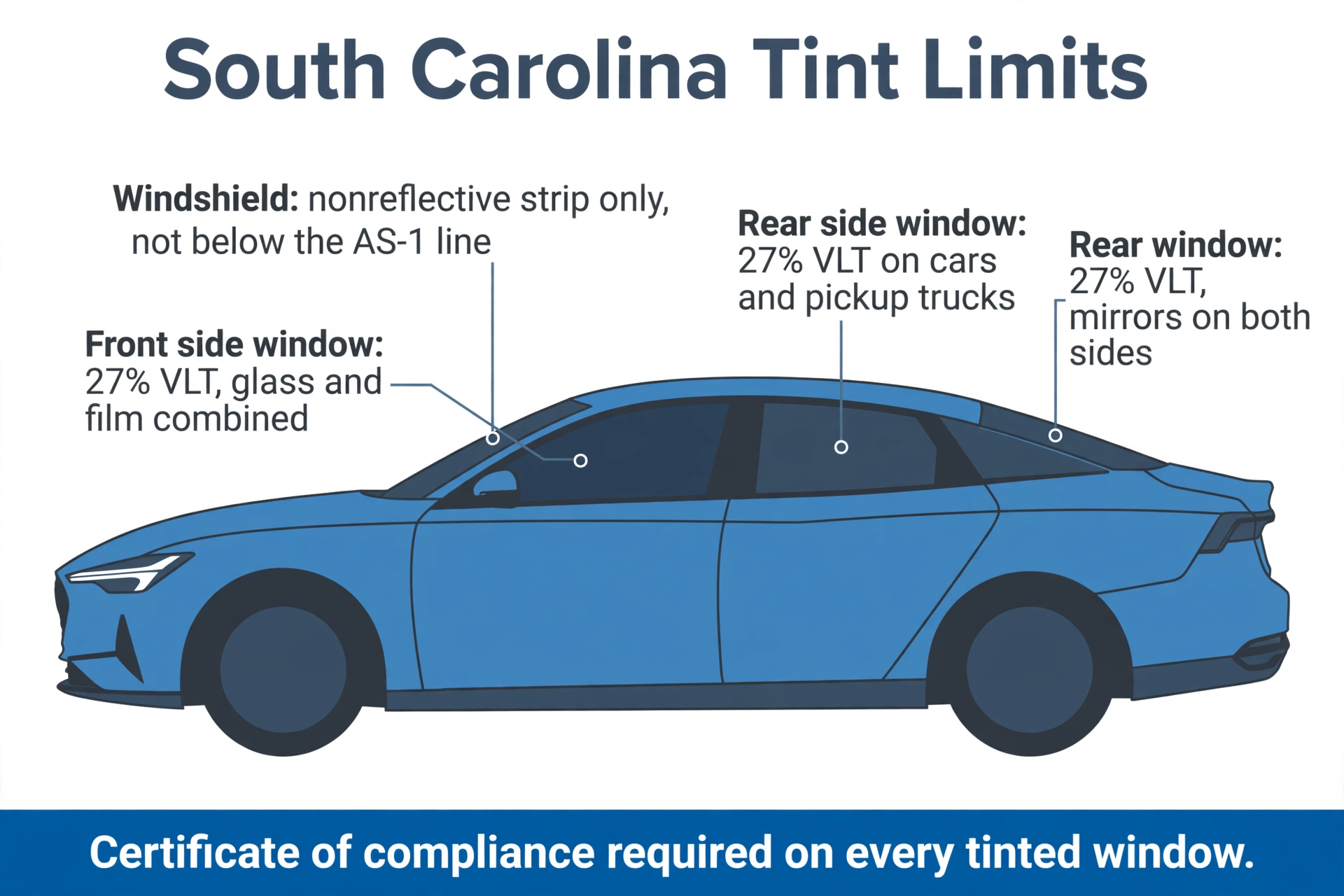
| Windshield | Nonreflective device along the top only, not below the AS1 line; none at all if no AS1 line is visible |
| Front side windows and side wings | 27% combined light transmission, nonreflective — every vehicle |
| Side windows behind the driver | 27% combined on cars and pickup trucks; no transmittance floor on MPVs, other trucks, buses, trailers, mobile homes, RVs |
| Rear-most window | 27% combined (since Jan. 1, 1993); outside mirrors on both sides required when tinted |
| Colors | Red, yellow, and amber devices prohibited |
| Certificate | Certificate of compliance on every window with an after-factory device |
The Windshield: The AS-1 Line, or Nothing
Subsection (B) holds the windshield rule, stricter than the “top strip” shorthand suggests: a sunscreening device “may be used only along the top of the windshield and may not extend downward beyond the AS1 line.” The AS1 line is a real marking — subsection (J)(11) defines AS1 by the federal standard, 49 CFR 571.205 — etched into the glass by its maker, usually a few inches below the top edge.
Then comes the sentence no other state in this series writes: “If the AS1 line is not visible, no sunscreening device may be applied to the windshield.” A windshield without a visible AS1 mark is not one where you measure down five or six inches instead — the statute gives no inch measurement anywhere — it takes no device at all. The allowed strip must also be nonreflective and not red, yellow, or amber.
What if scenario: A Columbia driver replaces a cracked windshield with aftermarket glass carrying no visible AS1 mark, then has the shop add the same top strip the old glass wore. On the old glass the strip was lawful; on the new one the statute’s condition is gone, and the strip has no exception to stand on.
Behind the Driver: Where Vehicle Class Matters
Subsection (I) is one sentence, and it is the most misquoted sentence in South Carolina tint law: “The light transmittance requirement of this section applies to windows behind the driver on pickup trucks, but does not apply to windows behind the driver on other trucks, buses, trailers, mobile homes, multipurpose passenger vehicles, and recreational vehicles.“
Read it slowly, because the copied charts get it wrong in both directions:
– The exemption is real. On a qualifying vehicle — a multipurpose passenger vehicle (subsection (J)(5): built to carry ten persons or less, on a truck chassis or with special features for occasional off-road operation), a non-pickup truck, a bus, a trailer, a mobile home, an RV — the windows behind the driver carry no light-transmission floor at all. That is where the “SUVs can go any darkness in back” claim comes from, and for a true MPV it is correct. – Pickup trucks are expressly carved OUT. The sentence names them first and keeps them under the rule. A chart that prints “SUVs, trucks and vans: any darkness behind the driver” has swept the pickup into an exemption the statute denies it. A South Carolina pickup’s rear glass is held to 27%, exactly like a sedan’s. – The front windows never move, and only the darkness floor lifts. Subsection (I) speaks only to “windows behind the driver” — an SUV’s front side windows are 27% like every other vehicle’s. And the exemption is from “the light transmittance requirement” only: the nonreflective and no red, yellow, or amber device rules still apply, and the dual-mirror condition for a tinted rear-most window sits in subsection (D) as its own sentence.
Common mistake: Assuming the badge decides. “SUV” is a marketing word; the statute’s word is the (J)(5) definition — truck chassis or off-road features, ten seats or fewer. The federal certification label on the driver’s door edge records how the maker classified the vehicle, and that classification is the one that counts.
The Certificate of Compliance: A Sticker on Every Window
South Carolina is one of the few states that makes the paperwork part of the window. Subsection (E): each vehicle equipped with an after-factory sunscreening device, “whether installed by a consumer or professional window tinter, at all times must bear a certificate of compliance,” in the size and form prescribed by the Department of Public Safety, attached “on the inside and lower right hand corner of each window containing a device,” showing:
1. The percentage of light transmission allowed by the sunscreening device; 2. The identity of the installer — name, address, and telephone number; and 3. The date of installation.
Subsection (F) puts the supply duty on the other end: devices sold in South Carolina must include installation instructions, and the manufacturer must provide the certificate and instructions for affixing it. Department of Public Safety regulation 38-621 adds the physical details: the certificate is non-transferable, not to exceed 2 inches square, applied between the film and the glazing on the lower left corner as viewed from the outside — the regulation describing from outside the car the corner the statute describes from inside it. For a DIY install, the retail store must furnish the certificate.
Two practical consequences follow. First, the certificate states the film’s rated transmission, not the finished window’s — a certificate reading 35 on a window that meters at 28 is normal. Second, film installed in another state arrives with no South Carolina certificate, and the statute lays out no process for certifying out-of-state film after the fact. Alabama’s label system is the closest cousin, with its own separate label. And pages claiming a compliance sticker “is not required by statute” in South Carolina have it backwards — leaving the certificate off is the most expensive mistake in the section, as the penalties below show.
The Medical Exemption: An Affidavit, Not a DMV Form
The medical route is subsection (H)(1), and it is a paper affidavit, full stop. The section does not apply to a vehicle registered in South Carolina in the name of a person — or the person’s legal guardian — who has an affidavit signed by a physician or an optometrist licensed to practice in this State, stating that the person has a physical condition making it necessary to equip the vehicle with material that would violate the section’s transmittance or reflectance rules.
Three features define the route:
– No condition list. The statute names no diseases. Any physical condition the signing physician or optometrist certifies as requiring the darker material qualifies on the affidavit’s own terms. – The affidavit lives in the car — and expires. It “must be in the vehicle at all times during its operation,” “must be produced at the request of a law enforcement officer,” and “must be updated every two years” — the only tint exemption in this series with a renewal written into the statute. – There is no DMV process. No form number, no fee, no state-issued certificate appears anywhere in § 56-5-5015. Dealer pages describing an “SC DMV Form MED-1,” a $1 fee, and a DMV-issued exemption certificate describe a process South Carolina law does not contain.
Subsection (H)(2) holds the only other exemption: a law enforcement vehicle used regularly to transport a canine trained for law enforcement purposes. In 2024 the House passed H. 4933, which would have exempted all law enforcement vehicles; it died in a Senate committee, so the K-9 wording still controls.
Penalties: A Cap for Drivers, a Floor for Installers
Section 56-5-5015 prices its violations on two tracks that run in opposite directions — mixing them up is how the “$1,000 tint ticket” headlines happen.
The driver track — subsection (K). A person who owns or operates a vehicle in violation of the section is guilty of a misdemeanor triable in magistrate’s court and “must be fined not more than two hundred dollars or imprisoned not more than thirty days.” That is the whole exposure for the darkness violation itself: a $200 cap, no per-window schedule.
The installer track — subsection (G). Two acts are banned: offering for sale a noncompliant sunscreening product, and installing product “without permanently affixing the certificate of compliance.” The penalties are written as floors, not caps:
– A professional window tinter who violates subsection (E) or (G) must be fined not less than one thousand dollars, or imprisoned up to thirty days, or both — for each offense. – A consumer who violates (E) or (G) must be fined not less than two hundred dollars, or imprisoned up to thirty days, for each offense.
So the $1,000 figure is real — it is simply aimed at the shop, and most often at the missing certificate rather than the shade. A professional who installs legal 27% film and skips the sticker has committed the (G) violation the statute prices highest. South Carolina runs no periodic safety inspection, so enforcement is the roadside meter and the officer’s eye looking for the certificate in the corner of the glass.
How South Carolina Compares With Other States
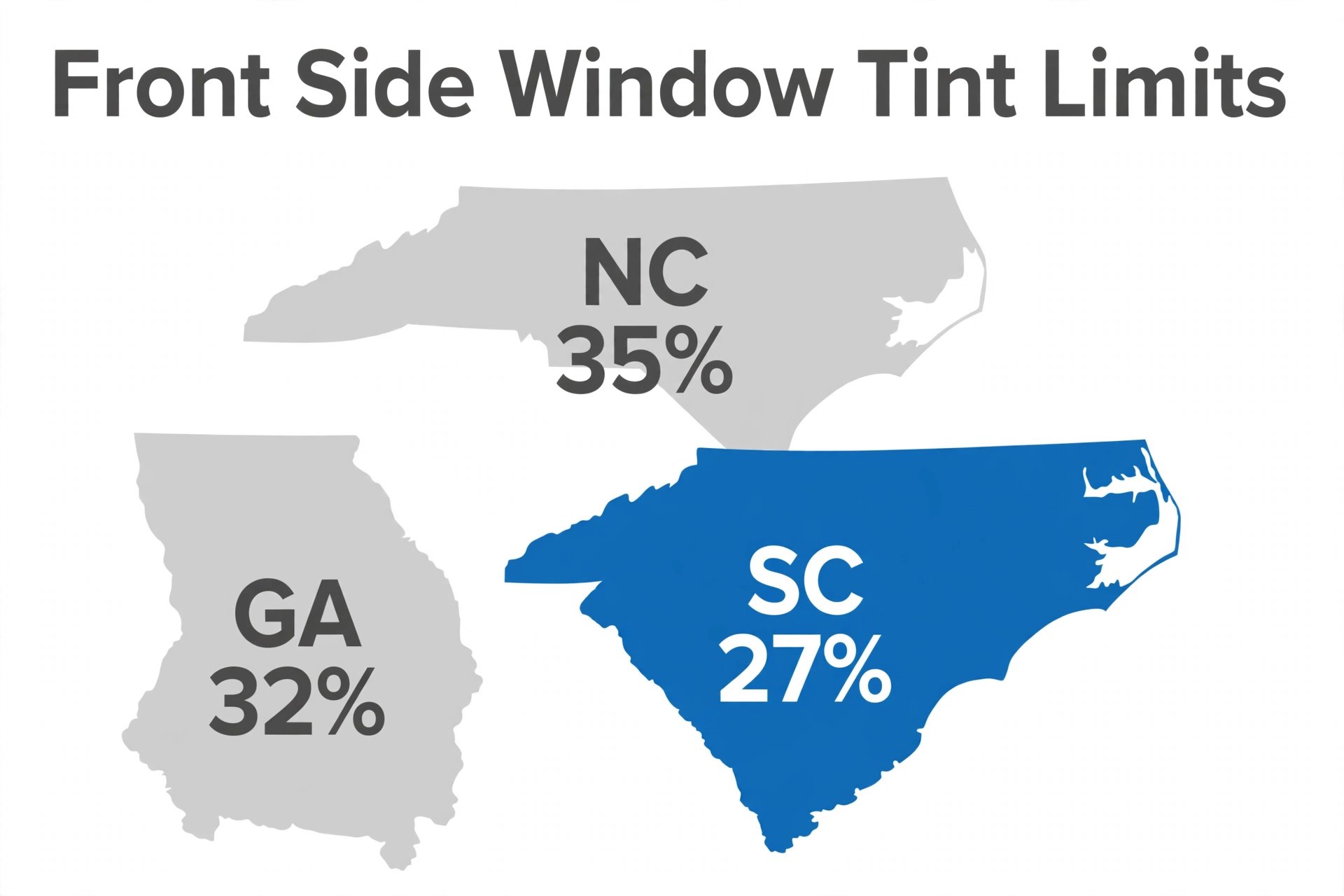
South Carolina’s 27% sits at the dark end of its neighbourhood: North Carolina holds front side windows to 35%, and Georgia sets 32% on every side window of every vehicle. South Carolina is darker than both and stricter on paperwork — neither neighbour demands a certificate on every window — yet looser than both behind the driver of an MPV, where its floor disappears while its own pickups stay at 27%.
Read also: Florida window tint law, Virginia tint law, Arizona tint laws, Texas tint laws
How to Stay Legal
1. Spec the finished window, not the film. The floor is 27% through glass and film together, with no tolerance in the statute. Leave margin — a film that should finish at 28% can meter at 26%. 2. One device per window. The section authorizes a single sunscreening device; stacked layers are outside the permission. 3. Windshield: find the AS1 line first. A strip is lawful only above a visible AS1 line. No visible line means no device — do not substitute an inch measurement the statute never gives. 4. No red, yellow, or amber, and nothing reflective. Every device must be nonreflective, with no numeric reflectance allowance to hide behind. 5. Know your vehicle class before darkening the rear. Cars and pickup trucks: 27% behind the driver too. True multipurpose vehicles and the other listed classes: no transmittance floor behind the driver — but keep both outside mirrors. 6. Get the certificate on every window. Transmission percentage, installer name, address and phone, install date. A missing certificate is a violation even when the shade is legal. 7. Medical need means an affidavit in the car. Signed by a South Carolina-licensed physician or optometrist, carried at all times, renewed every two years. There is no DMV form to file. 8. Shops: the sticker is the job. Selling noncompliant product or installing without permanently affixing the certificate starts at $1,000 per offense for a professional.
Frequently Asked Questions
What is the legal tint in South Carolina?
The side windows (front and rear) and the rear-most window must show 27% or more combined light transmission — film and factory glass together — with a nonreflective device that is not red, yellow, or amber. The windshield allows a device only along the top, not below the AS1 line. Windows behind the driver on multipurpose passenger vehicles and most non-pickup trucks are exempt from the 27% floor; pickup trucks are not.
Is 27% tint legal in South Carolina?
A finished window at 27% is the floor — but a film rated 27% does not produce one. Film multiplies against factory glass, so 27% film over typical glass finishes well under 27%. Legal installs use lighter film (commonly 35% or more) so the combined reading stays at or above 27% — with no tolerance in the statute for a short reading.
Can SUVs have darker tint than cars in South Carolina?
Behind the driver, yes — if the vehicle is a true multipurpose passenger vehicle: built on a truck chassis or with special features for occasional off-road operation, carrying ten people or fewer. Subsection (I) lifts the transmittance floor behind the driver on MPVs, other trucks, buses, trailers, mobile homes, and RVs. But pickup trucks are expressly excluded, and the front side windows are 27% on every vehicle, SUVs included.
Can I tint my windshield in South Carolina?
Only a nonreflective strip along the top, and only down to the AS1 line marked on the glass. If the AS1 line is not visible, the statute allows no sunscreening device on the windshield at all — there is no inch-based fallback. Full-windshield tint is not available to ordinary drivers under any reading of the section.
How do I get a medical tint exemption in South Carolina?
Get an affidavit signed by a physician or optometrist licensed in South Carolina stating that a physical condition makes it necessary to equip your vehicle with material that would otherwise violate the section. The vehicle must be registered in your name (or your legal guardian’s). Keep the affidavit in the vehicle at all times, produce it on an officer’s request, and update it every two years. There is no DMV form or fee — pages describing an “MED-1 form” are wrong.
How much is a tint ticket in South Carolina?
For the owner or driver, a violation is a misdemeanor with a fine of not more than $200 or imprisonment of not more than thirty days, under subsection (K). The larger figures belong to the installer track: a professional tinter who sells noncompliant product or installs without the certificate faces not less than $1,000 per offense, and a consumer violating the certificate provisions faces not less than $200.
Does my tint need a sticker in South Carolina?
Yes. Every window with an after-factory device must bear a certificate of compliance — under the statute, on the inside lower right-hand corner; under Department of Public Safety Regulation 38-621, between the film and the glass, no more than 2 inches square — showing the film’s light transmission percentage, the installer’s name, address, and telephone number, and the date of installation.
Did South Carolina change its tint law in 2025 or 2026?
No. Section 56-5-5015 was last amended in 2002 (Act No. 339). Bills to lower the standard to 20% failed in 2011–12 and again in 2019–20, and H. 4933 (2024) — which would have exempted all law enforcement vehicles, not just K-9 vehicles — passed the House but died in the Senate. The 27% rule and the certificate requirement remain the law.
Conclusion
South Carolina built its tint law around a single 27% combined standard, a windshield keyed to a visible AS1 line, a certificate on every tinted window, and a vehicle-class sentence that frees an SUV’s rear glass while holding a pickup truck to the full rule. Its traps are documentary: a DMV form that does not exist, a reflectance cap nobody enacted, charts that sweep pickups into an exemption written to exclude them, and a $1,000 penalty that belongs to installers, not drivers. The controlling text is S.C. Code § 56-5-5015, and Local Lawyers Online’s South Carolina tint guide tracks the same figures.
Disclaimer: This article is general information about South Carolina tint laws, not legal advice. Tint statutes and enforcement practice change, and how a rule applies depends on the vehicle and the facts. Confirm the current law in S.C. Code § 56-5-5015, or speak with a South Carolina attorney or the Department of Public Safety, before tinting, buying, or contesting a citation.