



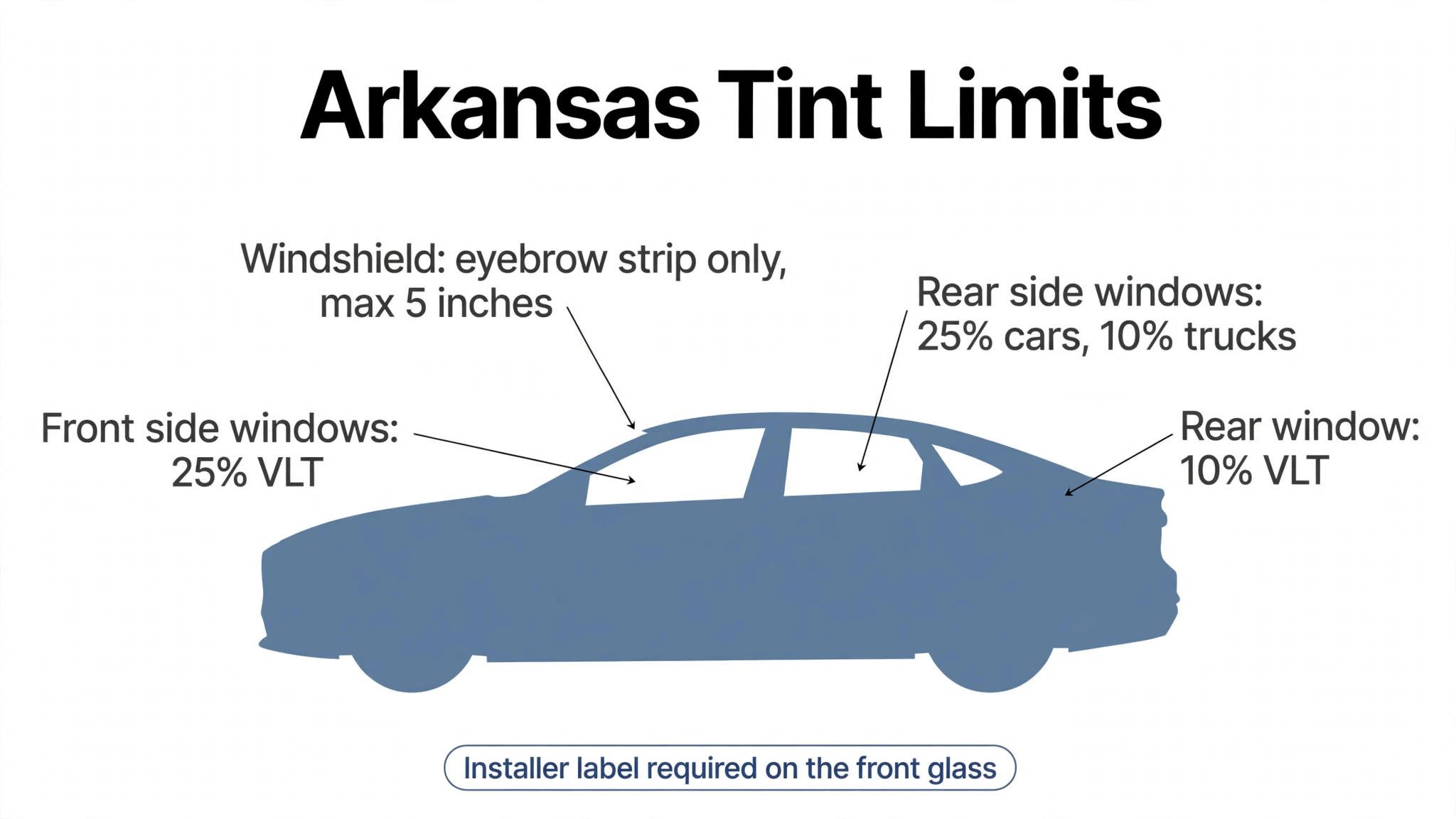
Arkansas tint laws are built around three numbers and one sticker. The statute, Ark. Code Ann. § 27-37-306, requires at least 25% net light transmission on the side windows beside and immediately behind the driver, at least 10% on the rearmost window, and nothing on the windshield beyond a five-inch “eyebrow” strip at the top. Every vehicle with after-market tint must also carry an installer label on the front glass — a rule most tint pages never mention.
- Quick Answer
- A Ban With Exceptions: How Section 27-37-306 Works
- Arkansas Tint Limits by Window
- The Eyebrow: Five Inches From the Top, Not the AS-1 Line
- Behind the Driver: 10% Floors, Not “Any Darkness”
- The Label on the Front Glass
- Medical Exemptions: Two Eras, Two Sets of Rules
- The Chauffeur Sedan Exception (and Where “15%” Really Lives)
- Penalties: A Class B Misdemeanor for Drivers and Installers
- How Arkansas Compares With Other States
- How to Stay Legal
- Frequently Asked Questions
- What is the legal tint in Arkansas?
- Is 20% tint legal in Arkansas?
- Is 15% tint legal in Arkansas?
- Can I tint my windshield in Arkansas?
- How do I get a medical tint exemption in Arkansas?
- What is the penalty for illegal tint in Arkansas?
- Did Arkansas change its tint law in 2025 or 2026?
- Does Arkansas tint law apply to out-of-state drivers?
- Conclusion
Two widely copied claims about Arkansas are simply wrong, and this guide corrects both: the rear window limit is 10%, not 15%, and there is no window on an ordinary Arkansas car that may be tinted to “any darkness” — even the rear glass of a truck has a 10% floor. The section was last amended in 2013, so the law in 2026 is the law as written then.
Quick Answer
Under Arkansas tint laws, the side windows and side wings beside the driver and immediately behind the driver must transmit at least 25% of light, measured as glass and film together. On a truck, bus, trailer, motor home, or multipurpose passenger vehicle, the side windows behind the driver may go to 10%. The rearmost window is 10% on every vehicle. The windshield takes only an “eyebrow” strip no more than five inches down from the top center. Driving or installing noncompliant tint is a Class B misdemeanor. A medical exemption exists, with set limits and a physician’s certification carried in the car.
A Ban With Exceptions: How Section 27-37-306 Works
Like Arizona’s tint statute, Arkansas writes its law as a ban with a short list of exceptions. Subsection (a) opens by making it unlawful to operate a vehicle on public highways with after-market tinting material applied to any window — and then subsection (b) takes it back, window by window, under the words “lawful only as follows.” If a window treatment is not on subsection (b)’s list, it is not lawful. Subsection (a) also bans letters or logos larger than one-quarter inch applied to the windows.
The numbers themselves date from Act 967 of 1993, which set the 25% and 10% figures for 1994 and later model vehicles. The legislature returned twice more: Act 1141 of 2011 carved out chauffeur-driven sedans (covered below), and Act 293 of 2013 rebuilt the medical exemption. Nothing since has touched the section — searches for an “Arkansas tint law 2025” or “2026 change” are chasing an amendment that does not exist. One drafting habit matters throughout: the statute speaks of net light transmission, the light that passes through glass and film combined, a distinction our guide to how window tint percentages work explains in full. A film rated 25% laid over factory glass that already blocks light finishes below 25% — and below the floor.
The section also reaches backward. Under subsection (h), the rules apply to 1993 and older vehicles that were never tinted under the old 1991 acts, and to older vehicles that were, at the moment ownership transfers. An old model year is not a blanket exemption.
Arkansas Tint Limits by Window
| Window | Passenger car | Truck, bus, motor home, or multipurpose vehicle |
|---|---|---|
| Windshield | “Eyebrow” strip only — no more than 5 inches down from the top center | Same |
| Front side windows and sidewings | 25% net light transmission minimum | 25% net light transmission minimum |
| Side windows immediately behind the driver | 25% net light transmission minimum | 10% net light transmission minimum |
| Rearmost window | 10% net light transmission minimum | 10% net light transmission minimum |
| Installer label | Required — front glass, immediately to the driver’s left | Required — front glass, immediately to the driver’s left |
| Medical exemption | Yes — physician’s certification; set limits since 2013 | Yes — physician’s certification; set limits since 2013 |
The Eyebrow: Five Inches From the Top, Not the AS-1 Line
Subsection (b)(1) allows one thing on an Arkansas windshield: “a strip of tinting material applied to the top edge, known in the industry as an ‘eyebrow’,” which “may not extend downward more than five inches (5″) from the top center of the windshield.” That is the whole rule — a tape-measure standard, taken from the top center of the glass.
Notice what the statute does not say. There is no reference to the AS-1 line — the federal marking most states borrow — yet shop pages routinely tell Arkansas drivers their strip is legal “above the AS-1 line.” On a windshield whose AS-1 line sits lower than five inches, that advice produces a strip the statute forbids; on one whose line sits higher, it forbids a strip the statute allows. Arkansas measures inches, not markings. Below the eyebrow, subsection (a)’s ban governs the rest of the windshield for ordinary drivers — the only full-windshield tinting the Code allows anywhere is the 50% medical treatment and the 50% law-enforcement windshields covered below.
Behind the Driver: 10% Floors, Not “Any Darkness”
The most expensive error in the Arkansas tint pages is the claim that SUVs, vans, and trucks may run any darkness behind the driver. They may not. Subsection (b)(2) sets the side windows immediately behind the driver at 25% for ordinary cars, and drops that figure only to 10% — not to zero — for a truck, bus, trailer, motor home, or multiple purpose passenger vehicle. Subsection (b)(3) then sets the rearmost window at 10% for every vehicle, sedan or SUV alike.
So Arkansas has no fully open window. Louisiana’s 12% rearmost floor and Arkansas’s 10% are close cousins: both states let the rear glass go dark, and both keep a meterable floor under it. The practical reading for a car is simple — 25% on every side window, 10% on the rear window — and for a truck or SUV, 25% up front, 10% everywhere behind the driver.
What if scenario: A Fayetteville driver reads a tint blog, blacks out the rear side windows and rear window of an SUV with 5% film, and is stopped a week later. Every one of those windows violates subsection (b): the rear sides sit below the 10% multipurpose-vehicle floor, and the rearmost window sits below the 10% floor that applies to all vehicles. The blog’s “any darkness” line described states like Texas — under Texas law the rear really is unrestricted — not Arkansas.
The Label on the Front Glass
Arkansas is one of the few states that makes the paperwork part of the window. Under subsection (c), any vehicle operated on Arkansas roads with after-market tinting material on any glass “shall have attached to the front glass immediately to the operator’s left a label containing the name and phone number of the company installing the tinting material and affirming that all tinting on the vehicle conforms to the requirements of this section.”
Three consequences follow. First, the label is not optional decoration: a car with legal tint and no label is not fully compliant with the section. Second, the label sits in a defined place — the front glass, immediately to the driver’s left — not in a glovebox or a door jamb. Third, the duty lands on the vehicle as operated, which is why a buyer of a tinted car inherits it: if the installing shop’s label is missing, the new owner is the one driving the noncompliant vehicle. Illinois, by contrast, requires no label at all, and Minnesota requires the film itself to carry a printed rating rather than the installer’s name. Arkansas wants to know who did the work — and the medical rules below repeat the same label duty for exemption installs under subsection (e)(3).
Common mistake: Peeling the “ugly sticker” off the windshield corner after a tint job. In Arkansas that sticker is a statutory label; removing it takes the car out of compliance even though the film itself meters legal.
Medical Exemptions: Two Eras, Two Sets of Rules
Arkansas has a real medical exemption, but which version you get depends on when the tint went on — the dividing line is August 16, 2013, when Act 293 of 2013 took effect.
Tint applied before August 16, 2013 sits under subsection (e)(1). A motorist diagnosed by a physician with a disease or disorder — the statute names albinism and lupus as examples, and the list is open — for which the physician determines exemption is in the motorist’s best interest, is exempt from the section altogether. The motorist must carry the physician’s certification in the vehicle, along with proof of the date the tint was applied and the installer’s name and phone number.
Tint applied after August 16, 2013 sits under subsection (e)(2), and the open-ended exemption became a schedule. With a physician’s certification attesting that tinting is in the motorist’s best interest, the vehicle may run:
– Side windows and sidewings beside and immediately behind the driver: at least 20% net light transmission; – Rearmost window: at least 10%; – Front windshield: at least 50% — the only route by which an ordinary Arkansas driver may tint the full windshield at all.
The supporting rules are uniform: the certification must be carried in the vehicle (e)(4), it is valid for three years from the date of issue (e)(5), the installation itself is exempt when performed for a certified motorist (e)(1)(B), and medical installs carry the installer label under (e)(3). One more duty appears at sale time: under (e)(6), anyone transferring a vehicle tinted under the medical waiver must either disclose that the tint is outside legal limits without a waiver or remove the waiver-based tint. The exemption belongs to the patient, not the car.
The Chauffeur Sedan Exception (and Where “15%” Really Lives)
Buried one section over is the source of Arkansas’s most copied error. Section 27-37-307, added by Act 1141 of 2011, sets separate tint rules for a “sedan” — a term of art meaning a vehicle licensed as an automobile for hire, seating at least three rear passengers, and chauffeur-driven. The section expressly excludes taxicabs and vans. A qualifying hire sedan may run 15% on its rear passenger doors, 10% on the rear windshield, an eyebrow strip reading at least 10%, and 25% on the front passenger doors — and subsection (j) of § 27-37-306 exempts it from the general rules while it complies.
That 15% is a limousine-service figure for rear doors, nothing more. Detached from its section, it wandered into tint charts as a supposed “rear window 15%” rule for everyone — a rule that has never existed in § 27-37-306, where the rearmost window has read 10% since 1993. And the exception is temporary by design: when a hire sedan is sold to someone outside the automobile-for-hire business and no longer expected to work as one, subsection (d) of § 27-37-307 requires the special tint to be removed and the car returned to § 27-37-306 compliance — unless the tint is in the glass itself rather than a film.
Penalties: A Class B Misdemeanor for Drivers and Installers
Subsection (g) puts both ends of the transaction on the hook: “any installer of motor vehicle glass tinting material who installs any glass tinting in violation of this section… or any person operating any motor vehicle with glass tinting… contrary to the provisions of this section shall be guilty of a Class B misdemeanor.”
In Arkansas, a Class B misdemeanor carries a fine of up to $1,000 (Ark. Code Ann. § 5-4-201(b)(2)) and up to 90 days in jail (§ 5-4-401(b)(2)). Those are ceilings, not typical first-offense outcomes — but the classification matters. An Arkansas tint violation is a criminal offense, not a fix-it ticket: there is no statutory repair-and-dismiss procedure in the section, and the same charge reaches the shop that installed the film as reaches the driver who bought it. Two classes of vehicle stand outside the section entirely: vehicles used exclusively or primarily for transporting the dead — hearses — are exempt under subsection (f), and law enforcement windshields may be tinted to 50% under subsection (i).
How Arkansas Compares With Other States
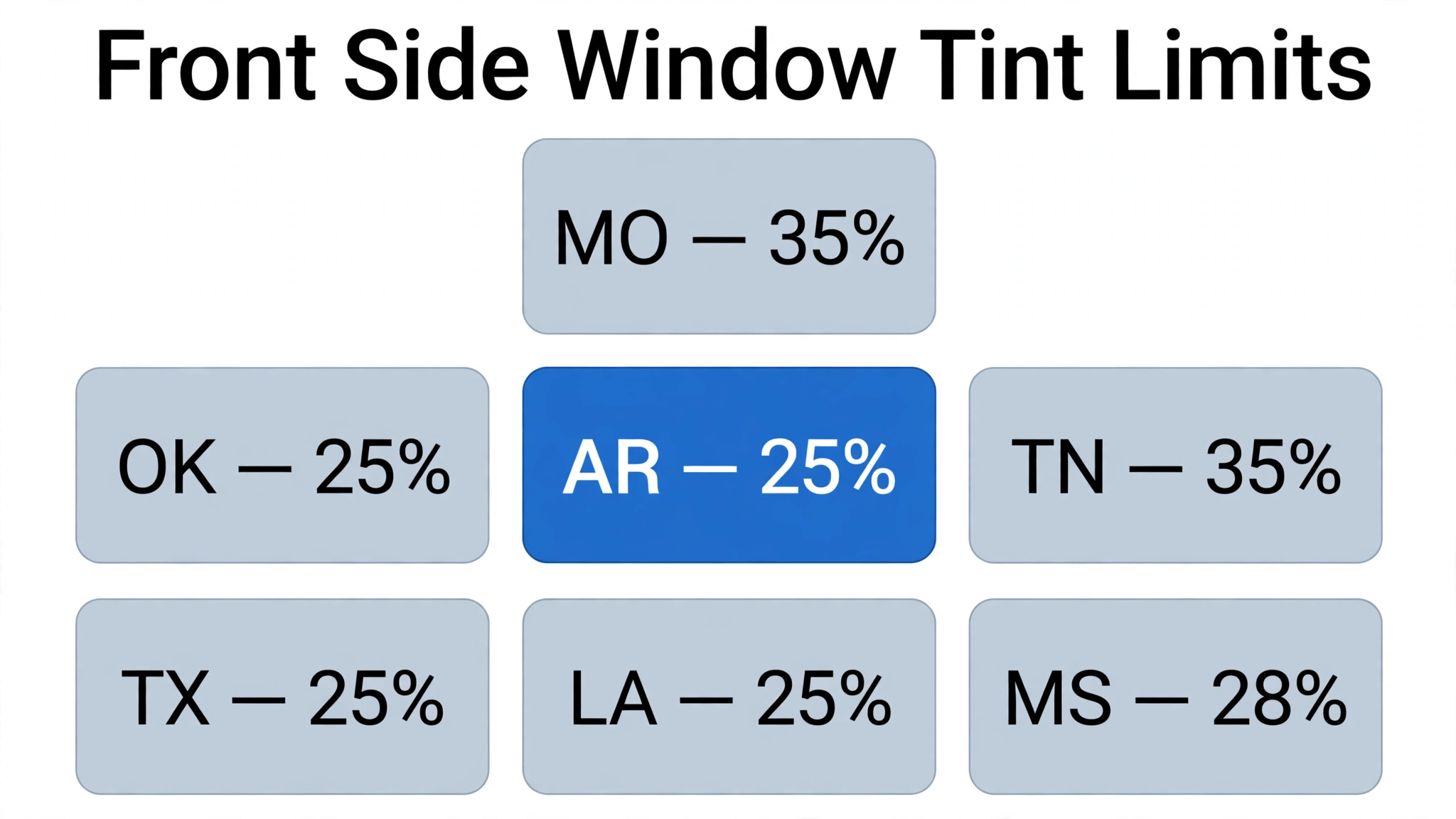
Arkansas’s 25% front figure puts it in the darkest-legal cluster in the South: Texas, Oklahoma, and Louisiana all read 25% on the front side windows. The rest of the ring is stricter — Missouri and Tennessee at 35%, Mississippi at 28%, and Georgia at 32%. What sets Arkansas apart is not the headline number but the machinery around it: a 10% floor under every rear window, a statutory installer label, a two-era medical exemption, and a chauffeur-sedan schedule hiding in the next section. Few states pack that much fine print into one page of code.
Read also: Florida window tint law, Hawaii tint laws
How to Stay Legal
1. Meter the finished window, not the film box. Every Arkansas figure is net — glass and film together. A 25% film over factory glass finishes darker than 25%. 2. Cars: 25% on every side window, 10% on the rear window. Trucks, SUVs, vans, and motor homes: 25% up front, 10% — not unlimited — behind the driver. 3. Eyebrow by the tape measure. Five inches down from the top center of the windshield, maximum. Do not let a shop substitute the AS-1 line. 4. Keep the installer label. Name and phone number of the installing company, affirming compliance, on the front glass immediately to your left. Do not peel it off. 5. Medical need goes through a physician’s certification — carried in the car, renewed every three years, and since 2013 limited to the 20% / 10% / 50% schedule. 6. Selling a medically tinted car? Disclose that the tint is illegal without a waiver, or remove it, before the sale. 7. Skip the mirror film folklore. The current section sets its limits in light transmission; if a shop quotes you a “25% reflectivity rule,” it is quoting a chart, not the Arkansas Code.
Frequently Asked Questions
What is the legal tint in Arkansas?
Under Ark. Code Ann. § 27-37-306, the side windows and sidewings beside and immediately behind the driver must transmit at least 25% of light, glass and film combined. On trucks, buses, trailers, motor homes, and multipurpose vehicles, the windows behind the driver may go to 10%. The rearmost window is 10% on every vehicle, and the windshield allows only a five-inch eyebrow strip. An installer label is required on the front glass.
Is 20% tint legal in Arkansas?
Not for an ordinary driver. The front and rear side windows of a car bottom out at 25%, and the rear window at 10% — 20% fails the side windows and passes only the rear. The one lawful home for 20% is the medical schedule: since August 16, 2013, a driver carrying a physician’s certification may run 20% on the side windows, 10% on the rear window, and 50% on the windshield.
Is 15% tint legal in Arkansas?
No — not on a personal vehicle. Fifteen percent appears in Arkansas law only in § 27-37-307, for the rear passenger doors of a chauffeur-driven sedan licensed as an automobile for hire. Tint charts that list “Arkansas rear window: 15%” have copied that figure out of its section; the rearmost window limit for everyone else is 10%.
Can I tint my windshield in Arkansas?
Only the eyebrow: a strip at the top edge extending no more than five inches down from the top center of the windshield. The statute never mentions the AS-1 line. Full-windshield tint exists in Arkansas law only at 50% for drivers with a medical certification and for law enforcement vehicles.
How do I get a medical tint exemption in Arkansas?
A physician must diagnose a disease or disorder — the statute names albinism and lupus as examples — and certify that exemption is in your best interest. For tint installed after August 16, 2013, the certification allows 20% on the side windows, 10% on the rearmost window, and 50% on the windshield. The certification must be carried in the vehicle and is valid for three years.
What is the penalty for illegal tint in Arkansas?
A violation is a Class B misdemeanor under subsection (g) — for the driver operating the vehicle and for the installer who applied the tint alike. A Class B misdemeanor in Arkansas carries a fine of up to $1,000 and up to 90 days in jail under §§ 5-4-201 and 5-4-401.
Did Arkansas change its tint law in 2025 or 2026?
No. Section 27-37-306 was last amended by Act 293 of 2013, which rebuilt the medical exemption. The 25% side-window, 10% rear-window, five-inch eyebrow, and label rules in force in 2026 are the rules as enacted in 1993 and adjusted in 2011 and 2013.
Does Arkansas tint law apply to out-of-state drivers?
Generally no. Subsection (d) provides that the section does not apply to motorists operating vehicles registered in other states that have enacted legislation regulating window shading, who are driving on Arkansas roads. Arkansas-registered vehicles get no such pass — the full section, label included, applies to them everywhere they drive in the state.
Conclusion
Arkansas tint law is a short statute with long fine print: 25% beside and behind the driver, 10% floors under every rear window including a truck’s, a five-inch eyebrow measured from the top center of the windshield, and an installer label riding on the front glass. Its medical exemption runs on a physician’s certification with a defined schedule and a three-year life, its penalty is a Class B misdemeanor for driver and installer alike, and its most famous number — 15% — belongs to chauffeur-driven hire sedans, not to your rear window. The controlling text is Ark. Code Ann. § 27-37-306, and WindowTintCentral’s Arkansas tint guide tracks the same figures window by window.
Disclaimer: This article is general information about Arkansas tint laws, not legal advice. Tint statutes and enforcement practice change, and how a rule applies depends on the vehicle and the facts. Confirm the current law in Ark. Code Ann. § 27-37-306, or speak with an Arkansas attorney or the Arkansas State Police, before tinting, buying, or contesting a citation.