



What is a deposition? It is a formal question and answer session where a witness gives sworn testimony outside of court, before a trial begins. A court reporter records every word, and the lawyers on each side can ask questions.
- What Is a Deposition? The Simple Definition
- Why Depositions Matter
- Where a Deposition Fits in Discovery
- Who Attends a Deposition
- Types of Depositions
- How a Deposition Works Step by Step
- What Questions Are Asked
- How Long Does a Deposition Last?
- Laws and Rules That Govern Depositions
- Can You Refuse to Give a Deposition?
- Who Pays for a Deposition?
- Deposition vs. Trial Testimony and Other Tools
- How Deposition Testimony Is Used Later
- Depositions in Criminal Cases
- A Hypothetical Example
- How People Prepare and Mistakes to Avoid
- When to Talk to a Lawyer
- Frequently Asked Questions
- What is a deposition in simple terms?
- Is a deposition the same as testifying in court?
- Do I need a lawyer for a deposition?
- How long does a deposition take?
- What should I wear to a deposition?
- What happens if I do not answer a question?
- Are depositions public record?
- Can a deposition be taken over video call?
- Conclusion
A deposition matters because the answers can shape the whole case. They can help settle a dispute, challenge a witness at trial, or preserve testimony when someone may not be around later.
What Is a Deposition? The Simple Definition
A deposition is out-of-court testimony given under oath. One lawyer asks questions, and the witness answers while a court reporter records everything. The person answering is called the deponent.
The Cornell Legal Information Institute describes it as a witness’s sworn out-of-court testimony. Here is the quick version:
- It happens before trial, during the discovery phase.
- The witness swears to tell the truth, just like in court.
- No judge is in the room.
- The words become a transcript that lawyers can use later.
The word has other meanings in everyday English, such as soil settling or a ruler being removed. This article covers the legal meaning only.

Why Depositions Matter
A deposition does several jobs at once.
It shows what a witness knows. A lawyer can ask follow-up questions and dig into details. A written answer cannot do that.
It locks in testimony. If a witness changes their story at trial, the lawyer can point back to the transcript. This is called impeachment.
It tests the witness. Lawyers see how a person speaks and handles pressure. That can change settlement talks.
It limits surprises. FindLaw explains that depositions help both sides evaluate a case before anyone takes the stand.
Depositions appear in many civil cases:
- Injury cases, such as a personal injury claim after a crash or a fall
- Employment disputes, like the discrimination appeal in this United Airlines lawsuit update
- Business conflicts, such as a franchise lawsuit that ended in dismissal
- Contract fights, divorce cases and medical malpractice claims
Not every lawsuit needs one. Cases about a pure legal question, with few disputed facts, often skip depositions.
Where a Deposition Fits in Discovery
Discovery is the fact-finding stage that starts after a lawsuit is filed. Each side gathers information from the other. Nolo’s guide to formal discovery says parties can generally ask for anything connected to the case, unless the law protects it.
| Discovery tool | What it is | Who answers |
|---|---|---|
| Deposition | Live, sworn questions with a court reporter | A party or a witness |
| Interrogatories | Written questions sent to the other side | A party, usually with lawyer help |
| Requests for documents | A demand for records, emails or files | A party |
| Subpoena | A court order for testimony or records | A person who is not a party |
Lawyers use these tools together. A document request may turn up an email. The deposition then lets the lawyer ask who wrote it and why.
Who Attends a Deposition
Depositions usually happen in a law office conference room, not a courthouse. The setting is calm, but the oath is real.
- The deponent answers the questions.
- The questioning attorney asks them.
- The deponent’s attorney can object and protect the witness’s rights.
- A court reporter swears in the witness and records the testimony.
- The parties may attend, since all parties to the case have that right.
- A videographer attends if the session is filmed.
A deponent’s lawyer plays a smaller role than at trial. That lawyer mainly objects or asks follow-up questions, and cannot answer for the witness.
Who gets deposed? It can be the person who sued, the person who was sued, an eyewitness, a doctor or a paid expert. In a wrongful death case, it may be family members, medical staff and accident witnesses.
Types of Depositions
Oral deposition. This is the most common type. The witness answers spoken questions, and a court reporter records them.
Written deposition. Lawyers send questions in advance, and an officer reads them aloud. It costs less, but nobody can ask a follow-up.
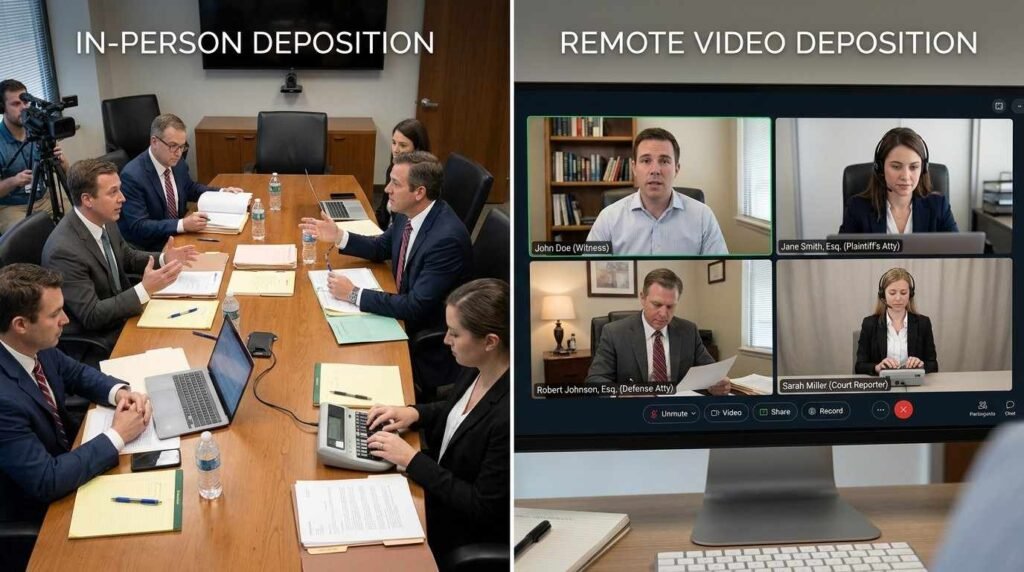
Video or remote deposition. Federal rules let the parties agree, or the court order, that a deposition happen by phone or other remote means. It is treated as taking place where the witness answers.
Discovery and evidence depositions. The first gathers facts. Some states separate it from an evidence deposition taken for use at trial, as Illinois Legal Aid describes.
Preservation deposition. A lawyer takes this when a witness is very ill, elderly or about to leave the country. The goal is to save testimony for trial.
Corporate deposition. A party can name a company or agency as the deponent. The organization picks people to speak for it, which is called a Rule 30(b)(6) deposition. Disputes between companies, like the Trulife distribution lawsuit in federal court, often involve company witnesses.
How a Deposition Works Step by Step
Every case differs. This is the general path in a civil lawsuit.
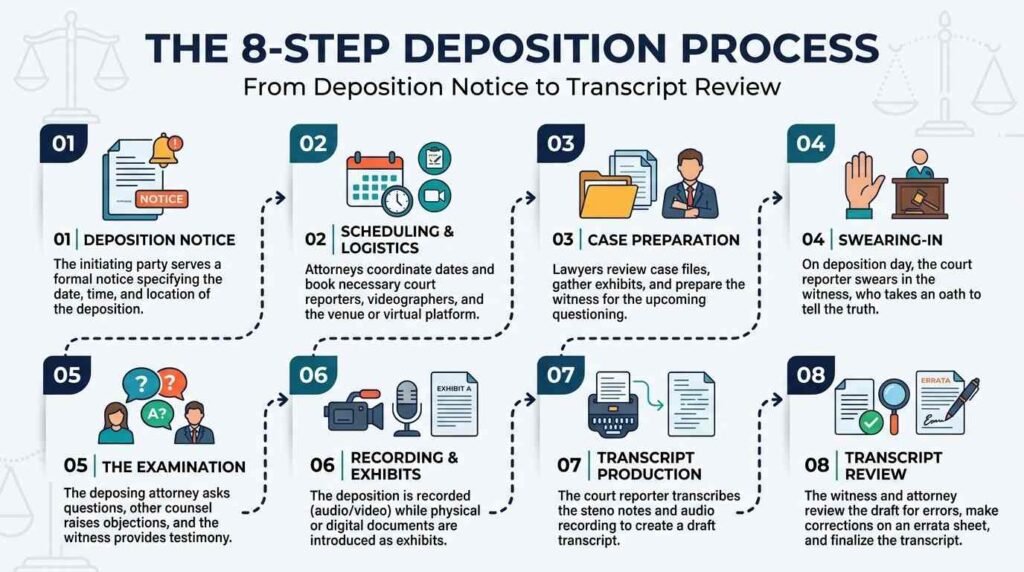
- Notice. The side that wants the deposition sends written notice to the other parties. Under the federal rule, it states the time, the place and how the testimony will be recorded.
- Subpoena, if needed. A person who is not a party usually needs to be served with a subpoena.
- Preparation. Lawyers review documents and plan questions. The witness often meets with their own lawyer.
- Oath. The court reporter, or another officer, swears in the witness. False statements under oath can lead to perjury charges.
- Questioning. Lawyers ask questions, and others may object. Exhibits are marked, and breaks happen often.
- Closing. The officer states on the record that the deposition is complete.
- Transcript. The reporter prepares a written record. Rev says this can take from about a day to two weeks.
- Review. The witness may get a chance to read it and list corrections.
What Questions Are Asked
Most depositions start with easy questions. The lawyer wants to confirm who you are and that you understand the process. Common openers include your name, your address, your job, and whether you have given a deposition before.
Then the lawyer moves to the facts. In an injury case, that could mean what you saw and which doctors you visited. In a business case, it may be emails and contracts.
Deposition questions can be broader than courtroom questions. FindLaw notes that a question a judge might reject at trial may still be asked here, as long as it relates to the lawsuit.
What happens when a lawyer objects?
The questioning usually keeps going. Under Federal Rule 30, the objection is noted on the record and the testimony is taken subject to it. A judge decides later if the objection was valid.
There is one big exception. A person may tell the witness not to answer only to protect a privilege, to enforce a court limit, or to ask the court to stop the deposition. Attorney-client communications are a common example of privileged material.
How Long Does a Deposition Last?
In federal court, a deposition is limited to one day of seven hours, unless the parties agree otherwise or the court orders more time. The court must allow extra time when it is needed for a fair examination.
Real depositions are often shorter. FindLaw says the average runs two to four hours, and some last only 10 to 30 minutes. Complex cases, many exhibits, long answers and translators can all add time.
State rules differ. Utah’s court guidance, for example, sets separate time caps for party and nonparty witnesses.
Laws and Rules That Govern Depositions
Which rules apply depends on where the case is filed.
Federal rules. Federal civil cases use the Federal Rules of Civil Procedure. Three rules matter most:
- Rule 30 covers oral depositions, including notice, recording, objections, the seven hour limit and witness review. It also caps each side at ten depositions without the court’s permission or the other side’s agreement.
- Rule 45 covers subpoenas. A subpoena can require a nonparty to attend a deposition within 100 miles of where they live, work or regularly do business.
- Rule 32 covers how depositions can be used in court.
State rules. Every state has its own civil procedure rules. They can change notice periods, time limits and travel distances. The Washington Law Help guide is a good plain-language state-level overview.
California offers a clear example. Its court self-help guide says a deposition location must be within 75 miles of the witness’s home, or 150 miles if it is in the county where the case is filed.
Privacy. Depositions are not public by default. They are part of discovery and are not automatically filed with the court.
They can become public if a lawyer files them, though a judge may seal parts. To see what is actually public, start with the court’s records search. Our guide on why a court search may not show your case explains common gaps.
Can You Refuse to Give a Deposition?
Usually, no. A party to the lawsuit must take part once properly notified. A nonparty served with a valid subpoena must also comply.
- A nonparty who ignores a subpoena without good reason can be held in contempt of court.
- A party who skips a properly noticed deposition can face sanctions, which can be serious.
There are lawful ways to push back. A person can object to a subpoena, ask the court to quash or change it, or request a protective order if the deposition would be harassing or unduly burdensome. Rule 45 requires a court to quash a subpoena in some situations, such as when it demands privileged material.
The Fifth Amendment is another issue. A witness may raise it to avoid self-incrimination, but the effects in a civil case can differ from a criminal one. A lawyer should explain this before the day arrives.
Who Pays for a Deposition?
In general, the side that asks for the deposition pays the main costs. Washington Law Help says a witness who cannot afford travel should tell the scheduling lawyer.
Under the federal rule, the party that notices the deposition pays to record it. Any other party can order a transcript. Costs can include the court reporter, the room, a videographer, and witness fees and mileage.
Fees vary. California’s guidance lists $35 a day plus 20 cents a mile each way as an example. Expert witnesses can charge much more.
Deposition vs. Trial Testimony and Other Tools
People mix these up. The table shows the difference.
| Feature | Deposition | Trial testimony | Interrogatories | Affidavit |
|---|---|---|---|---|
| Where | Law office or remote | Courtroom | On paper | On paper |
| Judge present | No | Yes | No | No |
| Live questions | Yes | Yes | No | No |
| Follow-up questions | Yes | Yes | No | No |
| Main purpose | Gather facts and save testimony | Prove the case | Gather basic facts | Give one-sided written proof |
The big difference is the live back and forth. A written answer can be polished by a lawyer. A live answer shows what the witness really knows.
How Deposition Testimony Is Used Later
A transcript can matter long after the room is empty.
To impeach a witness. Under Federal Rule 32, any party may use a deposition to contradict the witness. If you said one thing at the deposition and another at trial, expect your earlier answer to be read aloud.
To support a motion. Lawyers often attach excerpts when they ask a judge to rule before trial.
To replace live testimony. If a witness is unavailable, such as being dead or outside the United States, the rule can allow the deposition to be used at trial. A judge decides if the conditions are met.
To guide settlement. This is the most common use. After a few strong depositions, both sides understand their risks, and most civil cases settle before trial.
For one example, see how a consumer overcharging lawsuit ended in a settlement. Group cases follow different steps, which our guide to class action settlements explains.
Can you fix mistakes in your transcript?
Often, but only in a limited way. If the witness or a party asks before the deposition ends, the deponent gets 30 days after notice that the transcript is ready. The witness can sign a statement listing changes and the reasons.
Big changes can raise questions later. Many lawyers use the review to fix typos and clear errors, not to rewrite answers.
Depositions in Criminal Cases
Civil and criminal cases handle depositions very differently. In federal criminal cases, the main purpose is not discovery. A party must ask the court for permission to depose a witness to preserve testimony for trial, and the court may grant it only for exceptional circumstances and in the interest of justice.
That is a high bar. A typical example is a witness overseas who may not be able to come to trial. Federal Rule of Criminal Procedure 15 sets out the details.
State practice varies, and some states allow more discovery depositions than federal court does.
Anyone facing criminal charges should speak with a defense lawyer before saying anything.
A Hypothetical Example
This example is made up to show how a deposition works in practice.
Maria slips on a wet floor in a grocery store and breaks her wrist. She sues the store, and its lawyer deposes her. The lawyer asks about her shoes, the aisle, any warning signs and her doctor visits.
Her own lawyer sits beside her and objects when a question is unclear. Maria says she was in the store “about an hour.” Later, store video shows 20 minutes.
Her lawyer will want to know why the numbers differ. That is why guessing at a deposition is risky.

How People Prepare and Mistakes to Avoid
Preparation is where most of the real work happens. These are common steps, usually taken with a lawyer’s help.
- Review key documents, such as emails, contracts, photos or medical records. In injury cases, lawyers often build a timeline first, as in our guide to organizing medical records into a reliable chronology.
- Practice likely questions. A practice session can calm nerves.
- Plan the logistics, including time, place and any video link.
- Dress neatly. Rev says business casual or formal clothing is expected.
O’Connell and Aronowitz, a New York law firm, shares general rules for witnesses on its blog. Take your time and do not guess. Ask for a question to be repeated, avoid sarcasm, and stop talking if your lawyer objects.
Common mistakes include these:
- Guessing. A guess can later look like a fact. An honest “I don’t remember” is safer when true.
- Volunteering extra information. Answer the question that was asked.
- Arguing with the lawyer. It rarely helps and it reads badly on the page.
- Posting about the case online. Messages and posts can become evidence.
- Exaggerating. Small stretches can damage credibility, even when the main facts are true.
When to Talk to a Lawyer
If you receive a notice of deposition or a subpoena, speak with a litigation attorney. FindLaw makes the same point. A lawyer can explain your rights, spot objections and help you prepare.
Not sure which professional you need? Our explainer on attorney vs lawyer clears up the terms.
Local bar associations and legal aid groups can point you to low-cost help. Do not ignore any court paper, because deadlines can be short.
Frequently Asked Questions
What is a deposition in simple terms?
A deposition is a sworn interview that takes place before a trial. Lawyers ask questions, the witness answers under oath, and a court reporter records it. The record can be used later in the case.
Is a deposition the same as testifying in court?
No. Both are under oath, but a deposition happens out of court with no judge present. Lawyers can still use the transcript at trial.
Do I need a lawyer for a deposition?
You are not always required to have one, but many people do. A lawyer can object to improper questions and help you prepare. Ask a licensed attorney about your own situation.
How long does a deposition take?
Federal rules set a default limit of one day of seven hours. Many finish in two to four hours, and some are much shorter. State rules and court orders can change the limit.
What should I wear to a deposition?
Business casual or more formal clothing is the usual choice. Remote sessions are often recorded, so many people dress as they would for a job interview.
What happens if I do not answer a question?
A lawyer may tell you not to answer only in narrow cases, such as protecting a privilege. Other questions usually must be answered, even over an objection. A refusal can lead to a court motion and possible penalties.
Are depositions public record?
Usually not at first. They are not automatically filed with the court. If one is filed or used in court papers, it can become public unless a judge seals it.
Can a deposition be taken over video call?
Yes. The federal rule lets the parties agree, or the court order, that a deposition happen by phone or other remote means. Local rules and court orders set the details.
Conclusion
So, what is a deposition? It is sworn, out-of-court testimony that helps both sides learn the facts before trial. A court reporter records it, the lawyers ask the questions, and the transcript can matter for settlement, motions and trial.
Remember the key points. The oath is real, the answers can be used later, and the rules change by court. Careful preparation and honest, simple answers help more than clever ones.
If a deposition is coming up in your case, speak with a licensed attorney in your area. A lawyer who knows your court’s rules can explain what to expect and what to do next.