



The Buc-ee’s Teddy’s Market lawsuit is a federal trademark case in Atlanta. Buc-ee’s, the Texas travel center chain, says a small Georgia store chain copied its beaver mascot. Teddy’s Market says it did not, and it wants a judge to cancel some of Buc-ee’s trademarks.
- Buc-ee’s Teddy’s Market Lawsuit: The Quick Answer
- Who Are Buc-ee’s and Teddy’s Market?
- Timeline of the Case
- What Buc-ee’s Claims
- How Teddy’s Market Is Fighting Back
- How Courts Decide Trademark Confusion
- The Real Fight Is About Scope
- Why the Fraud and Antitrust Claims Are Hard to Win
- Buc-ee’s Other Trademark Lawsuits
- John Oliver and the Public Backlash
- What Could Happen Next
- Lessons for Small Business Owners
- How to Follow the Case
- FAQ
- 1. What is the Buc-ee’s Teddy’s Market lawsuit about?
- 2. Where was the lawsuit filed?
- 3. Has a judge ruled yet?
- 4. What does Buc-ee’s want?
- 5. What is Teddy’s Market’s defense?
- 6. What is the antitrust counterclaim?
- 7. How is this different from the Mickey’s case?
- 8. How long could the case take?
- Conclusion
As of October 4, 2026, nobody has won. The case is still pending, and no judge has ruled on who is right.
That is why people keep searching for it. A cartoon bear and a cartoon beaver sound like a small fight, but the result could change how small businesses think about mascots.
Buc-ee’s Teddy’s Market Lawsuit: The Quick Answer
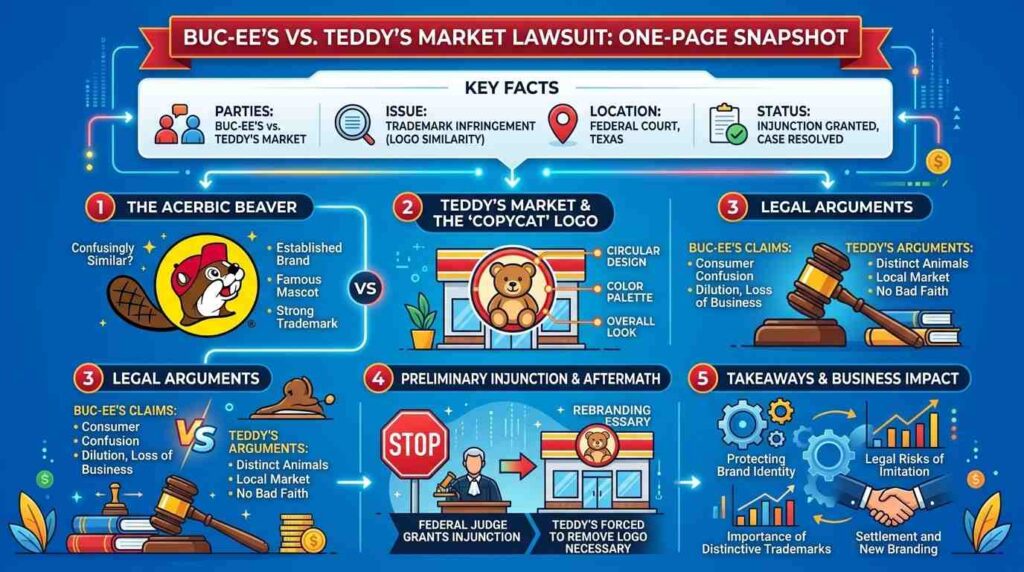
Buc-ee’s sued Teddy’s Market on May 1, 2026. It says Teddy’s bear mascot and name are too close to its beaver brand. Teddy’s denies that and has filed counterclaims of its own.
Here is the case at a glance:
- Plaintiff: Buc-ee’s Ltd., the Texas travel center chain
- Defendants: Teddy’s Market, owners Karan Ahuja and Mickey Kapoor, and six related LLCs
- Court: U.S. District Court, Northern District of Georgia, in Atlanta
- Buc-ee’s claims: trademark infringement, unfair competition, and dilution
- Teddy’s counterclaims: no infringement, cancel Buc-ee’s registrations for fraud, and antitrust
- Status: pending, with no ruling on the merits reported
Who Are Buc-ee’s and Teddy’s Market?
Buc-ee’s started in 1982. Recent reports put it at 57 locations across 13 states. Its smiling beaver in a red cap shows up on signs, shirts, and snack bags.
Teddy’s Market is far smaller. It opened in Canton, Georgia in November 2024 and added a Ball Ground store in January 2025. A third store is planned for Decatur.
Owner Karan Ahuja says he created the bear logo in 2024 to bring some fun to the gas station. Both Teddy’s stores sit near the Buc-ee’s in Calhoun, which is part of why the case drew attention.
Timeline of the Case
Here is how the Buc-ee’s Teddy’s Market lawsuit has moved so far:
- May 2024: Teddy’s files four trademark applications with the USPTO.
- November 2024: The first Teddy’s store opens in Canton.
- January 2025: The Ball Ground store opens.
- May 1, 2026: Buc-ee’s files suit in federal court and asks for a jury.
- June 2026: Teddy’s asks the court to dismiss the case and calls the complaint a “shotgun pleading.”
- Late July 2026: Teddy’s denies the claims and files counterclaims.
- Summer 2026: John Oliver features the dispute on Last Week Tonight.
- September 8, 2026: Buc-ee’s asks the judge to toss six of the counterclaims.
- September 18, 2026: Teddy’s amends its counterclaims to add antitrust claims.
A shotgun pleading is a messy complaint that does not tie specific facts to specific claims. Federal judges in Georgia see that argument often.
What Buc-ee’s Claims
Buc-ee’s says Teddy’s built its whole brand around a familiar cartoon animal. The complaint describes a smiling creature in a hat, with white eye highlights, a black nose, a hint of pink tongue, and lighter fur around the mouth. All of that sits inside a red-accented shape.
The complaint also compares the names. “Buc-ee’s” and “Teddy’s” are both two-syllable, six-letter possessives that end in an “eez” sound. Buc-ee’s points to the life-size animal statue at Teddy’s entrance too, according to CBS News Atlanta.
It asks the court to:
- Stop Teddy’s from using its current branding
- Order the destruction of infringing materials
- Hand over profits made under the disputed brand
- Award up to triple damages where federal law allows
- Direct the USPTO to reject Teddy’s pending applications
Federal law does allow remedies like these. Cornell Law School’s legal encyclopedia explains that the Lanham Act covers injunctions, profits, damages, and attorney’s fees in exceptional cases. For another example of how Lanham Act and unfair competition claims play out, see our guide to the Trulife Distribution lawsuit.
How Teddy’s Market Is Fighting Back
Teddy’s calls Buc-ee’s a “trademark bully.” Its main argument is simple: no shopper would mix these two businesses up. FOX 5 Atlanta reports that the filing lists these differences:
- Teddy’s is a small neighborhood store with BP-branded pumps, and it has only four or five of them.
- It has no billboards, no mobile app, and no loyalty program.
- It does not sell branded merchandise or hold mascot appearances.
- Its signs hang above the store entrances, and highway drivers can’t see them from the interstate.
- It says no customer has actually been confused.
Teddy’s also goes after Buc-ee’s trademarks. It claims the beaver logo was derived from “Bucky Beaver,” an old Ipana toothpaste cartoon. WSB-TV reported that Teddy’s says this made Buc-ee’s statements to the USPTO false, so the registrations should be canceled.
Other things Teddy’s wants:
- A ruling that its name and logo do not infringe
- An order for Buc-ee’s to drop its opposition to Teddy’s pending trademark applications
- An injunction against threats or new infringement claims
- Attorney’s fees and costs
Buc-ee’s pushes back. It says its enforcement is not a bullying campaign, and it asked the judge to dismiss six counterclaims.
Then came the biggest twist. In September, Teddy’s added antitrust claims. Law360 reported that Teddy’s says Buc-ee’s uses trademark suits to gain control over cartoon animal branding in the convenience store industry. None of this has been proven.
How Courts Decide Trademark Confusion
Every trademark infringement case comes down to likelihood of confusion. The USPTO explains that a plaintiff must show a valid mark, that its rights came first, and that the other mark is likely to confuse consumers about who is behind the goods or services.
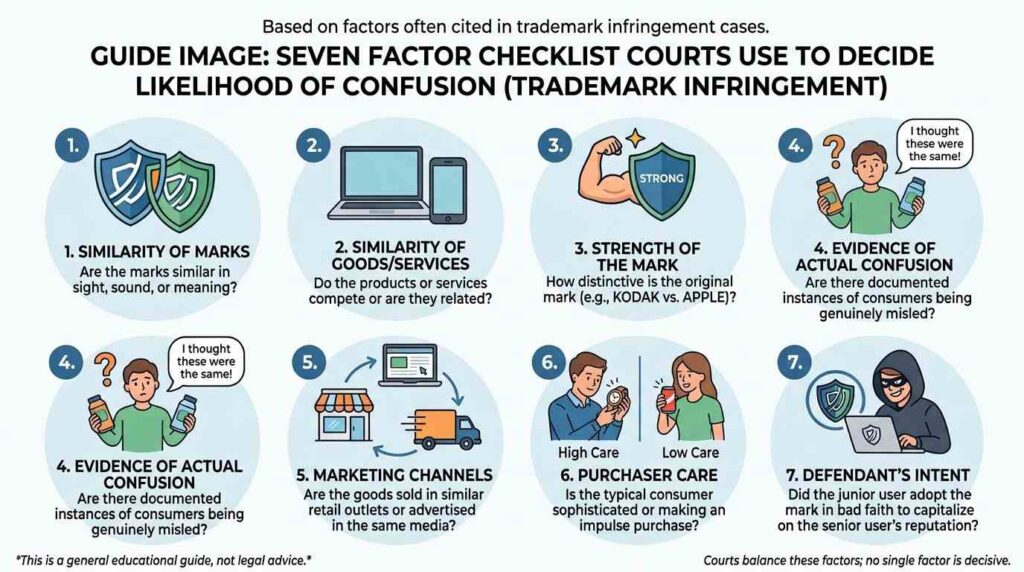
Georgia is in the Eleventh Circuit. Courts there generally weigh seven factors, as in Tana v. Dantanna’s, a dispute between two Atlanta restaurants. No single factor wins the case, and judges look at all of them together.
Here is how each factor could play out between these two companies:
- Strength of the mark: Buc-ee’s says its beaver is famous. Teddy’s says cartoon animals are everywhere in convenience retail.
- Similarity of the marks: Buc-ee’s points to the smile, hat, nose, colors, and name sound. Teddy’s points out that a bear is not a beaver.
- Similar products: Both sell fuel, snacks, and drinks. Teddy’s says a small BP store is a different thing from a giant travel center.
- Customers and stores: Both serve drivers near the same highways. Teddy’s says its customers are locals.
- Advertising: Buc-ee’s relies on billboards and merchandise. Teddy’s has neither.
- Intent: Buc-ee’s says the look was chosen to echo its brand. Teddy’s says it made its own bear.
- Actual confusion: Buc-ee’s can point to online speculation in other cases. Teddy’s says no one has been confused here.
Dilution works differently. The USPTO notes that a famous mark can be protected from blurring even without confusion. Buc-ee’s would have to prove its mark is truly famous and that Teddy’s logo weakens it.
The Real Fight Is About Scope
Most coverage asks whether the two mascots look alike. The deeper question is how much of the idea of a friendly cartoon animal Buc-ee’s can own.
Look at the traits in the complaint. A smile, a hat, a dark nose, and a red accent describe a lot of mascots. Trademark law protects a specific brand, not a general idea, so the judge has to decide whether Buc-ee’s rights stop at the beaver or reach further.
Teddy’s argument is built on exactly that point. It says Buc-ee’s is trying to claim rights over common cartoon animal mascots, and the counterclaims hit that theme again and again. The answer will matter well beyond Georgia.
What if a small bakery used a smiling fox in a red hat? A court would ask the same questions. The answer would depend on where the bakery sells, who its customers are, and how it markets itself.
Why the Fraud and Antitrust Claims Are Hard to Win
Teddy’s counterclaims are bold, but they face a steep climb.
Fraud on the USPTO takes more than a mistake. Courts want proof that an applicant knowingly made a false statement to trick the trademark office. Saying a logo was inspired by an old cartoon does not automatically clear that bar.
Sham litigation is the base of the antitrust theory. Under a well-known Supreme Court test, a lawsuit counts as a sham only if it is objectively baseless and filed to hurt a competitor. A suit is not baseless just because it loses.
Remember that these are allegations. We follow one rule on every case page, which is to separate confirmed facts from rumor, as in our Blind Frog Ranch lawsuit update. Until a judge rules, everything here is a position and not a finding.
Buc-ee’s Other Trademark Lawsuits
Teddy’s is far from the first target. This pattern is why the story spread so fast.
- Duckees, Kimberling City, Missouri: Sued in November 2024. Later filings pointed to a settlement.
- Barc-ee’s, Marshfield, Missouri: Sued in March 2025, then announced it was closing.
- Super Fuels, Dallas: Sued in 2025 over a dog mascot.
- Born United, South Carolina: Agreed to a consent judgment of $850,000 and to destroy “Tac-Bucc” merchandise.
- Mickey’s, northern Ohio: Sued in February 2026 over a moose mascot. Mickey’s countersued in April, and the two settled confidentially in mid-September.
- Beaver’s Mini Mart, Beavercreek, Ohio: Sued in late July 2026 over a beaver logo. Court records show the case is still pending.
Brand identity fights reach well beyond logos. In the Antthony Mark Hankins lawsuit against QVC and HSN, the plaintiff says the companies kept using his name and image without permission after a 31 year partnership.
John Oliver and the Public Backlash
The Buc-ee’s Teddy’s Market lawsuit turned into a national story after John Oliver covered it on Last Week Tonight. He joked that Teddy’s bear is looking you right in the eyes instead of looking like a beaver. He also launched a parody mascot to raise money for charity.
Ohio added fuel. Law firm commentary on Mondaq says Governor Mike DeWine called the Beaver’s Mini Mart suit “absurd,” and that the Beavercreek City Council passed a resolution on August 10 making the beaver an official part of the city’s history.
Reports say Buc-ee’s owner told Huber Heights’ mayor he had no problem with the Beavercreek store itself. His worry, according to the mayor, was copycat “Beavermarts” spreading across states. The public wasn’t convinced.
Winning in court and winning public opinion are different things. That gap is the brand risk lawyers now discuss.
What Could Happen Next
Nobody can predict the outcome. These are the realistic paths:
- Rulings on the motions. The judge decides whether Teddy’s counterclaims, including the antitrust claims, can move forward.
- Settlement. Many business cases end this way, and the Mickey’s deal shows Buc-ee’s will settle at least some disputes.
- Summary judgment. After both sides exchange evidence, either one can ask the judge to decide key issues without a trial.
- Jury trial. Buc-ee’s asked for one, so a jury could decide the confusion question.
Many business lawsuits take one to two years. Settlement offers can also start low. In the Warren Sapp lawsuit, an insurance fund reportedly offered $3,500 against a $20 million claim, and his lawyers called it insulting. Opening numbers are rarely final.
Lessons for Small Business Owners
This case offers practical points for any brand owner. This is general information, not legal advice.
- Search before you design. Check the USPTO database before you lock in a logo.
- Mascots draw attention. Cartoon animals are popular, so overlap is common.
- Document your choices. Keep sketches, dates, and notes showing how your logo was created.
- Respond early. A cease and desist letter is a signal to talk to a trademark attorney.
- Records win cases. In the Kim Muratori Mercedes-Benz lawsuit, the dealer could not produce a completed inspection checklist, and the arbitrator noticed.
What if a gas station owner gets a letter saying their mascot is too close to a famous brand? Ignoring it rarely helps. A licensed attorney can review the facts and explain the options.
How to Follow the Case
Federal case documents are public. You can search the Northern District of Georgia docket on PACER, the federal courts’ online records system, using the party names.
Some state courts offer free search tools. Our WebCrims guide shows how one of them works. WebCrims covers New York criminal cases, though, so this federal civil case needs PACER.
For news, local outlets such as CBS News Atlanta, FOX 5 Atlanta, and WSB-TV have covered each filing. Always compare news stories with the actual court documents.
FAQ
1. What is the Buc-ee’s Teddy’s Market lawsuit about?
Buc-ee’s says Teddy’s mascot, name, and branding are too similar to its beaver brand and could confuse customers. Teddy’s denies this and says Buc-ee’s is overreaching.
2. Where was the lawsuit filed?
It was filed in the U.S. District Court for the Northern District of Georgia in Atlanta.
3. Has a judge ruled yet?
No ruling on the merits has been reported as of October 4, 2026. The sides are still arguing over the claims and counterclaims.
4. What does Buc-ee’s want?
It asks for an end to Teddy’s current branding, destruction of infringing materials, profits, and enhanced damages. It also wants the USPTO to reject Teddy’s pending applications.
5. What is Teddy’s Market’s defense?
Teddy’s says it is a small neighborhood store with no billboards, app, or merchandise. It also says no customer has been confused.
6. What is the antitrust counterclaim?
Teddy’s claims Buc-ee’s uses baseless trademark suits to control cartoon animal branding in the convenience store market. It is only an allegation so far.
7. How is this different from the Mickey’s case?
Mickey’s is an Ohio chain with a moose mascot, and it settled confidentially in mid-September 2026. The terms are not public. Teddy’s is still fighting.
8. How long could the case take?
Many business lawsuits take one to two years. A settlement could end it sooner.
Conclusion
The Buc-ee’s Teddy’s Market lawsuit started as a dispute over a smiling animal. It has grown into a test of how far a famous brand can push trademark law. Teddy’s says it owes nothing, and Buc-ee’s says it is simply protecting what it built.
For now, the facts are simple. The case is pending, the claims are unproven, and the next rulings will shape what comes next. Bookmark this page, because we update it as new filings appear.