


The Alabama tint law is one of the simplest in the country to state and one of the most often misstated. Under Alabama Code Title 32, Chapter 5C — enacted in 1996 as Act 96-534 — every side window and the rear windshield of an Alabama-registered vehicle must let at least 32% of light through and reflect no more than 20%, measured with a tolerance of at least 3% written into the statute itself. There is one number, and it applies to cars, SUVs, trucks, and vans alike.
- Quick Answer
- One Number for Every Window: How Chapter 5C Works
- Alabama Tint Limits by Window
- The Windshield: No Film, One Six-Inch Exception
- The SUV Myth: No Darker Rear Glass for Trucks and Vans
- The Meter Rule: No Meter, No Stop, No Charge
- The Compliance Label and the Installer Rules
- Medical Exemptions Through ALEA
- Penalties: A Misdemeanor Ladder
- How Alabama Compares With Other States
- How to Stay Legal
- Frequently Asked Questions
- What is the legal tint in Alabama?
- Is 35% tint legal in Alabama?
- Can SUVs and trucks go darker on the rear windows in Alabama?
- Can I tint my windshield in Alabama?
- How do I get a medical tint exemption in Alabama?
- Can I be charged with a tint violation without a meter reading?
- How much is a tint ticket in Alabama?
- Does Alabama tint law apply to out-of-state cars?
- Conclusion
That last point is where the internet goes wrong. Widely copied charts claim Alabama lets SUVs and trucks run any darkness behind the driver. The statute says no such thing, and this guide works from its actual words — §§ 32-5C-1 through 32-5C-7 — including the two protections most guides bury: an officer must have a light meter before stopping you, and must take a reading before charging you.
Quick Answer
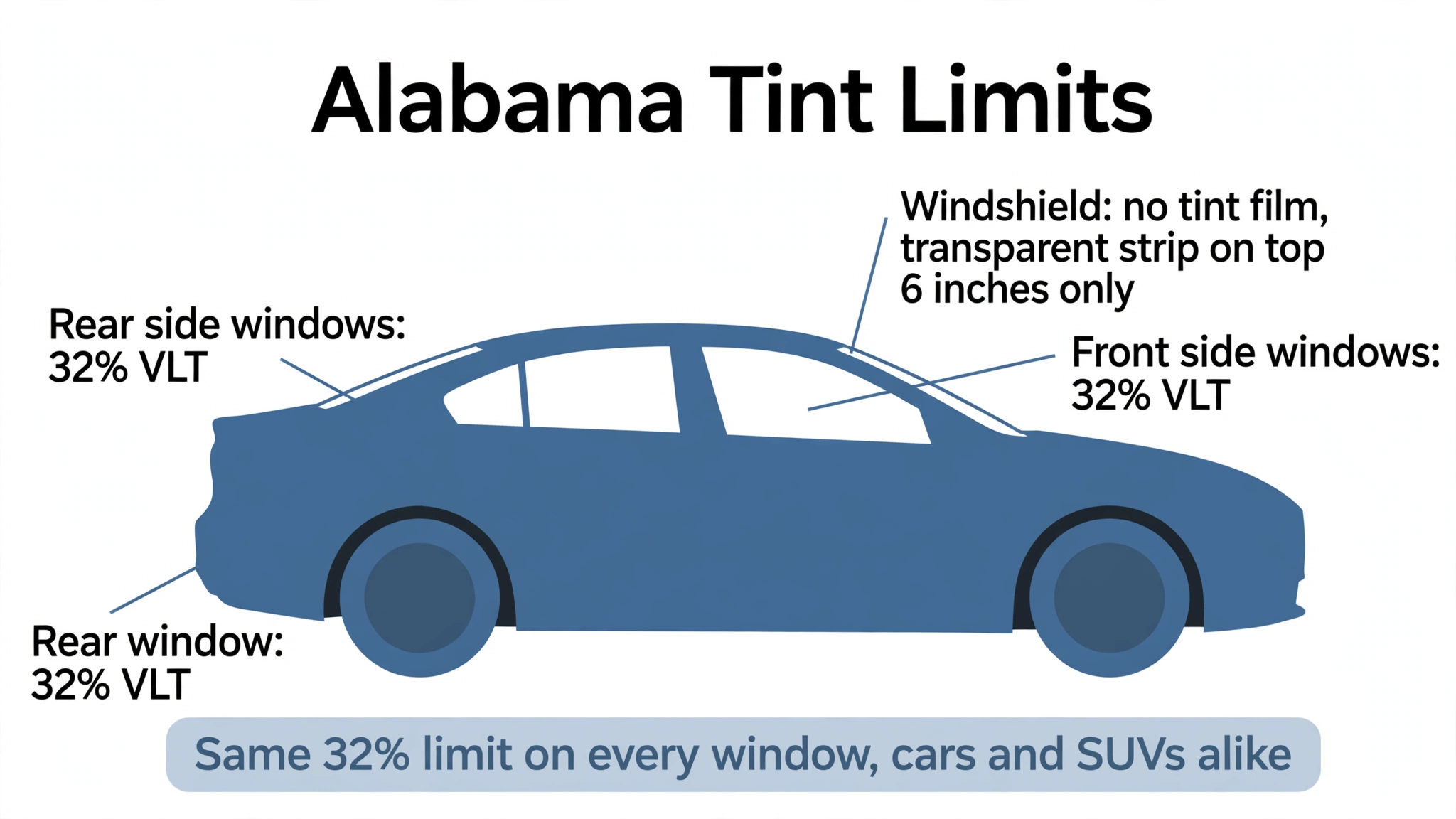
Under the Alabama tint law, the front side windows, rear side windows, and rear windshield must each transmit at least 32% of light and reflect no more than 20%, with a measurement tolerance of at least 3% — the same figures for every vehicle registered in Alabama. The front windshield may carry no light-reducing material at all, except a transparent item, not red or amber, on the uppermost six inches. A violation is a misdemeanor: up to $100 for a first conviction, rising to $500 for a third within a year. A medical exemption is available through the Alabama Law Enforcement Agency (ALEA), which issues a numbered windshield decal.
One Number for Every Window: How Chapter 5C Works
Section 32-5C-2(a) states the whole system in two clauses. A person shall not operate a motor vehicle registered in this state:
1. “With material or glazing applied or affixed to the front windshield which reduces light transmission through the front windshield”; or 2. “With material or glazing applied or affixed to the rear windshield or the side or door windows which reduce light transmission through the rear windshield or side windows to less than 32 percent or increase light reflectance to more than 20 percent, with a measurement tolerance of at least 3 percent.”
Three features of that drafting drive everything else in this guide. First, the 32% figure is a combined reading — the statute measures light transmission through the window, so factory glass and aftermarket film count together, exactly as our guide to how window tint percentages work explains. Second, the 3% tolerance is in the law, not in an officer’s discretion: a window metering at 29% sits inside the written allowance. Third, the chapter reaches only vehicles registered in Alabama — § 32-5C-3(7) excepts any vehicle not registered in the state, so a visiting driver is outside Chapter 5C entirely.
The rest of § 32-5C-3’s exception list is mechanical: adjustable sun visors not attached to the glass; signs and stickers inside a seven-inch square in the lower corner of the front or rear windshield; destination signs on passenger common carriers; stickers required by law; and vehicles whose glass was tinted before factory delivery or as federal law permits — the factory-glass exemption that causes so much confusion, taken up below.
Alabama Tint Limits by Window
| Window | Alabama rule (all vehicles registered in Alabama) |
|---|---|
| Front windshield | No material that reduces light transmission; transparent strip on the uppermost 6 inches only, not red or amber |
| Front side windows | 32% light transmission minimum; 20% reflectance maximum |
| Rear side windows | 32% light transmission minimum; 20% reflectance maximum |
| Rear windshield | 32% light transmission minimum; 20% reflectance maximum |
| Measurement tolerance | At least 3%, written into § 32-5C-2 |
| Compliance label | Required on tinted vehicles, visible from outside |
| Medical exemption | Yes — ALEA exemption with a numbered windshield decal |
The Windshield: No Film, One Six-Inch Exception
Alabama’s windshield rule has no percentage at all. Section 32-5C-2(a)(1) bans any material or glazing on the front windshield “which reduces light transmission” — the whole glass, top to bottom. The single opening is in the exceptions: § 32-5C-3(4) spares “any transparent item which is not red or amber in color which is placed on the uppermost six inches of the windshield.”
Two details separate Alabama from its neighbours here. The strip is measured in inches from the top of the glass — the statute never mentions the AS-1 line, the federal marking whose position varies from windshield to windshield. Six inches is six inches, whatever the glass is stamped with. And the item must be transparent: the exception is written for a clear shade band, not for a dark banner, and red or amber material is excluded by name. Arizona’s windshield strip, measured 29 inches up from the driver’s seat, shows how differently a state can draft the same idea — Alabama’s tape measure starts at the top of the glass and stops at six inches.
Common mistake: Ordering a dark “eyebrow” banner across the top of the windshield because the shop’s chart lists a six-inch strip as legal. The six inches are real; the darkness is not. Below the strip, and in any tinted form within it, windshield film violates § 32-5C-2(a)(1).
The SUV Myth: No Darker Rear Glass for Trucks and Vans
Here is the correction this article exists to make. A long line of tint charts — including some that cite Chapter 5C — states that Alabama passenger cars are held to 32% on the rear side windows and rear windshield, while SUVs, trucks, and vans may use any darkness behind the driver if they carry dual mirrors. Read § 32-5C-2(a)(2) again: the 32% floor and 20% reflectance cap apply to “the rear windshield or the side or door windows” of a motor vehicle registered in this state. No vehicle class is named. No multipurpose-vehicle carve-out exists. Chapter 5C contains no mirror condition at all.
The myth has an honest source. Section 32-5C-3(6) excepts “any other vehicle, the windows or windshields of which have been tinted or darkened before factory delivery or permitted by federal law or regulation.” Federal standards let manufacturers deliver SUVs and trucks with dark factory privacy glass behind the driver, and that factory glass is lawful in Alabama exactly as delivered. What the exemption does not do is license aftermarket film: the moment a shop adds film to that factory glass, the finished window is measured like any other, and it must still read 32% or above. A driver who pays to darken an SUV’s rear glass to 5% on the strength of a chart has bought a violation the statute never excused.
What if scenario: A Huntsville family buys a new SUV with dark factory rear glass — legal, untouched, under § 32-5C-3(6). A year later a shop films the rear windows down to 15% “because SUVs are exempt.” They are not. The factory glass was exempt; the film is measured, and 15% fails § 32-5C-2.
The Meter Rule: No Meter, No Stop, No Charge
Alabama writes the driver’s best protection into the same sentence as the limits. Before a person may be charged with a violation of § 32-5C-2, “the light transmission shall be measured with a device or instrument capable of measuring light transmission” — and, one clause further, “the officer shall be equipped with such a meter before stopping the driver.”
Both halves matter. The measurement requirement means a tint charge cannot rest on an officer’s eyeball estimate: there must be a meter reading, taken with a proper instrument, and the 3% tolerance applies to it. The equipment requirement reaches further back: an officer who does not have a meter is not equipped to make a tint stop at all under the section’s own terms. In practice, tint is often tested during a stop made for another reason — but the statute’s sequence is meter first, and it is the sequence a defence starts from. Illinois writes its own measurement allowance differently — a 5% variance on officer metering under its linked front-window system — which shows how unusual Alabama’s stop-level condition is: most states regulate the reading; Alabama also regulates the stop.
The Compliance Label and the Installer Rules
Alabama is one of the few states where legal tint is supposed to announce itself. Under § 32-5C-6, a motor vehicle with tint material on its windows or rear windshield must display a label indicating compliance with § 32-5C-2, visible from outside the vehicle — and the same section makes it unlawful to install material that does not comply. The label is affixed as part of the installation job, by the tinting dealer.
The system starts one step earlier, with the film itself. Under § 32-5C-5, every manufacturer of tinting material must apply to the director for approval and registration of the material and its label before shipping the material into Alabama. Approval requires showing the material, applied to a window, does not breach the 32% or 20% figures. The manufacturer must supply the approved labels, written instructions for placing them, and a notice that improper installation — or failing to display the label — violates state law. Altering or reproducing an approved label is itself unlawful.
For a driver, the practical meaning is simple: a tint job with no compliance label is unfinished work. The missing label is visible from outside the car, it is the first thing an officer can check without a meter, and it points straight back at the shop that skipped it.
Medical Exemptions Through ALEA
Alabama’s medical route is real, agency-run, and — unlike Iowa’s, which closed to new applicants in 2012 and was removed from the law in 2026 — still open. Under § 32-5C-4, the Alabama Law Enforcement Agency (ALEA) may issue an exemption from Chapter 5C to a person “required for medical reasons to be shielded from the direct rays of the sun.” The application must be supported by the written statement of a physician licensed to practice medicine in Alabama — an out-of-state doctor’s note does not qualify. Applications are handled by ALEA’s Driver License Division, Medical Records Unit in Montgomery.
The exemption’s shape:
– It covers any vehicle the person owns or in which the person is a habitual passenger — it follows the person, not one car. – ALEA may issue it with conditions and limitations of its own — how dark the tint may go, and which windows it covers. – ALEA designs a decal with a unique identification number, issued to each exempt person and placed on the windshield of each vehicle the person operates. ALEA may charge a reasonable fee for each decal.
One condition stands above the agency’s discretion. Under § 32-5C-4(b), an exemption granted to a person with light-sensitive porphyria “shall apply to all areas of the windshield and windows prescribed by the physician” in the written statement. For porphyria, the doctor’s prescription controls — including areas of the windshield no other Alabama driver may tint. For every other condition, ALEA sets the terms.
A separate exemption, added in 2021, answers another common search: under § 32-5C-2(b), the tint limits do not apply to personal use vehicles belonging to and occupied by active or retired state, local, or federal law enforcement officers — provided, under subsection (c), that the officer carries law enforcement identification while driving the vehicle.
Penalties: A Misdemeanor Ladder
A violation of Chapter 5C is a misdemeanor, and § 32-5C-7 prices it on a one-year ladder:
– First conviction: a fine of not more than $100, imprisonment for not more than 10 days, or both. – Second conviction for an offense committed within one year after the first: up to $200, up to 30 days, or both. – Third or subsequent conviction within one year after the first: up to $500, up to three months, or both.
Two cautions belong with those numbers. The ladder runs from the date of the first offense, so repeat stops inside a single year climb fast — and the same ladder reaches installers who apply noncomplying material, not just drivers. Some older pages still print $300 as the third-offense fine; the statute says $500, and the statute is what a court applies. Alabama’s fines are modest next to Louisiana’s installer ladder, but the jail exposure on the third rung is something most tint statutes never include.
How Alabama Compares With Other States
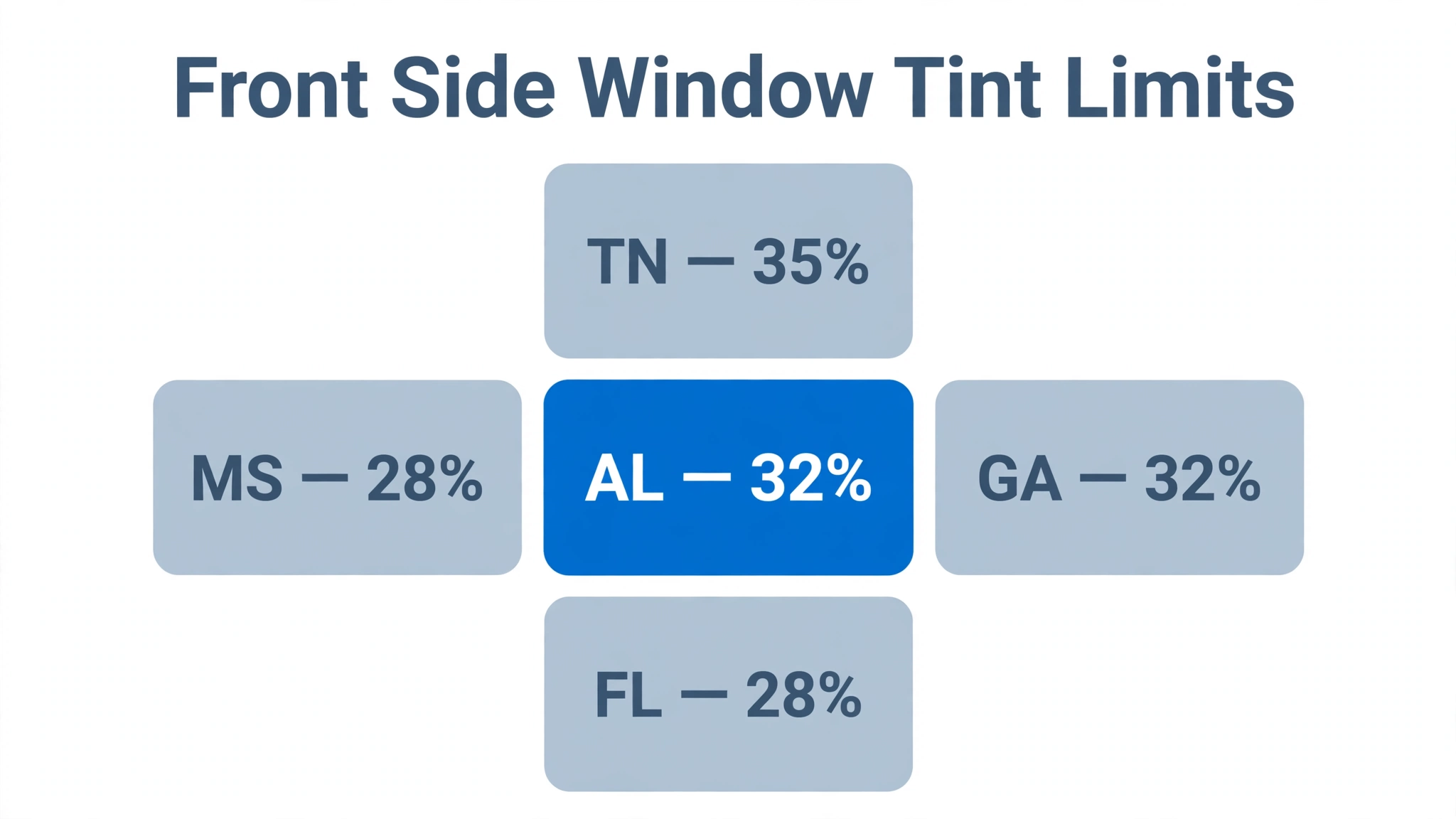
Alabama’s 32% is the joint-darkest front figure in its neighbourhood — and the only one applied to every window behind the windshield. Georgia matches Alabama at 32% on the front side windows. Tennessee allows 35%, Mississippi allows 28%, and Florida allows 28% on the front side windows while freeing the rear glass on multipurpose vehicles in a way Alabama does not. The cross-border trap runs in both directions: an Alabama driver at a legal 32% is too dark for Tennessee’s 35% the moment the trip crosses the state line — though Chapter 5C itself governs only Alabama-registered vehicles, other states enforce their own law on their own roads.
Read also: Texas tint laws, Virginia tint law, Hawaii tint laws
How to Stay Legal
1. One number everywhere: 32%. Front side, rear side, and rear windshield all answer to the same floor, on every vehicle. Buy film that leaves margin over factory glass — the reading is glass and film together. 2. Use the tolerance as a cushion, not a target. The statute allows at least 3%, so a finished reading of 29% sits inside the law — but film darkens and meters differ, so aim for 32% or above. 3. Windshield: clear strip only. A transparent item, never red or amber, within the top six inches — measured in inches, not by the AS-1 line. 4. Do not trust the SUV chart. Factory privacy glass is exempt as delivered; aftermarket film on it is not. There is no darker rear glass for trucks and vans under Chapter 5C. 5. Keep the compliance label. Your tinted vehicle must display it, visible from outside. If your installer did not affix one, go back and ask why. 6. Medical need goes through ALEA. An Alabama-licensed physician’s written statement, an application to the Medical Records Unit, and the numbered decal on the windshield — before the darker film goes on. 7. Officers: carry your identification. The law-enforcement exemption for personal vehicles depends on it.
Frequently Asked Questions
What is the legal tint in Alabama?
Every side window and the rear windshield must transmit at least 32% of light and reflect no more than 20%, with a measurement tolerance of at least 3%, under Alabama Code § 32-5C-2. The figures are the same for cars, SUVs, trucks, and vans registered in Alabama. The front windshield may carry no light-reducing material except a transparent strip on the top six inches.
Is 35% tint legal in Alabama?
Yes — 35% is lighter than the 32% floor, so a finished window reading 35% complies on any side or rear window. The confusion runs the other way: 35% is the limit in neighbouring Tennessee, while in Alabama the floor is 32%, and a window may lawfully go as dark as 32% (29% within the statutory tolerance).
Can SUVs and trucks go darker on the rear windows in Alabama?
No. That widely copied claim is not in the statute. Section 32-5C-2 applies the 32% floor to the rear windshield and side windows of every Alabama-registered vehicle, with no multipurpose-vehicle exception and no mirror condition. Dark factory privacy glass is exempt as delivered under § 32-5C-3(6), but aftermarket film added to it must still finish at 32% or above.
Can I tint my windshield in Alabama?
Only a transparent item, not red or amber, placed on the uppermost six inches of the windshield (§ 32-5C-3(4)). Alabama measures the strip in inches from the top of the glass; the statute does not use the AS-1 line. Any film that reduces light transmission below that strip violates § 32-5C-2(a)(1).
How do I get a medical tint exemption in Alabama?
Apply to the Alabama Law Enforcement Agency under § 32-5C-4, through its Driver License Division, Medical Records Unit, with a written statement from a physician licensed in Alabama confirming you must be shielded from direct sunlight for medical reasons. The exemption covers vehicles you own or regularly ride in, ALEA may set conditions, and you receive a numbered decal for the windshield. For light-sensitive porphyria, the exemption covers every area of the windshield and windows your physician prescribes.
Can I be charged with a tint violation without a meter reading?
No. Section 32-5C-2 requires that light transmission be measured with a proper instrument before a person may be charged — and the officer must be equipped with a meter before stopping the driver. A charge resting on a visual estimate alone does not follow the statute’s own sequence.
How much is a tint ticket in Alabama?
A violation is a misdemeanor under § 32-5C-7: up to $100 and/or 10 days for a first conviction; up to $200 and/or 30 days for a second offense within a year of the first; and up to $500 and/or three months for a third or later offense within that year. Court costs come on top of the fine.
Does Alabama tint law apply to out-of-state cars?
No. Chapter 5C governs vehicles registered in Alabama, and § 32-5C-3(7) expressly excepts any vehicle not registered in the state. Visitors drive under the chapter’s protection — but Alabama-registered cars remain bound by it, and other states enforce their own tint laws on Alabama drivers travelling there.
Conclusion
Alabama’s tint law is a one-number statute with three sharp edges: 32% of light through every side window and the rear windshield, 20% reflectance at most, and a 3% tolerance printed in the law itself. The sharp edges are the ones guides get wrong — there is no SUV exception behind the driver, the windshield strip is six inches measured in inches, and no charge can be brought without a meter reading by an officer who carried the meter to the stop. The controlling text is Alabama Code § 32-5C-2, and Film Slingers’ Alabama tint guide tracks the same figures for drivers and shops.
Disclaimer: This article is general information about the Alabama tint law, not legal advice. Tint statutes and enforcement practice change, and how a rule applies depends on the vehicle and the facts. Confirm the current law in Alabama Code Title 32, Chapter 5C, or speak with an Alabama attorney or the Alabama Law Enforcement Agency, before tinting, buying, or contesting a citation.