



Minnesota tint laws are built on one strict number: 50%. Every side window and the rear window of a Minnesota-registered car must let at least 50% of light through, and the statute writes its own measuring tolerance into the rule — plus or minus 3%. Reflectance is capped at 20%, the windshield may carry no light-reducing material at all, and SUVs — despite what many tint pages claim — get no exemption. The law is Minnesota Statutes section 169.71, subdivisions 4 and 4a.
- Quick Answer
- The 50% Rule and Its Built-In Tolerance
- Minnesota Tint Limits by Window and Vehicle
- Windshield Rules: No Film at All
- The Marking Your Film Must Carry
- Who Is Exempt: Pickups, Vans — but Not SUVs
- Medical Exemptions and the 2025 Changes
- Penalties: Petty Misdemeanors for Drivers, Misdemeanors for Shops
- Enforcement Without Inspections
- How Minnesota Compares With Other States
- How to Stay Legal
- Frequently Asked Questions
- What is the legal tint limit in Minnesota?
- Is 35% tint legal in Minnesota?
- Can I tint my windshield in Minnesota?
- Are SUVs exempt from Minnesota tint law?
- How do I get a medical tint exemption in Minnesota?
- How much is a tint ticket in Minnesota?
- Does Minnesota check tint at inspection?
- My car is registered in another state. Does the 50% rule apply to me?
- Conclusion
This guide explains the 50% rule, the windshield ban, the permanent marking your film itself must carry, the pickup and van exemptions, and the 2025 changes that widened the medical exemption.
Quick Answer
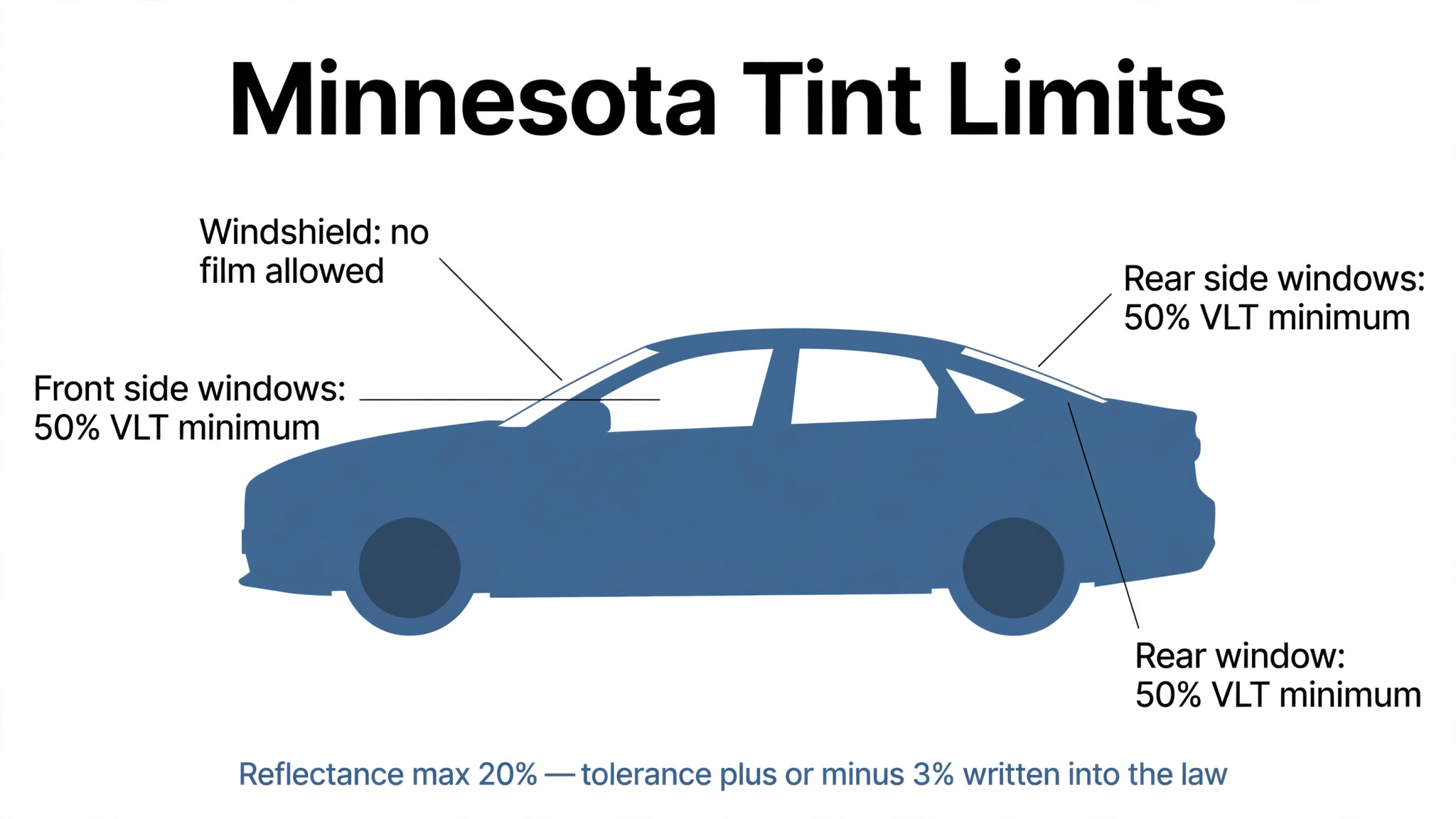
Under Minnesota tint laws, the front side windows, rear side windows, and rear window of a passenger car must each transmit at least 50% of light (±3%), with luminous reflectance no higher than 20% (±3%), measured through glass and film together. The windshield may not be treated with any material that reduces light transmission or adds reflectivity. Exemptions cover pickup rear windows, the rear and behind-driver windows of vans, limousines, funeral and police vehicles, factory glass, and documented medical needs. Driving on illegal tint is a petty misdemeanor with a fine of up to $300; selling or installing noncompliant film is a misdemeanor.
The 50% Rule and Its Built-In Tolerance
Subdivision 4(3) of section 169.71 prohibits driving a Minnesota-registered vehicle when a side or rear window is treated with material that obstructs or substantially reduces the driver’s clear view, has a light transmittance of less than 50 percent plus or minus three percent, or has a luminous reflectance of more than 20 percent plus or minus three percent. Subdivision 4(2) separately bans any window with a highly reflective or mirrored appearance.
Three features of that drafting matter more than the headline number:
– The tolerance is in the statute. Most states print a bare floor and leave meter error to officer discretion. Minnesota prints the cushion: a window metering 47% is inside the written allowance, and reflectance up to 23% passes the same way. There is no need to guess how much grace a trooper will give — the grace is law. – The measurement is the finished window. Transmittance is read through the glazing as treated — factory glass plus film. A film rated exactly 50% over typical 75% factory glass finishes near 37%, far outside the tolerance. Our guide to how window tint percentages work shows the multiplication for common combinations. – The same 50% covers the rear window. Minnesota writes no darker-rear allowance for cars, which puts it at the strict end of the region alongside inspection states like Massachusetts — without the inspection.
Common mistake: Buying film by its box rating. In Minnesota the box number is nearly meaningless on its own; the only number the statute cares about is the one a meter reads through your glass, and the ±3% band is the whole of your safety margin.
Minnesota Tint Limits by Window and Vehicle
| Window | Passenger car | Pickup truck | Van (statutory definition) |
|---|---|---|---|
| Windshield | No light-reducing or reflective material at all | Same | Same |
| Front side windows | 50% VLT minimum (±3%) | 50% VLT minimum (±3%) | 50% VLT minimum (±3%) |
| Rear side windows | 50% VLT minimum (±3%) | 50% VLT minimum (±3%) | Exempt behind the driver’s seat |
| Rear window | 50% VLT minimum (±3%) | Exempt | Exempt |
| Reflectance | 20% maximum (±3%); no mirrored appearance | Same | Same |
Windshield Rules: No Film at All
Subdivision 4(1) prohibits driving when the windshield “is composed of, covered by, or treated with any material which has the effect of making the windshield more reflective or in any other way reducing light transmittance through the windshield.” That sentence has no exceptions for shade bands, no inches from the top, and no AS-1 line. If a treatment measurably dims the glass, it is prohibited — including a visor strip and including clear film that reduces transmission even slightly.
This is stricter than most states, and it is where out-of-state advice does real damage. Some national pages — and even an occasional Minnesota shop page — describe an AS-1 strip allowance for Minnesota. The statute contains none. Minnesota joins Michigan in refusing percentages on the front glass, but goes further: Michigan at least allows a four-inch strip, while Minnesota allows nothing that reduces the light at all. The only windshields outside the ban are factory glazing built to the federal standard, covered by the exemption below.
The Marking Your Film Must Carry
Minnesota hides a second compliance rule inside subdivision 4(4), and it catches people who bought legal film and installed it badly — or bought film that was never labelled at all. Any material applied to a vehicle window after August 1, 1985 must carry an accompanying permanent marking that states the percent of transmittance and the percent of reflectance the material provides. The marking must be positioned so it does not obscure vision and must be readable when the film is installed on the vehicle.
In practice this is the small printed specification in the corner of professionally made film. Its absence is itself a violation, separate from darkness: a window can meter a legal 52% and still break the law because the film carries no marking. When you choose a shop, asking “does your film carry the permanent Minnesota marking?” is a five-second check that separates installers who know section 169.71 from installers who know only the 50% headline.
Who Is Exempt: Pickups, Vans — but Not SUVs
Subdivision 4a(a) lists exactly which glazing escapes subdivision 4. The list is short, and one popular vehicle type is missing from it:
– Factory glazing that has not been modified since original installation, and original-equipment replacement glass, installed in conformity with Federal Motor Vehicle Safety Standard 205. – Pickup trucks (section 168.002, subdivision 26): the rear windows are exempt. The front side windows are not — a pickup’s front glass is held to 50% like any car’s. – Vans (section 168.002, subdivision 40): the rear windows and the side windows on either side behind the driver’s seat are exempt. The statutory van is narrowly defined — a vehicle of box-like design with no barrier between the operator’s area and the cargo area, rated at three-fourths of a ton or less. A family minivan is not automatically this vehicle. – Funeral vehicles used to transport human remains, limousines, and police vehicles: side and rear windows exempt.
SUVs are not on the list. Pages claiming Minnesota gives SUVs unlimited rear tint are copying rules from other states. An SUV’s dark factory privacy glass is lawful — under the factory-glazing exemption, not an SUV exemption — and the moment aftermarket film darkens it further, the 50% rule applies to the finished window in full. Minnesota’s structure is the mirror image of Washington’s, where the multipurpose-vehicle class is written into the limits themselves; here the class exists only for pickups and cargo vans.
What if scenario: A Duluth driver films his SUV’s rear windows to 20%, pointing to the dark glass the vehicle wore on the lot. The factory glass was exempt as factory glass. His film is not factory glass, not a pickup, and not a van — the rear windows now sit 30 points below the floor, well outside the ±3% tolerance.
Medical Exemptions and the 2025 Changes
Subdivision 4a(a)(2) exempts glazing required by a prescription or a physician’s statement of medical need. Minnesota specifies the document in unusual detail. To work, the statement must:
1. Be held by the driver or a passenger and carried in the vehicle — there is no state application, permit, or sticker. 2. State whether the condition is temporary or permanent. 3. State the minimum percentage to which light transmittance may be reduced — the doctor sets the floor, not the tint shop. 4. Carry an expiration date no more than two years after issue, unless the physician indicates the condition is permanent.
A 2025 amendment (SF 1075, effective July 1, 2025) then widened the system in two ways that most summaries have not caught up with. First, for statements issued on or after that date, an optometrist may sign as well as a physician. Second — a genuinely unusual rule — a driver may now rely on a statement issued to a person who is not in the vehicle: the driver’s parent, child, grandparent, grandchild, sibling, or spouse, or a person for whom the driver works as a personal care attendant. The statement must name the make, model, and license plate of one or two vehicles, and the driver must carry it.
Common mistake: Treating any doctor’s note as the exemption. A note that omits the minimum transmittance figure or the temporary/permanent statement is an incomplete document under subdivision 4a, and a trooper reading it at the roadside has nothing to apply. Check the four elements before the film goes on.
Penalties: Petty Misdemeanors for Drivers, Misdemeanors for Shops
For the driver, a tint violation is a petty misdemeanor under section 169.89: a fine of up to $300, no jail time, and no criminal record of the kind a misdemeanor leaves. Real-world first tickets are often lower — around $125 before court surcharges push the total past $200 — but the $300 cap is the number the statute sets. Repeat offending escalates: state law allows repeat petty misdemeanor convictions within a twelve-month window to be charged as a misdemeanor, so a driver who collects tint tickets instead of removing film can climb out of the petty tier.
The business side is stricter from the first offense. Under subdivision 5, selling or installing glazing that does not comply, on a vehicle required to be registered in Minnesota, is a misdemeanor for the seller or installer — a criminal charge, not a petty ticket. As in Louisiana, the pricing is deliberate: the driver risks a modest fine, while the shop risks a record, which is why reputable Minnesota installers meter glass and refuse sub-50% jobs on ordinary cars.
Enforcement Without Inspections
Minnesota has no annual vehicle safety inspection, so tint is enforced the old way: at traffic stops, with a meter. Troopers and local officers carry tint meters, and a visibly dark car can be stopped on suspicion alone — the measurement then decides. That makes Minnesota the opposite of New York or Massachusetts, where the same numbers are re-checked every year whether or not an officer ever looks at the car. Here, an illegal install may ride for years — or be metered on its first weekend.
One neighbouring rule in the same statute surprises visitors: subdivision 1 also bans objects suspended between the driver and the windshield — the provision behind Minnesota’s famous air-freshener tickets — and nontransparent material on the windows beyond certificates the law requires. The tint numbers live in a statute that polices the whole windshield, not just its darkness.
How Minnesota Compares With Other States
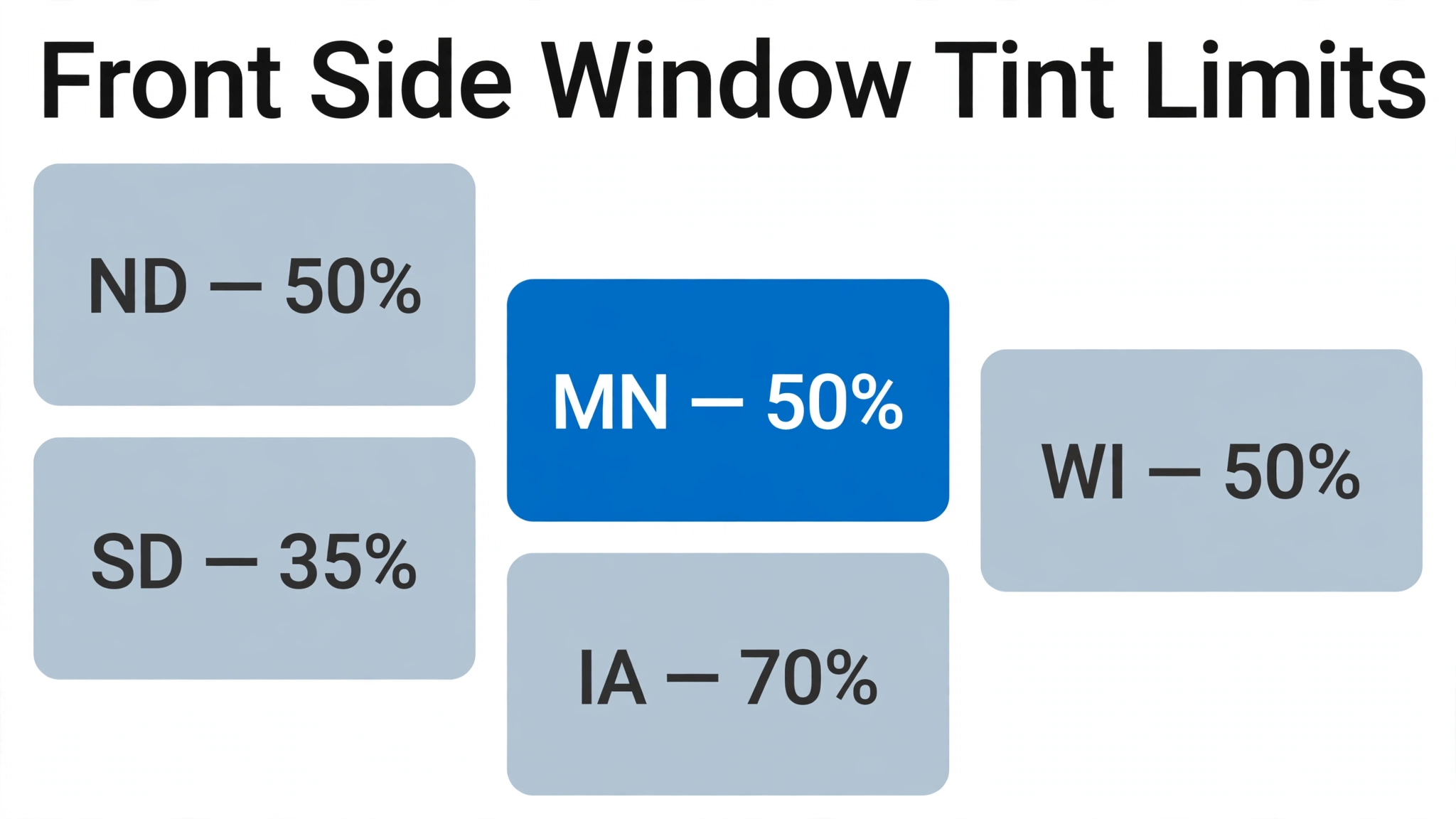
Minnesota’s 50% floor is the strictest standard limit in its neighbourhood. Wisconsin matches the 50% front rule but lets a car’s rear side windows go to 35% — the split Minnesota refuses. Iowa demands 70% on front side windows, stricter still, while South Dakota allows 35% up front. Further afield, Colorado’s 27% rule shows how far the national range runs, and California’s 70% front / free rear structure is the opposite design from Minnesota’s uniform 50%.
Read also: Texas tint laws, Florida window tint law, Maryland tint laws
How to Stay Legal
1. Meter the finished window, not the box. Aim the glass-plus-film reading at 50% or above; on typical factory glass that means film rated around 65–70%. 2. Use the tolerance as a floor check, not a target. 47% passes on paper, but meters and film age vary — a reading at the edge of the band is a reading one bad day from a ticket. 3. Leave the windshield alone. No strip, no clear film, nothing that reduces light at all. If a shop offers a Minnesota “AS-1 strip,” it is selling another state’s rule. 4. Ask about the permanent marking. Legal film carries its transmittance and reflectance percentages printed permanently and readable after install. 5. Know your vehicle class. Pickup rear windows and true cargo-van rear glass are exempt; SUV rear glass is not, whatever the forum says. 6. Medical drivers: complete the document. Minimum transmittance, temporary or permanent, expiry within two years unless permanent — and since July 2025, an optometrist’s signature counts, and a close family member’s statement can cover your named vehicle. 7. Shops: the misdemeanor is yours. Installing noncompliant film on a Minnesota-registered vehicle is a criminal charge for the installer, not a petty ticket.
Frequently Asked Questions
What is the legal tint limit in Minnesota?
50% visible light transmittance on the front side windows, rear side windows, and rear window, with the statute’s ±3% tolerance, and reflectance no higher than 20% (±3%) — measured through glass and film together under section 169.71, subdivision 4.
Is 35% tint legal in Minnesota?
No — not on a passenger car’s windows. 35% sits 15 points below the 50% floor, far outside the ±3% tolerance. It is legal only where an exemption applies: pickup rear windows, a statutory van’s rear and behind-driver windows, limousine, funeral and police vehicles, or a documented medical need.
Can I tint my windshield in Minnesota?
No. Subdivision 4(1) bans any material that makes the windshield more reflective or reduces light transmittance in any way. There is no strip allowance and no AS-1 rule in Minnesota — the only tinted windshields outside the ban are factory glazing built to the federal standard.
Are SUVs exempt from Minnesota tint law?
No. Subdivision 4a exempts pickup rear windows, van rear and behind-driver windows, limousines, funeral vehicles, police vehicles, and factory glass — SUVs are not listed. Dark factory privacy glass is legal as factory glass; aftermarket film on an SUV must meet the same 50% rule as a car.
How do I get a medical tint exemption in Minnesota?
Carry a prescription or physician’s statement of medical need in the vehicle stating whether the condition is temporary or permanent, the minimum light transmittance allowed, and an expiration within two years unless the condition is permanent. Since July 1, 2025, an optometrist may also sign, and a statement issued to a close family member or care client can cover your vehicle if it names the make, model, and plate. No state permit or sticker is involved.
How much is a tint ticket in Minnesota?
A tint violation is a petty misdemeanor with a fine of up to $300 and no jail time. First tickets are often around $125 before surcharges. Selling or installing noncompliant film is a misdemeanor for the shop, and repeat petty convictions within twelve months can be charged as a misdemeanor for the driver.
Does Minnesota check tint at inspection?
No. Minnesota has no annual vehicle safety inspection. Tint is enforced at traffic stops, where officers measure windows with a tint meter — there is no yearly checkpoint, but also no yearly all-clear.
My car is registered in another state. Does the 50% rule apply to me?
Subdivision 4 is written for vehicles required to be registered in Minnesota, so a car registered elsewhere is outside its registration hook. If you move to Minnesota and register the vehicle here, the 50% rule, the windshield ban, and the film-marking rule all apply from registration.
Conclusion
Minnesota keeps its tint law in a single statute with a strict spine: 50% of light through every side and rear window, tolerance printed in the law, reflectance capped at 20%, a windshield closed to any light-reducing material, and film that must carry its own permanent specification marking. The exemptions are narrower than the internet suggests — pickups and cargo vans at the rear, never SUVs — while the medical route widened in 2025 to include optometrists and family statements. The controlling text is Minnesota Statutes section 169.71, and ArmorAtlas’s Minnesota tint guide tracks the current limits and exemption paperwork.
Disclaimer: This article is general information about Minnesota tint laws, not legal advice. Tint statutes and enforcement practice change, and how a rule applies depends on the vehicle and the facts. Confirm the current law in Minnesota Statutes section 169.71, or speak with a Minnesota attorney or the Driver and Vehicle Services division, before tinting, buying, or contesting a citation.