


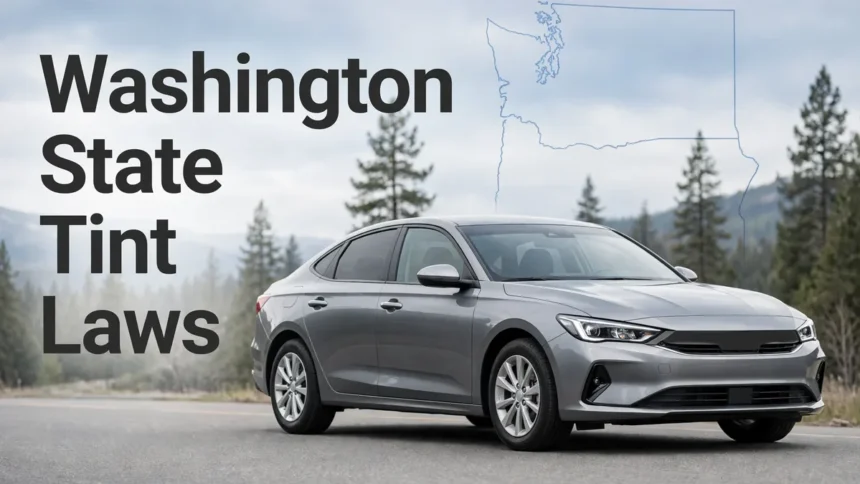
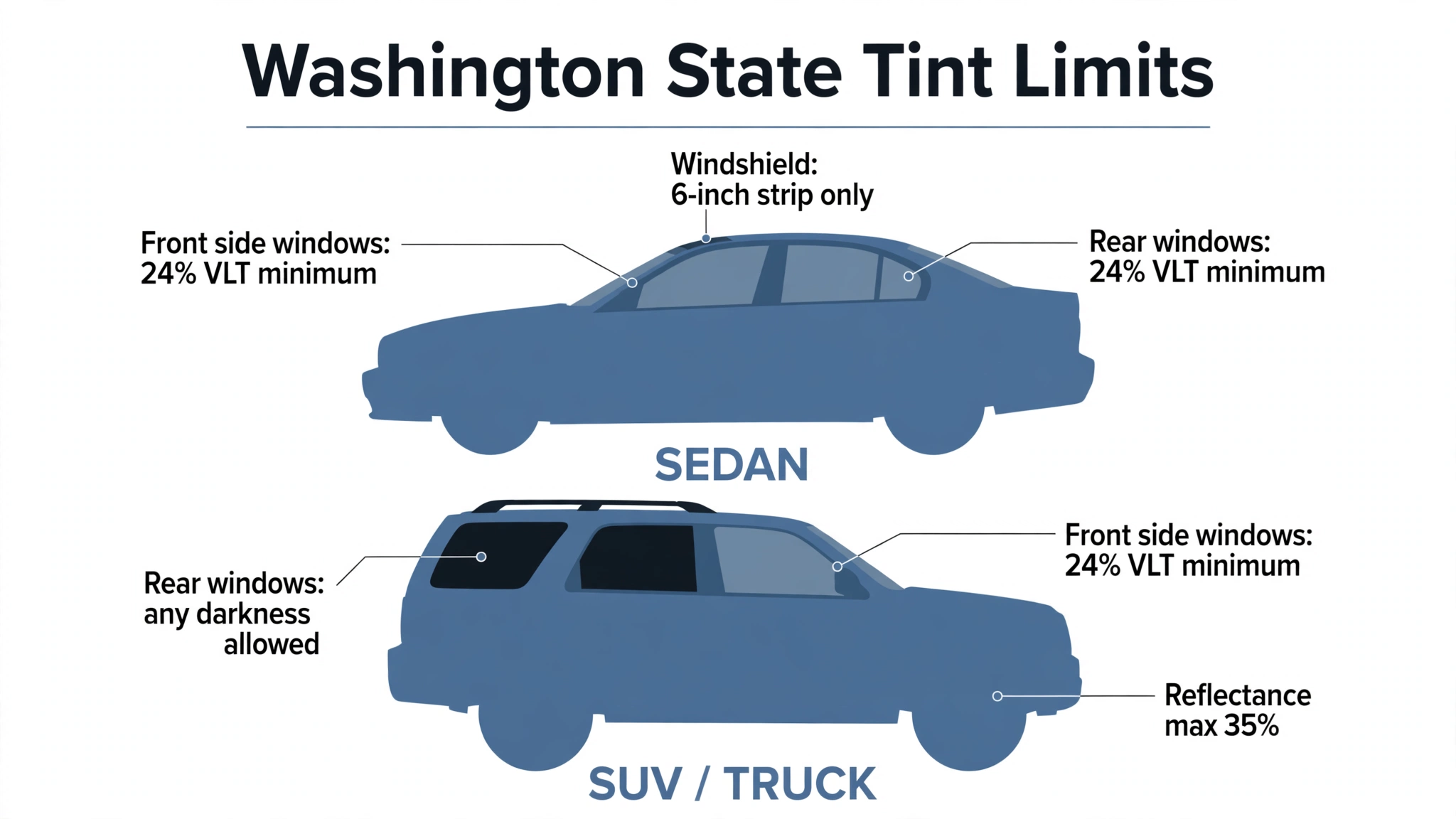
Washington state tint laws set one main number: 24%. Every window except the windshield must let at least 24% of light through, measured with the factory glass and film counted together, and no film may reflect more than 35% of light. Trucks, SUVs, and other multipurpose vehicles get one break: their rear windows may go darker. The rules sit in RCW 46.37.430, and the limits used today date from a 2009 rewrite of that statute.
- Quick Answer
- What Is VLT and What “Net” Means in Washington
- Washington Tint Limits: Cars vs SUVs and Trucks
- Windshield Rules: The 6-Inch Strip and Clear UV Film
- Rules Most Drivers Never Hear About
- Medical Exemption: The Physician’s Verification
- Penalties: What a Tint Ticket Costs in Washington
- Washington State vs Washington, DC
- How Washington Compares With Other States
- How to Stay Legal
- Frequently Asked Questions
- Is 20% tint legal in Washington state?
- Is 35% tint legal in Washington state?
- What is the darkest legal tint in Washington state?
- Can you tint your windshield in Washington state?
- How do I get a medical tint exemption in Washington state?
- How much is a tint ticket in Washington state?
- Can I put two layers of tint on a window in Washington?
- Is Washington, DC’s tint law the same as Washington state’s?
- Conclusion
This guide explains the limits for cars and SUVs, the windshield strip rule, the installer sticker most drivers have never heard of, and how Washington State differs from Washington, DC.
Quick Answer
Under Washington state tint laws, film on any window except the windshield must keep light transmission at 24% or more and reflectance at 35% or less, and the car needs outside mirrors on both sides. On trucks, SUVs, vans, and motor homes, windows behind the driver may go darker than 24%. The windshield may carry a transparent strip in the top 6 inches, and clear UV film may cover the whole windshield. A medical exemption exists on a physician’s written verification. Breaking the rules is a traffic infraction, typically about $124.
What Is VLT and What “Net” Means in Washington
VLT stands for Visible Light Transmission — the percentage of visible light that passes through a window. Washington’s statute calls it “light transmission,” and it adds a definition that decides real cases: “net film screening” means the manufacturer’s glazing plus any film applied afterwards, counted together (RCW 46.37.430(2)(b)).
So the 24% test is never about the film alone. Factory glass that reads 75% wearing a 35% film nets out near 26% — legal, but close. The same glass wearing a 30% film nets near 22% — illegal, even though a “30% film” sounds safely above the line. Washington installers who meter the finished window are not being fussy; the statute grades the combination. Our guide to how window tint percentages work shows the math for every common shade.
Common mistake: buying film by its box rating. In Washington the legal question is what the finished window transmits, and the only honest answer comes from a meter on the glass.
Washington Tint Limits: Cars vs SUVs and Trucks
Section 46.37.430(5) draws the line by vehicle type, and the split is narrower than most tint shops describe:
| Window | Passenger cars | Trucks, SUVs, vans, motor homes |
|---|---|---|
| Windshield | Transparent strip only — top 6 inches, not into the AS-1 area | Same |
| Front side windows | 24% VLT minimum | 24% VLT minimum |
| Rear side windows | 24% VLT minimum | Any darkness |
| Rear window | 24% VLT minimum | Any darkness |
| Reflectance (all film) | 35% maximum | 35% maximum |
Read the car column carefully. On a passenger car, the 24% floor covers the rear windows too — Washington does not give sedans a free rear window the way many states do. The darker-rear allowance in subsection (5)(b) belongs to vehicles the manufacturer identifies as a truck, motor home, or multipurpose passenger vehicle (the federal definition that covers SUVs), plus hearses, limousines, buses, and ambulances.
For those vehicles, windows to the rear of the driver may drop below 24% — to any darkness — as long as reflectance stays at or under 35% and the vehicle keeps outside mirrors on both sides. The front side windows of an SUV get no such break: 24% is the floor there too.
What if scenario: A Spokane sedan owner and her brother, who drives an SUV, both install 15% film all around at the same shop. His rear windows are legal under (5)(b); his front sides are not. Her entire car is illegal — the sedan’s rear windows are held to 24% just like the fronts.
Windshield Rules: The 6-Inch Strip and Clear UV Film
The windshield sits outside the 24% rule entirely — subsection (5)(a) covers “any window, except the windshield.” What the windshield may carry is set by subsection (5)(e):
– A tint strip along the top edge is allowed a greater degree of light reduction, but only if the product is transparent, does not extend into the AS-1 portion of the windshield, and reaches no more than 6 inches from the top. – Clear UV film is legal on the whole windshield. The same subsection expressly allows clear film sunscreening material that reduces or eliminates ultraviolet light to be applied to windshields — the one full-windshield film Washington permits.
So a dark or colored windshield film is illegal in Washington at any coverage, a transparent top strip is fine within 6 inches, and an invisible UV shield over the whole glass is legal. Drivers who want heat and UV protection without a ticket should be asking shops about the clear film, not a shade.
Rules Most Drivers Never Hear About
The headline numbers get all the attention, but RCW 46.37.430(5) carries four more rules that decide real tickets:
1. One sheet only. “Installation of more than a single sheet of film sunscreening material to any window is prohibited.” Layering a second film over an old one is illegal in itself — even if the combined window somehow metered legal. 2. The installer sticker. A business that tints windows for profit in the restricted areas must supply a sticker for the driver’s door post, next to the manufacturer’s ID tag, carrying the business name and state tax identification number and certifying the job meets the light transmission, reflectance, and placement standards. No sticker on the door post is a warning sign about the install. 3. Mirrors with a measured job. When film is applied to any window except the windshield, the outside mirrors on both sides must be positioned to reflect a view of the roadway at least 200 feet to the rear of the vehicle. 4. Banned materials. The statute refuses mirror finish products; red, gold, yellow, or black material; and film that comes in liquid form and is brushed or sprayed on. Tinted sunscreening devices behind the driver get their own allowance if they cut the driver’s vision uniformly by no more than 50%.
Medical Exemption: The Physician’s Verification
Washington’s medical exemption is paperwork-light but specific about whose signature counts. Under subsection (5)(d), a greater degree of light reduction is permitted on all windows and the top six inches of the windshield of a vehicle operated by, or carrying as a passenger, a person who possesses a written verification from a licensed physician that the person must be protected from exposure to sunlight for physical or medical reasons.
Four points drivers get wrong:
– Physician means physician. The statute names a licensed physician only. Pages that add optometrists are describing other states’ laws; an optometrist’s note is not what subsection (5)(d) asks for. – Nothing is filed anywhere. No form, fee, permit, or decal exists in the statute, and nothing is submitted to the Department of Licensing or the State Patrol. The verification itself is the exemption. – It follows the person, not the car. The exemption covers a vehicle the verified person is driving or riding in. Keep the letter with that person, in the vehicle, whenever the tint is on the road. – It lifts only the light limit. The 35% reflectance cap, the banned-materials list, the single-sheet rule, and the mirror rule are separate subsections and still apply. And even with a letter, darker film on the windshield stops at the top six inches.
Common mistake: tinting first and asking a doctor later. Without the verification in the vehicle, darker-than-24% tint is a traffic infraction even when the medical need is genuine — the officer at the window can only go by the paper you can show.
Penalties: What a Tint Ticket Costs in Washington
Operating a vehicle with film that violates the section is a traffic infraction under RCW 46.37.430(7) — not a criminal charge. Washington’s standard penalty for a tint infraction is commonly $124, with some courts totaling closer to $136 once local amounts are added; the statewide cap for a traffic infraction penalty is $250 under RCW 46.63.110.
The ticket is usually the smaller cost. The real bill is the film: a non-compliant install has to be removed or replaced to bring the car back inside the rules, and a shop that knowingly installs illegal tint faces its own exposure — a separate statute, RCW 46.37.435, governs installers, and paying for an installation known to be illegal was made a gross misdemeanor in 2019. That is one more reason the door-post sticker matters: it is the installer’s signed statement that your job was legal when it left the shop.
Officers can and do stop vehicles for tint that reads too dark, and the check is a meter on the glass — net transmission, factory glass included. There is no tolerance written into the current statute; claims online of an automatic “plus or minus 3%” cushion do not appear in RCW 46.37.430 as certified in 2024.
Washington State vs Washington, DC
The two Washingtons run different rulebooks, and search results mix them constantly. The District of Columbia’s law (D.C. Code § 50-2207.02) is far stricter:
| Rule | Washington State | Washington, DC |
|---|---|---|
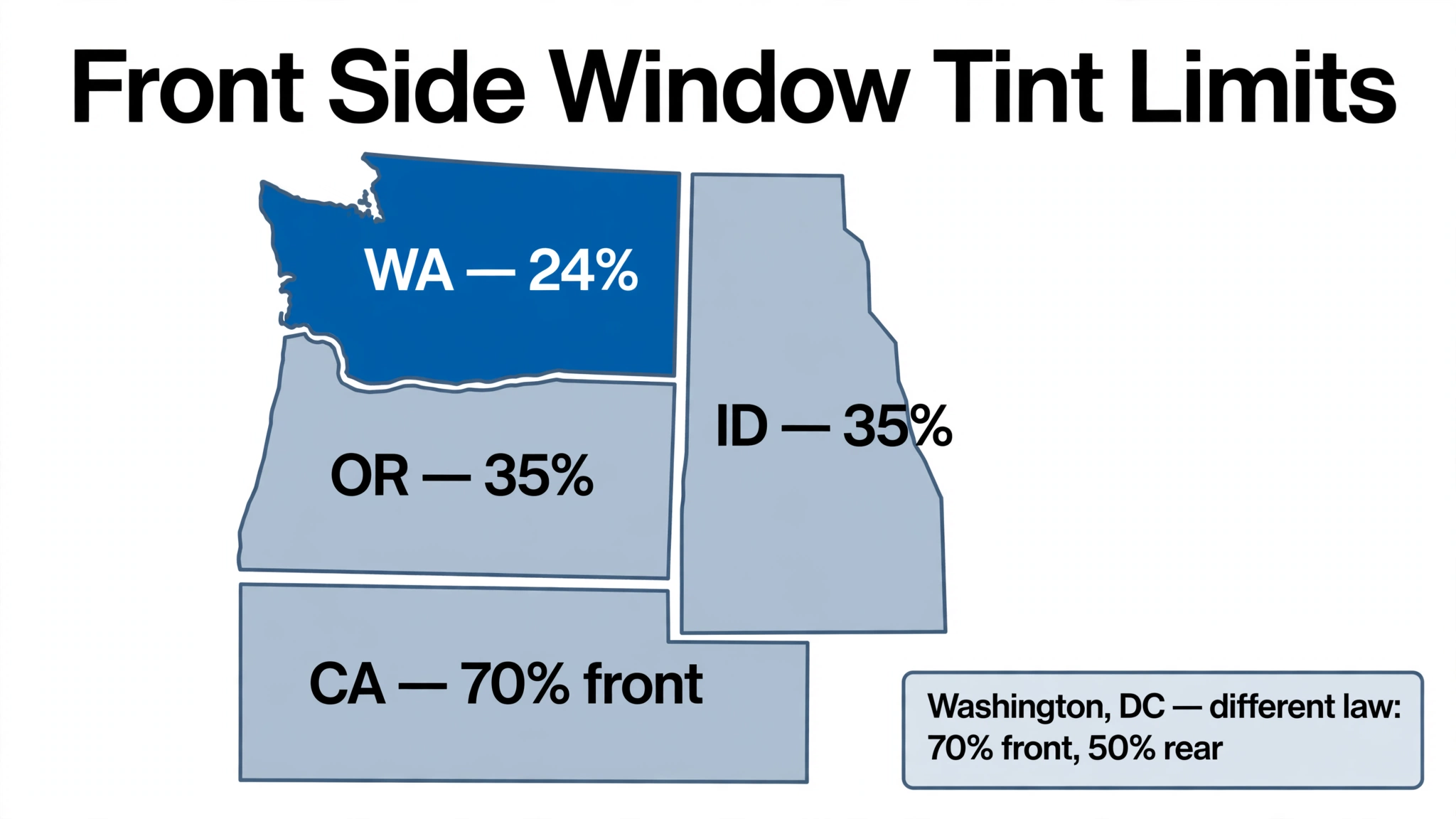
| Front side windows | 24% VLT minimum | 70% minimum (55% for minivans) |
| Rear windows (cars) | 24% minimum | 50% minimum (35% for minivans) |
| Windshield | Transparent strip, top 6 inches; clear UV film allowed | Darker tint only above the AS-1 line or top 5 inches |
| Typical ticket | About $124 (traffic infraction) | $50 citation, with compliance checked afterwards |
| Medical route | Physician’s written verification, kept in the vehicle | Exemption granted by the DC DMV Director |
A car that is legal in Seattle at 24% would be badly illegal in the District, where even the rear windows of a sedan must pass 50%. If your question was about the capital, the DC column is your law — this article covers the state.
How Washington Compares With Other States
Washington’s 24% floor sits at the darker end of the national range:
– California’s tint law effectively holds front windows near 70% once factory glass is counted — Washington allows noticeably darker front tint than its West Coast neighbour. – Maryland’s tint laws set 35% for cars on every window, stricter than Washington’s 24%, and Maryland gives sedans no darker-rear allowance either. – Michigan’s tint laws ban front film outright below a 4-inch strip — the opposite philosophy from Washington’s percentage floor — though both states use a doctor’s letter for medical tint. – Colorado’s tint laws set 27% on every window, close to Washington’s 24% but with no medical exemption at all. – New York’s tint laws require 70% on side windows and test tint at the annual inspection. – Read also: Texas tint laws (25% at the front, near Washington’s number) and Florida’s window tint law (28% front, 15% rear for cars), plus Ohio’s tint laws at 50% front — three more ways states split the same problem.
How to Stay Legal
1. Meter the finished window. The 24% test is net — factory glass plus film. A reading at 26–28% leaves room for meter error; a reading at exactly 24% does not. 2. Know your vehicle class. Sedans are held to 24% on the rear windows too. The darker-rear allowance belongs to trucks, SUVs, vans, and motor homes, behind the driver only. 3. One sheet, legal materials. No layered film, no mirror finishes, no red, gold, yellow, or black material, and nothing brushed or sprayed on. 4. Check for the door-post sticker. A for-profit install in the restricted areas should leave the installer’s certification sticker by the manufacturer’s tag. Its absence is worth a question. 5. Windshield: strip or clear film only. A transparent strip within the top 6 inches, or clear UV film anywhere — nothing darker, nothing colored. 6. Carry the physician’s letter. Medical tint lives and dies on the written verification being in the vehicle with the person it names.
Frequently Asked Questions
Is 20% tint legal in Washington state?
On a passenger car, no — every window except the windshield must transmit at least 24% net. On a truck, SUV, van, or motor home, 20% is legal on the windows behind the driver, but the front side windows still need 24% or more.
Is 35% tint legal in Washington state?
Yes, if the finished window meters at 24% or above. A 35% film over typical factory glass nets roughly 26%, which passes — but a darker factory glass can pull the same film under the line, which is why the meter reading, not the box, decides.
What is the darkest legal tint in Washington state?
For a passenger car, 24% net on every window except the windshield. For trucks, SUVs, vans, and motor homes, the windows behind the driver may go any darkness, provided reflectance stays at or under 35% and the vehicle has mirrors on both sides.
Can you tint your windshield in Washington state?
Only two ways: a transparent strip along the top edge that stays out of the AS-1 area and within 6 inches of the top, or clear UV-blocking film over the whole windshield. Dark or colored windshield film is not permitted.
How do I get a medical tint exemption in Washington state?
Get a written verification from a licensed physician stating that you must be protected from exposure to sunlight for physical or medical reasons, and keep it in the vehicle. There is no state form, permit, or filing. The exemption allows darker tint on all windows and the top six inches of the windshield, and it covers a vehicle you are driving or riding in.
How much is a tint ticket in Washington state?
A tint violation is a traffic infraction. The standard penalty is commonly about $124 (some courts total closer to $136), and the statewide cap for a traffic infraction penalty is $250. Removing or replacing the illegal film is usually the larger cost.
Can I put two layers of tint on a window in Washington?
No. RCW 46.37.430(5)(a) prohibits installing more than a single sheet of film on any window, even if the layered result would meter at a legal percentage.
Is Washington, DC’s tint law the same as Washington state’s?
No. The District of Columbia requires 70% light transmittance on front side windows and 50% on rear windows of a car (55% and 35% for minivans), with a $50 citation — far stricter than Washington state’s 24% rule. The two jurisdictions share a name and nothing else.
Conclusion
Washington state tint laws turn on one number and one definition. The number is 24%: the least light any non-windshield window may transmit, with reflectance capped at 35%. The definition is net — factory glass and film counted together — which is why legal installs are metered, not guessed. Trucks and SUVs earn a darker rear, the windshield takes a clear strip or clear UV film, and the whole system is written in RCW 46.37.430, also published in Justia’s Revised Code of Washington library; the District of Columbia’s separate rules are in D.C. Code § 50-2207.02.
If you are cited and believe the meter reading or the vehicle class was judged wrongly, speak with a Washington traffic attorney before you strip the film — on a class or measurement dispute, the film you remove cannot be put back as evidence.
Disclaimer: This article is general information about Washington law, not legal advice. It is not a substitute for advice from a qualified attorney licensed in Washington. Laws and court practice can change, so check the current statute or speak to a lawyer about your situation.