



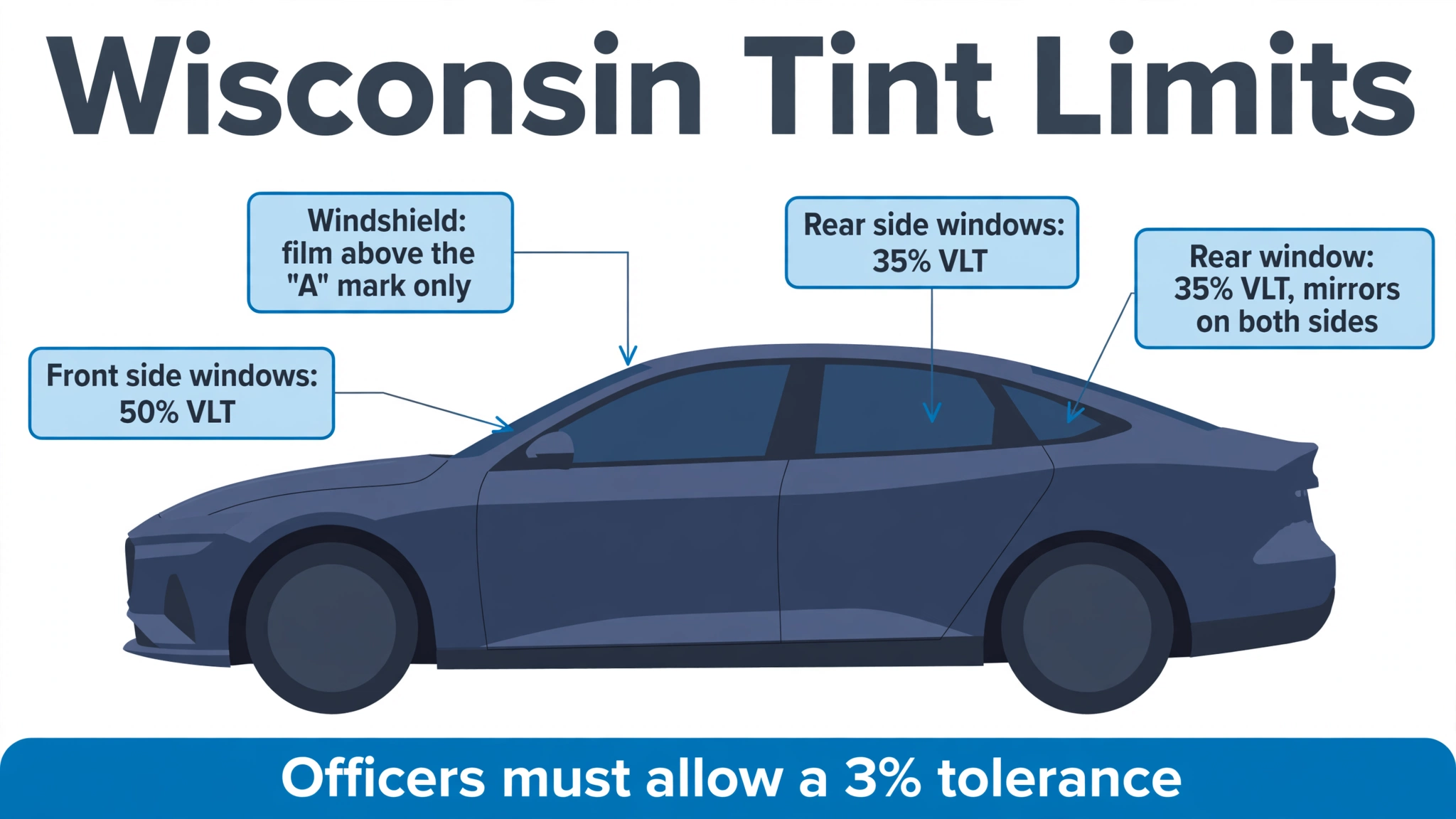
Wisconsin tint laws are unusual before you ever reach the numbers: there is no tint statute. The limits live in a Department of Transportation rule, Wis. Adm. Code Trans 305.32, which allows aftermarket film only if the glass and film together pass at least 50% of visible light on the vent and front side windows and at least 35% on the rear side windows and rear window — with film that may not be reflective, and a 3% tolerance officers must allow when they meter the glass.
- Quick Answer
- The Numbers Live in a Rule, Not a Statute
- Wisconsin Tint Limits by Window
- The Windshield: Above the “A” Line or Nothing
- Factory Glass: The Percentage That Isn’t There
- Medical Tint: A Statement in the Glovebox, Not a Permit
- Enforcement: No Inspection Lane, Just the Traffic Stop
- Penalties: A $10–$200 Forfeiture
- What About UTV Tint?
- How Wisconsin Compares With Other States
- How to Stay Legal
- Frequently Asked Questions
- What is the legal tint in Wisconsin?
- Is 35% tint legal in Wisconsin?
- Why do SUVs come with rear glass darker than 35%?
- Can I tint my windshield in Wisconsin?
- How do I get a medical tint exemption in Wisconsin?
- How much is a tint ticket in Wisconsin?
- Will dark tint fail a Wisconsin inspection?
- Did Wisconsin change its tint law in 2025 or 2026?
- Conclusion
This guide explains where the rule actually sits, the windshield’s “A” mark test, the factory-glass path with no percentage in it, the medical statement that replaces a permit, and the forfeiture.
Quick Answer
Under Wisconsin tint laws, aftermarket film on the vent and front side windows must leave the finished window passing 50% or more of visible light; film on the rear side windows and rear window must leave 35% or more; and no film on those windows may be reflective. Officers measuring the glass must allow a 3% tolerance. The windshield takes film only above the manufacturer’s “A” mark and outside the critical area — and if the glass carries no “A” mark, no film at all. A medical recommendation drops the front side windows to 35%. A violation is a civil forfeiture of $10 to $200, not a crime.
The Numbers Live in a Rule, Not a Statute
Open the Wisconsin Statutes looking for a tint percentage and you will not find one. Chapter 347, the vehicle equipment chapter, sets the backdrop — and the section some websites cite for tint, § 347.37, turns out to regulate brake fluid sales, not windows. The operative text is an administrative rule: Trans 305.32, “Vent, side and rear windows,” in force since 1996.
That structure explains the rule’s three drafting habits:
– It regulates film, and names its own exceptions. Each window position is “permitted as follows”: tinting by the manufacturer of the glazing, or tinting film applied to the inside of the glazing that meets a combined light figure. Anything outside those paths is not permitted. – Every figure is a combined figure. The test is “the combination of the glazing and tinting film” — glass and film together, the only reading a meter at a traffic stop will ever take. Our guide to how window tint percentages work walks through why a 50% film over factory glass finishes well below 50%. – The reflectivity standard is a word, not a number. Where other states cap reflectance at 20% or 35%, Trans 305.32 says the film “may not be reflective” — a flat ban on mirror and metallic finishes.
One class of vehicle sits outside the rule altogether. Under § 347.02(8), created by 2023 Wisconsin Act 251, the department’s tint limitations do not apply to police vehicles owned by the state or a county, city, village, or town when tinting is necessary to protect personnel, passengers, or equipment. It is the only tint legislation Wisconsin has passed in years — and it changed nothing for private drivers.
Wisconsin Tint Limits by Window
| Window | Wisconsin rule (all vehicles) |
|---|---|
| Windshield | Film only above the manufacturer’s “A” mark and outside the critical area; no “A” mark, no film |
| Vent and front side windows | Film on the inside; glass + film at least 50% light transmission; nonreflective |
| Rear side windows | Film on the inside; glass + film at least 35%; nonreflective |
| Rear window | Film on the inside; glass + film at least 35%; nonreflective; dual outside mirrors if under 60% |
| Medical recommendation | Front side windows may go to 35% (written statement carried in the vehicle) |
| Measurement | Officers must allow a 3% tolerance |
Two features deserve emphasis. First, there is no vehicle split: the rule never mentions sedans, SUVs, or multipurpose vehicles, so the same 50/35 figures govern a coupe and a pickup alike. Second, there is no color list and no installer paperwork — no compliance label, certificate, or sticker is required for an ordinary legal install.
The Windshield: Above the “A” Line or Nothing
Wisconsin’s windshield rule lives one section over, in Trans 305.34(6), and it is a location test with no percentage in it. Nothing may be placed on the windshield so as to obstruct the driver’s clear vision, and tinting film is saved by exactly one paragraph, (6)(c): film may be attached only to the portion of the windshield that is both outside the windshield critical area and above the horizontal line delineated by the mark “A” — the line glassmakers stamp into the glass, known elsewhere as the AS-1 line.
Then comes the sentence the shop charts leave out: “If no such mark was affixed to the windshield by its manufacturer, no window tinting film may be attached to the windshield.” A windshield without the “A” mark is not a windshield with a lower strip allowance. It is a windshield that takes no film, full stop. Windshields tinted by the manufacturer of the glazing are separately saved by (6)(b) — again, the factory path.
Notice what the rule does not do. It sets no light-transmission figure for the strip — no 70%, no 50%, nothing. Shops that tell you “any percentage is legal above the AS-1 line” are, for once, describing the text accurately: the strip is governed by where it sits, not how dark it is. But the same shops tend to skip the second condition — the film must also stay outside the critical area, the part of the glass the driver looks through.
Common mistake: Ordering a windshield strip for a replacement windshield that carries no “A” mark, on the theory that the strip “would have been” above the line. The rule keys everything to the mark the manufacturer actually affixed. No mark, no film — however light it is.
Factory Glass: The Percentage That Isn’t There
Every window position in Trans 305.32 opens with the same first path: tinting “by the manufacturer of the glazing”, installed “as part of the original manufacturing process.” Read it closely — that path carries no light-transmission figure at all. The 50% and 35% numbers attach only to the second path, aftermarket film applied to the inside of the glazing.
That is why the dark rear glass on a new SUV is lawful in Wisconsin even though it meters at 15–25%. A claim now circulating in shop videos — that factory privacy glass is “technically illegal from the factory” because it falls below 35% — misreads the rule: the 35% floor governs film, and factory glazing is permitted on its own terms.
The trap runs the other way. The moment a shop applies film over that factory glass, the film path governs, and the combination must pass 35% behind the driver or 50% at the front. A 20% film over 20% factory glass finishes near 4% — so “matching the front windows to the factory rear” is the single most common illegal install in the state.
What if scenario: A Milwaukee driver buys an SUV with dark factory rear glass and has 35% film added to the rear side windows “to even it out.” The factory glass alone was lawful; the film job is not, because the finished rear windows now pass well under 35% — and the front windows, left clear, were the only ones still legal.
Medical Tint: A Statement in the Glovebox, Not a Permit
Wisconsin’s medical route is Trans 305.32(4)(b)3, narrower than the “medical exemption” label suggests. It applies only to the vent and front side windows — the rear windows already sit at 35% — and allows film on the inside of the glazing down to a combined 35%, still nonreflective, when the tinting is done:
– Upon the recommendation of a physician, or a Christian Science practitioner — Wisconsin is the only state in this series whose tint rule names a religious practitioner alongside the doctor — treating the owner of the vehicle, or an immediate family member of the owner. A recommendation for a friend, a tenant, or an unrelated passenger does not qualify. – With a written statement carried in the vehicle at all times. The statement, from the treating physician or practitioner, must identify the patient, the medical condition justifying the recommendation, whether the condition is temporary or permanent, and the vehicle it applies to — make, model, year, and vehicle identification number.
And that is the whole system. There is no application to the DOT, no form, no permit, no sticker, and no expiry date printed in the rule — a deliberate contrast with Missouri’s permit-and-decal system and Indiana’s annually renewed certification. The statement in the glovebox is the authorization.
The rule also writes the ending. Film applied under a recommendation shall be removed when the vehicle is sold, when the person for whom the recommendation was made no longer resides in the owner’s household, or when a temporary condition has expired. Medical tint in Wisconsin is a personal, vehicle-specific allowance — it does not transfer to the next owner, and it does not follow the patient to a different car, because the statement names one vehicle by VIN.
Enforcement: No Inspection Lane, Just the Traffic Stop
Wisconsin drivers never face a tint check at renewal. The state has no periodic safety inspection for passenger vehicles — annual safety inspections were eliminated in 1981 — and the only recurring test, an emissions test every two years for 1996-and-newer gasoline vehicles registered in the seven southeastern counties (Kenosha, Milwaukee, Ozaukee, Racine, Sheboygan, Washington, and Waukesha), reads the engine computer. It does not meter windows.
Enforcement is therefore entirely roadside. Under § 110.075(2), when directed by any traffic officer or motor vehicle inspector, an operator shall stop and submit the vehicle to inspection of its equipment — glass and mirrors are named in the list — and an officer who finds nonconforming equipment can order it corrected. Trans 305.32(7) then disciplines the measurement itself: law enforcement officers shall allow a tolerance of 3%. The word is “shall,” and the direction runs one way — in the driver’s favour. A front window that meters at 47% has not been shown to violate a 50% standard; a rear window at 32% stands the same way. Guides that describe the tolerance as “plus or minus 3%” invert it: the rule does not let an officer round a passing window down into a violation.
The stop itself is litigated ground, and recently. In State v. Stenner (Wis. Ct. App. May 7, 2026, unpublished), the Court of Appeals rejected the argument that the rear-window rule is invalid and held that an officer had reasonable suspicion to stop a car for a possible violation of Trans 305.32(5)(b). Dark rear glass, on its own, can supply the reason for the stop that produces the meter reading.
Penalties: A $10–$200 Forfeiture
Follow the penalty through the documents, because the obvious citation is the wrong one. Trans 305.03 makes it unlawful to operate a vehicle on Wisconsin highways that does not conform to chapter Trans 305. Trans 305.04 sets the consequence: “unless a different penalty is provided by statute, any violation of this chapter shall be punishable as prescribed in s. 110.075 (7), Stats.” That subsection provides that persons violating chapter 347 or rules issued under it “shall forfeit not less than $10 nor more than $200.”
Two clarifications matter:
– It is a forfeiture, not a fine on a crime. A Wisconsin forfeiture is a civil penalty. A tint ticket creates no criminal record and no jail exposure; the real costs are the forfeiture, the court costs and surcharges added to it — county guidance in Dodge County has put the total on a tint citation at $175.30 — and removing or replacing the film. – Section 347.50(1) is a look-alike, not the route. The equipment chapter’s own penalty section carries the same $10–$200 range, but by its terms it reaches violations of §§ 347.35 to 347.49 — statutes. A tint charge breaches a rule, which is why the money runs through Trans 305.04 and § 110.075(7) instead.
What About UTV Tint?
The searches ask, so here is the short, verified answer. Trans 305.32 is a motor vehicle equipment rule; utility terrain vehicles are regulated by the Department of Natural Resources under § 23.33 and chapter NR 64. That rulebook has been moving toward the motor-vehicle standard: updated ATV/UTV regulations effective in June 2026 require UTVs to mirror the window-tint standards for motor vehicles, and a further DNR revision in progress would add medical exemptions and grandfather UTVs manufactured before March 1 whose factory tint falls outside the requirements. If you run a UTV with tinted glass, check the current NR 64 text before assuming the 50/35 figures — or the medical route — apply to you in the same words.
How Wisconsin Compares With Other States
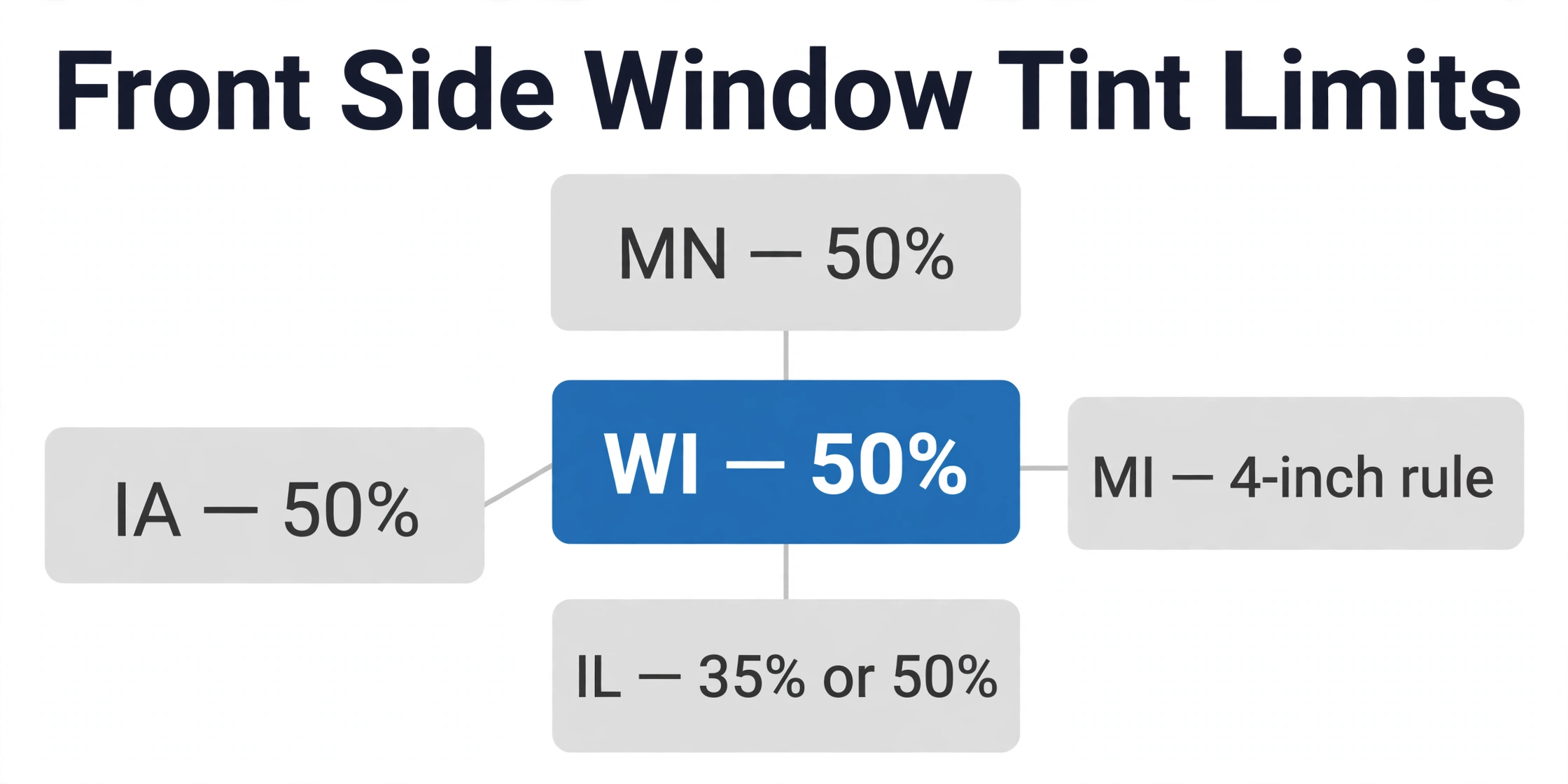
Wisconsin’s 50% front figure puts it in the lighter half of its own neighbourhood: Minnesota matches it at 50% with the same in-rule 3% tolerance, and Iowa arrived at 50% in July 2026. Illinois runs darker through its linked 35% or 50% system, while Michigan sets no percentage at all — a four-inch strip rule instead. Wisconsin’s distinctive features are structural: limits in an agency rule rather than a statute, a tolerance the officer must allow, a windshield keyed to a mark in the glass, and a medical route that runs on a statement naming the car by VIN.
Read also: Texas tint laws, Florida window tint law
How to Stay Legal
1. Front pair at 50% — finished. The standard is the glass and film together. On typical factory glass, that means ordering film rated well above 50%, and metering the finished window before you pay. 2. Rear glass at 35% — finished. Same combined rule behind the driver, on every vehicle. There is no SUV exception to find. 3. Nonreflective, always. Any film that reads as mirror or metallic fails on reflectivity before darkness is measured, at every window the rule covers. 4. Keep both outside mirrors. A rear window transmitting under 60% — which is to say, any legal 35% film job — requires an outside rearview mirror on the left and right of the driver’s compartment. 5. Windshield: find the “A” mark first. Film only above its line and outside the critical area. No mark on the glass means no film, at any shade. 6. Do not film over factory privacy glass and expect the factory rule to protect you. The manufacturer path covers factory glazing as installed. Film changes the path, and the combination is what gets metered. 7. Medical need means the statement, before the film. Physician or Christian Science practitioner treating you or an immediate family member; statement naming the patient, the condition, temporary or permanent, and the vehicle by make, model, year, and VIN; carried in the car at all times; film removed when the car is sold, the person leaves the household, or a temporary condition ends.
Frequently Asked Questions
What is the legal tint in Wisconsin?
Under Wis. Adm. Code Trans 305.32, aftermarket film must leave the vent and front side windows passing at least 50% of visible light, and the rear side windows and rear window at least 35%, measured through glass and film together, and the film may not be reflective. The windshield takes film only above the manufacturer’s “A” mark. Officers must allow a 3% tolerance when measuring.
Is 35% tint legal in Wisconsin?
Behind the driver, yes — 35% is the standard for the rear side windows and rear window. On the front side windows, only with a medical recommendation under Trans 305.32(4)(b)3, supported by the written statement carried in the vehicle. Without the recommendation, the front pair must pass 50%.
Why do SUVs come with rear glass darker than 35%?
Because the rule permits it. Trans 305.32 allows tinting by the manufacturer of the glazing, installed during manufacturing, at every window position without stating a percentage — the 35% floor governs aftermarket film. Factory privacy glass is lawful as installed; adding film over it brings the combined-reading test into play.
Can I tint my windshield in Wisconsin?
Only a strip, and only if your windshield carries the manufacturer’s “A” mark: under Trans 305.34(6)(c), film may sit above the horizontal line of that mark and outside the critical area. If the glass has no “A” mark, no tinting film may be attached at all. The rule sets no percentage for the strip — position is the test.
How do I get a medical tint exemption in Wisconsin?
There is no permit to apply for. Under Trans 305.32(4)(b)3, a physician or Christian Science practitioner treating the vehicle owner, or an immediate family member of the owner, recommends the tint, and their written statement — patient, medical condition, temporary or permanent, and the vehicle’s make, model, year, and VIN — is carried in the vehicle at all times. It allows the front side windows only, down to 35%, and the film must be removed when the vehicle is sold, the person leaves the household, or a temporary condition expires.
How much is a tint ticket in Wisconsin?
A violation of Trans 305.32 is punishable under Trans 305.04 as prescribed in § 110.075(7): a forfeiture of not less than $10 nor more than $200 — a civil penalty, not a crime. Court costs and surcharges are added; Dodge County’s published guidance has put the total on a tint citation at $175.30. Expect to remove or replace the film as well.
Will dark tint fail a Wisconsin inspection?
There is no inspection to fail. Wisconsin has no periodic safety inspection for passenger vehicles, and the emissions test required in seven southeastern counties does not check tint. Enforcement happens at traffic stops, where officers meter the glass — with the 3% tolerance allowed in your favour — and State v. Stenner (2026) confirms that suspect rear tint alone can justify the stop.
Did Wisconsin change its tint law in 2025 or 2026?
The 50% and 35% figures did not change — they have stood in Trans 305.32 since 1996. The recent movement is at the edges: 2023 Wisconsin Act 251 exempted government-owned police vehicles, the Stenner decision upheld roadside enforcement in 2026, and the DNR’s UTV tint rules under chapter NR 64 were updated in 2026 with further revisions proposed. “New Wisconsin tint law” headlines about lower percentages for cars have no enacted law behind them.
Conclusion
Wisconsin runs its tint law out of a transportation rule, not a statute: 50% on the front side windows, 35% behind the driver, no reflective film, a 3% tolerance the officer must allow, a windshield keyed to the “A” mark in the glass, factory glazing permitted without a percentage, and a medical route that lives in a written statement naming the car by VIN. The penalty is a $10–$200 forfeiture reached through Trans 305.04 and § 110.075(7). The controlling text is Wis. Adm. Code Trans 305.32, and RecordingLaw’s Wisconsin tint guide tracks the same figures for drivers and shops.
Disclaimer: This article is general information about Wisconsin tint laws, not legal advice. Tint rules and enforcement practice change, and how a rule applies depends on the vehicle and the facts. Confirm the current law in Wis. Adm. Code Trans 305.32 and Trans 305.34, or speak with a Wisconsin attorney or the Wisconsin State Patrol, before tinting, buying, or contesting a citation.