




Missouri tint laws are built around a single section — Mo. Rev. Stat. § 307.173 — and a single pair of windows. The statute meters only the front sidewing vents and the windows immediately to the left and right of the driver: 35% light transmission, plus or minus 3%, with luminous reflectance capped at 35%, plus or minus 3%. It says nothing at all about the windows behind the driver, bans sun-screening devices on the windshield outside the factory shade band, and routes darker front tint through a state permit that starts with a physician’s prescription.
- Quick Answer
- The One Rule Missouri Actually Wrote
- Missouri Tint Limits by Window
- The Windshield: Factory Band Only
- Behind the Driver: The Statute Says Nothing
- The Medical Permit: Prescription, Patrol, Stickers
- Enforcement: Meters at Stops, a Split at Inspection
- What About Headlight Tint?
- How Missouri Compares With Other States
- How to Stay Legal
- Frequently Asked Questions
- What is the legal tint in Missouri?
- Is 35% tint legal in Missouri?
- How dark can rear windows be in Missouri?
- Can I put a tint strip on my windshield in Missouri?
- How do I get a medical tint permit in Missouri?
- How much is a tint ticket in Missouri?
- Will dark tint fail a Missouri safety inspection?
- Did Missouri change its tint law in 2025 or 2026?
- Conclusion
This guide explains the front rule and its written tolerance, the windshield’s factory band, the silence behind the driver — and the places where copied charts, including one quoting a version of this statute repealed in 2002, will lead you wrong.
Quick Answer
Under Missouri tint laws, the front side windows and sidewing vents must show 35% or more light transmission (±3%) and 35% or less luminous reflectance (±3%), measured with the safety glazing. Windows behind the driver and the rear glass have no tint limit — the Highway Patrol says so in those words. The windshield may not carry any sun-screening device except the factory-tinted upper band and required stickers. Darker front tint is lawful only with a Department of Public Safety permit issued on a physician’s prescription for a serious medical condition. A violation is a class C misdemeanor — up to 15 days in jail and a fine up to $750. Vehicles on historical license plates are exempt entirely.
The One Rule Missouri Actually Wrote
Section 307.173(1) is a permission with numbers, not a ban with exceptions: “any person may operate a motor vehicle” whose front sidewing vents or windows beside the driver carry a sun-screening device that, in conjunction with safety glazing material, has a light transmission of 35% or more, plus or minus 3%, and a luminous reflectance of 35% or less, plus or minus 3%.
Three details in that sentence do real work:
– The tolerance is written into both figures. Most states print a bare number and leave the margin to practice. Missouri prints ±3% on the transmission floor and the reflectance ceiling, the same drafting habit Minnesota uses. The meter floor on a front window is therefore 32% — and the reflectance ceiling is, on the same logic, 38%. – The reading is combined. The device is measured “in conjunction with safety glazing material” — glass and film together, the only reading a meter at a traffic stop will ever take. Our guide to how window tint percentages work walks through why a 35% film over factory glass finishes below 35%. – The reflectance cap is a mirror rule. At 35% or less, ordinary smoke and ceramic films pass; mirror-finish film — the kind that throws sunlight back at other drivers — is what the cap exists to catch.
Anything darker or more reflective on those two windows is, in the statute’s words, “prohibited without a permit pursuant to a physician’s prescription” — the medical route covered below. The same numbers apply to every vehicle; the section never splits cars from SUVs, vans, or pickups.
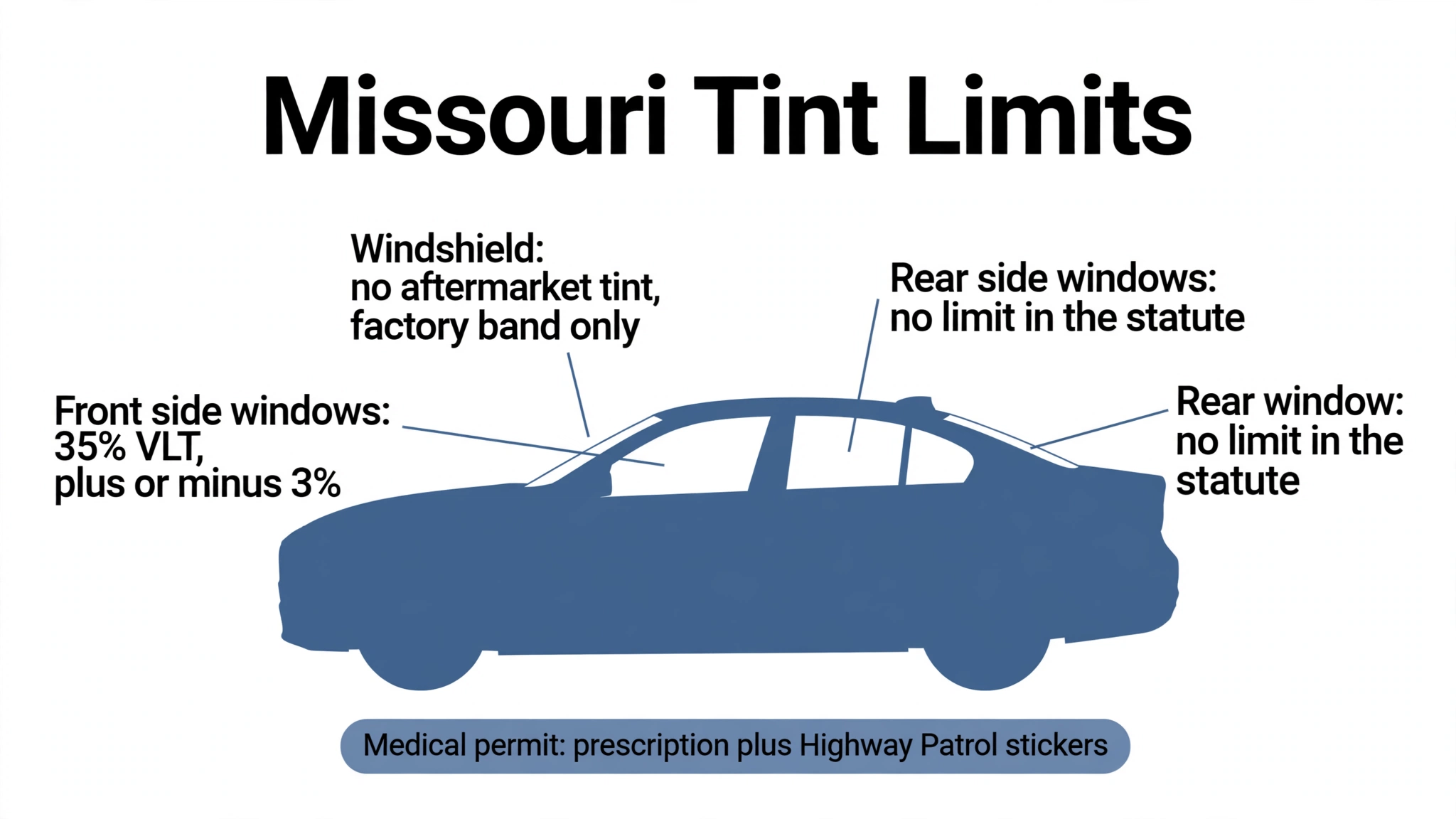
Missouri Tint Limits by Window
| Window | Missouri rule (all vehicles) |
|---|---|
| Windshield | No sun-screening device — factory-tinted upper band and required stickers only |
| Front side windows and sidewing vents | 35% light transmission (±3%), luminous reflectance 35% or less (±3%), glass and film together |
| Side windows behind the driver | No limit in the statute |
| Rear window | No limit in the statute |
| Medical permit | Department of Public Safety permit on a physician’s prescription (front windows) |
| Historical license plates | Fully exempt |
The Windshield: Factory Band Only
The windshield sentence is the shortest in the section: “all sun-screening devices applied to the windshield of a motor vehicle are prohibited,” except as subsection 2 provides. What subsection 2 saves is narrow:
– Labels, stickers, decalcomania, and informational signs — the inspection sticker, the city license, the parking permit. – Tinted or solar screening material on recreational vehicles, as defined in § 700.010, that does not interfere with the driver’s normal view of the road. – Factory-installed tinted glass, or its equivalent replacement. – Tinting material applied to the upper portion of the windshield “which is normally tinted by the manufacturer of motor vehicle safety glass” — the shade band the glassmaker built in.
Read that last item carefully, because it is the one the internet rewrites. The statute does not authorize an aftermarket strip. It does not mention the AS-1 line, and it gives no measurement in inches. The exception describes the band that is normally tinted by the manufacturer — a feature of the glass as made, not an invitation to add film down to a line. Pages that sell Missouri drivers a “legal strip above the AS-1 line” are importing other states’ drafting; Arizona’s 29-inch rule and Hawaii’s four-inch rule are real, but they are Arizona’s and Hawaii’s. In Missouri, film on the windshield below — or above — the factory band is a sun-screening device on the windshield, and the section bans it.
Common mistake: Paying for a windshield “eyebrow” strip and being told it is legal because it stops at the AS-1 mark. The mark is real; the Missouri exception tied to it is not. The same car fails at the inspection lane too — as the enforcement section shows, the windshield is the one piece of glass Missouri inspectors do reject for aftermarket material.
Behind the Driver: The Statute Says Nothing
Open the current § 307.173 and search it for the rear windows. They are not there. The section meters the front sidewing vents and the windows beside the driver, bans devices on the windshield, and stops. The Missouri State Highway Patrol’s own brochure (SHP-510) states the consequence plainly: “Windows behind the driver and the rear glass are not subject to tint limitations.“
That means:
– Any darkness — 20%, 5%, fully blacked out — on the rear side windows and the rear window, on a sedan exactly as on an SUV. The statute draws no vehicle-class line because it draws no rear line at all. – No reflectance cap behind the driver either. The 35% luminous-reflectance figure belongs to the front pair alone. Charts that print a rear reflectance limit for Missouri are filling a blank the legislature left empty. – No mirror condition in the tint section. Section 307.173 does not condition rear darkness on dual mirrors the way several states do.
So where does the widely copied “Missouri rear windows: 35%” come from? From this same section, before 2002. The pre-2002 text of § 307.173 set a 35% standard for “side and rear windows,” and that version still circulates on mirror sites — including an outdated page on the Revisor’s own site. The 2002 rewrite (House Bill 1386) narrowed the section to the front windows, and the rear figure was repealed with the old text. A shop quoting 35% for your rear glass is quoting a statute that has not existed for more than two decades.
What if scenario: A Kansas City driver runs 5% film on the rear side windows and rear window of a sedan, 35% on the front pair. Every window complies: the front pair meets the only metered standard in the section, and the rear glass answers to no standard at all. The same driver adding a dark strip across the top of the windshield “to match” is the one who has created a violation.
The Medical Permit: Prescription, Patrol, Stickers
Missouri’s medical route is a permit system, and it is more formal than a note in the glovebox. Under § 307.173(1), a permit to run front side windows darker than the 35% ±3% standard “may be issued by the department of public safety to a person having a serious medical condition which requires the use of a sun-screening device if the permittee’s physician prescribes its use.” The director of the department writes the rules; the rule is 11 CSR 30-7.010, and the Highway Patrol runs the process:
1. Get the prescription. Your physician issues a prescription — it must be issued within one year of your application — stating the serious medical condition and the specific tint percentage you need beyond the standard allowance. 2. Bring the vehicle. Present the prescription and the vehicle to the Missouri State Highway Patrol’s Motor Vehicle Inspection Division at a troop headquarters. One prescription can cover more than one vehicle, but every vehicle must be presented. 3. The Patrol issues the permit. The certifying officer verifies the prescription and completes form SHP-524 in triplicate. 4. Carry it, and wear the stickers. The permit is kept in the vehicle with a copy of the prescription at all times. A sticker is affixed to the lower left corner of the windshield and a decal to the rear glass or rear bumper — the visible signal to a trooper with a meter that the dark front windows are permitted.
Two scope rules complete the picture. The permit remains valid during the current ownership of the vehicle — it is tied to the car, not renewed on a calendar. And the statute lets the vehicle be operated under the permit by any titleholder or relative within the second degree — a spouse, parent, grandparent, sibling, child, grandchild, aunt, uncle, niece, or nephew — who resides in the household. A spouse driving the permitted car is covered; a friend borrowing it is not the person the permit describes. Permits issued before August 28, 2001 — which could reach the windshield itself — remain valid, a grandfather clause now a quarter-century old.
Enforcement: Meters at Stops, a Split at Inspection
Section 307.173(4) makes any violation a class C misdemeanor. Missouri’s general penalty statutes price that class at up to 15 days in jail (§ 558.011) and a fine of up to $750 (§ 558.002), plus court costs. There is no separate installer schedule and no points table inside the tint section — the exposure is the misdemeanor itself, and the practical cost of stripping or replacing the film.
Enforcement runs on two tracks, and they split in a way that surprises people:
– At the traffic stop, troopers meter. The Highway Patrol equips its troopers with tint meters, and a stop may follow when front tint looks too dark and no permit sticker is visible in the windshield corner. The meter reading is taken on the finished window — glass and film together. – At the safety inspection, only the windshield counts. Missouri still runs a biennial safety inspection, but the Patrol’s own guidance draws the line: the law “does not require safety inspection stations to inspect window tinting on side or rear windows; however, the front windshield is inspected, and rejection will occur if after-market vision-reducing material is present.” Dark side windows will not fail your inspection; film on the windshield will. Dealer pages that list “window tint” as a general inspection-failure item have the rule exactly half right.
One exemption sits outside both tracks: under subsection 5, any vehicle licensed with a historical license plate is exempt from the section entirely — the 35% standard, the windshield ban, all of it.
What About Headlight Tint?
The keyword searches ask, so here is the short, verified answer. No Missouri section regulates “headlight tint” by name. What the law regulates is the light itself: under § 307.095, headlamps, when lighted, must exhibit lights “substantially white in color” (auxiliary, cowl, and spot lamps may be white, yellow, or amber), and no lamp or device may display a red light visible from the front of the vehicle, school buses and emergency vehicles aside. A violation of § 307.095 is an infraction. A tint film or cover that dims the beam or shifts its color takes the lamp out of “substantially white” — which is why smoked headlight covers are a citation risk in Missouri even though the tint statute never mentions them.
How Missouri Compares With Other States
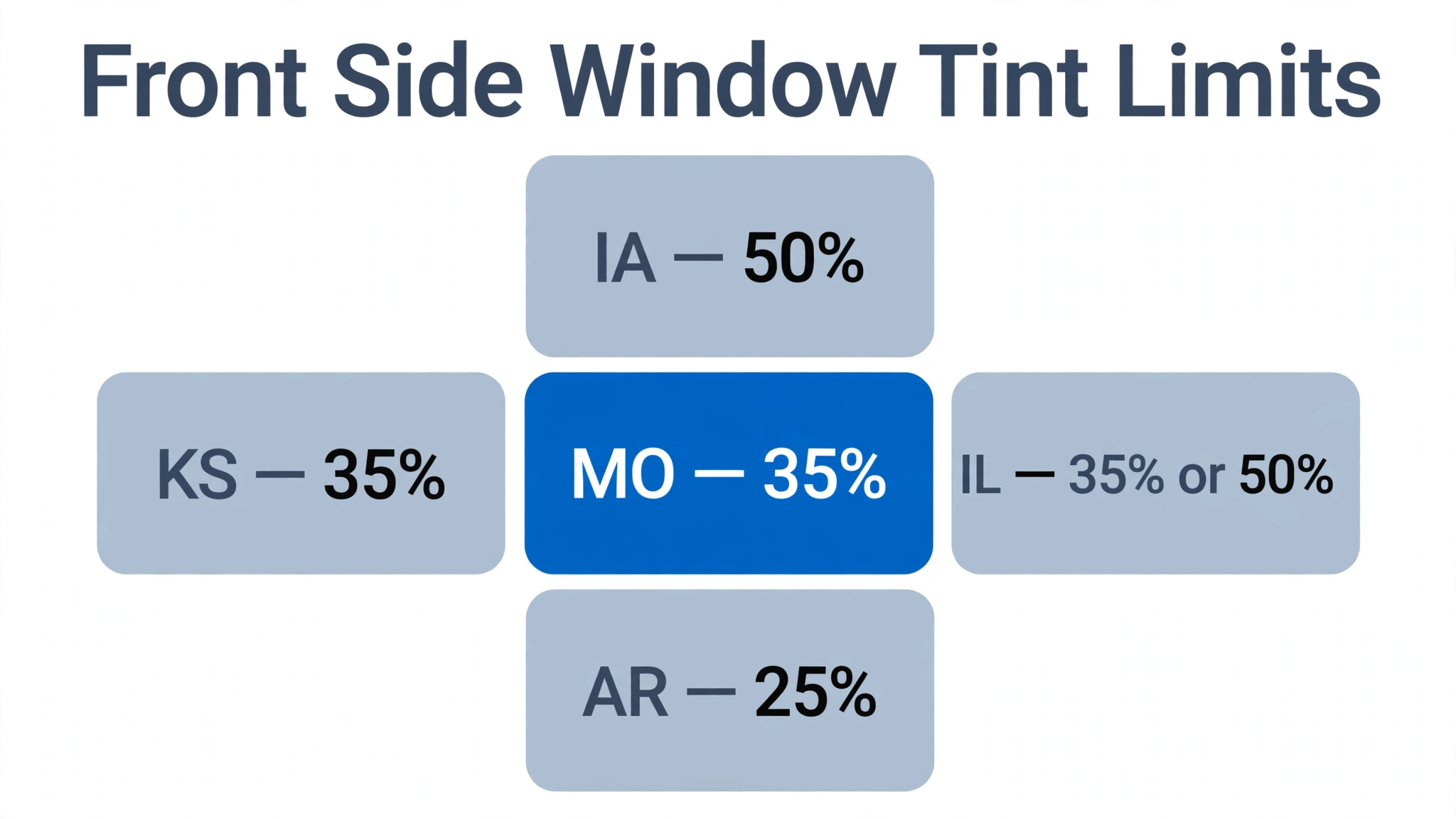
Missouri’s 35% front figure is the regional centre of gravity: Illinois runs its linked 35% or 50% system, Kansas holds every window — rear included — to 35%, and Arkansas meters its front pair darker at 25% and its rear at 10%. Iowa, at 50% since July 2026, is now the lightest front standard on Missouri’s border. Missouri’s distinctive features are structural: a tolerance printed on both numbers, a rear the statute leaves entirely alone, a windshield exception that protects only the factory band, and a medical route that ends in stickers on the glass rather than a card in the wallet — the closest cousin being Indiana’s physician-certification system, which still issues no permit at all.
Read also: Texas tint laws, Florida window tint law
How to Stay Legal
1. Front pair at 35% — finished. The standard is 35% ±3% through glass and film together. Order film that leaves margin; a 35% film over tinted factory glass can finish under the floor. 2. Watch reflectance too. Luminous reflectance must be 35% or less (±3%) on the front windows. Mirror-finish film fails on reflectance before darkness is argued. 3. Windshield: nothing aftermarket. No strip, no band, no clear film with a tint claim — only the factory shade band and required stickers are safe. 4. Rear glass is yours. Any darkness behind the driver, on any vehicle — but do not let a shop sell you a “35% rear limit”; that rule was repealed in 2002. 5. Medical need means a permit, not a note. Physician’s prescription (within a year), vehicle presented to the Highway Patrol, permit and prescription copy carried in the car, sticker and decal on the glass. 6. Historical plates exempt the car — if the vehicle genuinely qualifies and is plated as historical, § 307.173 does not apply to it. 7. Headlights stay white. Skip tinted covers; § 307.095 requires headlamps to show substantially white light, and a violation is an infraction.
Frequently Asked Questions
What is the legal tint in Missouri?
The front side windows and sidewing vents must transmit 35% or more of light (±3%) with luminous reflectance of 35% or less (±3%), glass and film together, under Mo. Rev. Stat. § 307.173. The rear side windows and rear window have no limit, and the windshield allows no sun-screening device beyond the factory-tinted upper band and required stickers. The same rules apply to every vehicle.
Is 35% tint legal in Missouri?
On the front side windows, 35% is the floor — but the floor is measured on the finished window, not the film box. A film rated 35% over factory glass that itself transmits about 80% finishes near 28%, outside even the ±3% tolerance. Legal installs aim the combined reading at 35% or above.
How dark can rear windows be in Missouri?
As dark as you like. The current § 307.173 sets no limit on the side windows behind the driver or the rear window — the Highway Patrol confirms they “are not subject to tint limitations.” Pages quoting a 35% rear limit are using the version of the statute repealed in 2002.
Can I put a tint strip on my windshield in Missouri?
Not an aftermarket one. The statute bans all sun-screening devices on the windshield and excepts only factory-installed tinted glass and material on the upper portion “normally tinted by the manufacturer” — the built-in shade band. It names no AS-1 line and no inch measurement, so a film strip sold as “AS-1 legal” has no basis in Missouri’s text.
How do I get a medical tint permit in Missouri?
Get a physician’s prescription, issued within the last year, stating your serious medical condition and the specific tint percentage you need. Take the prescription and the vehicle to the Missouri State Highway Patrol’s Motor Vehicle Inspection Division, which issues the permit (form SHP-524). Keep the permit and a copy of the prescription in the vehicle; a sticker goes on the lower left of the windshield and a decal on the rear glass or bumper. The permit stays valid while you own the vehicle.
How much is a tint ticket in Missouri?
A violation of § 307.173 is a class C misdemeanor: up to 15 days in jail and a fine up to $750 under §§ 558.011 and 558.002, plus court costs. In practice the fine and the cost of bringing the windows into compliance are the real exposure for a first ticket.
Will dark tint fail a Missouri safety inspection?
Only on the windshield. Inspection stations are not required to inspect tint on side or rear windows, so dark side glass alone does not fail the inspection — but the front windshield is inspected, and aftermarket vision-reducing material on it means rejection. Roadside enforcement is separate: troopers carry tint meters.
Did Missouri change its tint law in 2025 or 2026?
No. Section 307.173 was last amended in 2010 (House Bill 1540), and its 35% ±3% front standard dates to the 2002 rewrite. Senate Bill 1059 — an HOA-restrictions bill in the 2026 session, and education legislation in earlier ones — does not touch window tint in any recent session. The “new Missouri tint law” searches have no new law behind them.
Conclusion
Missouri wrote one of the shortest tint laws in this series: a 35% ±3% standard with a 35% reflectance cap on the two windows beside the driver, a windshield closed to everything but the factory band, a rear the statute does not regulate at all, a permit with stickers for medical need, and a class C misdemeanor behind it. The traps are documentary — a repealed 2002 text still quoting a rear limit, an AS-1 strip the statute never grants, and an inspection rule that rejects windshield film but ignores side tint. The controlling text is Mo. Rev. Stat. § 307.173, and WindowTintCentral’s Missouri tint guide tracks the same figures for drivers and shops.
Disclaimer: This article is general information about Missouri tint laws, not legal advice. Tint statutes and enforcement practice change, and how a rule applies depends on the vehicle and the facts. Confirm the current law in Mo. Rev. Stat. § 307.173, or speak with a Missouri attorney or the Missouri State Highway Patrol, before tinting, buying, or contesting a citation.