



Indiana tint laws run on two numbers and a short list. Under Indiana Code § 9-19-19-4, the windshield, the side wings, the side windows that are part of a front door, and the rear back window may not carry tint with light transmittance below 30% or total solar reflectance above 25%. That is the whole percentage law — and the first surprise is what the list leaves off: the rear side windows are never named, so the statute sets no percentage for them on any vehicle.
- Quick Answer
- Four Windows, Two Numbers: How Section 9-19-19-4 Works
- Indiana Tint Limits by Window
- The Rear Side Window Gap
- The SUV Myth: No Vehicle-Class Split
- Windshield Rules: The AS-1 Line and Nothing Below It
- Medical Exemption: A Doctor’s Certificate, Renewed Every Year
- Trucks and Semis: The Federal 70% Rule
- Penalties: $500 for Drivers, $10,000 for Installers
- How Indiana Compares With Other States
- How to Stay Legal
- Frequently Asked Questions
- What is the legal tint in Indiana?
- How dark can the rear side windows be in Indiana?
- Can an SUV or truck have darker rear tint than a sedan in Indiana?
- Can I tint my whole windshield in Indiana?
- How do I get a medical tint exemption in Indiana?
- How much is a tint ticket in Indiana?
- What tint is legal on a semi truck in Indiana?
- Did Indiana change its tint law in 2025 or 2026?
- Conclusion
The second surprise is what the law does not contain: no car-versus-SUV split, no tolerance, no sticker, and no inspection. This guide works through the statute window by window, corrects the vehicle-class myth, explains the medical certificate, and covers the separate federal 70% rule for semi trucks.
Quick Answer
Under Indiana tint laws, tint on the windshield (top strip only, reaching no further than the AS-1 line), side wings, front door side windows, and rear back window must transmit at least 30% of visible light and reflect no more than 25%, measured on the nonfilm side. The rear side windows carry no percentage in the statute. The same figures apply to cars, SUVs, vans, and pickups. A driver who breaks the rule commits a Class C infraction (judgment up to $500); an installer who applies illegal tint commits a Class A infraction (up to $10,000). A medical exemption runs on an Indiana physician’s or optometrist’s certification, carried in the vehicle and renewed every year — no BMV process exists.
Four Windows, Two Numbers: How Section 9-19-19-4 Works
Section 9-19-19-4(c) is written as a driving ban, not a film standard: a person may not drive a motor vehicle that has one of four listed windows “covered by or treated with sunscreening material or tinted with material” that fails the test. The four windows are the windshield, each side wing, each side window that is part of a front door, and the rear back window.
The test itself has two figures, and one honest complication. The statute bans material that has a total solar reflectance of visible light of more than 25%, as measured on the nonfilm side, “and light transmittance of less than 30%” in the visible light range. Read word by word, the “and” suggests a window must fail both figures to break the law. That is not how the law is enforced: the Indiana State Police state the rule as two separate limits — reflectance cannot exceed 25%, transmittance must be at least 30%. Treat the “and” as a drafting quirk, not a loophole: the safe window satisfies both numbers, and a meter reading on either figure can support a stop.
Two measurement points matter in practice. Reflectance is measured on the nonfilm side — the outside face of the glass — which is why mirrored finishes are the reflectance problem. And Indiana writes no tolerance into the section: unlike the ±3% variance band in Minnesota, a reading of 29% is simply below the line. Our guide to how window tint percentages work shows why the finished glass-plus-film figure, not the film’s box rating, is what the meter sees.
Indiana Tint Limits by Window
| Window | Indiana rule (all vehicles) |
|---|---|
| Windshield | Treatment on the uppermost part only, no further than the AS-1 line; 30% / 25% test applies |
| Side wings | 30% light transmittance minimum; reflectance 25% maximum |
| Front door side windows | 30% light transmittance minimum; reflectance 25% maximum |
| Rear side windows | Not listed in § 9-19-19-4 — no percentage; § 9-19-19-3 clear-view rule still applies |
| Rear back window | 30% light transmittance minimum; reflectance 25% maximum |
| Tolerance / colors / mirrors | No variance written in; no colors banned; no dual-mirror rule |

The Rear Side Window Gap
The most searched question about Indiana tint has a genuinely odd answer: the statute sets no darkness limit for the rear side windows. Section 9-19-19-4(c) names the windshield, the side wings, the front-door side windows, and the rear back window — and stops. The windows behind the front doors, on a sedan, an SUV, or anything else, are simply not in the percentage law. The State’s own FAQ lists the same four windows.
“No percentage” does not mean “no law.” Two backstops still reach those windows:
– The clear-view rule, § 9-19-19-3(b). No sign, poster, sunscreening material, or other nontransparent material may sit on the front windshield, side wings, or side or rear windows if it obstructs the driver’s clear view of the highway or an intersecting highway. The same subsection allows small items — four inches square or less — in the lower corner farthest from the driver. In Anthony v. State (Ind. App. 2018), the Court of Appeals reversed a § 9-19-19-3 citation because the material must be upon the windows — cargo stacked inside a car is not; applied film is. – The State Police position. In guidance reported in February 2025, the Indiana State Police described legal tint as film transmitting at least 30% of light on any side window or rear glass — a broader reading than the statute’s list. A trooper’s meter does not consult the subsection list before it reads a window.
What if scenario: An Indianapolis driver runs 5% film on the rear side windows of a sedan and 30% everywhere the statute names. On the text of § 9-19-19-4, the rear sides break no percentage rule. The risk is practical: a stop under the State Police’s 30%-everywhere position, or a § 9-19-19-3 argument if the film is said to obstruct the driver’s view. Drivers who want zero argument keep the rear sides at 30% too.
The SUV Myth: No Vehicle-Class Split
A claim repeated across tint sites holds that Indiana splits its rules by vehicle: sedans held to 30% on every window including the rear sides, while SUVs, vans, and trucks may go any darkness behind the driver. The statute says no such thing. Section 9-19-19-4 contains no vehicle classes at all: the rear back window answers to the same 30% / 25% test on a sedan and on a Suburban, and the rear side windows are unlisted for both.
The myth has a physical source: the dark rear glass on factory SUVs and trucks is manufacturer glazing under the federal standard, FMVSS 205, and subsection (a) takes factory glazing that complies with FMVSS 205 out of the section entirely. Two duties come with that exception. The proof of factory compliance — from the manufacturer, supplier, or installer — must be carried in the vehicle, ready for the officer whose meter reads factory privacy glass at 15% and cannot know it is original equipment. And the exception protects the glass as the factory made it: aftermarket film over it is measured as a finished window like any other.
Common mistake: Ordering “SUV rules” film for the rear window of a crossover because a tint site listed the rear glass as unlimited for multipurpose vehicles. On the statute, the rear back window of an SUV is a 30% window — the unlimited listing belongs to other states’ laws, not Indiana’s.
Windshield Rules: The AS-1 Line and Nothing Below It
Windshield treatment in Indiana is governed by subsection (d): anything allowed on the windshield “may be applied only to the uppermost part of the windshield” and may “extend no further than the AS-1 line.” Indiana gives no inch measurement — no five-inch or six-inch strip — so the manufacturer’s AS-1 marking is the entire rule. The strip itself must still pass the 30% / 25% test of subsection (c), which names the windshield first in its list.
Below the line, the windshield is factory glass only, and § 9-19-19-3(b) polices what sits on it: nothing that obstructs the driver’s clear view, apart from the four-inch-square allowance in the lower corner farthest from the driver. One enforcement detail cuts in the driver’s favor: subsection (f) allows an officer to stop a vehicle to determine compliance — but the vehicle, its contents, the driver, and any passenger may not be inspected, searched, or detained solely because of a tint violation. The stop is authorized; expanding it on tint alone is not.
Medical Exemption: A Doctor’s Certificate, Renewed Every Year
Indiana’s medical exemption is real, simple, and entirely paper-based. Under subsection (b), the tint section does not apply to the driver of a vehicle:
1. Owned by an individual who is required for medical reasons to be shielded from the direct rays of the sun; or 2. In which such an individual is a habitual passenger.
Three conditions must all hold: the medical reason is attested to by a physician or optometrist licensed to practice in Indiana; the physician’s or optometrist’s certification is carried in the vehicle; and the certificate is renewed annually — an expired certificate is, on the text, no exemption at all.
What the route does not involve is the BMV: the statute names no agency, no application, no state form, and no sticker. Any website selling an “Indiana tint exemption permit” is selling paper the statute never created. The exemption also reaches the tint shop: under subsection (e), an installer who tints a vehicle past the limits commits no violation when the customer submits the physician’s or optometrist’s statement described in subsection (b) — the statement is handed to the installer before the work, not produced afterward.
Trucks and Semis: The Federal 70% Rule
The search data behind this article carries a real sub-cluster of commercial and semi truck questions, and those drivers answer to a different sovereign. For a commercial motor vehicle in interstate commerce, the governing text is federal: 49 CFR 393.60(d). It allows coloring or tinting of the windshield and the windows to the immediate right and left of the driver only if the parallel luminous transmittance through the tinted glazing is not less than 70%, in the portions of glass marked as meeting that standard. The restriction, the regulation adds, “does not apply to other windows on the commercial motor vehicle.”
The practical consequences are stark. Indiana’s 30% figure does not dilute the federal 70% floor on a semi’s cab glass, and the FMCSA has refused to soften it — the agency denied the International Window Film Association’s exemption application in 2015 (Docket FMCSA-2013-0436). Troopers certified for commercial vehicle inspections can cite under the federal standard, which, as the Indiana State Police’s own outreach notes, costs more than the state infraction. A sleeper cab’s rear windows sit outside the federal restriction but remain subject to Indiana’s clear-view rule.
What if scenario: An owner-operator based in Fort Wayne runs 35% film on the cab side windows of a tractor hauling interstate freight — comfortably legal for an Indiana pickup under § 9-19-19-4, and a federal violation the first time a certified inspector meters it at a weigh station, because a commercial motor vehicle’s cab windows answer to 70%, not 30%.
Penalties: $500 for Drivers, $10,000 for Installers
Indiana prices the two ends of a tint job very differently:
– Driving a vehicle that violates the chapter is a Class C infraction under § 9-19-19-7(b). Infractions are civil judgments, not criminal fines: under § 34-28-5-4(c), a judgment of up to $500 may be entered, plus court costs. Where the violation is admitted or pleaded before the appearance date, § 34-28-5-4(f) caps the judgment itself at $35.50 plus costs. – Installing tint that makes a vehicle illegal to drive violates subsection (e), classified as a Class A infraction by § 9-19-19-8 — a judgment of up to $10,000 under § 34-28-5-4(a), plus court costs. That twenty-to-one ratio is why reputable Indiana shops meter before they install and refuse shades the statute cannot carry.
One drafting footnote, verified against the chapter’s history: § 9-19-19-8 still points at “section 4(d),” the installer ban’s address before P.L.164-2018 renumbered § 9-19-19-4 and moved the ban to subsection (e); the classification is applied to the ban where it now sits. Indiana has no periodic safety inspection, and the tint law creates no compliance sticker or installer certificate — enforcement happens entirely at the roadside.
How Indiana Compares With Other States
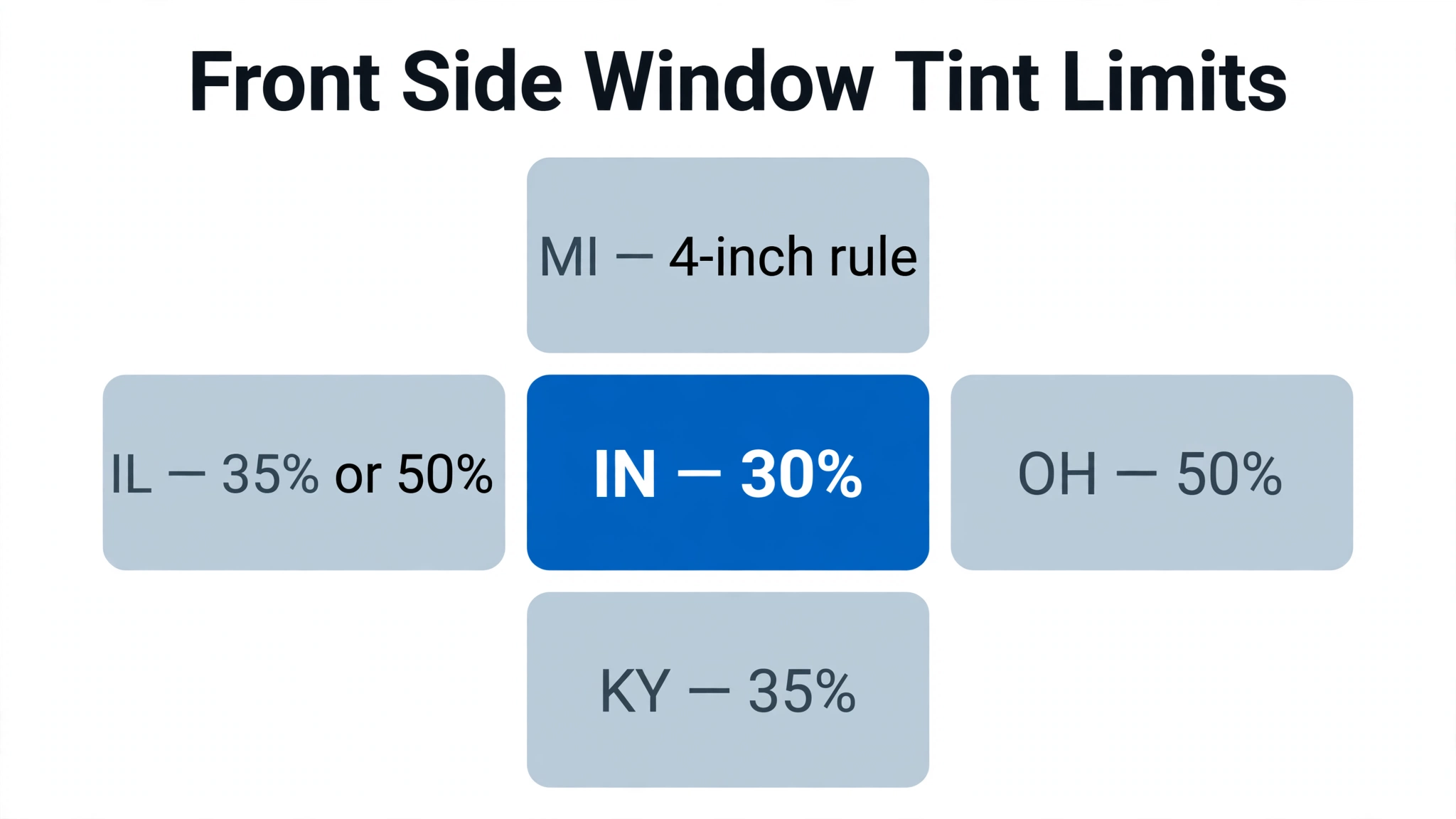
Indiana’s 30% front figure sits in the darker half of its own neighbourhood, and its rear-window rule is the strictest on the ring. Illinois runs its linked 35% or 50% front system but expressly exempts vehicles registered in another state, so an Indiana car keeps its home figures on Illinois roads. Michigan has no percentage at all — a four-inch strip rule at the front and a reflectance cap behind. Ohio’s front side standard is 50% and Kentucky’s is 35% — both lighter than Indiana’s 30%, so an Indiana-legal front window can violate on their roads, where Indiana’s medical certificate also means nothing (Kentucky has no medical exemption at all). And no neighbour replicates Indiana’s oddest feature: Pennsylvania meters nearly every window at 70%, while Indiana leaves an entire pair of windows out of its percentage law altogether.
Read also: Texas tint laws, Florida window tint law, Iowa tint laws
How to Stay Legal
1. Hold every listed window to both numbers. Windshield strip, side wings, front door windows, rear back window: at least 30% transmittance and at most 25% reflectance, finished glass and film together. The statute writes no tolerance — leave margin. 2. Windshield: strip only, to the AS-1 line. No inches are given and no full-windshield film exists in this law. 3. Rear side windows: know the gap and the risk. The statute prints no percentage, but the State Police describe 30% as the figure for any side window — 30% there too is the zero-argument choice. 4. Carry the factory proof. If your dark glass is manufacturer glazing under FMVSS 205, subsection (a) protects it only with the compliance proof in the vehicle. 5. Medical need: paper, renewed yearly. An Indiana-licensed physician’s or optometrist’s certification, carried in the car, renewed annually, and shown to the installer before any darker work. The BMV issues nothing. 6. Truckers: the cab answers to Washington, not Indianapolis. Commercial motor vehicles need 70% transmittance on the windshield and the windows beside the driver under 49 CFR 393.60(d). 7. No sticker, no certificate, no inspection — Indiana’s whole regime is the meter at the stop, and subsection (f) limits that stop to the tint question.
Frequently Asked Questions
What is the legal tint in Indiana?
Tint on the windshield (top strip only), side wings, front door side windows, and rear back window must transmit at least 30% of visible light and reflect no more than 25%, measured on the nonfilm side, under Indiana Code § 9-19-19-4. The rear side windows have no percentage in the statute. The figures are identical for cars, SUVs, vans, and pickups.
How dark can the rear side windows be in Indiana?
Section 9-19-19-4 does not list them, so the percentage law sets no floor. Two limits still apply: § 9-19-19-3(b) bans material on side or rear windows that obstructs the driver’s clear view, and Indiana State Police guidance describes 30% as the legal figure for any side window. The conservative, zero-argument specification is 30%.
Can an SUV or truck have darker rear tint than a sedan in Indiana?
No. The statute has no vehicle-class split: the rear back window is a 30% window on every vehicle, and the rear side windows are unlisted on every vehicle. The dark rear glass on factory SUVs is manufacturer glazing under FMVSS 205, exempt under subsection (a) — with the proof of compliance carried in the vehicle.
Can I tint my whole windshield in Indiana?
No. Subsection (d) allows windshield treatment only on the uppermost part, extending no further than the AS-1 line marked on the glass. Indiana sets no inch measurement, and the strip itself must pass the 30% / 25% test.
How do I get a medical tint exemption in Indiana?
Through a physician or optometrist licensed in Indiana, not the BMV — there is no agency application, form, or sticker. The doctor must attest that you (as owner) or a habitual passenger must be shielded from the direct rays of the sun for medical reasons; the certification rides in the vehicle and must be renewed annually. Give the statement to your installer before any darker tint is applied.
How much is a tint ticket in Indiana?
Driving in violation is a Class C infraction (§ 9-19-19-7(b)): a judgment of up to $500 plus court costs under § 34-28-5-4(c), with the judgment capped at $35.50 plus costs where the violation is admitted or pleaded before the appearance date. Installing illegal tint is a Class A infraction for the installer — up to $10,000.
What tint is legal on a semi truck in Indiana?
The federal rule controls the cab: under 49 CFR 393.60(d), a commercial motor vehicle’s windshield and the windows beside the driver must keep at least 70% light transmittance. Indiana’s 30% state figure does not apply to those windows on a truck in commerce. Windows behind the cab are outside the federal restriction but still answer to Indiana’s clear-view rule.
Did Indiana change its tint law in 2025 or 2026?
No. Section 9-19-19-4 was last amended by P.L.164-2018, which set the current 30% / 25% structure. No 2025 or 2026 amendment is in force — pages announcing a “new Indiana tint law” are describing the 2018 figures or another state’s change.
Conclusion
Indiana’s tint law is a short list with two numbers on it: the windshield strip, side wings, front door windows, and rear back window held to 30% transmittance and 25% reflectance — the same for a sedan as for an SUV — while the rear side windows sit outside the percentage law, guarded only by the clear-view rule and the State Police’s broader reading. The medical route is an annually renewed doctor’s certificate with no BMV in it, the installer faces twenty times the driver’s maximum judgment, and a semi’s cab answers to a federal 70% instead. The controlling text is Indiana Code § 9-19-19-4, and CarTeks’ Indiana tint guide checks the same figures against the General Assembly’s site and the State’s own FAQ.
Disclaimer: This article is general information about Indiana tint laws, not legal advice. Tint statutes and enforcement practice change, and how a rule applies depends on the vehicle and the facts. Confirm the current law in Indiana Code § 9-19-19-4, or speak with an Indiana attorney, the Indiana State Police, or the BMV, before tinting, buying, or contesting a citation.