



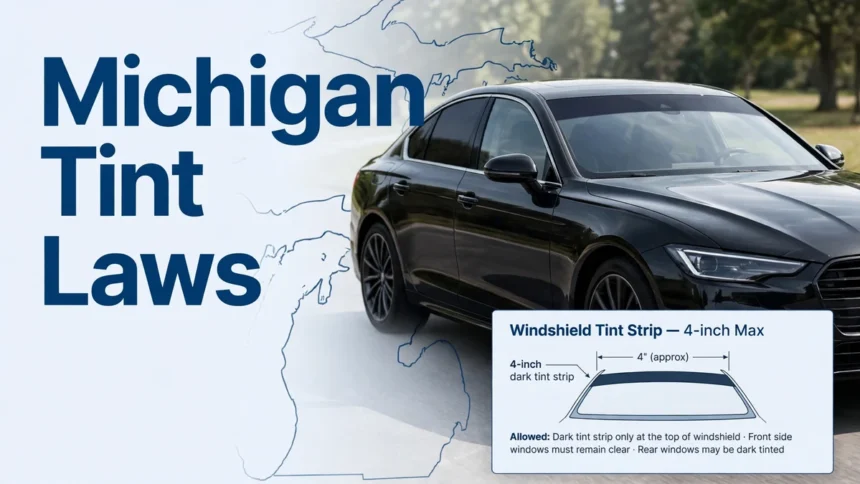
Michigan tint laws work differently from almost every other state. Michigan sets no legal tint percentage at all. Instead, the law controls where film may go: nothing on the windshield or front side windows except a strip in the top 4 inches, and almost anything behind the driver. The rule is section 709 of the Michigan Vehicle Code (MCL 257.709), and it has not changed since 2010.
- Quick Answer
- Why Michigan Has No Tint Percentage
- Michigan Tint Limits by Window
- The 4-Inch Strip Rule
- Rear Windows: Any Darkness, One Limit
- Medical Exemptions: A Letter, Not a Permit
- Penalties: The Fine, the Costs, and No Points
- Out-of-State Cars and Moving to Michigan
- Myths About Michigan Tint Laws
- How Michigan Compares With Other States
- How to Stay Legal
- Frequently Asked Questions
- Is 35% tint legal in Michigan?
- Is 20% tint legal in Michigan?
- How much is a window tint ticket in Michigan?
- Do you get points for a tint ticket in Michigan?
- How do I get a medical exemption for window tint in Michigan?
- Does Michigan tint law apply to out-of-state cars?
- What is the darkest legal tint in Michigan?
- Did Michigan tint laws change for 2026?
- Conclusion
This guide explains the 4-inch rule, the one place a “35%” figure really appears, the medical letter that replaces a permit, and what a ticket actually costs.
Quick Answer
Under Michigan tint laws, you may not put film on the windshield or front side windows below a tinted strip in the top 4 inches. Windows behind the driver — rear side windows and the rear window — may be any darkness, as long as the film’s total solar reflectance stays under 35% and the car keeps two outside mirrors if the rear view is blocked. Michigan has no VLT percentage for any window. A medical exemption exists, and it is a signed doctor’s letter kept in the car, not a state permit.
Why Michigan Has No Tint Percentage
Most states grade tint by VLT (Visible Light Transmission) — the percentage of light a window lets through. Michigan never adopted that system. The Michigan State Police say it in one sentence in their Traffic Laws FAQs: Michigan “does not have a specification for the darkness of the window application.”
That single fact breaks most of what the internet says about Michigan. When a tint shop page tells you the legal limit here is “35%,” it has copied another state’s rule. A 70% film and a 5% film are equally illegal on a Michigan front side window, because the ban is on the film being there at all, not on its shade. If you want to see how percentage-based states work, our guide to how window tint percentages work explains the system Michigan chose not to use.
So where does “35%” come from? It is real, but it measures reflectance, not darkness, and it applies only behind the driver. That rule is covered in the rear windows section below.
Michigan Tint Limits by Window
Section 257.709 names no vehicle classes, so one rulebook covers every car, SUV, van, and pickup — a sharp contrast with states that split cars and SUVs into different limits.
| Window | What Michigan allows |
|---|---|
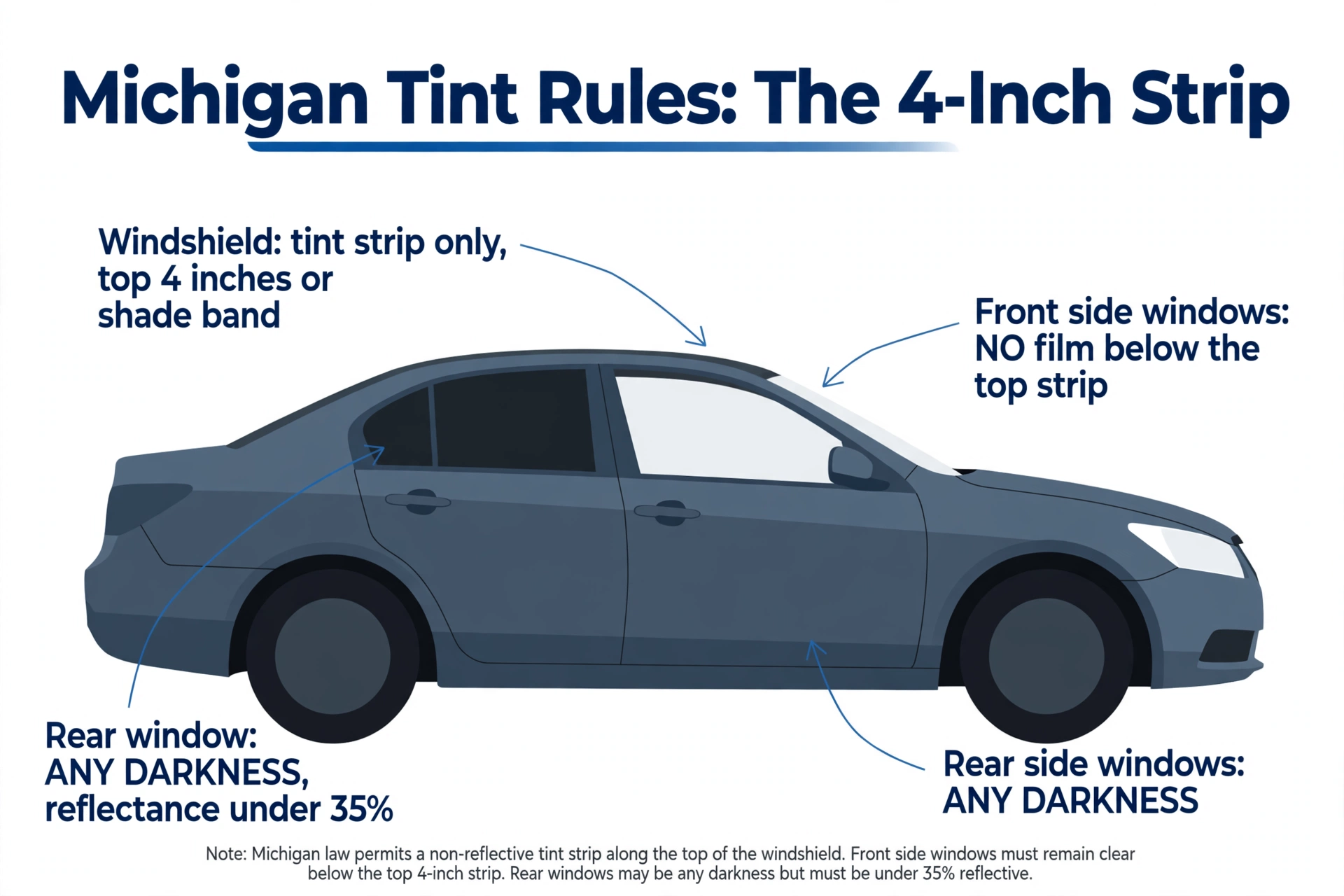
| Windshield | Tinted strip only — top 4 inches or the shade band, whichever is higher |
| Front side windows and sidewings | No film below that same top strip |
| Rear side windows | Any darkness; reflectance under 35% |
| Rear window | Any darkness; reflectance under 35%; two outside mirrors if the view through it is obstructed |
| Legal VLT percentage | None — Michigan sets no darkness percentage |
What if scenario: A Detroit driver pays for 35% film on every window because a website called it “Michigan legal.” The rear windows are fine. The front doors are not — the film there is illegal at 35%, at 50%, and at 70%, because below the top strip the legal amount of front film is zero.
The 4-Inch Strip Rule
The only tint allowed at the front of a Michigan vehicle is a strip along the top edge. Under § 257.709(1)(a), tinted film may be used along the top edge of the windshield and the front side windows only if it does not extend more than 4 inches from the top of the windshield, or lower than the shade band, whichever is closer to the top.
Three details in that sentence matter:
1. The shade band can shrink your strip. If your car’s factory shade band ends 3 inches down, the strip must stop at 3 inches, not 4.
2. Side windows are measured against the windshield. The statute measures the strip on the front side windows from “the top of the windshield,” not from the top of the door glass. On most cars those lines are close, but the legal yardstick is the windshield.
3. Michigan does not use the AS-1 line. Many states mark the windshield limit with the AS-1 line etched in the glass. Michigan’s limit is the 4-inch/shade-band measure instead, whatever an out-of-state guide says.
A Michigan Court of Appeals case makes the point bluntly: the court read subsection (1)(a) and held that it is illegal to apply any material with tinting properties to the front driver’s or passenger’s windows beyond that narrow top band — the lightness of the film is no defence.
Common mistake: ordering a “legal Michigan tint” package online that includes light front-door film. There is no such thing. Front doors get the strip, and only the strip.
Rear Windows: Any Darkness, One Limit
Behind the driver, Michigan flips from strictest to loosest. Section 257.709(3)(b) expressly allows nonreflective, smoked or tinted glass, nonreflective film, perforated screens, and other decorative applications on the rear window and the side windows behind the driver. No darkness floor applies — 5% limo tint is legal there.
One limit does apply. Under § 257.709(1)(b), no rear or rear side window may be treated with a material that creates a total solar reflectance of 35% or more in the visible light range. The statute names silver and gold reflective film as examples. In plain terms: dark is fine, mirror is not.
Two supporting rules:
– Mirrors. If tint or anything else obstructs your view through the rear window, § 257.709(2) requires two rearview mirrors, one on each side, adjusted so you can see the highway behind you. The same dual-mirror condition covers draperies and louvers on the rear glass under (3)(a).
– Factory glass counts as legal. The dark privacy glass fitted to SUVs at the factory is “smoked or tinted glass” under (3)(b), not an illegal window application.
Medical Exemptions: A Letter, Not a Permit
Michigan’s medical exemption is the simplest in the country to hold, because there is no application, no form, and no state-issued certificate. Under § 257.709(3)(e), the tint ban does not apply to a special window treatment determined necessary by a physician or an optometrist for the protection of a person who is light sensitive or photosensitive — if the owner or operator has in their possession a letter signed by that physician or optometrist stating the treatment is a medical necessity.
How it works in practice:
1. See a physician or optometrist. Only these two professions, as defined in Michigan’s Public Health Code, can make the determination.
2. Get the signed letter. It must state that the window treatment is a medical necessity. No state form exists.
3. Keep the letter in the vehicle. Possession while driving is the condition. The Michigan State Police confirm the exception allows tint on the front side windows, and that another person may drive the vehicle as long as the letter is in it.
4. Keep your view clear. The statute adds one limit: the treatment must not interfere with or obstruct the driver’s clear vision of the highway.
The statute sets no darkness limit and no expiry date for exempt film. Even so, treat the letter like a licence: if it is at home when you are stopped, the exemption does you no good at the roadside.
Penalties: The Fine, the Costs, and No Points
A Michigan tint violation is a civil infraction, not a crime. Section 257.683(6) makes equipment violations under the Vehicle Code civil infractions, and the money breaks into three parts under MCL 257.907:
– Fine: up to $100 (the general civil-infraction cap in § 257.907(2)).
– Justice system assessment: $40 per civil infraction (§ 257.907(12)).
– Court costs: up to $100 (§ 257.907(4)).
So the true ceiling is $240, and the district court sets the actual amounts inside it — which is why one driver’s ticket is $110 and another’s is $180. The flat “$95” or “$115” figures quoted online appear in no Michigan statute.
No points. Section 257.320a(4) bars points “for defective equipment,” and the Court of Appeals proved it in People v. Pitts (1997): a driver assessed two points for front window tint had them reversed, because tinted windows are an equipment violation for which no points may be assessed. If points ever appear on your record after a tint ticket, Pitts is the case to raise.
One possible break: § 257.907(9) lets a court waive the fine, costs, and assessments on a defective-equipment citation when a law enforcement agency certifies the repair was made before the court date. Whether a court applies that waiver to a § 709 citation varies by court — but showing up with the film already removed is never a bad strategy.
Out-of-State Cars and Moving to Michigan
Michigan wrote visitors a real exemption. Under § 257.709(3)(d), the tint section does not apply to a vehicle registered in another state, territory, commonwealth, country, or province. Drive in from Toledo, Indianapolis, or Ontario with tint that is legal at home, and Michigan’s 4-inch rule does not reach your car while it stays registered there.
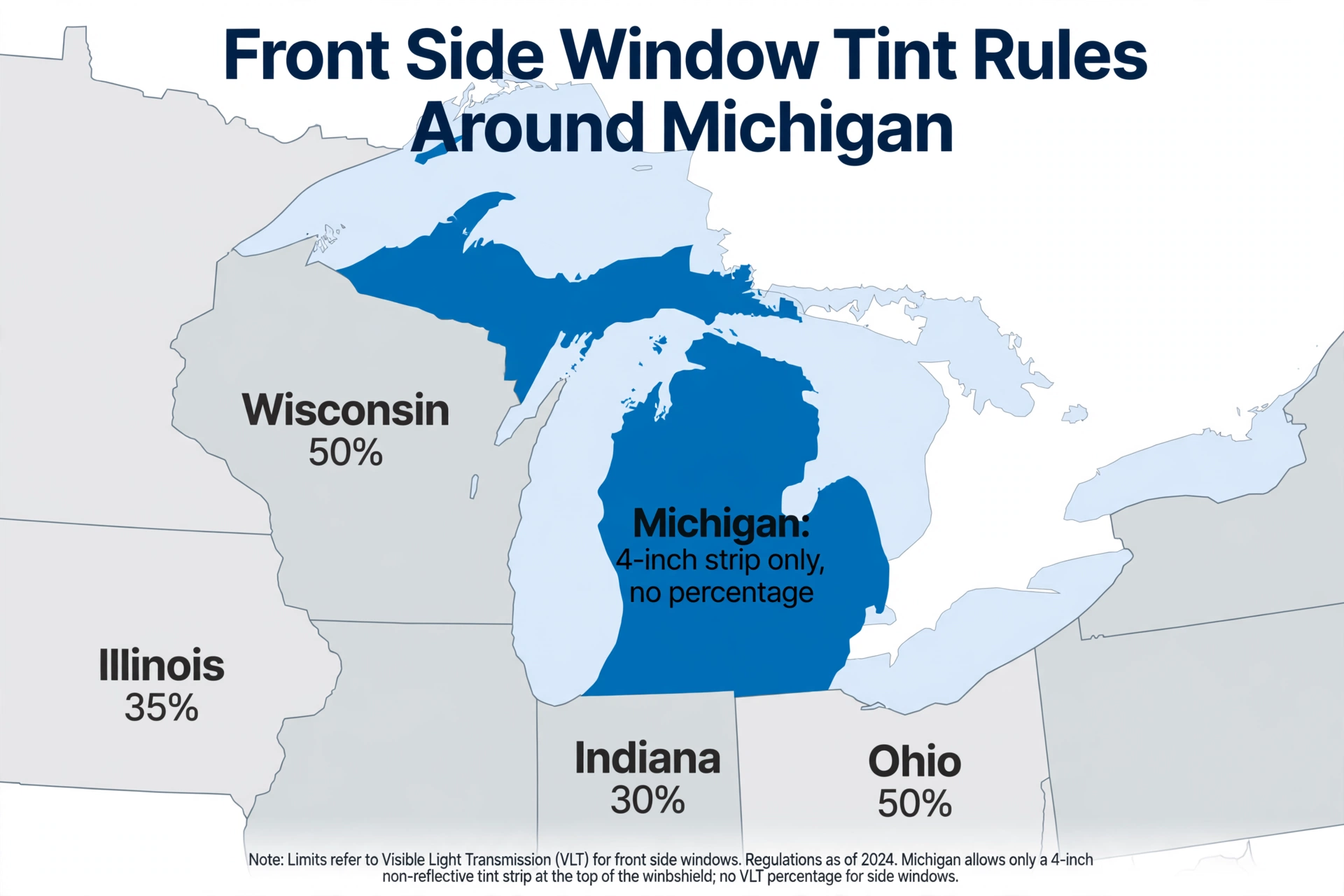
The flip side bites new residents. Once you register the vehicle in Michigan, the exemption ends and the full rule applies — including the front-window ban. A car that was perfectly legal under Ohio’s tint laws, which allow 50% film on the front side windows, becomes illegal in Michigan the day it wears Michigan plates, because Michigan allows no front film below the strip at any shade.
What if scenario: A nurse moves from Columbus to Ann Arbor with 50% front tint, legal in Ohio. Her first Michigan registration makes the car a Michigan vehicle. The rear film can stay; the front film has to come off — all of it, not just down to some percentage.
Myths About Michigan Tint Laws
Because Michigan’s system is unusual, bad information spreads fast. The claims below appear on tint pages every year. None of them is in the statute.
– “Michigan allows 35% tint on the front windows.” False. There is no front percentage. The 35% figure is the reflectance cap for rear glass.
– “Tint is allowed down to the AS-1 line.” False. Michigan uses the 4-inch / shade band measure, not the AS-1 line.
– “A tint ticket costs $95 (or $115) and adds 2 points.” False on both halves. The fine is court-set inside a $240 ceiling of fine, assessment, and costs, and People v. Pitts settled that tint carries no points.
– “The law changed in 2024 / 2025 / 2026.” False. MCL 257.709 was last amended by 2010 PA 258. Pages announcing recent Michigan tint changes are describing a law that does not exist.
– “You need to apply to the state for a medical tint permit.” False. There is no permit. There is a doctor’s letter, kept in the car.
How Michigan Compares With Other States
Michigan’s neighbours mostly use the percentage system Michigan rejected:
– Ohio’s tint laws allow 50% VLT on the front side windows — film that is flatly illegal across the state line in Michigan.
– Colorado’s tint laws set a 27% floor on every window and offer no medical exemption at all, where Michigan offers the letter.
– New York’s tint laws require 70% on side windows and check tint at inspection — strict like Michigan, but by percentage.
– California’s tint law and Texas tint laws both grade the front windows by VLT (about 70% effective in California, 25% in Texas).
– Florida’s window tint law allows 28% front and 15% rear for cars — darker at the front than Michigan permits at any shade.
– Read also: Virginia’s tint law and Georgia’s tint laws, two more percentage states whose front limits (50% and 32%) would both fail in Michigan.
How to Stay Legal
1. Front windows: strip only. Windshield and front side windows get a tinted strip in the top 4 inches or down to the shade band, whichever is higher — and nothing below it.
2. Rear windows: dark is fine, mirror is not. Any darkness behind the driver, with total solar reflectance under 35% — skip silver and gold films.
3. Keep two outside mirrors. If your rear window is tinted dark enough to block the view through it, both side mirrors are a legal requirement, not an accessory.
4. Carry the letter. Medical tint without the signed physician or optometrist letter in the car is just illegal tint at a traffic stop.
5. Re-check your car when you move. Out-of-state tint is exempt only while the car stays registered out of state. Michigan plates mean Michigan rules.
Frequently Asked Questions
Is 35% tint legal in Michigan?
On the rear side windows and rear window, yes — Michigan sets no darkness limit there. On the front side windows, no: no film of any shade is legal below the top 4-inch strip. The 35% in Michigan law is a reflectance cap for rear glass, not a darkness limit.
Is 20% tint legal in Michigan?
The same split applies. Twenty percent is legal behind the driver, illegal on the front side windows and windshield below the top strip — as is 50% or 70%. At the front, Michigan bans the film itself, not a shade of it.
How much is a window tint ticket in Michigan?
It is a civil infraction. The fine can reach $100, plus a $40 justice system assessment and court costs of up to $100 — a $240 ceiling, with the district court setting the real amount. Many drivers pay somewhere in the $110–$180 range once costs are added.
Do you get points for a tint ticket in Michigan?
No. Michigan law bars points for defective equipment, and in People v. Pitts (1997) the Court of Appeals reversed two points assessed for front window tint, holding that tinted windows are an equipment violation for which no points may be assessed.
How do I get a medical exemption for window tint in Michigan?
Ask a physician or optometrist to sign a letter stating that a special window treatment is a medical necessity because you are light sensitive or photosensitive. There is no state form, permit, or sticker — keep the signed letter in the vehicle whenever you drive.
Does Michigan tint law apply to out-of-state cars?
No. Section 257.709(3)(d) exempts vehicles registered in another state, territory, or country from Michigan’s tint section. Your home state’s rules travel with the car — until you register it in Michigan, when Michigan’s rules apply in full.
What is the darkest legal tint in Michigan?
Behind the driver, there is no darkness limit — even 5% “limo tint” is legal on rear side windows and the rear window if reflectance stays under 35% and you keep two outside mirrors. At the front, the darkest legal tint below the top strip is none at all.
Did Michigan tint laws change for 2026?
No. MCL 257.709 was last amended by 2010 PA 258 and reads the same today: a 4-inch strip at the front, any darkness at the rear, reflectance under 35%, and a doctor’s-letter medical exemption. Websites announcing a recent Michigan tint update are mistaken.
Conclusion
Michigan tint laws ask one question other states do not: not how dark is your film, but where is it. Film belongs in a 4-inch strip at the top of the windshield and front side windows, and almost nowhere else at the front. Behind the driver, Michigan is among the most permissive states in the country — any darkness, one reflectance cap, two mirrors. Add the doctor’s-letter exemption and the out-of-state carve-out, and the whole system fits in MCL 257.709, published by the Michigan Legislature and in FindLaw’s Michigan Compiled Laws library; the Court of Appeals’ reading of the front-window ban is in its 2001 tint decision.
If you are cited and believe the film, the measurement, or the stop was wrong, a Michigan traffic attorney can tell you quickly whether the ticket is worth fighting — equipment tickets are often cheaper to fix than to contest, but points or a wrong reflectance claim are worth a second look.
Disclaimer: This article is general information about Michigan law, not legal advice. It is not a substitute for advice from a qualified attorney licensed in Michigan. Laws and court practice can change, so check the current statute or speak to a lawyer about your situation.