



The HexClad lawsuit was a California class action over cookware that was sold as “non-toxic” and “PFAS free.” It ended in a $2.5 million settlement that a judge approved on March 9, 2026, and HexClad denied doing anything wrong.
- Quick Answers
- What Is the HexClad Lawsuit?
- HexClad Lawsuit Timeline
- What the Buyers Claimed
- What HexClad Said and Why a Settlement Is Not a Court Loss
- HexClad Lawsuit Settlement Terms
- Settlement Payouts: When and How Much
- HexClad Lawsuit Deadline: What If You Missed It?
- The Rolls-Royce Trademark Lawsuit Against HexClad
- Is HexClad Cookware Safe?
- Why Cookware Lawsuits Like This Keep Happening
- Practical Steps for HexClad Owners
- When to Talk to a Lawyer
- FAQ Section
- Conclusion
If you own a HexClad pan, you probably want to know where the HexClad lawsuit stands. Three questions come up most. Were you covered? Is the claim window still open? And is your cookware safe to use?
Quick Answers
- What was the HexClad lawsuit about? Buyers said HexClad advertised its pans as non-toxic and free of PFAS and PFOA, even though the nonstick coating contained PTFE.
- How much was the settlement? $2,500,000.
- Who was covered by the HexClad lawsuit settlement? People in the United States who bought certain HexClad products between February 1, 2022 and March 31, 2024.
- Is the HexClad lawsuit claim deadline still open? No. The deadline was November 14, 2025.
- Did HexClad admit fault? No. The company denied the allegations.
- Was there a recall in the HexClad lawsuit? No recall was part of the deal.
What Is the HexClad Lawsuit?
The HexClad lawsuit is a consumer class action called Cliburn et al. v. One Source to Market, LLC. One Source to Market is the company behind the HexClad brand. According to ClassAction.org, the case was filed on November 17, 2023, under case number 23STCV28390 in California.
Several buyers brought the case, including Mandy and Matthew Cliburn. They sued on behalf of everyone who bought the same products during the same period. That is what makes it a class action.
Chef Gordon Ramsay is the face of the brand, but he was not the defendant. The company was.
If you want to see how class actions are tracked once they are filed, our Life360 lawsuit guide shows what a case status update usually covers.
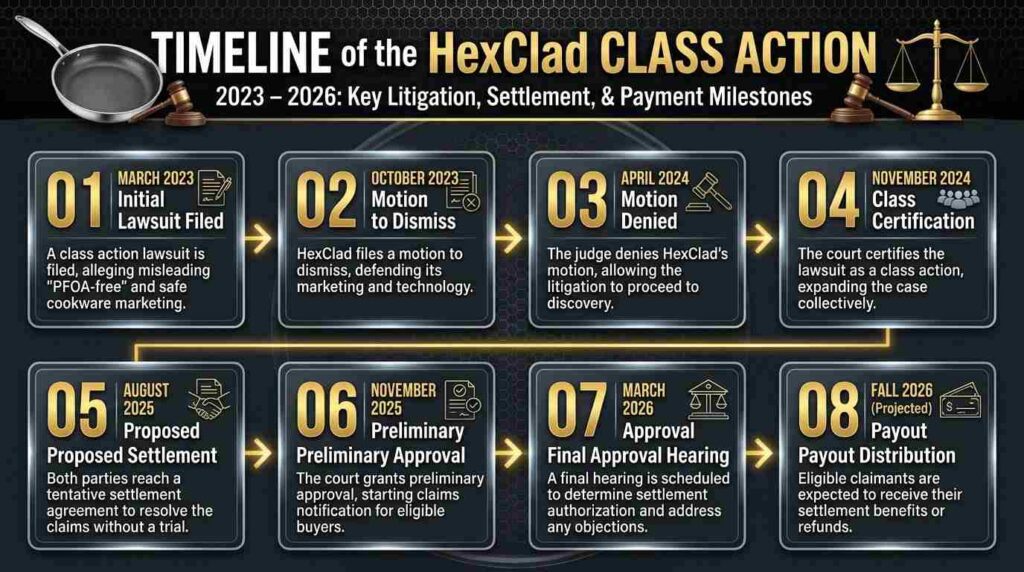
HexClad Lawsuit Timeline
Here is the full path of the HexClad lawsuit, from filing to payouts.
| Date | What Happened |
|---|---|
| February 1, 2022 to March 31, 2024 | The period covered by the settlement class |
| August 23, 2023 | Rolls-Royce files a separate trademark suit against HexClad’s parent company |
| November 17, 2023 | The PFAS class action is filed in California |
| April 22, 2025 | The court grants preliminary approval |
| November 14, 2025 | Deadline to file a claim |
| February 10 and 20, 2026 | Further fairness hearings are held |
| March 9, 2026 | The judge signs the order granting final approval |
| Spring and summer 2026 | Payments to approved claimants are expected to go out |
One note on dates. A few cookware blogs list February 20, 2026 as the approval date. The more detailed accounts point to a hearing on that day and a signed order on March 9, so this article uses March 9.
What the Buyers Claimed
The buyers said HexClad’s marketing did not match what was in the pan. They pointed to three phrases in particular: “non-toxic,” “PFOA free,” and “PFAS free.” They also challenged a claim that the pans were safe for metal utensils.
The core of the complaint was a chemical called PTFE, short for polytetrafluoroethylene. PTFE is the slippery coating many people know as Teflon. The plaintiffs argued that PTFE belongs to the PFAS family, often called “forever chemicals,” so calling the pans PFAS free was misleading.
Here is what the key terms mean in plain English:
- PFAS are man-made chemicals used for their resistance to heat, water, and grease. They break down very slowly.
- PFOA is one older PFAS chemical that US manufacturers phased out of nonstick production.
- PTFE is a fluoropolymer, which is a type of PFAS, used in many nonstick coatings.
The HexClad lawsuit relied on California consumer laws. These include the Unfair Competition Law, the Consumers Legal Remedies Act, and the Song-Beverly Consumer Warranty Act. In simple terms, these laws let buyers challenge ads that could fool a reasonable shopper.
A key point many articles miss: the HexClad lawsuit was about marketing claims, not about proving that anyone got sick. No plaintiff had to show a health injury for the case to move forward.
What HexClad Said and Why a Settlement Is Not a Court Loss
HexClad denied all wrongdoing. The settlement notice says the company resolved the case without admitting fault.
This matters because people often search “did HexClad lose the lawsuit?” The accurate answer is no. A judge never ruled on whether the ads were false. The parties settled, and the court only checked that the deal was fair to the class.
Companies settle for many reasons. A trial costs money, takes years, and brings bad press. Paying $2.5 million can be cheaper than fighting, even when a company believes it would win.
Still, a settlement is not nothing. HexClad agreed to pay, and it agreed to change how it advertises.
HexClad Lawsuit Settlement Terms
Here are the main terms, based on the settlement agreement as reported by ClassAction.org and the settlement summary on Top Class Actions.
The money. HexClad agreed to pay $2,500,000 into a settlement fund. The fund covers payments to class members, attorneys’ fees, administration costs, and $2,500 service awards for each class representative.
Who was covered. The class included anyone in the United States or its territories who bought one or more eligible HexClad products between February 1, 2022 and March 31, 2024.
Which products. Covered items included hybrid pans in sizes from 7 inches to 14 inches, hybrid woks, griddle pans, saucepans, stock pots, deep saute pans, and pot lids. Sets that included those pans also counted, such as the 12-piece, 13-piece, and 6-piece cookware sets and several bundles.
How payments were set. Each valid claim received a pro rata share of what was left in the fund. The agreement says no one could receive more than they paid for the covered items.
The advertising change. HexClad agreed to stop calling products “non-toxic,” “PFOA free,” or “PFAS free” if they contain PTFE or any other PFAS chemical.
No recall. The settlement did not require HexClad to recall or replace pans.

Settlement Payouts: When and How Much
After the judge granted final approval of the HexClad lawsuit settlement on March 9, 2026, the administrator could start issuing payments. Most accounts expected checks and electronic payments to go out about 90 days later, which points to a window from late spring through the summer of 2026, as long as no one filed an appeal.
How much did people get? There was no fixed number.
The amount depended on how many valid claims came in and how much each person paid for covered products. Because one fund was split among every valid claim, payouts were likely modest.
No verified official average has been published that we could find, so treat any specific dollar figure you see online as an estimate. If you filed a claim, the settlement administrator is the only reliable source for your payment status.
If you want a sense of how other consumer refund programs are paid out, our report on the Walmart $5.6 million overcharging settlement shows another example of how shoppers receive money in this type of case.
HexClad Lawsuit Deadline: What If You Missed It?
The claim deadline was November 14, 2025. Since it has passed, you cannot submit a new claim for this settlement.
Here is what that usually means in practice:
- You probably cannot file a late claim. Courts rarely reopen a closed window.
- You are likely bound by the deal. Class members who did not opt out generally give up the right to sue separately over the same claims for the covered products.
- Later purchases are different. If you bought HexClad cookware after March 31, 2024, you were outside the class period.
- Warranty issues are separate. A peeling pan or a defect covered by the manufacturer’s warranty is a different matter from this class action.
Not sure whether a particular case covers you? Our guide to the CarGuard lawsuit explains who can file a claim in a similar class case, and the same eligibility questions apply here: purchase dates, product types, and proof.
Hypothetical example. Maria bought a 12 inch hybrid pan in June 2023. She never saw the notice and missed the deadline. She likely cannot claim now, but she may still have a warranty claim if the pan itself fails.
Second hypothetical. Dev bought the same pan in July 2024. His purchase falls after March 31, 2024, so he was not in this class at all.
This is an example only. Your situation may be different.
The Rolls-Royce Trademark Lawsuit Against HexClad
The PFAS class action was not the only HexClad lawsuit. In August 2023, Rolls-Royce Motor Cars sued One Source to Market in federal court in New Jersey, under case number 2:23-cv-08387, as reported by Law.com’s New Jersey Law Journal.
The problem was a slogan. HexClad’s ads featured Gordon Ramsay calling the pans “the Rolls Royce of pans.” Rolls-Royce said that use of its name amounted to trademark infringement, dilution, and unfair competition.
HexClad fought back. It argued that the phrase was a way to describe quality, not a way to point to a brand, and it asked the court to declare that it did not infringe. The Fashion Law later reported that the case settled, though public reports do not detail the terms.
This second HexClad lawsuit is a good lesson in how trademark law works. A famous name can be protected even when the products are very different, such as cars and cookware. For another example of a modern trademark fight, read our update on the Buc-ee’s Teddy’s Market lawsuit.
Is HexClad Cookware Safe?
This is the question behind most searches. The honest answer has two parts.
First, the HexClad lawsuit did not decide it. No court ruled that HexClad pans make people sick. The case asked whether the advertising was misleading.
Second, regulators treat intact nonstick cookware as acceptable. The FDA has authorized certain PFAS for use in nonstick cookware coatings, and it describes a premarket review for those uses. You can read the agency’s overview of authorized PFAS uses in food contact products. As reported by the Washington Post, an FDA spokesperson has also said the agency is not aware of research showing the PFAS used in nonstick cookware is a safety concern for consumers.
That said, PFAS as a broad group are a serious public health topic. The EPA explains what it currently understands about PFAS health and environmental risks, and many shoppers choose to avoid them for that reason.
The main practical risk with PTFE pans is overheating. According to Healthline’s nonstick cookware safety guide, these pans are generally considered safe for everyday cooking if they stay under 500 degrees Fahrenheit. Fumes from an overheated pan can cause polymer fume fever, which brings temporary flu-like symptoms.
HexClad has since moved toward a newer coating. Reporting on the settlement notes that the company began transitioning in 2024 to a PTFE-free coating, and HexClad’s own product pages describe a coating called TerraBond. Check the exact product listing for the pan you are buying, because older and newer lines may be sold side by side.
This is not medical advice. If you have health concerns, talk to a qualified professional.

Why Cookware Lawsuits Like This Keep Happening
The HexClad lawsuit fits a larger pattern. Brands use health words like “non-toxic,” “clean,” and “free of forever chemicals” because shoppers pay more for them. When a label promises something absolute, a single ingredient can undo it.
ClassAction.org has also reported similar claims against other cookware brands, including Made In and Anolon. These cases follow a familiar script: a marketing phrase, a lab or ingredient detail that seems to contradict it, and a class of buyers who say they paid extra.
Class actions are not limited to kitchenware. Product complaints in other fields follow the same path, as shown in our coverage of the Ford F-150 oil consumption lawsuit.
The takeaway for shoppers: words like “non-toxic” are marketing claims, not legal standards. There is no single government definition that cookware makers must meet to use them.
Practical Steps for HexClad Owners
Here is a simple checklist to follow after the HexClad lawsuit.
- Find your purchase date. Check your email receipt or order history. If it falls between February 1, 2022 and March 31, 2024, you were in the class period.
- Check your claim status. If you filed a claim, contact the settlement administrator for payment details instead of relying on blogs.
- Look at your pan. Deep scratches or flaking are signs to retire any nonstick pan.
- Cook within heat limits. Avoid heating an empty pan, and keep temperatures below the maker’s stated limit.
- Read the product page before buying. Look for the actual coating name, not just a slogan.
- Keep your records. Receipts and order numbers are useful if you ever need to prove a purchase.
Common pitfalls to avoid:
- Assuming a settlement means a product was banned or recalled.
- Trusting a dollar figure from a random website instead of the administrator.
- Missing a claim deadline because the notice landed in spam.
- Using an empty pan on high heat.
When to Talk to a Lawyer
Most HexClad owners do not need a lawyer. The HexClad lawsuit handled the claims for the covered period.
You may want to speak with one if you believe you were injured by a product, if you have a warranty dispute that the company will not resolve, or if you are unsure whether the settlement released your claims. Because laws and deadlines differ by state, only an attorney who knows your jurisdiction can tell you where you stand.
Not sure what kind of professional to call? Our explainer on attorney vs lawyer breaks down the difference in simple terms.
FAQ Section
1. Is there a HexClad lawsuit?
Yes. A California class action called Cliburn v. One Source to Market, LLC challenged HexClad’s “non-toxic” and “PFAS free” claims. It ended in a $2.5 million settlement.
2. Did HexClad lose the lawsuit?
No. The parties settled, and HexClad denied all allegations. A court did not decide whether the ads were false.
3. How much was the HexClad lawsuit settlement?
The settlement fund was $2,500,000. Class members received a pro rata share after fees and costs, and no one could get more than they paid.
4. Can I still file a claim in the HexClad lawsuit?
No. The claim deadline was November 14, 2025, so the window is closed.
5. When were HexClad lawsuit payments sent?
The judge granted final approval on March 9, 2026. Payments were expected roughly 90 days later, from late spring into summer 2026.
6. Which products did the HexClad lawsuit cover?
Eligible items included many hybrid pans, woks, griddle pans, pots, stock pots, deep saute pans, and sets bought between February 1, 2022 and March 31, 2024.
7. Does HexClad cookware contain PTFE?
The lawsuit alleged that the covered products used PTFE, and HexClad agreed to stop using “non-toxic” and “PFAS free” on products that contain PTFE or other PFAS. HexClad says newer products use a different coating, so check the listing for your exact pan.
8. Was there a recall after the HexClad lawsuit?
No. The settlement did not include a recall.
Conclusion
The HexClad lawsuit is over. It ended in a $2.5 million settlement, final approval on March 9, 2026, and a promise from HexClad to stop using certain health claims on pans that contain PTFE or other PFAS.
For owners, the facts are simple. The claim window has closed, no recall was ordered, and no court ruled on whether the pans are safe. The settlement changed how HexClad can advertise certain products.
If you want to keep learning about consumer cases like this one, browse our lawsuit coverage for more updates. And if you have a specific legal question, speak with a qualified attorney licensed in your jurisdiction.