



When trucking firms file Chapter 11, they ask a federal bankruptcy court for time to fix their debts while the trucks keep rolling. The company stays in charge, pays key bills first, and proposes a plan to repay creditors over time. It is a reorganization, not a shutdown.
- What Does It Mean When Trucking Firms File Chapter 11?
- Why Trucking Companies Are Filing in 2026
- Recent Trucking Chapter 11 Filings
- How a Trucking Company Files Chapter 11 Step by Step
- The New $7.5 Million Subchapter V Limit
- Chapter 11 vs Chapter 7 for Trucking Companies
- What Happens to Drivers and Employees
- What Happens to Owner-Operators
- What Shippers and Brokers Should Do
- Lenders, Lessors and Vendors
- Accident Claims Against a Bankrupt Carrier
- Operating Authority and Insurance During Bankruptcy
- Common Mistakes to Avoid
- When to Talk to a Lawyer
- Frequently Asked Questions
- Why do trucking firms file Chapter 11?
- Does Chapter 11 mean a trucking company is going out of business?
- What is the Subchapter V debt limit for trucking firms in 2026?
- Do drivers get paid if a trucking company files Chapter 11?
- Can a trucking company in Chapter 11 keep hauling freight?
- What is the difference between Chapter 11 and Chapter 7 for a trucking company?
- Can I still sue a trucking company that filed Chapter 11?
- Conclusion
This topic is in the news for a reason. Sixteen trucking and delivery companies entered bankruptcy court between late August and September 21, 2026, according to a FreightWaves count, and half of them chose Chapter 11. On November 10, 2026, a new federal law also doubled the debt limit for small business reorganizations, which matters a lot for small fleets.
This is general information only and not a substitute for advice from a qualified attorney licensed in your jurisdiction. Bankruptcy rules are federal, but court practices and state laws differ.
What Does It Mean When Trucking Firms File Chapter 11?
Chapter 11 is the part of the U.S. Bankruptcy Code built for reorganization. According to the U.S. Courts bankruptcy basics page, a Chapter 11 debtor usually proposes a plan to keep its business alive and pay creditors over time.
The company becomes a debtor in possession. That means the owners and managers keep running the business, with court oversight. Dispatchers still dispatch. Drivers still drive.
The filing also triggers the automatic stay. Most lawsuits, collection calls and repossession efforts must stop while the case is open. For a carrier facing a truck lender at the yard gate, that pause can save the business.
A Chapter 11 case ends in one of three ways: the court confirms a reorganization plan, the case converts to Chapter 7 liquidation, or the court dismisses it. If you want the basics first, our plain guide on what a bankruptcy is and how the main types work covers all chapters in simple terms.
Key takeaway: Chapter 11 buys time and legal protection. It does not erase every debt automatically, and it does not guarantee survival.
Why Trucking Companies Are Filing in 2026
Trucking runs on thin margins. When costs climb faster than rates, a carrier can fall behind in a few months. Several pressures hit at once this year.
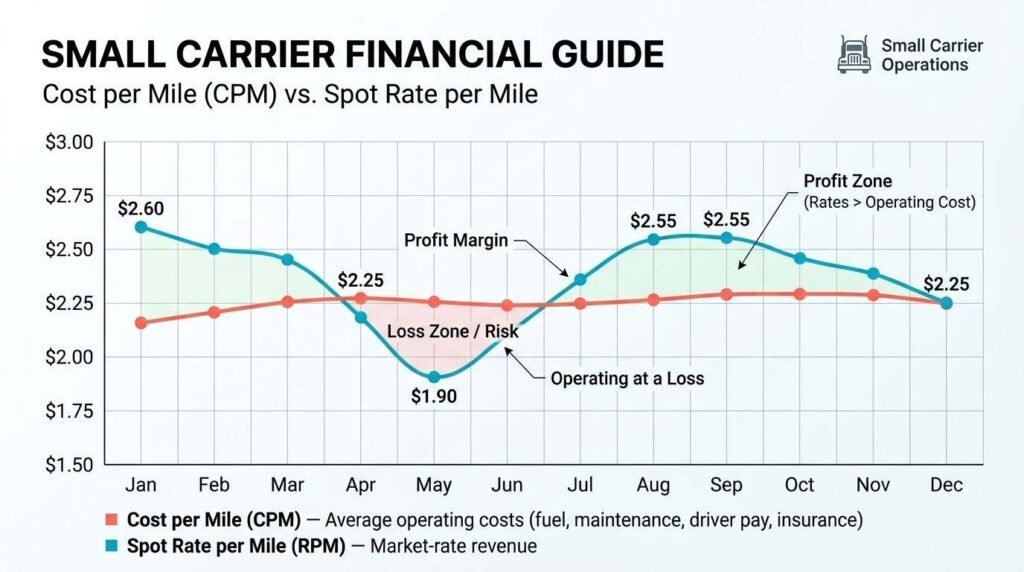
The American Transportation Research Institute (ATRI) reported in July 2026 that the average cost to run a truck reached a record $2.336 per mile in 2025, up 3.4% from 2024. Costs outside fuel rose 4.2% to $1.854 per mile. ATRI’s 2026 cost report also noted that early 2026 data showed the same trend continuing.
| Pressure | What the data shows |
|---|---|
| Operating cost per mile | $2.336 in 2025, a record, up 3.4% (ATRI) |
| Insurance per mile | 10.6 cents in 2025, up 23.9% from 2021 (ATRI) |
| Diesel | National average of $6.53 per gallon on September 21, 2026 |
| Spot rates | DAT dry van spot rate near $2.17 per mile in August 2026 |
| Business bankruptcies | 26,941 filings in the 12 months ending June 2026 |
Do the math on a hypothetical small carrier. If it earns about $2.17 per mile on the spot market and its all-in cost is near $2.30, every loaded mile loses money before the owner takes a paycheck. Equipment notes and insurance premiums still come due on the first of the month.
Small operators in other industries feel the same squeeze. Our report on Mexican restaurant bankruptcies in 2026 shows how rising costs and weak demand push thin-margin businesses toward court.
Common causes of a trucking Chapter 11 filing:
- Falling freight rates and fewer loads
- Higher insurance, fuel, repair and equipment payments
- Slow-paying customers and tight cash flow
- Large lawsuit judgments or settlements
- Driver pay increases to keep trucks staffed
Recent Trucking Chapter 11 Filings
Recent cases show how wide the trend is. Small owner-operators, regional fleets and delivery contractors have all filed.
Trucking Dive reported on August 19, 2026 that Anchor South Transport (Alabama), Rambo Transport (California) and Stoneman Trucking (Michigan) filed Chapter 11 petitions. Trucking Dive’s coverage noted that business filings rose 16.9% from Q3 2025 to Q2 2026 compared with the prior 12 months.
| Company | Reported assets | Reported liabilities |
|---|---|---|
| Anchor South Transport (AL) | About $1.4 million | About $2.2 million |
| Rambo Transport (CA) | About $417,000 | About $454,000 |
| Stoneman Trucking (MI) | Over $1 million | Over $892,000 |
In September 2026, the FreightWaves roundup counted eight Chapter 11 cases and eight Chapter 7 cases. The Chapter 11 group included Xoco Transport in Texas (over 40 tractors and 65 drivers), Globemaster in Illinois (51 power units) and CLJ Transporting in Florida (18 trucks, working as an Amazon delivery contractor).
A pattern stands out. Seven of the eight Chapter 7 filers ran six or fewer trucks, while the Chapter 11 filers ran roughly 14 to 51 power units. Mid-size fleets with real equipment and contracts tend to try reorganizing first.
Earlier in 2026, STG Logistics and Mast Trucking of Kansas, which ran 55 trucks, also filed. Bulmaks, an interstate freight company, reportedly blamed falling income and rising insurance, fuel and equipment costs.
A history lesson worth knowing: Yellow Corporation filed Chapter 11 in Delaware on August 6, 2023, with roughly 30,000 employees. It had already stopped operations, so the case became a wind-down and asset sale.
Not every large case ends that way. For a look at a carrier-style reorganization where the business kept operating, see our explainer on the American Airlines bankruptcy, where the company filed Chapter 11 in 2011 and kept flying.
How a Trucking Company Files Chapter 11 Step by Step
The process follows a general order. Timing varies by court and case size.
- Prepare the petition. The company lists assets, debts, creditors and income in the court filing.
- File in the right district. A carrier usually files where it is based or incorporated. Xoco filed in the Southern District of Texas, while Globemaster filed in the Northern District of Illinois.
- First day motions. The company asks the judge for quick approval to pay drivers, keep insurance active and use cash. These early orders keep trucks moving.
- Automatic stay starts. Creditors must pause collection. Lenders can still ask the court for permission to take back equipment.
- Creditors’ meeting. The company answers questions under oath from the trustee and creditors.
- Plan and disclosure statement. The debtor proposes how it will repay creditors. Under general Chapter 11 rules the debtor has an early window to file the plan before others can.
- Vote and confirmation. Creditors vote, and the judge decides whether the plan meets the legal tests.
- Carry out the plan. The company makes payments under the plan, often over several years.
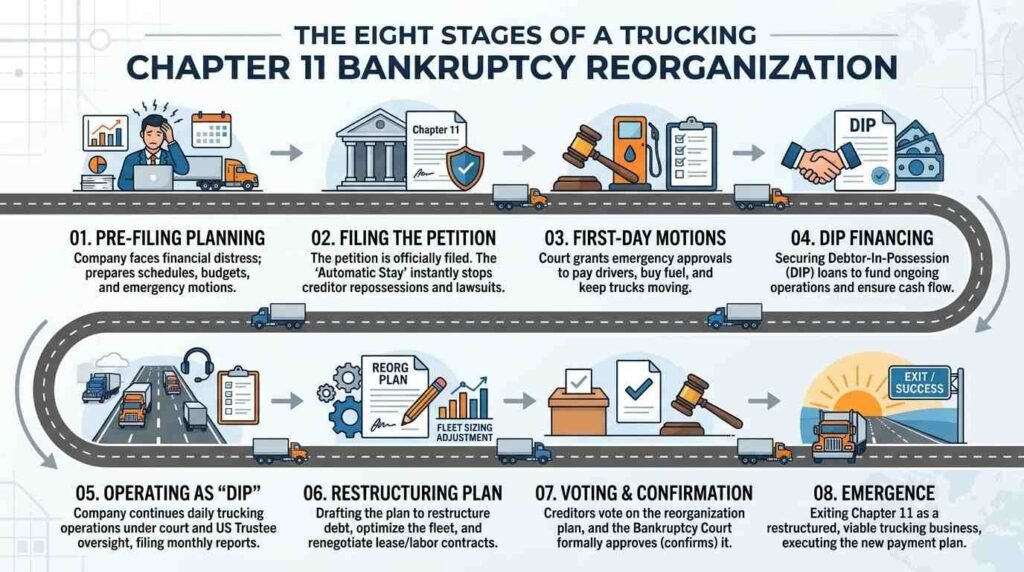
Many smaller companies do not need every step in full. The next section explains why.
For a retail example of how a Chapter 11 case moves from filing to next steps, our breakdown of the Car Toys bankruptcies shows what a business owner and creditors can expect to see on the docket.
The New $7.5 Million Subchapter V Limit
This is the biggest legal change for small fleets in years. On November 10, 2026, the Bankruptcy Threshold Adjustment Act (H.R. 7730) became law. According to McDonald Hopkins, it permanently sets the Subchapter V debt limit at $7.5 million.
Before the Act, the limit was $3,424,000. The higher limit applies to cases filed on or after November 10, 2026. Cases filed earlier keep the old limits.
Subchapter V is a faster, lower-cost track inside Chapter 11. Key features include:
- No creditors’ committee by default
- No U.S. Trustee quarterly fees
- A standing trustee who helps the process
- Only the debtor can file a plan in the first 90 days
- Owners can often keep their equity if the plan commits several years of disposable income
Early data supports the track. One bankruptcy attorney summary reported a 52% plan confirmation rate in Subchapter V compared with 23% in traditional small business Chapter 11. Epiq data reported by Bloomberg also showed Subchapter V elections up 67% in the first quarter of 2026.
What if a fleet owes $5 million? Here is a hypothetical. A regional carrier has 40 trucks and about $5 million in equipment loans, insurance financing and trade debt. Under the old $3.4 million cap it could not use Subchapter V. Under the new $7.5 million cap it may qualify, subject to the other eligibility rules.
Eligibility has other tests. At least half of the debt must come from business activity, and certain debts owed to insiders and affiliates are excluded. A bankruptcy lawyer should confirm whether a specific company qualifies.
Chapter 11 vs Chapter 7 for Trucking Companies
Both chapters appear in trucking news. They work very differently.
| Feature | Chapter 11 | Chapter 7 |
|---|---|---|
| Goal | Reorganize and keep operating | Liquidate and close |
| Who runs the company | Owners and managers (debtor in possession) | A court-appointed trustee sells assets |
| Trucks | Usually stay in service | Usually sold to pay creditors |
| Typical filer | Fleets with equipment, contracts and cash flow | Very small carriers and failed businesses |
| Business debts | Repaid through a plan | Most are discharged for entities, with limits |
For the 12 months ending June 30, 2026, business Chapter 7 filings reached 15,298 (up from 13,314), and Chapter 11 filings reached 9,766 (up from 7,900), according to BankruptcyData. Those totals cover every industry.
A Chapter 11 case can also fail. If the company cannot fund the plan or keep up with reports, the court may convert it to Chapter 7. A Chapter 11 case can also end in a sale of the business or its assets, as Lugano Diamonds’ case shows in our write-up on the Lugano Diamonds Chapter 11 filing and liquidation.
What Happens to Drivers and Employees
In Chapter 11, drivers usually keep working. The court often approves first day orders to pay wages that were owed before filing. In the Celadon case, the Delaware bankruptcy court allowed the company to pay $5.4 million in unpaid wages, contracts and termination bonuses early in the case.
The law also gives wage claims priority. For cases filed on or after April 1, 2025, priority for wages and benefits earned within 180 days before filing is capped at $17,150 per person, according to the Federal Register notice of the adjustment. Amounts above the cap are treated like regular unsecured claims.
If a case converts to Chapter 7, operations usually stop and a trustee takes over. Mass layoffs can raise questions under the federal WARN Act, which requires 60 days’ notice for covered employers and events. Whether it applies depends on the company size and the facts.
What drivers can do:
- Keep pay stubs, load records and messages
- Watch for the court notice that sets the deadline to file a proof of claim
- Ask a wage and hour attorney about unpaid wages
- Check state unemployment options if laid off
What Happens to Owner-Operators
Owner-operators leased to a bankrupt carrier face the hardest position. They are usually unsecured creditors for unpaid settlements, which means they are paid after secured lenders and priority claims. In the Celadon case, freight industry reports warned that independent contractors could end up last in line.
Here is a hypothetical. An owner-operator is owed $9,000 in unpaid settlements when the carrier files. If the carrier’s plan pays unsecured creditors only a fraction, the owner-operator may recover a small part of that amount.
Practical steps for owner-operators:
- Read the lease and equipment agreement before making new moves
- File a proof of claim by the deadline in the court notice
- Keep fuel receipts, load tickets and chargebacks
- Do not abandon a leased truck without legal advice, since that can add disputes
What Shippers and Brokers Should Do
A carrier in Chapter 11 can still haul freight. Shippers do not need to drop a carrier the day it files. They should check risk, not react to a headline.
- Check the carrier’s authority and insurance on the FMCSA Licensing and Insurance site.
- Confirm the exact legal name that filed, including any d/b/a name.
- Search the federal court records for the petition and schedules.
- Ask whether the court approved payment to drivers and vendors.
Lenders, Lessors and Vendors
Chapter 11 changes how creditors get paid. Secured creditors, such as banks financing tractors, look to their collateral. Unsecured creditors, such as fuel vendors and repair shops, may receive only part of what they are owed.
Lessors and lenders can ask the court to lift the automatic stay if the company is not protecting the equipment. In Anchor South’s case, banks and financial institutions generally held secured claims on its tractors and trailers.
Factoring companies play a special role. Some will provide debtor in possession financing after court approval, while others choose to collect out and stop buying invoices. A carrier that loses its factor in the middle of a case can face unpaid drivers and missed loads.
Accident Claims Against a Bankrupt Carrier
A crash victim may wonder what a bankruptcy means for an injury claim. The short answer is that the automatic stay can pause a lawsuit against the carrier. The claim is not automatically gone.
Insurance matters a great deal here. Federal rules require for-hire carriers hauling general freight in vehicles of 10,001 pounds or more to carry at least $750,000 in liability coverage, and that figure has not changed since 1985. A serious crash can exceed that amount, which can leave a gap that the carrier itself cannot fill.
If you were hurt in a truck crash, keep records of every medical bill and the police report. Our guide on how a personal injury claim works explains deadlines, evidence and what claims may be worth. An injury lawyer can explain how the stay and the insurance policy affect a specific case.
Operating Authority and Insurance During Bankruptcy
Filing Chapter 11 does not cancel a carrier’s federal operating authority. Authority depends on staying compliant, especially on insurance. FMCSA’s insurance filing rules require proof of insurance on file, and a lapse can lead to suspension or revocation.
This is one reason first day motions often focus on insurance. If a premium goes unpaid and the insurer cancels the filing, the authority is at risk. Without authority, a for-hire carrier cannot legally haul interstate freight.
Reinstating lost authority takes time and paperwork. Brokers may also treat a reinstated number like a brand new carrier.
Common Mistakes to Avoid
Mistake 1: Treating Chapter 11 as the end of the company. Many carriers keep operating and confirm plans. Others do fail, so each case needs a look at its own facts.
Mistake 2: Missing the claim deadline. Creditors who skip the proof of claim deadline can lose their chance to be paid from the case.
Mistake 3: Waiting too long to file. Chapter 11 cases rarely improve with age, and a carrier that waits until cash is gone has fewer options. Early talks with lenders and lessors also help.
When to Talk to a Lawyer
Talk to a bankruptcy attorney if you run a trucking company with debts you cannot pay. Talk to one if you are a lender, lessor or vendor owed money by a carrier that filed. Talk to an employment lawyer if wages went unpaid.
Bring documents. Useful items include loan papers, equipment leases, insurance policies, recent tax returns, payroll records and a list of creditors.
General information only. Nothing here is legal advice, and no article can replace a lawyer who knows your facts and your court.
Frequently Asked Questions
Why do trucking firms file Chapter 11?
They file to restructure debt while still hauling freight. Common triggers are high operating costs, weak freight rates, insurance increases, equipment payments and lawsuit judgments. Chapter 11 gives a company court protection to negotiate with creditors.
Does Chapter 11 mean a trucking company is going out of business?
No. Chapter 11 is a reorganization process, and many companies keep operating during the case. Some cases do end in a sale or liquidation, and Yellow Corporation is a well-known example.
What is the Subchapter V debt limit for trucking firms in 2026?
It is $7.5 million for cases filed on or after November 10, 2026, under the Bankruptcy Threshold Adjustment Act. Cases filed earlier use the older limit of $3,424,000. A company must also meet other eligibility rules.
Do drivers get paid if a trucking company files Chapter 11?
Often yes for work done after filing, and courts can approve payment of earlier wages early in the case. Wage claims also have priority up to $17,150 per person for amounts earned within 180 days before filing. Results depend on the court order and the company’s cash.
Can a trucking company in Chapter 11 keep hauling freight?
Yes, as long as it keeps valid operating authority and required insurance. The company remains in control as a debtor in possession. Shippers should still check FMCSA records and the court docket.
What is the difference between Chapter 11 and Chapter 7 for a trucking company?
Chapter 11 reorganizes the business under a plan, and the company usually keeps trucks and operations. Chapter 7 liquidates assets through a trustee. Very small carriers more often choose Chapter 7, while mid-size fleets more often try Chapter 11.
Can I still sue a trucking company that filed Chapter 11?
The automatic stay usually pauses lawsuits against the company. The claim may continue later, and insurance coverage can matter a lot. A personal injury lawyer can explain the options.
Conclusion
When trucking firms file Chapter 11, the goal is to keep the business alive while debts are restructured under court supervision. Record costs, soft rates and costly insurance explain much of the 2026 wave. The new $7.5 million Subchapter V limit gives more small and mid-size carriers a faster, cheaper route.
Drivers, owner-operators, shippers, lenders and injury victims each face different risks. Each should watch deadlines, keep records and check the court docket. If your business or income depends on a carrier in trouble, speak with a licensed bankruptcy attorney soon.