



At least seven U.S. Mexican restaurant chains and franchisees have filed for bankruptcy since 2024. On the Border has fallen furthest: it closed its company-owned restaurants, and its operating company filed for Chapter 7 liquidation on June 19, 2026. Others, including Abuelo’s, El Burro Loco, and Salt and Lime, are working through Chapter 11.
- Which Mexican Restaurant Chains Have Filed for Bankruptcy?
- Is On the Border Closed for Good?
- What Really Happened at Abuelo’s?
- Other Mexican Restaurant Bankruptcies Worth Knowing
- Salt and Lime (Arizona)
- Quality Fresca (a Moe’s franchisee)
- El Burro Loco (Florida)
- Rubio’s and Tijuana Flats
- Why Are So Many Mexican Restaurants Going Bankrupt?
- Chapter 11 vs. Chapter 7: What Is the Difference for a Restaurant?
- Are Gift Cards Still Valid After a Restaurant Files?
- What Happens to Employees When a Chain Files?
- What About Landlords and Franchisees?
- Mexican Restaurant Closures Without a Bankruptcy Filing
- Can a Mexican Restaurant Chain Come Back?
- How to Check Whether a Restaurant Has Filed
- Common Mistakes People Make
- Frequently Asked Questions
- Which Mexican restaurant chains have filed for bankruptcy recently?
- Is On the Border still open?
- Does bankruptcy mean the restaurant is closing?
- Can I still use my gift card at a restaurant in bankruptcy?
- Will employees get their final paychecks?
- Why did Abuelo’s file for bankruptcy?
- How do I find out if a restaurant has filed?
- Conclusion
Why does this matter to you? A Mexican restaurant bankruptcy can touch gift card holders, employees, landlords, franchise owners, and anyone who wants chips and salsa.
Picture this. It is December, and you find a $50 gift card in an old coat. Before you drive over, you read that the chain filed for bankruptcy last month. Can you still use it? The answer depends on the type of case, and this guide explains how.
Which Mexican Restaurant Chains Have Filed for Bankruptcy?
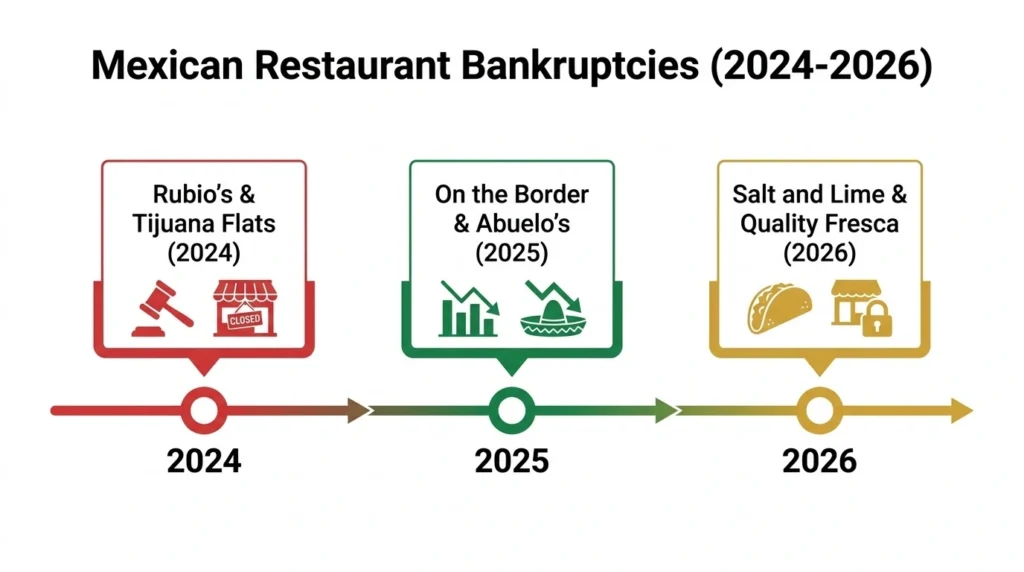
At least seven Mexican restaurant chains or franchisees have filed since 2024: Rubio’s, Tijuana Flats, On the Border, Abuelo’s, El Burro Loco, Quality Fresca (a Moe’s franchisee), and Salt and Lime. Most chose Chapter 11 to reorganize. On the Border later moved to Chapter 7 liquidation.
The table below lists the filings we could confirm in news reports and court records. Other filings may exist.
| Chain | Chapter | Filed | Where things stand (October 2026) |
|---|---|---|---|
| Salt and Lime | 11 | Aug. 20, 2026 (third 2026 case) | Two earlier cases were dismissed; three restaurants in Arizona |
| Quality Fresca (Moe’s franchisee) | 11 | 2026 | Southern District of Florida; closed 16 of 38 restaurants |
| On the Border | 11, then 7 | Mar. 4, 2025; June 19, 2026 | Company-owned restaurants closed; some franchised units still open |
| El Burro Loco | 11 (Subchapter V) | Oct. 10, 2025 | Middle District of Florida; post-confirmation reports filed in 2026 |
| Abuelo’s | 11 | Sept. 2, 2025 | Northern District of Texas; restructuring plan reported in spring 2026 |
| Rubio’s Coastal Grill | 11 | June 5, 2024 | Reported closure of 48 California locations |
| Tijuana Flats | 11 | April 2024 | New owner after the case; a second ownership change was reported in 2025 |
TheStreet’s own list also names Burnt BBQ & Tacos among recent filers. We could not confirm the details of that case, so we left it out of the table.
In short, Chapter 11 means the company tries to reorganize. Chapter 7 means it shuts down and sells what it owns. We explain the difference later in this guide.
Is On the Border Closed for Good?
No single answer fits every location, but the company-owned restaurants are closed. The operating company, OTB Hospitality, filed for Chapter 7 liquidation on June 19, 2026, after closing all locations. A few franchised restaurants in South Dakota, Florida, Nevada, California, and South Korea run on their own. Call ahead before you go.
On the Border had about 120 restaurants at the start of 2025. It closed or left roughly 40 weak locations on February 24, 2025, then filed for Chapter 11 on March 4, 2025. The plan was to sell its assets to its bridge lender, an affiliate of Pappas Restaurants.
Court papers showed why the numbers broke. The chain paid $25.3 million in lease payments in 2024, and $11.8 million of that went to underperforming locations. Think of paying rent on a dining room that loses money every month.
Pappas bought the brand, but the rescue did not last. In June 2026, Pappas said fixing the brand would need heavy ongoing investment that would pull attention from its core restaurants, and it stressed the filing covered only OTB Hospitality, not its other brands. TheStreet reported the closures in June 2026.
Here is the lesson. A sale in Chapter 11 is not a guarantee. A rescued brand can still fail if the costs stay too high.
See also: Bankruptcy Forces Ice Cream Chain to Close 500 Locations
What Really Happened at Abuelo’s?
Abuelo’s filed Chapter 11 on September 2, 2025, in the Northern District of Texas. It blamed falling sales, higher food and labor costs, and staffing problems. It reported $10 million to $50 million in debts and liabilities. It had 16 restaurants at filing, down from about 40 at its peak.
Abuelo’s began in Amarillo in 1989 and is based in Lubbock. Its owner, Food Concepts International, filed too, and the two companies asked the court to combine their cases.
In a statement, Abuelo’s called the filing part of a strategic restructuring and said it would keep operating normally for employees, vendors, and customers.
The slide started years earlier. Technomic data cited by Restaurant Business shows growth stalled around 2009 and system-wide sales fell more than 15% in the year before the filing. Abuelo’s ended 2024 with 20 locations.
Court papers add detail. Traffic fell 5.9% in 2023, and storms in May and June 2024 closed some restaurants for 63 store-days, costing about $550,000 in sales, according to FSR Magazine. The company owed $8 million to First Bank & Trust.
Local reporting from LubbockLights found two shareholders agreed to lend $500,000 right away and up to $1 million later. Three more restaurants then closed, leaving 13 in six states. A spring 2026 restructuring plan was reported as the path to keep the rest open.
The “24 closures” myth
Some headlines said Abuelo’s was closing 24 restaurants. That does not match the filings, which show 16 restaurants when the case began. The 24 appears to be the gap between the 40-restaurant peak and the 16 at filing. That drop took many years, not one closing wave.
A good habit with any bankruptcy headline: ask, “Closed since when?”
Other Mexican Restaurant Bankruptcies Worth Knowing
Salt and Lime (Arizona)
Salt and Lime opened in Scottsdale in 2014 and added Cave Creek and Phoenix locations in 2025, for three restaurants in all. Its owner, Four Fingers LLC, filed Chapter 11 on June 15, 2026, and the court dismissed that case on August 7. A sister company, Salt and Lime 44 LLC, filed on February 26, 2026, and was dismissed on March 16. A third case followed on August 20, 2026, and the filing gave no reason.
A dismissed case is not a win. The court ended it without a reorganization plan, and the protection from collection that came with the filing ends too.
Quality Fresca (a Moe’s franchisee)
Quality Fresca bought 67 Moe’s Southwest Grill restaurants in 2020, just before COVID-19 shutdowns. It later ran 38 restaurants in Florida, South Carolina, Virginia, and Washington, D.C., and closed 16 after filing.
Its numbers show how a business can look big and still lose money. It made $58.9 million in sales but posted negative EBITDA of $111,204. EBITDA means earnings before interest, taxes, depreciation, and amortization. It still owed about $16 million after 11 loan changes and $800,000 in new borrowing. Moe’s parent company, GoTo Foods, did not file.
El Burro Loco (Florida)
El Burro Loco started as a food truck and built a following in Central Florida’s tourist areas. It filed on October 10, 2025, in the Middle District of Florida under Subchapter V, a faster and cheaper form of Chapter 11 for small businesses. The court docket shows post-confirmation reports for the quarters ending March 31 and June 30, 2026, which suggests the court approved a plan.
Subchapter V has a debt limit, and the limit matters. It is $3,424,000 today, according to the American Bankruptcy Institute. Congress has passed the Bankruptcy Threshold Adjustment Act to restore a $7.5 million limit, and as of late September 2026 it was waiting for the President’s signature. Check the current status before relying on either number.
Demand for the small-business track is rising. A law-firm alert counted 1,663 Subchapter V elections in the first half of 2026, up 50% from 1,107 a year earlier.
Rubio’s and Tijuana Flats
Rubio’s Coastal Grill filed on June 5, 2024, and reportedly closed 48 California locations. It still runs roughly 80 restaurants, mostly in Southern California, according to a recent news video summary.
Tijuana Flats grew from a $20,000 family loan to about 140 restaurants. After a 2015 sale to a private equity firm, the brand changed its concept and dropped practices like grilling burritos before serving. It filed in April 2024, changed owners, and was reported to have about 95 restaurants open.
Why Are So Many Mexican Restaurants Going Bankrupt?
Most Mexican restaurant chains cite the same pressures: higher food, labor, and rent costs, fewer diners, and heavy debt. Sit-down chains also sit in a squeezed middle. They cost more than fast food but must compete with cheaper fast-casual rivals. When sales dip, fixed costs like leases can sink the business.
It is easy to assume a filing means someone made bad choices. TheStreet’s reporting argues that is not always true. Rising labor costs, inflation, supply chain problems, and changed spending habits have hit the whole industry.
Costs and leases
Rent is the cost that does not bend. On the Border’s $25.3 million lease bill in 2024 is the clearest example. Abuelo’s lost 5.9% of its traffic, and Quality Fresca lost money even with $58.9 million in sales.
Here is a simple what-if. The numbers are made up to show the idea. A restaurant pays $30,000 a month in rent whether it serves 100 guests a night or 94. If traffic slips about 6%, like Abuelo’s, and food and labor cost more, the rent does not shrink. The profit disappears first.
The squeezed middle
Many people think of Mexican food as a cheap meal. TheStreet’s Daniel Kline says sit-down Mexican chains need to focus on value, because many of the ones closing sit at a higher price point.
They cost less than upscale dining but more than Taco Bell, Chipotle or Del Taco. If the middle disappears, diners may face a choice between a quick burrito and a premium meal. That hurts families who want an occasional sit-down treat.
Debt and ownership changes
A news video summary of these chains points to a pattern. On the Border was sold in 2010 and again in 2014 to a private equity firm. Tijuana Flats was sold to a private equity firm in 2015 and then reworked its concept. Heavy debt and new owners leave little room for a slow year.
Brand identity
Customers notice when a favorite changes. Rubio’s shifted to a seafood-heavy “Coastal Grill” menu, Tijuana Flats stopped grilling burritos, and Chevy’s removed its famous tortilla machine, “El Machino.” Each change cost the brand some of what made it special, according to that same video summary.
What helps
TheStreet lists five ways restaurants can adapt: rethink menus, use more authentic recipes, specialize in one region’s food, add premium extras such as craft cocktails, and improve loyalty programs. The sector is not shrinking overall. One market estimate cited by Yahoo Finance projects growth from $76.2 billion in 2025 to $80.2 billion in 2026. The winners are different chains, not fewer diners.
See also: Home Depot Rival Files for Bankruptcy
Chapter 11 vs. Chapter 7: What Is the Difference for a Restaurant?
Chapter 11 lets a restaurant keep serving customers while it reorganizes debt, often by closing weak locations. Chapter 7 shuts the business down. A trustee sells its assets and pays creditors in a set order. Chapter 11 aims to save the company. Chapter 7 ends it.
| Question | Chapter 11 | Chapter 7 |
|---|---|---|
| Goal | Reorganize debt | Liquidate and close |
| Who runs things | Current management, under court oversight | A court-appointed trustee |
| Do restaurants stay open? | Usually, at least for a while | No |
| Typical result | Plan, sale, or dismissal | Assets sold; creditors paid in order |
| Example in this article | Abuelo’s, El Burro Loco, Salt and Lime | On the Border (OTB Hospitality) |
For more background, see the federal courts’ bankruptcy basics and the U.S. Trustee Program.
The automatic stay
The first big effect of a filing is the automatic stay. Under 11 U.S.C. § 362(a), a bankruptcy petition “operates as a stay, applicable to all entities” of most efforts to collect old debts from the company.
What if a supplier keeps calling for payment after the filing? In general, it must stop. A creditor who ignores the stay can face court sanctions.
Chapter 11 in five steps
- Petition. The company files, and the stay starts.
- First-day requests. The company asks the court for permission to keep paying workers and keep customer programs running. On the Border did both in its 2025 case.
- Lease decisions. The company decides which restaurants to keep and which leases to reject.
- Plan or sale. It proposes a reorganization plan or sells its assets.
- Court approval. The judge confirms the plan or approves the sale.
Small businesses may use Subchapter V, which skips some of the cost and delay. We covered it in the El Burro Loco section above.
See also: American Airlines Bankruptcy
Are Gift Cards Still Valid After a Restaurant Files?
Often yes, at least for a while, but it depends on the case. In Chapter 11, a company may ask the court to keep honoring gift cards and rewards. In Chapter 7, restaurants close, so cards usually become claims against the estate. Use any card quickly and watch the court notices.
In its 2025 Chapter 11 case, On the Border asked the court for permission to continue its customer rewards program. That is common in Chapter 11, because angry customers hurt a company that is trying to survive.
Now compare two outcomes for that $50 card. If the chain is in Chapter 11 and the restaurant stays open, you can probably still eat there. If the chain moves to Chapter 7 and the doors close, the card may become a claim, and you may have to wait for any payment.
The Bankruptcy Code gives some consumers a priority claim for money paid in advance for goods or services. Under 11 U.S.C. § 507(a)(7), that priority is capped at $3,800 per person for cases filed on or after April 1, 2025, according to the Judicial Conference notice. Courts do not always agree that gift cards fit, and priority claims are paid only after higher-ranking claims. Recovery can be small.
A short checklist helps:
- Use your card or rewards balance now.
- Keep the card, the receipt, and a photo of the balance.
- Watch the claims agent site and court notices for a claim deadline.
- Do not buy new cards from a chain that has just filed.
See also: Lugano Diamonds Bankruptcy
What Happens to Employees When a Chain Files?
Employees should be paid for time worked, but bankruptcy can delay checks. Wages earned in the 180 days before filing get priority up to $17,150 per person. Large layoffs may also trigger the federal WARN Act, which can require 60 days’ notice. Workers should file for unemployment right away.
Under 11 U.S.C. § 507(a)(4), “wages, salaries, or commissions, including vacation, severance, and sick leave pay” earn priority. The cap is $17,150 per person for cases filed on or after April 1, 2025, and the wages must be earned within 180 days before the filing, according to a Troutman Pepper Locke guide.
Here is a hypothetical. A kitchen manager is owed $20,000 in covered pay. Under this rule, $17,150 would be a priority claim and the other $2,850 would be an ordinary unsecured claim. Pay for work done after the filing is treated as an administrative expense, which ranks higher.
The WARN Act
The federal WARN Act requires employers with 100 or more employees to give 60 calendar days’ written notice of a plant closing or mass layoff affecting 50 or more employees at a single site. The U.S. Department of Labor does not enforce it for workers, and some states have their own laws.
What if a chain has 12 restaurants with 30 workers each? Because the rule looks at a single site, WARN may not apply to the closings. An employment lawyer can check the facts, including state law.
What to do if you work there
- Save pay stubs and keep a record of your hours and tips.
- File for unemployment benefits right away.
- File a proof of claim before the deadline if you are owed pay.
- Contact your state labor department about final pay rules.
See also: Car Toys Bankruptcies
What About Landlords and Franchisees?
Do bankrupt chains still pay rent?
Not always. Under 11 U.S.C. § 365, a company in Chapter 11 can keep a lease or reject it. Rejecting a lease frees the company from future rent, and the landlord gets a claim instead. The Code limits how much a landlord can claim for future rent.
Leases are why closures cluster around filings. FAT Brands, a non-Mexican restaurant operator, asked a court to reject 32 leases to cut more than $492,000 in monthly rent.
Here is a hypothetical. A landlord is owed three months of rent from before the filing. In general, the landlord cannot sue or evict over that old debt while the stay is in place. The landlord files a proof of claim and waits for the plan.
Franchisee or franchisor?
A franchisee’s case does not automatically include the franchisor. Quality Fresca filed, but Moe’s parent GoTo Foods did not. In the same way, On the Border’s Chapter 7 did not include its franchised restaurants in South Dakota, Florida, Nevada, California, and South Korea.
If you own a franchise unit, read your franchise agreement and talk to a lawyer early.
Mexican Restaurant Closures Without a Bankruptcy Filing
Closing restaurants is not the same as filing for bankruptcy. Many chains shrink quietly. Here are recent examples from news reports.
| Chain | What happened | Source |
|---|---|---|
| Taco Cabana | Closed 5 of 146 restaurants in September 2025 | Yahoo Finance |
| Torchy’s Tacos | Announced closure of 4 restaurants in two states, including Columbus, Ohio | Yahoo Finance |
| Fuzzy’s Tacos | Closed all remaining Houston-area restaurants in September 2026 | Yahoo Finance |
| Dos Coyotes Border Cafe | Closed its last Bay Area restaurant on Sept. 24, 2026; 10 remain | Yahoo Finance |
| Chevy’s Fresh Mex | Down from 100+ locations to 15 in seven states | Yahoo Finance |
| Acapulco | Had 39 locations before its former owner’s 2011 Chapter 11; now about two | TheStreet |
The story can be messy. Chevy’s previous owner, Real Mex Restaurants, filed for Chapter 11 in October 2011, according to TheStreet. Another report dates a Real Mex filing to 2018, so check the primary court record before you cite either year.
Can a Mexican Restaurant Chain Come Back?
Sometimes. Tijuana Flats changed owners after its 2024 filing. Abuelo’s filed a restructuring plan in 2026 to keep its remaining restaurants open. But On the Border shows the risk: a rescue buyer later liquidated the operating company. Recovery depends on debt, leases, and whether customers return.
A comeback needs three things: lower costs, a clear identity, and customers who still care. Chi-Chi’s is a rare example of nostalgia paying off. After closing its restaurants in the 2000s, a new location reportedly opened in St. Louis Park, Minnesota, in October 2025, according to a news video summary.
The strategies TheStreet describes, such as sharper menus and better loyalty programs, are the same ones that survivors tend to try.
How to Check Whether a Restaurant Has Filed
Search the company’s legal name in PACER, the federal court records system, or a free docket tracker. Look for a claims agent website too. Then call the restaurant. Many chains keep operating during Chapter 11, so a filing alone does not prove a closing.
- Find the legal name. The brand is often not the debtor. On the Border’s operating company is OTB Hospitality. Abuelo’s owner is Food Concepts International. Salt and Lime’s owner is Four Fingers LLC. El Burro Loco is El Burro Loco Food Corp.
- Search the court record. Use PACER or a tracker such as PacerMonitor.
- Read the company’s own notice. On the Border posted a press release when it filed Chapter 7.
- Write down the claim deadline. Missing it can cost you your claim.
- Call the restaurant. Ask if it is open and what it accepts.
A common mistake is to search only the brand name. That finds news, not the case.
Common Mistakes People Make
Most mistakes come from waiting or assuming. Gift card holders often wait until the restaurant is gone. Readers see “bankruptcy” and assume the doors have closed, when Chapter 11 chains often stay open. Employees and landlords miss the claim deadline. Others repeat a headline number, like the “24 closures” claim, without checking the filing.
A quick checklist:
- Use gift cards and rewards now.
- Do not assume a filing means a closing, or that a rescue means safety.
- Write down the claim deadline the day you learn of the case.
- Verify numbers against court records or the company’s statement.
- File for unemployment right away if you lose a job.
Frequently Asked Questions
Which Mexican restaurant chains have filed for bankruptcy recently?
On the Border (March 2025, then Chapter 7 in June 2026), Abuelo’s (September 2025), El Burro Loco (October 2025), Quality Fresca (2026), and Salt and Lime (August 2026) are among the most recent. Rubio’s and Tijuana Flats filed in 2024. Most used Chapter 11 to reorganize.
Is On the Border still open?
Its company-owned restaurants are closed. OTB Hospitality filed Chapter 7 liquidation on June 19, 2026. Some franchised locations in South Dakota, Florida, Nevada, California, and South Korea keep operating on their own, so call a specific location before you go.
Does bankruptcy mean the restaurant is closing?
Not necessarily. Chapter 11 lets a restaurant keep serving customers while it reorganizes, though weak locations often close. Chapter 7 means the business shuts down. Check which chapter was filed, and call the location to confirm it is open.
Can I still use my gift card at a restaurant in bankruptcy?
Often yes in Chapter 11, if the restaurant stays open and honors cards. In Chapter 7, cards usually become claims. Use your card quickly, keep the receipt, and watch for a claim deadline. Consumer deposit claims have a priority cap of $3,800 per person.
Will employees get their final paychecks?
Employees can file claims for unpaid wages. Pay earned within 180 days before filing gets priority up to $17,150 per person, but payment may be delayed or partial. File for unemployment right away, save pay stubs, and ask your state labor department about final pay rules.
Why did Abuelo’s file for bankruptcy?
Abuelo’s blamed a significant drop in sales, rising food and labor costs, staffing challenges, and changing customer preferences. Technomic data shows system-wide sales fell more than 15% the year before. It filed Chapter 11 on September 2, 2025, with 16 restaurants and $10 million to $50 million in debt.
How do I find out if a restaurant has filed?
Search the company’s legal name, not the brand, in PACER or a free tracker such as PacerMonitor. Read the company’s notice, note any claim deadline, and call the restaurant. A filing does not always mean a closing.
Conclusion
Mexican restaurant bankruptcies come from a mix of rising costs, heavy debt, tough competition, and brand missteps, not one cause. On the Border’s liquidation shows that even a rescued chain can fail, while Abuelo’s and El Burro Loco show that Chapter 11 can keep restaurants open. For diners, the practical steps are simple: use gift cards soon, check headlines against court records, and call before you drive.
If you are an employee, landlord, franchisee, or creditor tied to a restaurant that filed, talk to a licensed bankruptcy attorney in your state soon. Claim deadlines can pass quickly, and the right move depends on the facts of your case.
Disclaimer: This is general information only and not a substitute for advice from a qualified attorney licensed in your jurisdiction.