



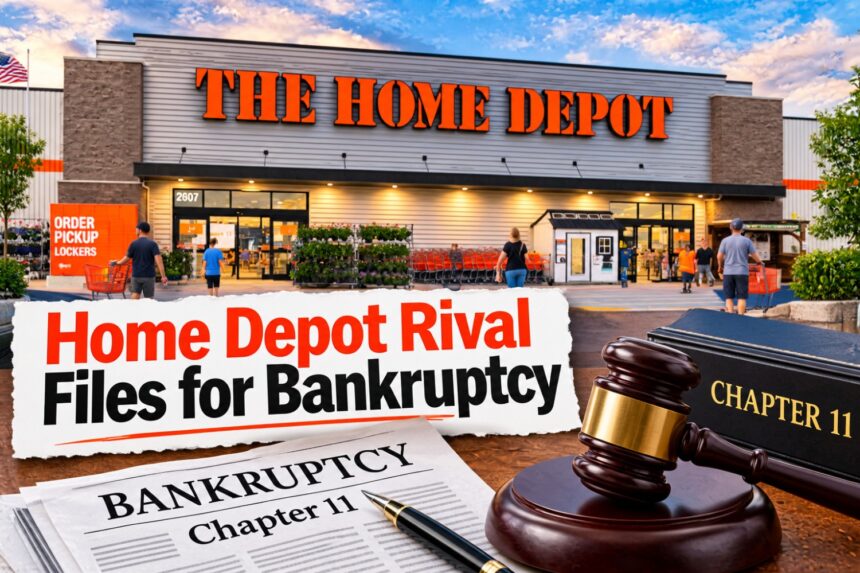
A Home Depot rival files for bankruptcy protection, and the company is far smaller than the headline suggests. Home Value Store, a family-run retailer with three Florida locations, filed for Chapter 11 on June 2, 2026. Home Depot has not filed for anything.
- Which Home Depot Rival Filed for Bankruptcy in 2026?
- Home Depot Rival Files for Bankruptcy: Home Value Store Filing Details
- Why Did Home Value Store File for Bankruptcy?
- What Does Chapter 11 Mean for Home Value Store?
- What Is Subchapter V Bankruptcy?
- Is Home Value Store Closing?
- Chapter 11 vs. Chapter 7: What Is the Difference?
- What Happens to Customers, Employees and Vendors?
- What Happens Next in a Subchapter V Case?
- Is Home Depot Going Bankrupt?
- How Can I Check the Home Value Store Bankruptcy Case?
- Why Are Home Improvement Retailers Struggling?
- Other Home Depot Rivals That Filed in 2026
- Frequently Asked Questions
- Did a Home Depot competitor file for Chapter 11?
- Who owns Home Value Store?
- Is Home Value Store the same as Home Depot?
- Will Home Value Store’s stores stay open?
- Can I still buy from Home Value Store?
- What if Home Value Store owes me money?
- Bottom Line
News outlets attached the phrase “Home Depot rival” to several small retailers this year. This article covers the Home Value Store filing, what the Subchapter V track means, and what customers, employees, and vendors can expect. It also lists the other 2026 filings that share the label, so you can tell which company a headline is about.
Status check: As of September 29, 2026, our review of public reporting found no story about a confirmed plan, a dismissal or a store closure. The court docket is the only reliable source, and a later section shows how to read it. This article is general legal information, not legal advice.
| Company | Home Value Store II, LLC (Hialeah, Fla.), one of three stores run by a family-owned retailer |
| Filed | June 2, 2026 |
| Court and case | U.S. Bankruptcy Court, Southern District of Florida, No. 26-17280 |
| Chapter | Chapter 11, Subchapter V (the small business track) |
| Reported size | $1 million to $10 million in assets, $500,000 to $1 million in liabilities |
| Reason given in the petition | None |
Which Home Depot Rival Filed for Bankruptcy in 2026?
Several small retailers described as Home Depot rivals have filed in 2026. Wren Kitchens filed Chapter 7 on April 24, Home Value Store filed Chapter 11 on June 2, and Woodcrest Ace Hardware filed Chapter 11 on August 11. Home Depot itself has not filed, and each company is unrelated to the others.
| Company | Filed | Chapter | Court | Footprint | Status |
|---|---|---|---|---|---|
| Wren Kitchens (Wren US Holdings) | Apr 24 | 7 | D. Del. | 15 East Coast showrooms | Liquidation, all stores closed |
| Home Value Store II, LLC | Jun 2 | 11 (Subchapter V) | S.D. Fla. | 3 Florida stores | No closure reported |
| Woodcrest Ace Hardware | Aug 11 | 11 | C.D. Cal. | 2 Ace stores | Stores operating as normal |
Wren is the one company here with a real tie to Home Depot. It ran showrooms inside Home Depot stores under a partnership that began in 2024.
Illustration (hypothetical): A homeowner in Riverside, Calif., sees a “Home Depot rival files for bankruptcy” headline in August and assumes it refers to the June Florida story. It does not. The August filing is Woodcrest Ace Hardware, a different company in a different state, and its two stores are still open.
Home Depot Rival Files for Bankruptcy: Home Value Store Filing Details
Home Value Store II, LLC filed a Subchapter V petition on June 2, 2026, in the Southern District of Florida. It lists $1 million to $10 million in assets and $500,000 to $1 million in liabilities. PacerMonitor lists the case as 1:26-bk-17280. The petition puts the number of creditors in the 1 to 49 bracket, which is a small creditor base.
Largest creditors
| Creditor | Amount owed | Note |
|---|---|---|
| U.S. Small Business Administration | $350,000 | Lender |
| Florida Department of Revenue | Over $303,000 | State tax claim |
| Porsche Financial | $40,000 | Financing |
| Quality Millwork Solutions | Over $33,000 | Civil lawsuit |
| Individual plaintiff | $30,000 | Civil lawsuit |
| Internal Revenue Service | Over $24,000 | Federal tax claim |
Worked example: These six claims add up to at least about $780,000, which accounts for most of the reported $500,000 to $1 million in liabilities. Three of them come from government bodies (the SBA, the state and the IRS) and total roughly $677,000. That is close to 87 percent of the listed amount. The two lawsuit claims are small by comparison. The percentage is our arithmetic from figures reported as “over,” so the true share may differ slightly.
Which entity filed
The petition names Home Value Store II, LLC, the Hialeah entity. Florida’s business registry lists Home Value Store II, LLC as its own limited liability company, and the registry appears to list the first store separately as well. No report we found says whether the Fort Lauderdale and Bartow entities also filed. The docket answers that question, and it decides whether all three stores are inside the bankruptcy.
See also: Attorney vs. Lawyer: What Is the Difference?
Why Did Home Value Store File for Bankruptcy?
The petition does not give a reason. It lists creditors including the Small Business Administration ($350,000) and the Florida Department of Revenue (over $303,000), plus two civil lawsuit claims. A filing-alert service also reports delinquent tangible personal property taxes for 2024 and 2025 and several active lawsuits. Market conditions add context but are not a stated cause.
TheStreet’s report said revenue problems led to the filing. That is the reporter’s framing, since the same article notes the petition gave no reason. The Ch11.ai service, which cites public records rather than the petition itself, says the company faced financial pressure before filing, including unpaid business property taxes and multiple lawsuits. Tangible personal property tax is a county tax on business equipment and fixtures. We can call these facts a likely backdrop. We cannot call them the cause until the company or the court record says so.
Illustration (hypothetical): A shop that misses its 2024 and 2025 equipment tax bills while two suppliers sue over unpaid invoices has several pressures at once. A bankruptcy petition does not need to rank them, which is why a filing can be clear about who is owed money and silent about why.
What Does Chapter 11 Mean for Home Value Store?
Chapter 11 is a court-supervised reorganization, not a shutdown. Home Value Store can keep operating while it proposes a plan to repay creditors over time. The filing also starts an automatic stay, which generally pauses collection efforts and most lawsuits against the company while the case is pending.
The automatic stay comes from 11 U.S.C. § 362, and it matters here because the company faces both lawsuits and tax claims. Certain tax claims get priority treatment in a plan, so the state and federal amounts above will not be handled like an ordinary supplier invoice. The stay has exceptions, so a creditor who thinks it does not apply to their claim should ask a bankruptcy attorney.
Illustration (hypothetical): Suppose a supplier was one week from a court hearing to collect a $30,000 claim when the company filed. After the filing, the supplier generally cannot go forward with that collection effort without the bankruptcy court’s involvement. Its claim moves into the bankruptcy process instead.
What Is Subchapter V Bankruptcy?
Subchapter V is a faster, cheaper track inside Chapter 11 for small businesses, created by the Small Business Reorganization Act of 2019. A trustee helps the parties negotiate, the debtor’s plan is generally due within 90 days, and the owners usually keep running the business. Debts must be $3,424,000 or less.
Eligibility has changed. A temporary $7.5 million limit expired on June 21, 2024, and for cases started after that date the U.S. Trustee Program applies the original limit as adjusted, which is $3,424,000. At least half of the debt must come from business activities. Home Value Store’s reported liabilities of $500,000 to $1 million sit well under the ceiling.
Three features set Subchapter V apart from standard Chapter 11:
- Only the debtor files a plan. Creditors cannot propose a competing one.
- A trustee acts as a neutral. The trustee helps the debtor and creditors reach a deal and must appear at the status conference.
- The clock runs fast. The court must hold a status conference within 60 days of filing, and the debtor must file a report at least 14 days before it. The reorganization plan is due within 90 days.
Worked example with real dates: For a case filed on June 2, those default dates fall around August 1 and August 31, 2026. Both have passed. Courts can extend the deadlines when the delay is not the debtor’s fault, and we found no public reporting on whether a plan was filed or the dates were moved. That is a reason to read the docket before relying on any news story.
Is Home Value Store Closing?
No closure has been reported. Home Value Store runs three Florida locations, in Fort Lauderdale, Hialeah, and Bartow, and Chapter 11 does not close stores by itself. A reorganization plan can still include closures or lease rejections, so check with your store and watch the court docket.
A Chapter 11 debtor decides which leases to keep and which to give up. Woodcrest Ace Hardware, discussed below, told the court it plans to assume its leases. Home Value Store’s plan will show which locations it intends to keep.
Company profile
- Founded: 2015, as a family-run business.
- Stores: Home Value Store I (Fort Lauderdale), II (Hialeah) and III (Bartow). Bartow sits in Polk County, well north of the other two.
- Products: hardware, laminate flooring, kitchen and bath accessories, decorative finishes, moldings, coatings and acrylic panels.
- Customers: contractors, builders, remodelers and homeowners.
- Delivery: a fleet of 15 trucks.
- Headquarters listing: business databases list the Hialeah address as 2860 W 3rd Ct and describe a focus on European brand products.
- Size estimate: one data provider estimates 11 to 20 employees and $1 million to $5 million in revenue. Treat that as a rough third-party estimate, not a company figure.
Chapter 11 vs. Chapter 7: What Is the Difference?
Chapter 11 reorganizes a business so it can keep operating and repay creditors under a court-approved plan. Chapter 7 liquidates it, meaning a trustee sells the assets and the business stops operating. Home Value Store filed Chapter 11. Wren Kitchens filed Chapter 7 and closed all 15 of its East Coast stores.
Real example: Wren US Holdings filed Case No. 26-10581 in Delaware and listed $100 million to $500 million in assets. Home Depot said it had no advance notice that Wren would close, which left customers with unfinished kitchen orders and questions. A Chapter 11 case can also fail. If a plan cannot be confirmed, the court can convert the case to Chapter 7 or dismiss it.
What Happens to Customers, Employees and Vendors?
Stores generally keep operating during a Subchapter V case. Customers with deposits or special orders may become unsecured creditors, so keep receipts. Employees usually stay on the payroll unless the plan changes that, and unpaid vendors file claims that a plan may pay in full, in part, or over time.
Customers
Keep every receipt, order confirmation, and text about a custom or special order. Ask the store to confirm in writing what happens to open orders. New purchases on a credit card may give you dispute options if an order is never delivered. Manufacturer warranties usually stay with the manufacturer, but store-backed warranties and return policies can change, so ask before buying.
Illustration (hypothetical): A contractor pays a $2,000 deposit on custom cabinets three weeks before a store files. Delivery slips. With a written order and a card receipt, the contractor can show what was paid and can file a claim or dispute the charge. With only a verbal promise, the contractor has little to point to.
Employees
Ordinary paychecks continue while the business runs. Wages earned before the filing generally receive priority treatment up to a statutory cap, so an employee owed back pay should speak with a labor or bankruptcy attorney about filing a claim.
Vendors and suppliers
Suppliers who are unpaid for pre-filing deliveries are typically unsecured creditors. If creditors do not agree to the plan, a Subchapter V plan generally has to commit the owners’ disposable income for three to five years. Vendors weighing new orders often ask for cash on delivery until the plan is settled.
See also: Rebeca Mingura Credit One Lawsuit
What Happens Next in a Subchapter V Case?
After filing, a Subchapter V trustee is appointed, and the debtor files a report before a status conference held within 60 days. The debtor’s plan is generally due within 90 days. The court then confirms the plan, or the case can be dismissed or converted to Chapter 7.
- Trustee appointed. The trustee reviews the finances and helps the parties negotiate.
- Report and status conference. The debtor explains its efforts to reach a consensual plan (about August 1 for this case, absent an extension).
- Plan filed. The default deadline was about August 31, 2026.
- Creditors respond. Creditors can vote or object, and the court sets a deadline to file proofs of claim.
- Confirmation, dismissal, or conversion. The court decides which path the case follows.
Is Home Depot Going Bankrupt?
No. Home Depot has not filed for bankruptcy. It is the largest home improvement retailer, holding 28% of the market in 2025 according to the Numerator tracker, ahead of Lowe’s at 17% and Amazon at 11%. “Home Depot rival” is a media label for smaller companies that operate independently of Home Depot.
Home Depot’s fourth quarter of fiscal 2025 (ended February 1, 2026) showed sales down 3.8%, though full-year sales rose 3.2%. Slower sales at a market leader are not a bankruptcy warning.
How Can I Check the Home Value Store Bankruptcy Case?
Search Case No. 26-17280 in the U.S. Bankruptcy Court for the Southern District of Florida through PACER, the federal courts’ records system. Free case summaries appear on services such as PacerMonitor and Ch11.ai. Creditors should watch the court’s notices for the deadline to file a proof of claim.
PACER charges small per-page fees. On the docket, look for four things: the trustee appointment, the status conference report, the plan filing date, and any motion about leases or store closings. The U.S. Courts’ Chapter 11 basics page explains how these steps work in plain language.
Illustration (hypothetical): A supplier owed $12,000 opens the docket for Case No. 26-17280 and scrolls to the entries after the June 2 filing. Finding a notice with a claims deadline tells the supplier how long it has to file. Finding a filed plan shows how the company proposes to treat unsecured creditors.
See also: Walmart to Pay $5.6 Million Over Lawsuit
Why Are Home Improvement Retailers Struggling?
Home improvement retailers face weak housing turnover, which Home Depot’s CFO said has stayed at historic lows since 2023, along with consumer reluctance to fund renovations and competition from three giants. Home Depot, Lowe’s and Amazon held about 56% of sales in 2025, leaving smaller chains to compete for the rest.
Market share depends on the period measured. The tracker put the three at 56% for full-year 2025. For the third quarter of 2025 alone it showed Home Depot at 29%, Lowe’s at 17% and Amazon at 11%, or 57% combined. Ace Hardware’s whole cooperative held about 2%.
Real examples of quiet closures: Many small chains close without filing. Miller’s Hardware in Winter Park, Fla., an 80-year-old family business, said it would close its store by the end of May 2026 after three generations of ownership. Ritter’s True Value in Mechanicsburg, Pa., closed after 117 years on September 30, 2025. Those closures suggest bankruptcy filings undercount the strain on independents.
Other Home Depot Rivals That Filed in 2026
Woodcrest Ace Hardware
Woodcrest Ace Hardware filed Chapter 11 on August 11, 2026, in the Central District of California, listing $1 million to $10 million in assets and debts. It runs stores in Riverside and Wildomar, and it owns a uniform shop. The petition mentions a disputed product liability and negligence lawsuit tied to Roundup weed killer and gives no other reason for filing. The debtor plans to keep its leases, and the stores are operating.
Its largest unsecured creditor is Ace Hardware Corporation, owed more than $620,000, which reflects how Ace’s retailer-owned cooperative works. Both stores sit close to Home Depot locations: about 5 miles for Riverside and about 3.8 miles for Wildomar. This is the company’s second bankruptcy. It filed in April 2019, and that case closed with a final decree on September 14, 2020.
Wren Kitchens
Wren’s Chapter 7 filing is covered above. It is the only 2026 case here where the company shared floor space with Home Depot.
Frequently Asked Questions
Did a Home Depot competitor file for Chapter 11?
Yes. Home Value Store filed Chapter 11 (Subchapter V) on June 2, 2026, and Woodcrest Ace Hardware filed on August 11. Both are small regional retailers, not national chains.
Who owns Home Value Store?
It is described as a family-run business founded in 2015. The coverage reviewed does not name the owners.
Is Home Value Store the same as Home Depot?
No. They are unrelated companies. Home Depot has not filed for bankruptcy.
Will Home Value Store’s stores stay open?
No closure has been reported, and Chapter 11 does not close stores by itself. A plan can include closures, so call the store and check the docket.
Can I still buy from Home Value Store?
Stores generally keep operating during a Subchapter V case. For large or custom orders, get written confirmation of delivery terms and pay by card if you can.
What if Home Value Store owes me money?
You may need to file a proof of claim by the deadline the court sets. A bankruptcy attorney can confirm the deadline and your priority.
Bottom Line
When a Home Depot rival files for bankruptcy, the label is usually bigger than the company. Home Value Store is a three-store Florida retailer using the Subchapter V track to restructure roughly $500,000 to $1 million in reported debt, most of it owed to government bodies. The petition gives no reason, no closures have been reported, and the default plan deadlines have already passed, so the docket for Case No. 26-17280 holds the answers.
Anyone with money at stake should read that docket and speak with a licensed bankruptcy attorney.
Legal information notice: This article is general information and does not create an attorney-client relationship. Bankruptcy outcomes depend on the facts and the court.