



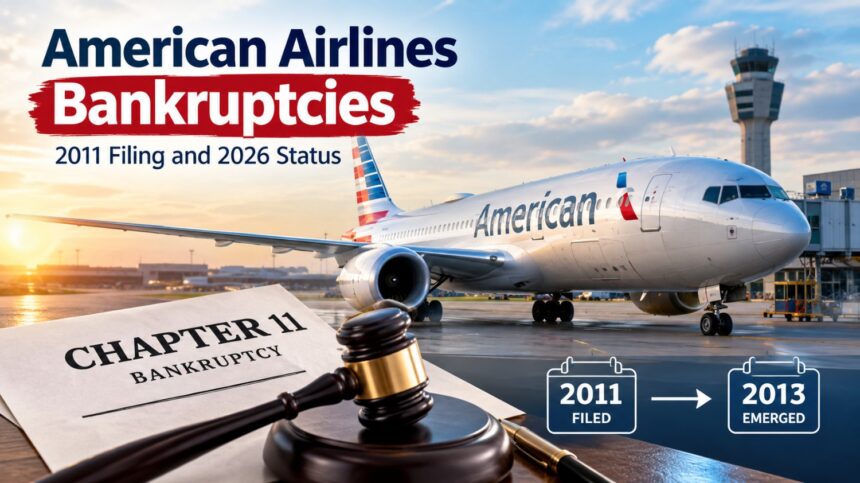
American Airlines bankruptcies come down to one case. The airline filed Chapter 11 on November 29, 2011. It kept flying, honored tickets and miles, and emerged on December 9, 2013. It has not filed since.
- Did American Airlines Go Bankrupt?
- When Did American Airlines File for Bankruptcy?
- Why Did American Airlines File for Chapter 11?
- What Is Chapter 11?
- Did American Airlines Keep Flying During Bankruptcy?
- What Happened to Tickets and AAdvantage Miles?
- How Long Was American Airlines in Bankruptcy?
- When Did American Airlines Emerge From Bankruptcy?
- Did the US Airways Merger Happen Because of the Bankruptcy?
- What Happened to Employees and Pensions?
- What Happened to Creditors and Shareholders?
- American Airlines Bankruptcies: Has It Filed More Than Once?
- Is American Airlines Bankrupt Now?
- How Does This Compare to Spirit Airlines?
- Common Mistakes
- FAQ
- Conclusion
This guide covers why it happened, what changed for travelers and workers, and what has happened since. It also shows how one filing differs from the “bankruptcies” people picture.
Did American Airlines Go Bankrupt?
The filing covered more than one company. AMR Corporation, American Airlines, Inc., and 18 affiliates filed together. That made 20 debtors. The list included American Eagle, the Admirals Club and Reno Air.
The court combined the cases for procedural purposes under one name, In re AMR Corporation, Case No. 11-15463. Each company stayed a separate legal entity.
On day one, the airline also asked the judge for permission to pay critical vendors, pay employee wages, and keep honoring customer programs like mileage awards. Those routine requests are called first-day motions.
When Did American Airlines File for Bankruptcy?
| Date | What happened |
|---|---|
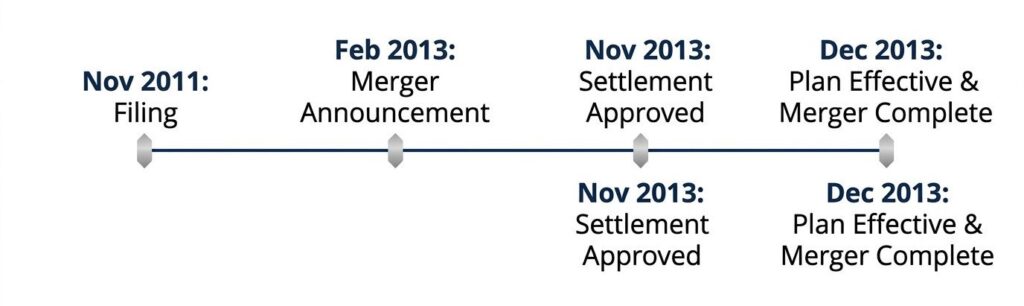
| Nov. 29, 2011 | AMR and 19 affiliates file Chapter 11 |
| Feb. 1, 2012 | American says it will seek to end its pension plans |
| Mar. 7, 2012 | American retreats and proposes freezing most pensions instead |
| Feb. 14, 2013 | American and US Airways announce their merger |
| Sept. 12, 2013 | Judge Lane approves the reorganization plan from the bench |
| Oct. 21, 2013 | The court enters the Confirmation Order |
| Nov. 27, 2013 | The court approves the Justice Department settlement |
| Dec. 9, 2013 | The plan takes effect; American Airlines Group begins trading as “AAL” |
Why Did American Airlines File for Chapter 11?
That detail surprises people. The company said it was the only major network airline that hadn’t used Chapter 11 to cut costs. Competitors had come out of their own cases with “dramatically improved balance sheets,” in the company’s words. American was still paying the old bills.
The balance sheet was stressed, not empty. Late 2011 filings showed about $24.7 billion in assets and about $29.6 billion in liabilities. Most of the debt was bonds and notes. The rest was owed to airports, municipalities and trade creditors.
One restructuring adviser lists industry consolidation, high fuel prices, weak travel demand and rising labor costs as causes. It also calls the case the second-largest airline bankruptcy at the time.
The losses were real. AMR lost $884 million in the first nine months of 2011 and another $904 million in December alone. It had lost more than $11 billion since 2001.
CEO Gerard Arpey had long argued American could fix itself without a filing. He retired the day it filed. Tom Horton took over.
What Is Chapter 11?
Hypothetical: A lender wants its jet back the morning after a filing. The automatic stay says wait. Then Section 1110 sets a clock: the airline has 60 days to catch up on payments or the lender can take the plane.
How It Works
The moment a company files, the automatic stay applies. Under 11 U.S.C. § 362, a bankruptcy petition “operates as a stay, applicable to all entities.” Lawsuits and collection efforts stop.
Management then stays in control as a debtor in possession (11 U.S.C. §§ 1107–1108). The company runs day to day while it writes a plan.
Two sections matter most for airlines. Section 1110 protects aircraft lenders. Section 1113 governs union contracts, covered below.
Finally, the plan must meet the tests in 11 U.S.C. § 1129 before the judge confirms it.
Chapter 11 vs. Chapter 7
| Feature | Chapter 11 | Chapter 7 |
|---|---|---|
| Goal | Reorganize and keep operating | Shut down and sell assets |
| Who runs the company | Existing management (debtor in possession) | A court-appointed trustee |
| Customers see | Business as usual | Operations stop |
| American Airlines | Used in 2011 | Not used |
Did American Airlines Keep Flying During Bankruptcy?
Even the Admirals Club lounges stayed open. Most travelers never saw the bankruptcy. It happened in a courtroom, not at the gate.
What Happened to Tickets and AAdvantage Miles?
Hypothetical: Maya books a $480 flight for February in late November 2011. She reads the headlines and panics. She cancels and eats a fee on a fare that was never at risk. The better move was to keep her confirmation email and fly.
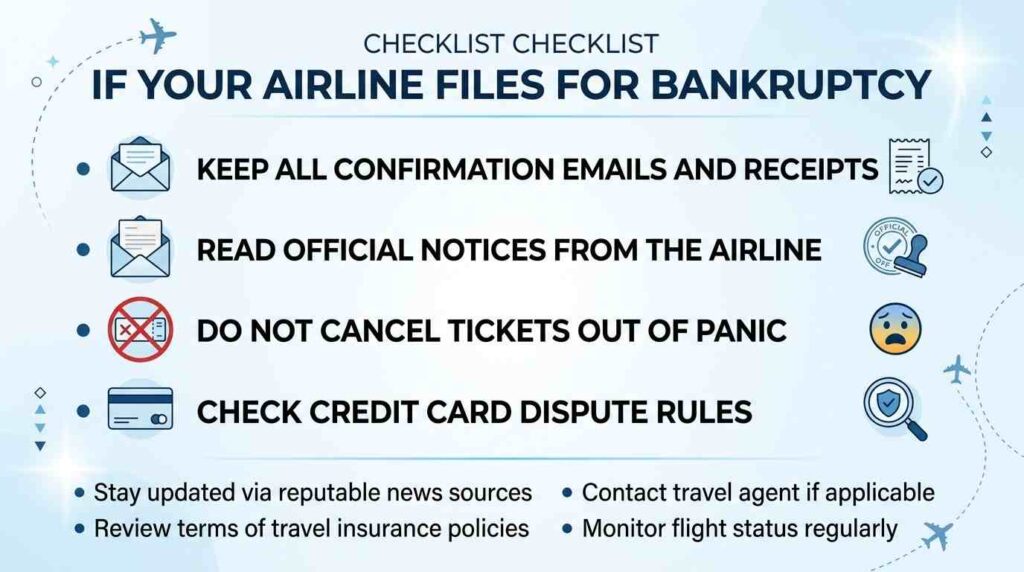
If an airline ever files, take these steps.
- Keep every confirmation email and receipt.
- Read the airline’s official bankruptcy notice for customer instructions.
- Don’t cancel an honored ticket out of fear.
- If you paid by card and the airline fails to deliver, ask your card issuer about a dispute. The Fair Credit Billing Act and card-network rules may help.
- Treat miles as a program benefit, not cash in a bank account.
How Long Was American Airlines in Bankruptcy?
When Did American Airlines Emerge From Bankruptcy?
American’s own Form 8-K filed with the SEC gives the dates. The Confirmation Order was entered on October 21, 2013, approving the fourth amended joint plan. The plan took effect on December 9, 2013.
Did the US Airways Merger Happen Because of the Bankruptcy?
Here’s how it unfolded. US Airways CEO Doug Parker went after American soon after it filed. In August 2012, creditors pushed AMR to hold merger talks so they could compare a merger against staying independent. The union side weighed both paths too.
The deal came on February 14, 2013. It carried an implied combined equity value of about $11 billion. The companies said they expected about $1 billion a year in combined benefits.
Then came a hurdle. The Justice Department sued in August 2013 to block the deal. The case settled, and the court approved the settlement on November 27, 2013.
Judge Lane also declined to approve a roughly $19.9 million severance package for outgoing CEO Tom Horton inside the plan. He said it could be handled after the merger.
The result was a board of 12: three from American, four from US Airways, and five chosen by American’s creditors. Parker became CEO, and Horton served as chairman for a time.
What Happened to Employees and Pensions?
The plan was blunt. Management wanted to cut about $2 billion a year in costs, including $1.25 billion in labor costs. The job cuts broke down roughly like this: 4,600 maintenance workers, 4,200 baggage handlers, 2,300 flight attendants, 1,400 managers and 400 pilots.
Pensions were the bigger fight. American had four defined-benefit plans covering about 130,000 workers and retirees. They were underfunded by an estimated $10 billion. American announced in February 2012 that it would seek to terminate them.
The federal pension insurer, the PBGC, pushed back hard. It filed $91 million in liens after American paid only $6.5 million of a required $100 million contribution. Its director said American “needs to show there is no better alternative.”
On March 7, 2012, American retreated. It proposed freezing the non-pilot plans, so workers would keep the benefits they had already earned. The pilots’ plan stayed an open question at that point.
The union fight centered on Section 1113. It lets a company ask a judge to reject union contracts, but only after it proposes changes, bargains in good faith, and shows the changes are necessary.
Congress wrote that rule after airline history. Continental Airlines filed in 1983 and cut pay sharply. The Supreme Court then decided NLRB v. Bildisco & Bildisco (1984), which made it easier to cancel union contracts. Congress added safeguards afterward.
American’s largest union, the TWU, represented more than 26,000 workers and thousands of retirees. Its restructuring adviser testified as an expert in the contested Section 1113 proceedings. The union later negotiated new contracts and an equity stake in the merged airline.
What Happened to Creditors and Shareholders?
Court papers described full recovery for unsecured creditors with $2.6 billion in claims and for creditors with $6.8 billion in claims backed by aircraft. American itself called a shareholder payout unusual in Chapter 11 and unprecedented in recent airline restructurings.
The new company’s ownership split roughly 72% to AMR’s stakeholders and 28% to US Airways shareholders. Inside that 72%, American employees and unions held 23.6%.
Hypothetical: A catering company is owed $18,000 for lounge food when American files. The stay stops it from suing. Its smart move is to watch for the deadline to file a proof of claim. Missing it is a common and costly mistake.
Hypothetical: An investor owns 1,000 AMR shares at filing. She expects zero. Instead, her shares are canceled and replaced with new stock. The final value was debated, so no single number fits everyone.
American Airlines Bankruptcies: Has It Filed More Than Once?
Here is how to keep the years straight.
- 2003: American faced heavy pressure after 9/11 and avoided Chapter 11 by winning labor concessions.
- 2011: The only filing.
- 2020: The pandemic crushed travel demand. American didn’t file. It used federal payroll support and a federal loan.
- US Airways: It filed in August 2002 and again in 2004. It merged with America West in 2005. After the American merger, its last flight under the US Airways name took off on October 17, 2015.
Old articles that mention a 2003 “bankruptcy” usually mean the near miss.
Is American Airlines Bankrupt Now?
The debt story is real, and it’s worth separating from the legal one. The company’s own “total debt” measure includes leases and pension obligations. It peaked near $54 billion in mid-2021, according to company slides.
The airline set a goal to cut $15 billion. It reported hitting that goal in the fourth quarter of 2024, a year early. It now targets total debt below $35 billion by the end of 2027.
Critics point to share buybacks. From July 2014 through 2019, American repurchased 312.7 million shares for $12.4 billion, at an average of $39.76. Then the pandemic hit. The company has argued it also spent heavily on employee raises over the same period.
Two numbers help with balance. American ended 2024 with $10.3 billion in available liquidity and record 2024 revenue of $54.2 billion. Check the latest filing for newer figures. Heavy debt is a strength question. It is not a bankruptcy filing.
How Does This Compare to Spirit Airlines?
Spirit’s court filings then listed assets for sale, including takeoff and landing slots at LaGuardia Airport. That is what a wind-down looks like. Spirit’s problems grew faster than its plan.
Common Mistakes
The first mistake is thinking “bankrupt” means “shut down.” Under Chapter 11, the company keeps working. The second is canceling trips out of fear, as Maya did. The third is treating miles like cash. The fourth is trusting old articles that blur the 2003 near miss with the 2011 filing. The fifth, for anyone owed money, is missing the claim deadline.
FAQ
Did American Airlines file for bankruptcy?
Yes. AMR Corporation, the parent of American Airlines, filed for Chapter 11 on November 29, 2011, along with American Airlines, Inc. and 18 affiliates. It is the only time American has filed. The airline kept flying and emerged on December 9, 2013.
How many times has American Airlines filed for bankruptcy?
Once. It filed Chapter 11 on November 29, 2011. It came close in 2003 but avoided a filing by winning labor concessions, and it did not file during the 2020 pandemic.
Is American Airlines bankrupt right now?
No. As of October 5, 2026, we found no report of a new filing. The airline still carries heavy debt, so check its latest 10-K and 10-Q on SEC EDGAR for current numbers.
How long was American Airlines in bankruptcy?
Two years and ten days, from November 29, 2011, to December 9, 2013. Large airline cases take time because unions, creditors and regulators all have a say before the judge signs off.
Were American Airlines tickets safe during bankruptcy?
Yes. Flights kept operating, and the airline told customers on filing day that tickets would be honored. Travelers didn’t need to take any action to protect their bookings.
What happened to AAdvantage miles?
The program continued. American asked the court on day one for permission to keep honoring customer programs like mileage awards. Treat miles as a program benefit, not cash, and use them normally.
Did American merge with US Airways because of the bankruptcy?
The merger was how American exited bankruptcy, not what caused it. American first resisted, but its creditors pushed for talks. The plan combined the two airlines, and the merger closed on December 9, 2013.
What happened to American’s pensions?
American first announced in February 2012 that it would seek to terminate its four pension plans, which covered about 130,000 workers and retirees. In March 2012 it proposed freezing the non-pilot plans instead. A freeze lets workers keep the benefits they had already earned.
What should I do if my airline files for bankruptcy?
Keep your receipts and confirmation emails, and read the airline’s official notice. Don’t cancel out of panic. If you paid by credit card and the airline fails to deliver, ask your card issuer about a dispute.
Conclusion
American Airlines bankruptcies boil down to one real case. The airline filed Chapter 11 on November 29, 2011, kept flying, and emerged on December 9, 2013, after merging with US Airways. It has not filed since.
The lesson is bigger than one airline. Chapter 11 is a tool for reorganizing, not for closing down. If you are a creditor, vendor, employee or investor tied to a company in bankruptcy, talk to a licensed bankruptcy attorney in your jurisdiction. Deadlines matter, and the right advice depends on your facts.