


A federal judge dismissed the capitol plaque lawsuit in late September 2026. Judge Dabney Friedrich ruled that Harry Dunn and Daniel Hodges, two officers who defended the Capitol on January 6, 2021, did not have legal standing to sue. The ruling did not decide whether the plaque follows the law. It only decided that these two officers could not bring the case.
- What Is the Capitol Plaque Lawsuit?
- Quick Facts at a Glance
- Capitol Plaque Lawsuit Timeline
- What the 2022 Plaque Law Says
- What the Plaque Says and Where It Hangs
- Why the Judge Dismissed the Case
- Standing in Plain English
- What the Ruling Did Not Decide
- Can the Officers Appeal?
- What Happens to the Plaque Now
- How Lawsuits Against the Government Work
- Common Pitfalls in Cases Like This
- When to Talk to a Lawyer
- FAQ
- What is the capitol plaque lawsuit?
- Who is the judge in the capitol plaque lawsuit?
- Why was the capitol plaque lawsuit dismissed?
- Did the judge say the plaque broke the law?
- Where is the January 6 plaque located?
- Does the plaque list officers’ names?
- Can Dunn and Hodges appeal the dismissal?
- What would it take to move the plaque to the western front?
- Conclusion
This matters because Congress ordered the plaque in 2022 and then missed its own deadline by years. The case now shows how hard it can be to enforce a law against the government, even when the law is clear.
What Is the Capitol Plaque Lawsuit?
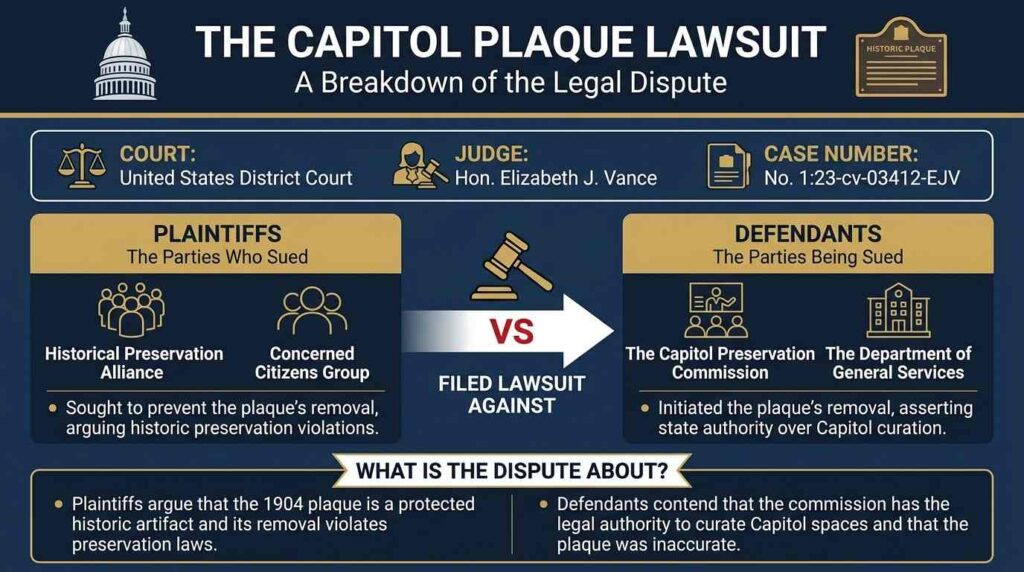
The capitol plaque lawsuit is a federal case called Dunn et al. v. Austin et al. It was filed on June 12, 2025, in the U.S. District Court for the District of Columbia. The case number is 1:25-cv-01844.
The two plaintiffs are Harry Dunn, a former U.S. Capitol Police officer, and Daniel Hodges, an officer with the Metropolitan Police Department of the District of Columbia. They sued the Architect of the Capitol, Thomas Austin, who is the official in charge of the building.
Their request was simple. They wanted a court to force the Architect to put up the plaque that Congress ordered in 2022. Later, after the plaque went up in a hallway closed to the public, they argued it was hidden and did not meet the law.
At the time they filed, Dunn said the case was needed because Congress had not followed its own law. He put it this way in a 2025 livestream: “Put the plaque up or change the law.”
Quick Facts at a Glance
| Detail | What We Know |
|---|---|
| Case name | Dunn et al. v. Austin et al. |
| Court | U.S. District Court, District of Columbia |
| Case number | 1:25-cv-01844 |
| Judge | Dabney L. Friedrich |
| Plaintiffs | Harry Dunn and Daniel Hodges |
| Defendant | Architect of the Capitol (Thomas Austin) |
| Filed | June 12, 2025 |
| Outcome | Dismissed for lack of standing (reported September 30, 2026; written opinion dated October 1, 2026) |
| Law at issue | Section 214 of the Consolidated Appropriations Act of 2022 |
| Appeal status | No appeal announced in the reports reviewed as of early October 2026 |
Capitol Plaque Lawsuit Timeline
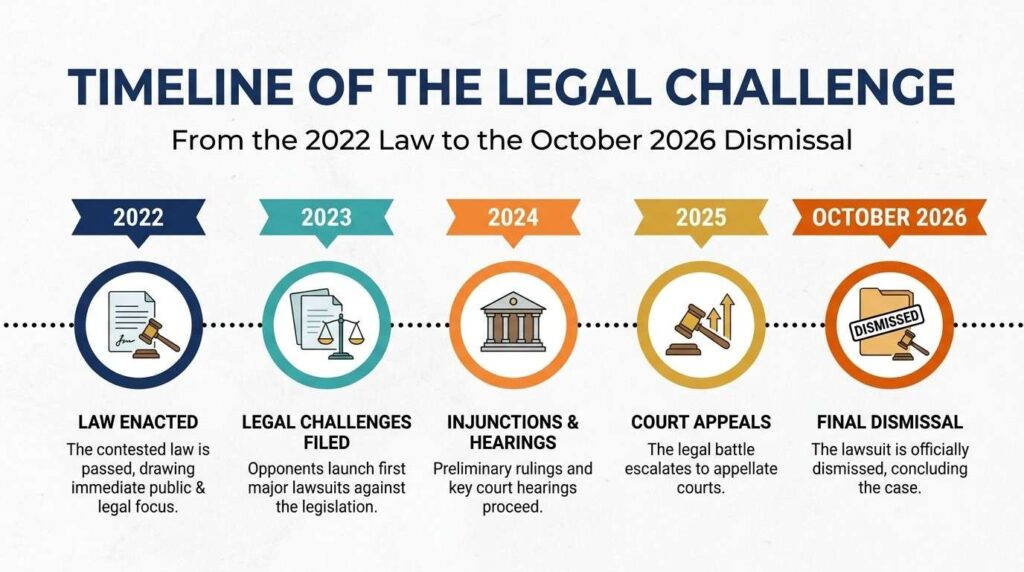
The story runs over four years. Here are the key dates.
- March 2022: The House passes a giant spending bill that includes the plaque order. It is one section buried in a bill of about a thousand pages.
- Spring 2023: The one-year deadline passes. No plaque goes up.
- June 12, 2025: Dunn and Hodges file the capitol plaque lawsuit.
- January 8, 2026: The Senate unanimously passes a resolution to display the plaque in a publicly accessible spot in the Senate wing. Senators Thom Tillis and Jeff Merkley led the push.
- March 7, 2026: Workers bolt the bronze plaque to a wall at about 4 a.m. A QR code sits beside it.
- March 10, 2026: The officers tell the court the plaque is hidden and does not follow the law.
- March 30, 2026: Judge Friedrich rules on motions from outside parties who asked to join the case.
- September 30, 2026: The judge’s dismissal is reported. The written opinion is dated October 1.
The House side of the story also matters. Speaker Mike Johnson’s office argued the law was “not implementable.” Its reason was that the law talked about listing officers’ names, while the plaque that was made listed agencies instead.
What the 2022 Plaque Law Says
The order came from Section 214 of the Consolidated Appropriations Act of 2022. The section told the Architect of the Capitol to get an honorific plaque within one year. It was supposed to list the names of the officers who responded on January 6, 2021.
The list covers officers from the U.S. Capitol Police, the D.C. Metropolitan Police, and other federal, state, and local agencies. The plaque was also supposed to hang at a permanent spot on the western front of the Capitol. The western front is the outside side of the building where some of the worst fighting took place.
Notice what the law does not say. It does not say who can sue if the plaque is late. That gap is exactly where the capitol plaque lawsuit ran into trouble.
A law on paper is only as strong as the person who can enforce it. For a different example of someone challenging a public body over a demand it made, read our guide on the homeschool diploma lawsuit in Pennsylvania.
What the Plaque Says and Where It Hangs
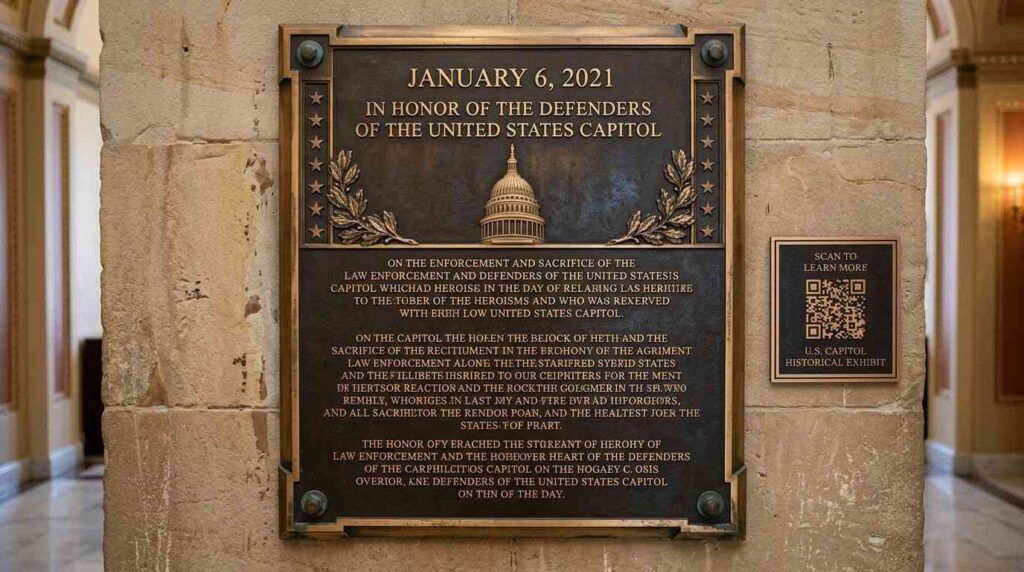
The plaque is bronze. Its text says a grateful Congress honors the people who bravely protected the Capitol on January 6, 2021, and that their heroism will never be forgotten. Under that message, it lists agencies instead of individual officers.
The Architect of the Capitol’s own plaque page lists these agencies:
- Capitol-area police: U.S. Capitol Police and the D.C. Metropolitan Police Department
- Nearby local and state departments: Arlington County, Fairfax County, Prince William County, Prince George’s County, Montgomery County, Maryland State Police, Virginia State Police, New Jersey State Police, Metro Transit Police, and the Metropolitan Washington Airports Authority
- Federal agencies: ATF, the Department of Health and Human Services, the Department of Homeland Security, the FBI, the National Guard Bureau, the Pentagon Force Protection Agency, the U.S. Marshals Service, the U.S. Park Police, and the U.S. Secret Service
You can read the full list on the official Architect of the Capitol plaque page.
Individual names are not engraved. Instead, a QR code beside the plaque leads to a file of officers’ names. The plaque hangs near a West Front entrance on the Senate side, at the end of a hallway that is not open to the public, according to CNN’s report. House Democrats led reporters to see it on March 17, 2026, as covered by States Newsroom.

Why the Judge Dismissed the Case
The judge did not say the officers were wrong about the law. She said they could not bring the case at all. The reason is Article III standing.
Article III of the U.S. Constitution lets federal courts hear only real “cases” and “controversies.” To get into court, a plaintiff must show three things. The plaintiff must have suffered an injury in fact, the injury must be caused by the defendant, and a court order must be likely to fix it.
Dunn and Hodges said the missing plaque added to their psychological injuries from January 6. They also said it made it easier for others to harass them and brush off what officers did that day.
Judge Friedrich agreed the officers have a far more personal link to the plaque than the public does. They are among the very officers Congress wanted to honor. But she wrote that standing is “not measured by the intensity of the litigant’s interest,” as reported by Law&Crime.
Here is how the judge worked through the problem, based on court reporting:
- Injury: Distress over how the government honors your service is not, by itself, a concrete injury under Article III.
- Causation: The complaint did not show that the missing plaque caused or made worse the officers’ mental health problems. At most, it suggested the plaque would not have improved an already poor public view.
- Redressability: Installing the plaque would not likely ease their harm, because that depends on how the public and other people react.
She also said standing is judged as of the day the complaint was filed. The officers filed in June 2025. The plaque did not go up until March 2026, so the later installation could not fix a missing foundation.
Standing in Plain English
Standing sounds technical, but the idea is simple. A court only helps you if you can show a real, personal harm that the court can actually fix.
Here is a hypothetical example. Imagine a town promised to repair a bridge, and the repair is late. A driver whose car was damaged on the broken bridge can probably show a real injury. A neighbor who just feels upset that the town broke its promise has a harder road.
Another example: suppose a state agency ignored a rule about posting public notices. A person who lost money because they never saw the notice has a clear harm. A person who simply believes the rule should be followed usually does not have enough.
The officers’ situation sat in a hard middle zone. They had a deep personal stake, but the court said emotional distress tied to disagreement with government conduct was not enough on its own.
Standing comes up in many government cases. If you want to see another lawsuit against a public body explained in simple steps, see our breakdown of the Rhode Island voter data lawsuit.
What the Ruling Did Not Decide
This part is easy to miss. The judge did not rule on the plaque itself.
She did not decide whether a plaque that lists agencies, with a QR code for names, meets the 2022 law. She did not decide whether the Senate-wing hallway counts as a “permanent location on the western front.” She did not decide whether the Architect broke any rule.
Those questions are still open. The ruling only closed the courthouse door for these two plaintiffs, for now.
In general, a dismissal for lack of standing says nothing about who is right on the merits. That is why people on both sides read the result differently. Supporters of the officers say the law was never tested. Others say the decision shows Congress, not a court, should decide how and where to honor the officers.
Can the Officers Appeal?
Yes, an appeal is possible. The next court up is the U.S. Court of Appeals for the D.C. Circuit.
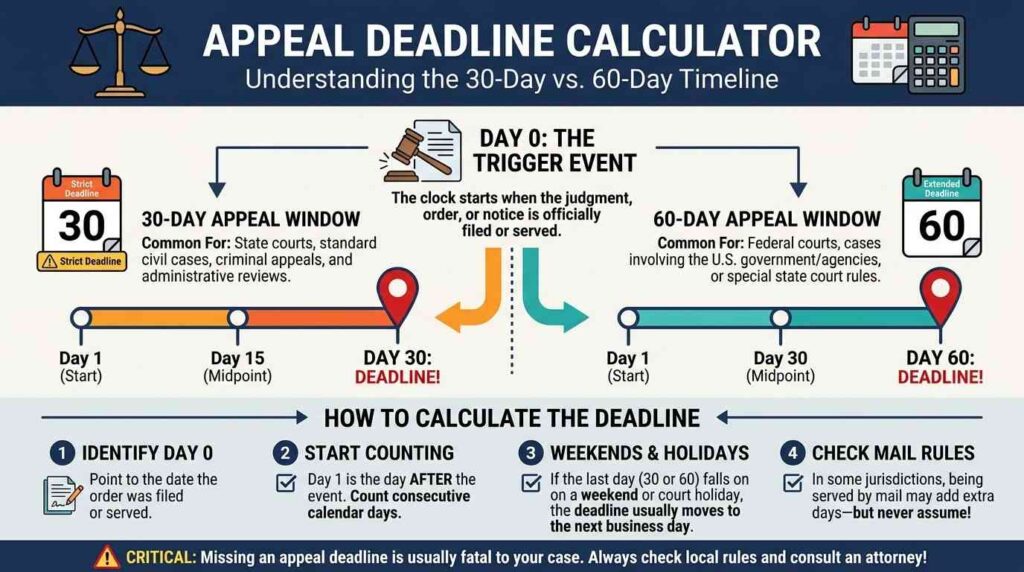
Deadlines matter here. In most civil cases, a notice of appeal is due within 30 days. But when the United States, a U.S. agency, or a U.S. officer sued in an official capacity is a party, the window is 60 days under Federal Rule of Appellate Procedure 4.
If that longer window applies and the order was entered October 1, 2026, the deadline would land around the end of November 2026. Always check the court docket for the exact date, because the clock starts when the order is formally entered.
As of early October 2026, the reports reviewed did not show any appeal announcement. Some outlets said the officers’ lawyers were reviewing options, but those reports did not name a decision. This could change, so check the docket for Dunn et al. v. Austin et al. for the latest.
Time limits are strict in every kind of lawsuit. If you want a plain guide to how deadlines work in a very different type of case, read our article on the slip and fall lawsuit, including steps, costs, and legal deadlines.
What Happens to the Plaque Now
For now, the plaque stays where it is. Nothing in the dismissal orders it moved.
The Senate resolution from January 2026 says the plaque should be prominently displayed in a publicly accessible location in the Senate wing until it can go to its permanent home. Whether the current hallway meets that wording is a political and administrative question now, since no court ruled on it. NBC News reported on that resolution, including the House Speaker’s objection to the original law.
The officers’ lawyer, Brendan Ballou, argued in March that honor is public recognition, and that a spot hidden from visitors fails that test. NBC News covered that filing after the plaque went up.
Paths that could change things from here:
- An appeal to the D.C. Circuit by Dunn and Hodges
- New legislation from Congress that changes the law or the location
- Administrative action by the Architect of the Capitol, on Congress’s direction
- A new case brought by someone who can show a clearer, concrete injury
Which of these happens, if any, is unknown today.
A side note on a related issue: in February 2025, bronze copies of the Congressional Gold Medal honoring January 6 officers briefly vanished from the U.S. Mint website and then came back about a week later. It is a separate matter, but it shows how recognition of these officers has been a point of friction.
How Lawsuits Against the Government Work
Suing the government is not like suing a company. Several extra rules apply, and they trip up many plaintiffs.
First, a court needs power over the case. That is called jurisdiction. Standing is part of it. If standing is missing, the judge must dismiss, even if the plaintiff’s cause is sympathetic.
Second, the government often has special protections. In federal court, the defendant may argue it cannot be sued at all, or that the case belongs to another branch of government. The Architect of the Capitol works for Congress, which adds a layer of separation-of-powers questions.
Third, timing runs differently. The government usually gets more time to respond and to appeal. Cases can take many months before a judge even reaches the main question.
For a clear example of a person taking on a federal agency, see our article on the Homeland Security student visa lawsuit.
Common Pitfalls in Cases Like This
Many people believe that if a law is clear, a court will force the government to follow it. The capitol plaque lawsuit shows why that is not always true.
Here are the most common pitfalls:
- Assuming a broken rule equals a harm. A court wants a concrete injury, not only a violation.
- Relying on emotional distress alone. The judge here said distress from disagreeing with government conduct, standing alone, was not enough.
- Filing before the facts are set. Standing is judged when the complaint is filed, so later events may not rescue a weak start.
- Asking for a remedy that does not fix the harm. The court must find that its order would likely help.
- Missing deadlines. An appeal window can be as short as 30 days, or 60 when the federal government is a party.
For a broader look at how public bodies and officials end up in court, and how fault gets argued, see our report on the Pima County Sheriff lawsuit.
When to Talk to a Lawyer
If you are thinking about suing a government office, talk to a lawyer before you file. Standing problems are hard to fix after the fact.
A lawyer can check whether you have a concrete injury, which court is right, and how long you have to act. They can also tell you if another route, such as a complaint to an oversight office or a request to lawmakers, may work better.
Costs and fee setups vary a lot by case type. If you want to see how an attorney relationship and fees are usually explained in a high-stakes area, read our wrongful death attorney guide.
Reminder: this article gives general information about a public court case. It does not give legal advice for your situation.
FAQ
What is the capitol plaque lawsuit?
It is a federal case filed in June 2025 by officers Harry Dunn and Daniel Hodges against the Architect of the Capitol. They wanted a court to force the installation, and later the proper display, of a plaque Congress ordered in 2022 to honor January 6 responders.
Who is the judge in the capitol plaque lawsuit?
U.S. District Judge Dabney L. Friedrich of the District of Columbia handled the case. She was appointed by President Trump and has handled many January 6 matters.
Why was the capitol plaque lawsuit dismissed?
The judge ruled the officers lacked Article III standing. In short, she found they had not shown a concrete injury caused by the Architect that a court order would likely fix.
Did the judge say the plaque broke the law?
No. She did not decide whether the plaque, its agency list, its QR code, or its location comply with the 2022 law. The ruling was about who may sue, not about whether the law was followed.
Where is the January 6 plaque located?
It hangs in a hallway just inside a West Front entrance on the Senate side of the Capitol. That area is not open to regular public tours, according to news reports.
Does the plaque list officers’ names?
Not on the bronze itself. It lists participating agencies. A QR code beside it links to a file with the officers’ names.
Can Dunn and Hodges appeal the dismissal?
They can ask the D.C. Circuit to review it. The notice of appeal window is likely 60 days because a federal officer is a party, but the exact date depends on the docket entry. No appeal had been announced in the reports reviewed as of early October 2026.
What would it take to move the plaque to the western front?
A court did not order it, so the likely routes are action by Congress, direction from congressional leaders to the Architect, a successful appeal, or a new case by a plaintiff who can show a concrete injury.
Conclusion
The capitol plaque lawsuit ended, at least for now, on a narrow legal point. Judge Friedrich did not say the officers’ cause was unworthy. She said federal courts need a concrete, fixable injury, and strong personal feelings were not enough.
The plaque is up, but the question Congress raised in 2022 is still open: where should it hang, and who gets to decide? An appeal, new legislation, or action by the Architect could still change the answer.
If you follow the capitol plaque lawsuit, watch the D.C. Circuit docket for a notice of appeal around the end of November 2026. And if you are weighing a case of your own against a public office, speak with a qualified attorney early. Standing and deadlines can decide a case before anyone looks at the facts.