



Iowa tint laws changed on July 1, 2026 — and a remarkable number of official-looking pages have not caught up. For decades, Iowa Code § 321.438(2) banned front glass that was “excessively dark or reflective,” and an Iowa DOT rule translated that phrase into 70% light transmittance for the windshield and the windows beside the driver. House File 766 — signed by Governor Kim Reynolds on May 15, 2026, as 2026 Iowa Acts chapter 1100 — struck the vague wording and the DOT’s rulemaking sentence, and wrote the numbers into the statute itself: 70% for the windshield, 50% for the front side windows and sidewings.
- Quick Answer
- What Changed on July 1, 2026: House File 766
- Iowa Tint Limits by Window
- The Windshield: 70% Everywhere, No Strip
- The Stale-Rule Trap: Sources That Still Say 70%
- Medical Exemptions: Closed in 2012, Buried in 2026
- Penalties: $70, Then the Add-Ons
- How Iowa Compares With Other States
- How to Stay Legal
- Frequently Asked Questions
- What is the legal tint in Iowa?
- Did Iowa change its window tint law?
- Is 50% tint legal in Iowa now?
- Is 35% tint legal in Iowa?
- Can I put a tint strip on my windshield in Iowa?
- Can I get a medical exemption for window tint in Iowa?
- How much is a tint ticket in Iowa?
- Are rear windows limited in Iowa?
- Conclusion
This guide explains the new figures, the twenty years of failed 35% bills behind them, the medical exemption that closed for good on the same day, and the stale-rule trap that still catches drivers reading the DOT’s old documents.
Quick Answer
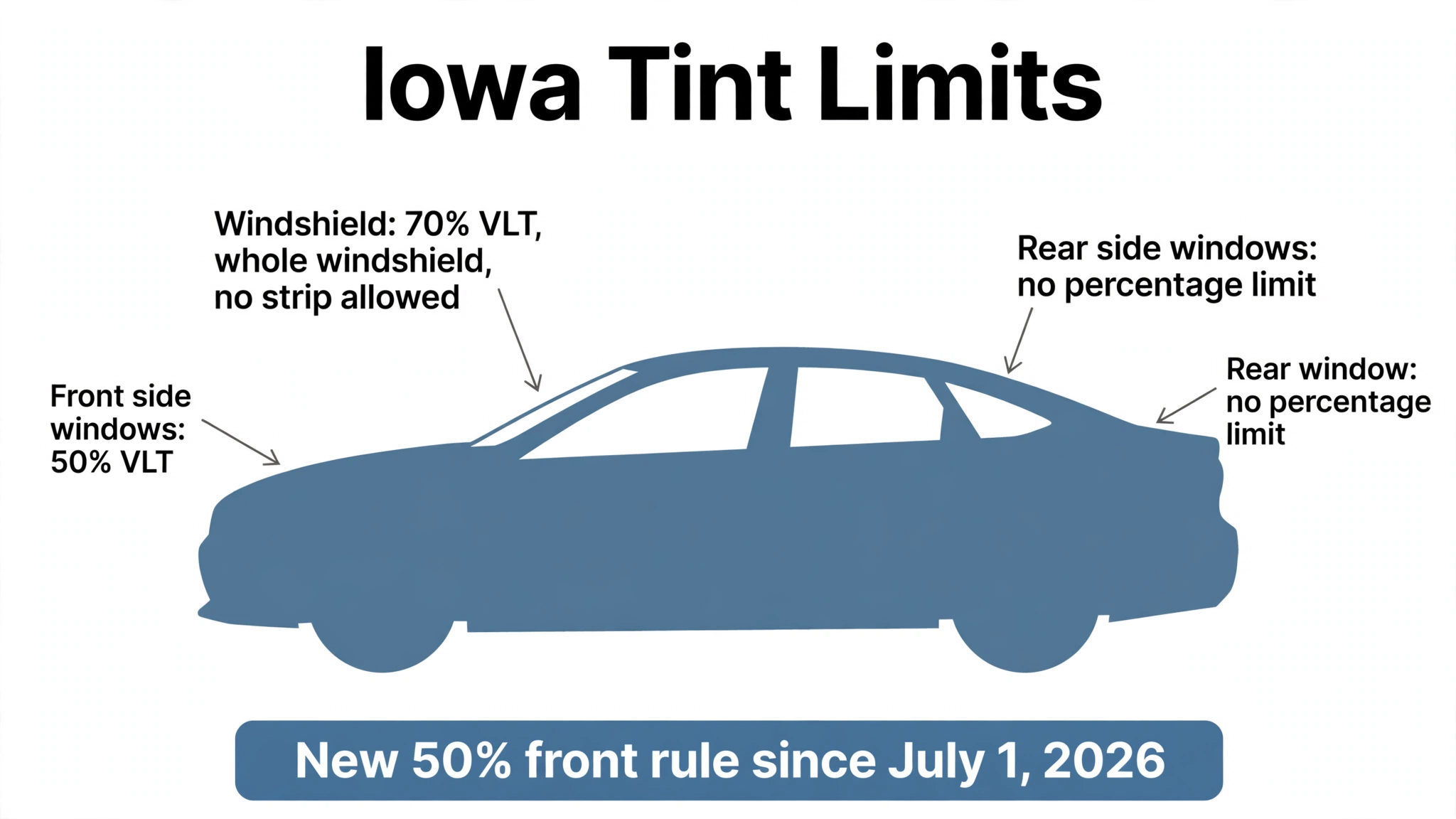
Under Iowa tint laws since July 1, 2026, the front windshield must meet a minimum standard of transparency of 70% light transmittance — the whole windshield, with no strip exception — and the side windows immediately beside the driver and the front sidewings must meet 50%. Windows behind the driver carry no percentage; they must simply permit clear vision, and the Iowa DOT confirms any darkness may be used. The same figures apply to every vehicle. A violation carries a $70 scheduled fine (about $135.50 with statutory add-ons). The only exemption the statute names is for law enforcement vehicles on official duty — there is no medical exemption.
What Changed on July 1, 2026: House File 766
The old section 321.438(2) never printed a number. It banned a windshield, front side window, or sidewing that was “excessively dark or reflective so that it is difficult for a person outside the motor vehicle to see into the motor vehicle,” and told the Department of Transportation to set “a minimum measurable standard of transparency” by rule. The DOT’s rule, 761 IAC 450.7, set that standard at 70% — for the windshield and the front glass alike — and 70% is the figure a generation of Iowa tint pages learned.
The legislature spent years trying to replace the arrangement with 35%: Senate File 2267, Senate Study Bill 1019, Senate File 2149, Senate File 271, and House File 405 all proposed a 35% front standard in one form or another, and none became law. The bill that finally moved began as House File 206 in 2025, was renumbered HF 766 in committee, passed the House 72–25 on March 25, 2025 and the Senate 31–16 on March 23, 2026, and was signed on May 15, 2026. The compromise it enacted is 50%, not 35%.
HF 766 amended subsection 2 to ban operating a vehicle equipped with:
1. A front windshield that meets a minimum standard of transparency of less than 70% light transmittance; or 2. A side window to the immediate right or left of the driver, or a sidewing forward of the driver, that meets a minimum standard of transparency of less than 50% — the amended text keeping the “excessively dark or reflective” see-into framing around the new figure.
And it struck the sentence that had the DOT adopt the standard by rule. The numbers now live in the Code, which is why the DOT has proposed rescinding its old tint rule — and why documents built on that rule are expiring underneath the people still reading them.
Iowa Tint Limits by Window
| Window | Iowa rule (all vehicles) |
|---|---|
| Windshield | 70% light transmittance minimum — whole windshield, no strip exception |
| Front side windows | 50% light transmittance minimum |
| Front sidewings | 50% light transmittance minimum |
| Side windows behind the driver | No percentage — must permit clear vision; any darkness in practice |
| Rear window | No percentage — must permit clear vision; any darkness in practice |
| Tolerance / reflectivity | No variance and no reflectivity percentage written into the statute |
The Windshield: 70% Everywhere, No Strip
Iowa’s windshield rule is the plainest in this series: the whole windshield must meet the 70% standard, and the statute grants no top-strip allowance — no AS-1 line, no inches from the top, no transparent-band exception of the kind Arizona measures from the driver’s seat or Hawaii cuts at four inches. Section 321.438 mentions neither a line nor a measurement for the windshield; the 70% figure applies to the glass as a unit, which in practice means factory-spec glass and no film at all. (Older tint records sometimes mention a strip for Iowa; the 2026 statute does not.) Our guide to how window tint percentages work explains why a 70% whole-glass standard leaves no room for even light film over factory glazing.
Behind the driver, the drafting flips from numbers to the older standard: subsection 1 of § 321.438 bans windows that do not permit clear vision, and no percentage attaches to the rear side windows or the rear window. The Iowa DOT’s own standards summary states the practical result directly — for back-seat side windows and the rear window, “any tint darkness can be used.”
The Stale-Rule Trap: Sources That Still Say 70%
The hazard in Iowa right now is not the law; it is the paper trail the old law left behind. HF 766 struck the DOT’s rulemaking authority, but rules do not rewrite themselves: when researchers checked in the autumn of 2026, 761 IAC 450.7 still printed the 70% front-side standard, and the DOT’s own Window Tinting Standards handout still showed 70% for the front side windows alongside a medical-exemption section describing a program that no longer exists. The DOT has proposed rescinding the rule precisely because the limits moved into the Code — but a driver who downloads the handout today can walk into a tint shop quoting a repealed number.
The hierarchy that resolves every conflict is simple: the statute beats the rule, and the rule beats the handout. Since July 1, 2026, Iowa Code § 321.438(2) is the law — 50% beside the driver — whatever any PDF still says. The same discipline applies in reverse to the search results full of “Iowa’s new 35% law”: 35% was the proposal in bill after bill, and it lost. The enacted number is 50%.
Common mistake: Paying a shop to strip legal 50% front tint — or refusing a legal 50% install — on the strength of the DOT handout’s 70% figure. The handout describes the rule HF 766 replaced.
Medical Exemptions: Closed in 2012, Buried in 2026
Iowa’s medical exemption has a two-stage ending, and both stages matter:
– The old program. Rule 450.7(3) allowed a person suffering from a severe light-sensitive condition, documented by a physician (licensed under Iowa Code chapters 148, 150, 150A, 151, or 154 — a list running from physicians to chiropractors to optometrists), to run front glass between 35% and 70% on the strength of Form 432020, signed by the physician and carried at all times in the vehicle it covered. Commercial vehicles were excluded. – The closure. The DOT’s guidance is blunt: “Medical exemptions shall not be granted on or after July 4, 2012,” and a lost Form 432020 cannot be replaced — the form is no longer available. For fourteen years the program survived only as a grandfather clause for pre-2012 forms in the same vehicle. – The burial. HF 766’s amended statute names no medical exemption at all — its only exemption is law enforcement — and the DOT states that previously approved exemptions are no longer authorized as of July 1, 2026. A driver who needs shielding today is pointed by the DOT to nearly transparent UV-blocking films instead: the lawful answer in Iowa is clear film, not darker film.
What if scenario: A Des Moines driver has carried a physician-signed Form 432020 since 2011 and runs 40% front windows under it. Before July 2026 the grandfather clause covered exactly that car and that form. Under the amended statute there is no medical exemption left to carry — the same windows now answer to the plain 50% floor, and 40% fails it.
Penalties: $70, Then the Add-Ons
A violation of § 321.438 is a scheduled violation with a fine of $70 under § 805.8A(3) — the figure the legislature’s own bill explanations print. As with most scheduled fines, the $70 is the start of the arithmetic, not the end: statutory surcharges and court costs bring the usual total to about $135.50. There is no separate installer penalty schedule and no tint-specific fix-it procedure in the section.
One heavier consequence sits in the DOT’s guidance rather than the fine schedule: under Iowa Code § 321.101(1)(b), law enforcement may send the DOT a request to suspend the registration and plates of a vehicle operated as mechanically unfit or unsafe. A $70 ticket is a nuisance; a suspended registration is a problem — and it is the reason a repeat stop for the same dark windows costs more than the fine suggests. Iowa has no annual safety inspection to catch tint off the road, so enforcement lives at the traffic stop.
How Iowa Compares With Other States
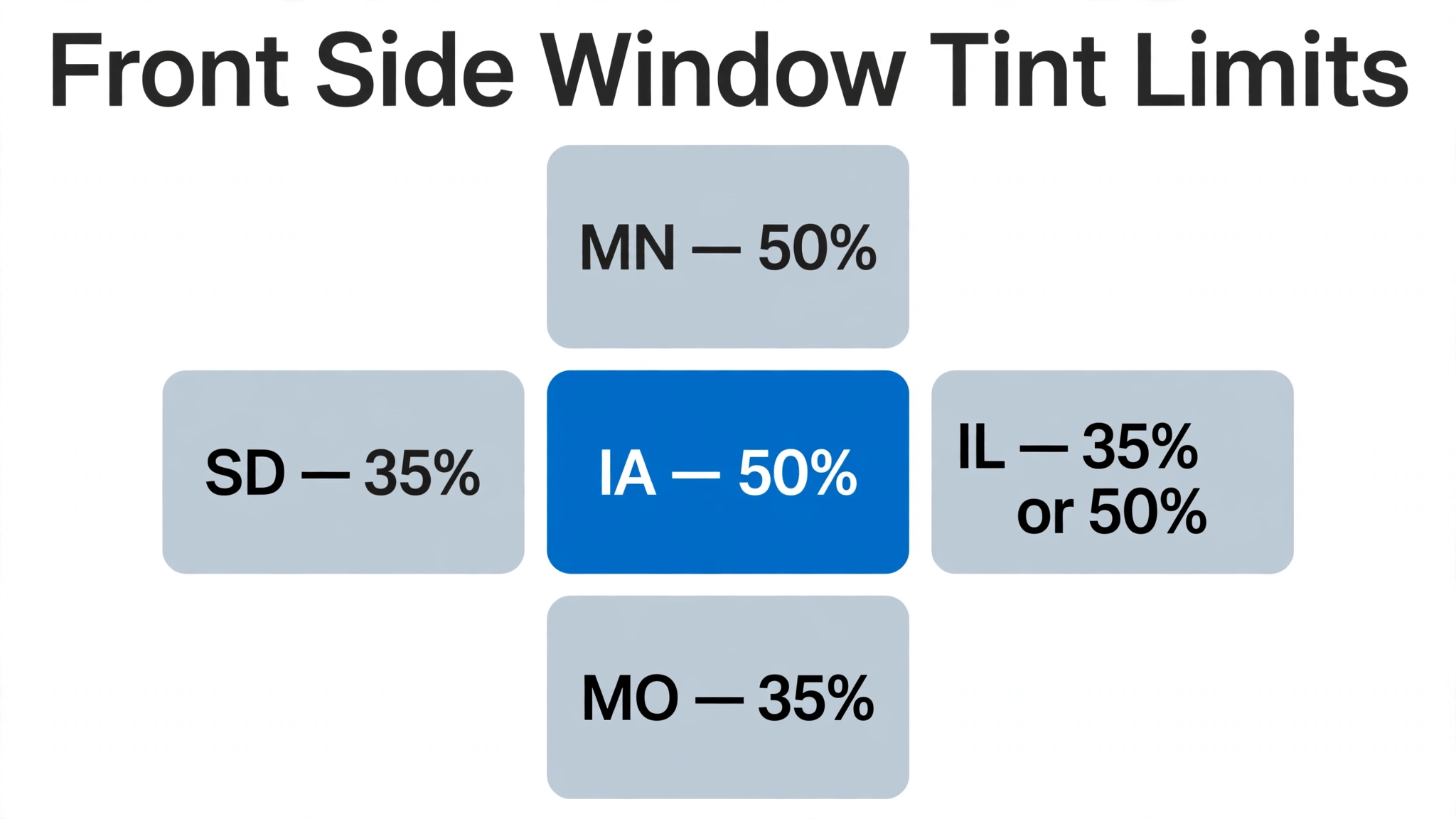
Iowa’s new 50% lands it exactly on its northern border: Minnesota has run a 50% standard (±3%, mirrors and markings included) for years, and Wisconsin matches it at 50% on the front side windows. The rest of the ring is darker: Illinois runs its linked 35% or 50% system, Missouri allows 35%, and Nebraska and South Dakota allow 35% on the front side windows. Iowa’s genuinely unusual features are structural rather than numerical — a windshield with no strip at all, a medical exemption that exists nowhere in current law, and a front number that spent decades in an agency rule before the legislature claimed it in 2026.
Read also: Texas tint laws, Florida window tint law, Washington State tint laws
How to Stay Legal
1. Front side windows and sidewings: 50% or lighter, finished. The statute prints no tolerance, so buy film that leaves margin over factory glass — the reading that counts is glass and film together. 2. Windshield: leave it alone. Seventy percent across the whole glass and no strip exception means no film, however light, is the safe reading of the statute. 3. Rear glass is open. Any darkness behind the driver, provided the windows still permit clear vision. 4. Ignore the old 70% documents. The DOT rule and handout still circulating describe the law HF 766 replaced; the Code controls. 5. Ignore the 35% headlines too. Thirty-five percent was proposed for twenty years and never enacted; the legal front floor is 50%. 6. Do not rely on an old medical form. Form 432020 exemptions are no longer authorized as of July 1, 2026; for medical light sensitivity, use clear UV-blocking film instead. 7. Out-of-state drivers: the section speaks to operating on Iowa highways; a car legal at home can still be measured against § 321.438 here.
Frequently Asked Questions
What is the legal tint in Iowa?
Since July 1, 2026, the front windshield must transmit at least 70% of light across the whole glass, and the front side windows and sidewings at least 50%, under Iowa Code § 321.438(2) as amended by HF 766. Windows behind the driver have no percentage limit. The figures are the same for cars, SUVs, vans, and pickups.
Did Iowa change its window tint law?
Yes. House File 766, signed May 15, 2026 and effective July 1, 2026, lowered the front side window standard from 70% to 50%, wrote the 70% windshield figure into the statute, and removed the DOT’s rulemaking role. Pages still showing 70% beside the driver — including the DOT’s own older rule and handout — describe the replaced law.
Is 50% tint legal in Iowa now?
Yes — 50% is the floor, so a finished front side window reading exactly 50% complies, and anything lighter complies with room to spare. Remember the reading is glass and film together: a 50% film over tinted factory glass can finish below 50%.
Is 35% tint legal in Iowa?
No. Thirty-five percent was the number in a long line of proposed bills — SF 2267, SSB 1019, SF 2149, HF 405, and others — and none of them passed. The enacted compromise is 50%. A front side window at 35% violates § 321.438 today.
Can I put a tint strip on my windshield in Iowa?
The statute gives the windshield no strip exception: the whole windshield must meet the 70% standard, and § 321.438 mentions no AS-1 line and no inches-from-the-top allowance. A darker band at the top of an Iowa windshield has no basis in the current text.
Can I get a medical exemption for window tint in Iowa?
No. New medical exemptions stopped on July 4, 2012, lost Form 432020s cannot be replaced, and the DOT states previously approved exemptions are no longer authorized as of July 1, 2026. HF 766’s statute names no medical exemption — only law enforcement vehicles are exempt. The DOT points drivers with light sensitivity to nearly transparent UV-blocking films.
How much is a tint ticket in Iowa?
The scheduled fine is $70 under § 805.8A(3); with statutory surcharges and court costs the usual total is about $135.50. Separately, law enforcement can ask the DOT to suspend the registration and plates of an unsafe vehicle under § 321.101(1)(b).
Are rear windows limited in Iowa?
No percentage applies to the side windows behind the driver or the rear window. Subsection 1 of § 321.438 requires that windows permit clear vision, and the Iowa DOT’s standards state that any tint darkness can be used on the back-seat side windows and the rear window.
Conclusion
Iowa’s tint law is now a statute with numbers in it: 70% across a windshield that takes no strip, 50% beside the driver, an open rear, a $70 scheduled fine, and a medical exemption that closed in 2012 and was removed from the law’s future in 2026. The two traps are documentary — an old DOT rule and handout still printing 70%, and a decade of headlines promising a 35% law that never passed. The controlling text is Iowa Code § 321.438 as amended by House File 766, and CarGlassFix’s Iowa tint guide tracks the post-change figures.
Disclaimer: This article is general information about Iowa tint laws, not legal advice. Tint statutes and enforcement practice change, and how a rule applies depends on the vehicle and the facts. Confirm the current law in Iowa Code § 321.438, or speak with an Iowa attorney or the Iowa Department of Transportation, before tinting, buying, or contesting a citation.