



Illinois tint laws contain the most unusual front-window rule in America: your front side windows have no fixed limit of their own. Under 625 ILCS 5/12-503(a-5), the legal darkness beside the driver — 35% or 50% light transmittance — is decided by how dark the windows behind the driver already are. Tint the rear too dark and the front allowance does not merely shrink; below a 30% rear reading, it disappears entirely. The statute adds a 5% metering variance, a 6-inch windshield strip, and a medical exemption that runs through special license plates rather than a letter in the glovebox.
- Quick Answer
- The Linked Rule: Your Rear Windows Set Your Front Limit
- Illinois Tint Limits by Window
- Windshield Rules: 6 Inches, Nonreflective Only
- Rear Windows: No Floor, but Two Mirrors
- Medical Exemptions: The License-Plate System
- Penalties: Petty Offense, Then a Misdemeanor
- Chicago, Home Rule, and Out-of-State Cars
- How Illinois Compares With Other States
- How to Stay Legal
- Frequently Asked Questions
- What is the legal tint in Illinois?
- Is 35% tint legal in Illinois?
- Is 20% tint legal in Illinois?
- Can SUVs have darker tint than cars in Illinois?
- How do I get a medical tint exemption in Illinois?
- How much is a tint ticket in Illinois?
- Does Chicago have its own tint law?
- Did Illinois change its tint law in 2025 or 2026?
- Conclusion
This guide explains the linked front-and-rear rule, the factory-glass path, the windshield strip, the medical plates, and the fines — all from the current text of section 12-503.
Quick Answer
Under Illinois tint laws, the front side windows may carry nonreflective film at 35% VLT if no window behind the driver is treated below 35%, or at 50% VLT if no rear window is below 30% — or where the dark rear glass is factory-installed. Rear side windows and the rear window have no VLT floor of their own, but any rear treatment requires a side mirror on each side. The windshield takes only a nonreflective strip in the top 6 inches. A first violation is a petty offense, $50–$500; a second becomes a Class C misdemeanor, and a conviction carries a court order to bring the windows into compliance.
The Linked Rule: Your Rear Windows Set Your Front Limit
Section 12-503(a-5) starts with a ban — “no window treatment or tinting shall be applied to the windows immediately adjacent to each side of the driver” — and then opens exactly three doors, each for nonreflective film, each with a 5% variance allowed when an officer meters the glass:
1. The 50% door. Where none of the windows to the rear of the driver’s seat is treated in a manner that allows less than 30% light transmittance, front film allowing at least 50% may be used. 2. The 35% door. Where none of the rear windows is treated below 35%, front film allowing at least 35% may be used. 3. The factory-glass door. Where the vehicle carries nonreflective smoked or tinted glass originally installed by the manufacturer behind the driver, front tint of at least 50% may be used.
Read together, the doors produce a sliding scale no other state uses:
– Rear windows at 35% or lighter → the 35% door is open; front windows may be 35%. – Rear windows between 30% and 35% → only the 50% door is open; front windows must be 50%. – Rear windows darker than 30% (aftermarket) → neither door is open. Front film is not allowed at all, at any shade. – Dark rear glass fitted by the manufacturer → the factory door holds the front at 50%, however dark the factory glass is.
Two consequences follow. First, body style decides nothing: the old sedan-versus-SUV charts still circulating online describe a framework Illinois replaced — the statute never asks what the vehicle is called, only what is on its rear glass. Second, the order of work matters: a driver who blacks out the rear windows first has, by that single choice, set the front limit at 50% — or closed the front entirely. Our guide to how window tint percentages work covers the net glass-plus-film measurement that all of these readings assume.
Common mistake: Ordering “35% all around, plus 20% on the back for privacy.” In Illinois that combination is self-defeating — the 20% rear takes the car out of the 35% door and out of the 50% door too, leaving the 35% front film with no exception to stand on.
Illinois Tint Limits by Window
| Window | Illinois rule |
|---|---|
| Windshield | Nonreflective film only, top 6 inches |
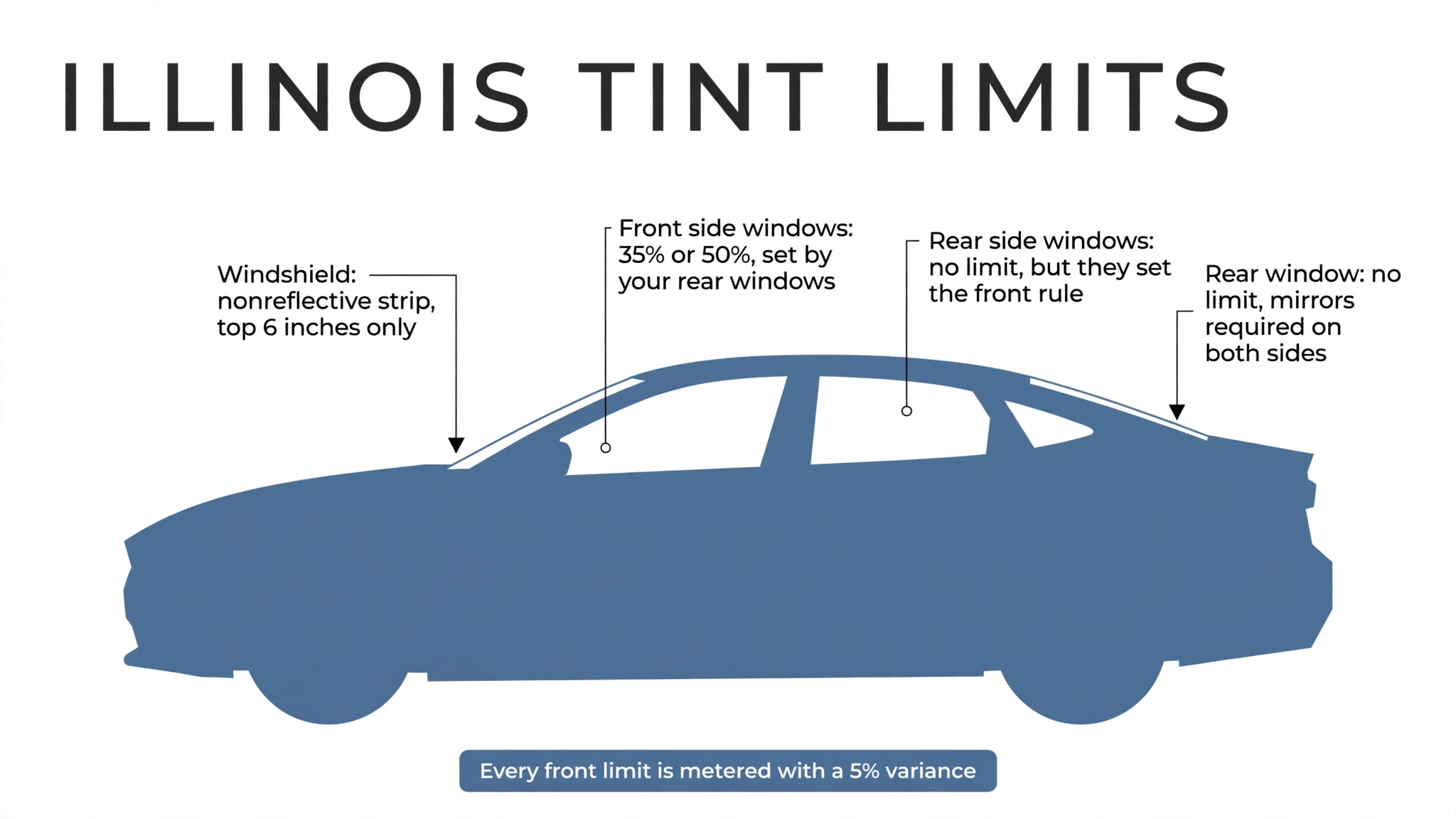
| Front side windows | 35% VLT if no rear window is below 35%; 50% VLT if no rear window is below 30% or rear glass is factory tint; no film if aftermarket rear tint is below 30% |
| Rear side windows | No VLT floor — but their darkness sets the front rule |
| Rear window | No VLT floor — side mirror required on each side when treated |
| Reflectance | All permitted film must be nonreflective |
Windshield Rules: 6 Inches, Nonreflective Only
Subsection (a) bans any sign, poster, window application, or reflective or nonreflective material — tinted film included — on the front windshield, with one exception: a nonreflective tinted film along the uppermost portion, extending no more than 6 inches down from the top. Two limits ride on that strip: it must be nonreflective (mirrored visor strips are out), and six inches is measured from the top edge of the glass — Illinois does not use the AS-1 line here either.
The same section polices the space in front of the driver more broadly. Subsections (c) and (c-5) ban objects placed or suspended between the driver and the windshield, rear window, or front side windows that materially obstruct the view — but (c-5) adds a protection drivers should know: no vehicle, driver, or passenger may be stopped or searched solely on the basis of a suspected windshield-objects violation. The hanging air freshener can be a violation; it cannot, by itself, be the reason for the stop.
Rear Windows: No Floor, but Two Mirrors
Behind the driver, section 12-503 sets no minimum light transmittance at all — a rear window may be fully blacked out. What the statute regulates instead is equipment and interplay:
– Two side mirrors. Under (b-5), a vehicle with a window behind the driver’s seat treated in this manner must carry a side mirror on each side conforming to section 12-502, which requires a view of the highway for at least 200 feet to the rear. Subsection (e) adds the mirror image of the rule: a car with conforming mirrors on both sides is deemed compliant even when its rear window is materially obscured. – The front-price of dark rears. Every point of rear darkness is spent against the (a-5) doors described above. “No floor” never means “no consequences.” – Decorative applications. Where the front side windows are untreated, subsection (b) expressly allows perforated window screens and other decorative window applications behind the driver.
Enforcement is by traffic stop and meter — Illinois runs no tint inspection and issues no compliance sticker for ordinary tint, a contrast with inspection states like Massachusetts, where the same numbers are re-measured every year.
Medical Exemptions: The License-Plate System
Illinois routes its medical exemption through the license plate, and it is the most administrative system in this series. Under subsection (g), subsections (a) and (a-5) do not apply to window treatment on a vehicle carrying distinctive license plates or a license plate sticker issued under section 3-412(k), where:
1. The vehicle is owned and operated by a person with a qualifying medical disease, or is used to transport such a person who resides at the same address as the registered owner. 2. The disease is one requiring the person to be shielded from the direct rays of the sun. The statute names, as a non-exhaustive list: systemic or discoid lupus erythematosus, disseminated superficial actinic porokeratosis, light sensitivity as a result of a traumatic brain injury, and albinism. 3. The owner holds a certified statement or letter from a physician licensed to practice medicine in Illinois. One hard limit is written in: no exemption is granted for any condition that sunglasses or other eye protective devices can adequately handle.
The certification is a working document, not a one-time form. It must be carried in the vehicle at all times, legible, showing the date of issuance, the physician’s name, address, and signature, and the patient’s name, address, and medical condition. It must be renewed every 4 years, and the owner submits a copy to the Secretary of State, who may forward notice to law enforcement agencies.
The installer rules close the loop. Under (g-7), a shop may install medical window treatment only on a vehicle already displaying the distinctive plates or sticker — the plates must be on the vehicle at the time of installation. Under (a-10), before installing, the shop must obtain a copy of the physician’s certified statement and keep it in its permanent records.
What if scenario: A Peoria driver with lupus gets the physician’s statement, has dark film installed the same week, and applies for the plates afterwards. Every step is out of order: the statute wants the plates issued first and physically on the car before a shop may lawfully fit the film — and a shop that installs anyway has committed its own violation.
Penalties: Petty Offense, Then a Misdemeanor
Subsection (j) prices violations of (a), (a-5), (b), (b-5) — and of the installer subsections (a-10) and (g-7) — on a two-step ladder:
– First violation: a petty offense, fined not less than $50 nor more than $500. A petty offense carries no jail time in Illinois. – Second or subsequent violation: a Class C misdemeanor, fined not less than $100 nor more than $500. – Plus the fix. Any person convicted under (a), (a-5), (b), or (b-5) shall be ordered to alter the nonconforming windows into compliance — the fine buys no right to keep the film.
The section carries no point value for the driver’s record. Note also what subsection (a-10) does to the supply side: installing or repairing material prohibited by subsection (a) is itself an offense on the same ladder — removing illegal material to bring a car into compliance is expressly allowed, but putting it on is not. The pattern matches Louisiana’s installer fines in spirit: the state prices the shop’s risk higher than the driver’s.
Chicago, Home Rule, and Out-of-State Cars
Three scope rules in section 12-503 settle arguments that fill Illinois forums:
– Chicago cannot go stricter. Subsection (m) provides that a home rule unit may not regulate motor vehicles in a manner inconsistent with this section, and declares the section a limit on home-rule power under the Illinois Constitution. The state numbers govern inside Chicago exactly as they do in Cairo — a city ordinance cannot revive a stricter local tint rule. – Out-of-state cars are outside the section. Subsection (f)(2) exempts vehicles properly registered in another jurisdiction from subsections (a), (a-5), (b), and (b-5) entirely. A car legal at home stays legal on the Dan Ryan. – New Illinois residents get told. Under subsection (l), the Secretary of State must give a new resident applying for registration notice of this section’s requirements (posting them on the Secretary’s website satisfies the duty) — so “I just moved here” meets a statute that anticipated the move.
How Illinois Compares With Other States
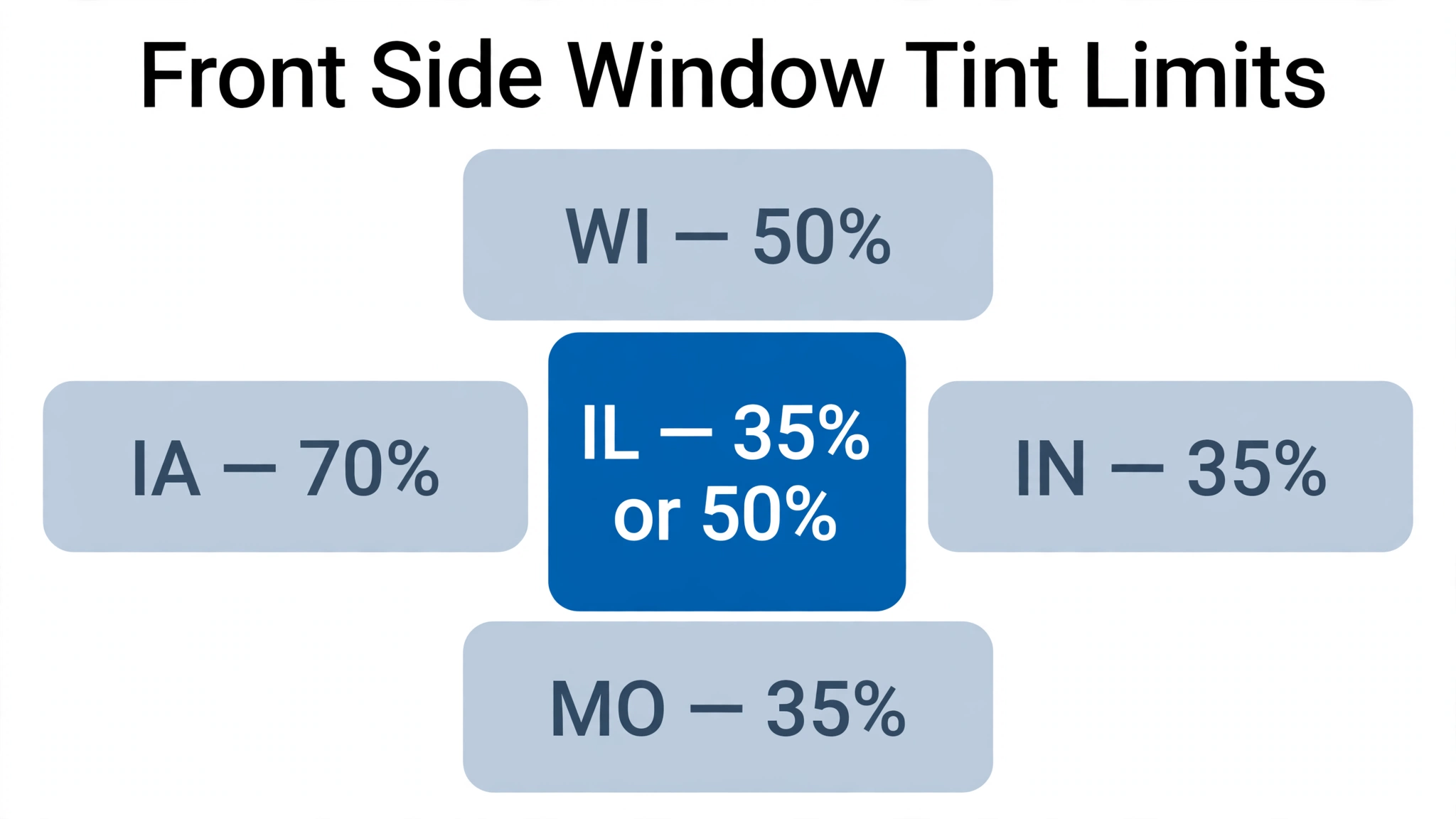
Illinois’ neighbours use fixed numbers, which makes the linked rule stand out. Indiana allows 35% on front side windows, Wisconsin 50%, Iowa 70%, and Missouri 35%. Further afield, Washington’s flat 24% is simpler and darker, Michigan bans front film beyond a four-inch strip instead of metering it, and New Jersey bans front film outright while leaving its rear as open as Illinois’. Illinois is the only state in the set where the rear windows hold the pen that writes the front rule.
Read also: Texas tint laws, Florida window tint law, Colorado tint laws
How to Stay Legal
1. Decide the rear first. Your rear darkness chooses your front door: 35% or lighter behind the driver keeps 35% fronts legal; 30–35% rears mean 50% fronts; aftermarket rear tint below 30% means no front film at all. 2. Factory dark glass? Fronts at 50%. Manufacturer-installed smoked glass behind the driver opens only the 50% path. 3. Nonreflective everything up front. The windshield strip (top 6 inches) and any front side film must be nonreflective — mirrored film fails before darkness is even measured. 4. Use the 5% variance as a cushion, not a target. Each (a-5) exception is metered with a 5% variance; a front window aimed exactly at the line is one meter-reading from a ticket. 5. Fit both side mirrors before darkening the rear. A treated rear window requires a conforming mirror on each side, showing 200 feet behind. 6. Medical need? Plates before film. Physician’s certified statement, Secretary of State distinctive plates or sticker on the vehicle, then — and only then — the install, with the certification carried in the car and renewed every 4 years. 7. Shops: keep the paperwork. Medical installs require the physician’s statement copy in your permanent records before the film goes on.
Frequently Asked Questions
What is the legal tint in Illinois?
The front side windows may use nonreflective film at 35% VLT when no window behind the driver is treated below 35%, or 50% VLT when no rear window is below 30% or the rear glass is factory tint. The rear windows have no VLT floor, and the windshield allows only a nonreflective strip in the top 6 inches — all under 625 ILCS 5/12-503.
Is 35% tint legal in Illinois?
On the front side windows, yes — conditionally: 35% front film is legal only while every window behind the driver transmits at least 35%. Darken the rear below 35% and the front allowance rises to 50%; darken it below 30% with aftermarket film and no front film is legal at all.
Is 20% tint legal in Illinois?
On the rear side windows and rear window, the darkness itself breaks no VLT rule — there is no rear floor — but a 20% rear closes both front-window doors, so the car may carry no front side film, and it needs a side mirror on each side. On front side windows or the windshield beyond the top strip, 20% is never legal for ordinary drivers.
Can SUVs have darker tint than cars in Illinois?
The statute does not ask. Illinois’ rule turns on the treatment of the rear glass, not the vehicle’s body style: an SUV with factory smoked rear glass gets 50% fronts under the manufacturer-glass path, and a sedan with light rear tint can run 35% fronts. The old multipurpose-vehicle framing no longer decides anything.
How do I get a medical tint exemption in Illinois?
Obtain a certified statement from a physician licensed in Illinois for a condition requiring shielding from direct sunlight — the statute names lupus, disseminated superficial actinic porokeratosis, light sensitivity from a traumatic brain injury, and albinism, among others — then get the distinctive license plates or plate sticker from the Secretary of State under section 3-412(k). The certification is carried in the vehicle, renewed every 4 years, and a copy goes to the Secretary of State. No exemption is granted where sunglasses would adequately protect.
How much is a tint ticket in Illinois?
A first violation is a petty offense with a fine of $50 to $500. A second or subsequent violation is a Class C misdemeanor, fined $100 to $500 — and a conviction also brings a court order to alter the windows into compliance. The offense carries no point value.
Does Chicago have its own tint law?
No stricter local rule can stand. Subsection (m) of section 12-503 bars home rule units from regulating motor vehicles inconsistently with the state section, so the state limits apply in Chicago exactly as elsewhere in Illinois.
Did Illinois change its tint law in 2025 or 2026?
No. The current text of section 12-503 carries amendments effective January 1, 2022 (P.A. 102-111) and January 1, 2024 (P.A. 103-32). The linked 35%/50% front rule, the medical-plate system, and the $50–$500 ladder all predate 2025 and remain the law.
Conclusion
Illinois built the country’s only linked tint rule: the front side windows inherit their limit — 35%, 50%, or nothing — from the glass behind the driver, with a 5% metering variance, a nonreflective 6-inch windshield strip, an unrestricted but mirror-conditioned rear, and a medical exemption that lives on the license plate instead of in the glovebox. The controlling text is 625 ILCS 5/12-503, and Film Slingers’ Illinois tint guide tracks the same figures for drivers and shops.
Disclaimer: This article is general information about Illinois tint laws, not legal advice. Tint statutes and enforcement practice change, and how a rule applies depends on the vehicle and the facts. Confirm the current law in 625 ILCS 5/12-503, or speak with an Illinois attorney or the Secretary of State, before tinting, buying, or contesting a citation.