


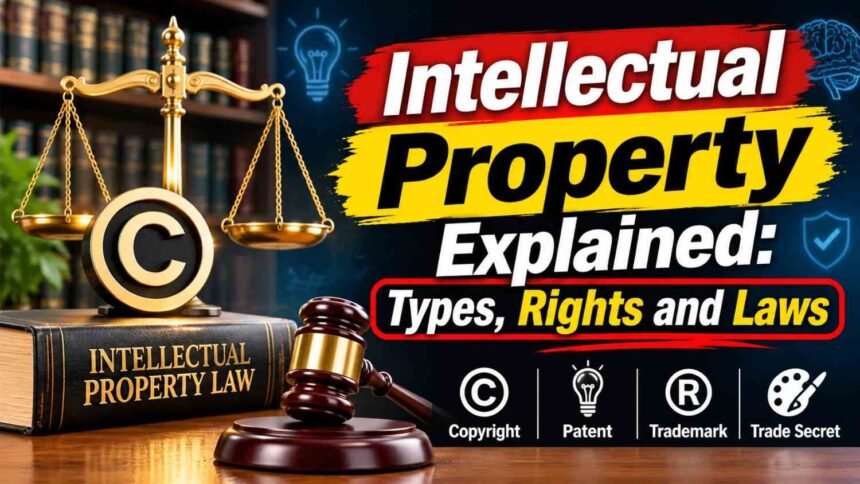
Intellectual property is the legal name for creations of the mind that the law lets you own. That includes inventions, brand names, logos, books, music, software code, and business secrets. If you own it, you can control who copies it, sells it, or uses it.
- What Is Intellectual Property?
- Why Intellectual Property Matters in 2026
- The Four Main Types of Intellectual Property
- Patent vs Trademark vs Copyright vs Trade Secret
- How Long Does Intellectual Property Protection Last?
- How to Protect Your Intellectual Property Step by Step
- What Intellectual Property Law Does Not Protect
- Who Owns Intellectual Property at Work?
- Intellectual Property Infringement and Fair Use
- AI and Intellectual Property in 2026
- Intellectual Property for Small Businesses and Creators
- International Intellectual Property Rights
- What Does Intellectual Property Protection Cost?
- Common Intellectual Property Mistakes
- When to Hire an Intellectual Property Attorney
- Frequently Asked Questions
- What is intellectual property in simple words?
- What are the four main types of intellectual property?
- Do I need to register my intellectual property?
- How long does intellectual property last?
- What is the difference between a patent, a trademark, and a copyright?
- Can I protect an idea?
- What happens if someone steals my intellectual property?
- Can AI-generated content be protected by intellectual property law?
- Conclusion
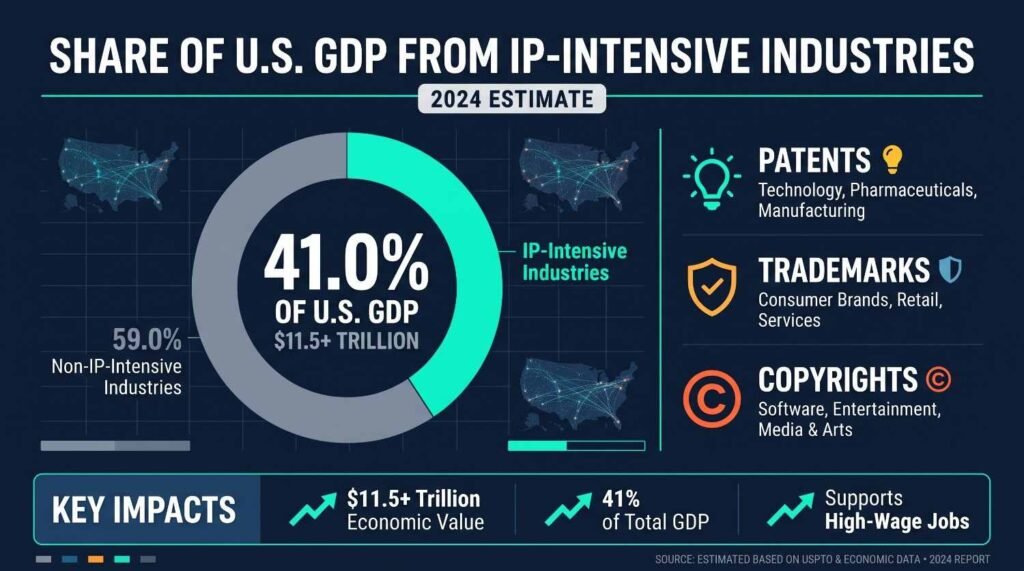
This matters because ideas only turn into money when you can protect them. The U.S. Patent and Trademark Office (USPTO) reported that IP-intensive industries added $11.4 trillion to U.S. GDP in 2024. That is 44% of private sector GDP, and those industries directly employ 49.6 million workers.
What Is Intellectual Property?
Intellectual property (IP) means creations of the mind that the law treats as property. You cannot touch it like a car or a house. You can still sell it, license it, give it away, or leave it to your family.
Rules for physical items are easy to picture. Our explainer on whether dumpster diving is illegal shows how the law treats discarded things. Intangible assets follow a different set of rules, and that is where IP law steps in.
The idea goes back to the U.S. Constitution. Article I gives Congress the power to promote science and useful arts by securing exclusive rights to authors and inventors for limited times. The key words are limited times. IP rights are strong, but they do not last forever, with a few exceptions.
Why Intellectual Property Matters in 2026
Most of a modern company’s value is not in its buildings. It sits in its brand, its software, its data, and its know-how. Intellectual property rights are how the law protects that value.
The numbers show how big this is. The same USPTO study found that trademark-intensive industries alone produced $9.5 trillion of output in 2024. Manufacturing and information services lean on IP the most.
The global picture is just as strong. WIPO’s Global Innovation Index 2026 ranks 139 economies. Switzerland, Sweden, the United States, South Korea, and Singapore lead the list. WIPO also reports that world trade in ideas, know-how, and IP now tops $1.3 trillion.
Big technology firms feel this pressure too. Large data and product disputes, like the Google Android cellular data settlements covered in our full guide to the $485 million in settlements, show how much money rides on tech rules.
The Four Main Types of Intellectual Property
The law gives four main kinds of protection. Each one fits a different kind of creation. Picking the wrong one is a classic mistake.
Patents
A patent protects a new invention. In the U.S., a utility patent covers a process, a machine, a product, or a composition of matter. A design patent covers how a product looks.
To qualify, an invention must be new, useful, and not obvious. You also have to describe it in public. In return, you get the right to stop others from making, using, or selling it.
Imagine an engineer who builds a new battery cooling system. A patent can block a rival from copying that exact system. It will not stop the rival from building a different system that reaches the same goal.
Only humans can be named as inventors. The Federal Circuit said so in Thaler v. Vidal (2022), as discussed in this Holland & Knight analysis.
Trademarks
A trademark protects names, logos, slogans, and other marks that tell customers who made a product. Think of a swoosh, a shape, or a catchy tagline. The test is whether the mark causes confusion with another brand.
You gain some rights just by using a mark in business. You gain much stronger rights by registering it with the USPTO. The agency’s trademark basics page walks through the process.
Brand names often sit at the center of business fights. Our report on the Blingle franchise lawsuit shows how much a brand relationship can matter to a franchise.
Use the ™ symbol on an unregistered mark. Use the ® symbol only after the USPTO registers it.
Copyrights
A copyright protects original creative works once they are fixed in some form. That covers books, songs, photos, films, paintings, software code, and architectural plans. It protects the way you express an idea, not the idea itself.
Copyright starts automatically the moment you create and save the work. You do not need to register to own it. You do need to register before you can file an infringement lawsuit in a U.S. federal court.
Imagine a photographer who posts a photo online. A business downloads it and uses it in an ad. The photographer owns the copyright from day one, and registration gives her the tools to enforce it.
Trade Secrets
A trade secret is valuable business information that you keep secret. Think of a formula, a customer list, a manufacturing method, or a pricing model. The USPTO’s trade secret toolkit says no government body grants or registers trade secrets.
The information has to be valuable because it is secret. You also must take reasonable measures to guard it. The federal Defend Trade Secrets Act of 2016 lets owners sue in federal court when someone steals a secret.
Reasonable measures can include limited access, passwords, and written agreements. A Winston & Strawn study of cases from 2009 to 2018 found that courts dismissed 11 percent of disputed trade secret claims because the owner failed to take such steps. Secrecy is the whole game.
Trade secrets have one big weakness. If someone figures out your secret through lawful means, such as reverse engineering, you cannot stop them.
Patent vs Trademark vs Copyright vs Trade Secret
This table gives a quick comparison. Use it to match your creation to the right type of protection.
| Type | What it protects | Example | Who grants it | Registration needed? |
|---|---|---|---|---|
| Patent | New inventions and product designs | A new medical device | USPTO | Yes |
| Trademark | Brand names, logos, slogans | A shoe brand’s logo | USPTO (federal) | Optional, but strongly advised |
| Copyright | Original creative works | A novel or a song | Automatic, with U.S. Copyright Office registration | Optional, but needed to sue |
| Trade secret | Confidential business information | A secret sauce recipe | Nobody grants it | No |
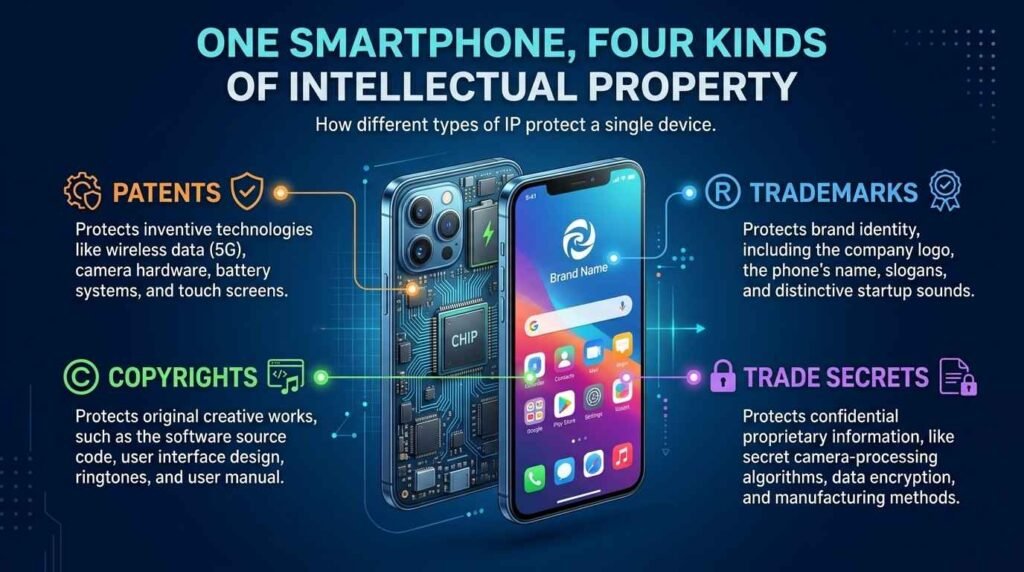
One product can use several types at once. A phone maker can patent a new chip, trademark its name, copyright its software, and keep its supplier list secret. Layered protection is normal.
How Long Does Intellectual Property Protection Last?
Each type has its own clock. Here are the general U.S. rules.
| Type | Typical length of protection |
|---|---|
| Utility patent | 20 years from the filing date |
| Design patent | 15 years from the grant date |
| Copyright (individual author) | The author’s life plus 70 years |
| Copyright (work made for hire) | 95 years from publication or 120 years from creation, whichever ends first |
| Trademark | Can last forever if you keep using it and renew it |
| Trade secret | As long as the information stays secret |
Trademark owners must file maintenance papers on a schedule. The first one is due between the fifth and sixth year after registration, and renewals follow every ten years. Missing a deadline can cost you the registration.
Patents also need maintenance fees paid at set points after they are granted. Miss them, and the patent expires early.
How to Protect Your Intellectual Property Step by Step
You do not need to be a lawyer to take smart first steps. Follow this order.
- Write down what you made. Keep dated notes, drafts, sketches, and files. Good records win arguments later.
- Pick the right type of protection. Use the table above. Ask whether you made an invention, a brand, a creative work, or a secret.
- Search before you file. For a brand, search the USPTO trademark database for similar names. For an invention, search patent records for similar ideas.
- Use written agreements. Sign nondisclosure agreements before you share a secret. Get written assignments from anyone who helps you create something.
- File where it counts. Register trademarks and copyrights. File a patent application before you publicly sell or disclose your invention, since timing rules can be strict.
- Mark your work. Add ©, ™, or ® symbols where they apply.
- Watch the market. Set alerts for your brand name and check for copycats. Act early, because delay can weaken your position.
- Keep your filings current. Track renewal and maintenance dates on a calendar.
Here is a short case. Imagine Priya starts a candle brand and picks a catchy name. She skips the search and the registration. Six months later, a larger seller in another state sells candles under a nearly identical name, and she has no registration to point to.
That story is made up, but the pattern is common. A short search and an early filing could have saved her the fight.
What Intellectual Property Law Does Not Protect
Many people think they have rights that they do not. Knowing the limits saves time and money.
- Bare ideas. Copyright protects expression, not the concept behind it. A plot idea alone is not protected.
- Facts and data. Nobody owns the fact that water boils at 100 degrees Celsius.
- Common words and short phrases. A simple name or title is rarely protected by copyright.
- Works from before the term ran out. Once a work enters the public domain, anyone can use it.
- Anything you failed to keep secret. Once a trade secret leaks through your own carelessness, the protection is gone.
- Purely functional items without a patent. Without a patent, others can usually copy how a useful product works.
A trademark can still protect a short phrase when it works as a brand. A slogan on a shirt can qualify. The difference is whether the words tell customers who made the product.
Who Owns Intellectual Property at Work?
Ownership surprises people more than almost any other issue. The answer depends on who made the work and what the paperwork says.
For employees, the employer usually owns copyright in work done as part of the job. The law calls this a work made for hire. Patent rights work a bit differently, and most employers require employees to sign an assignment agreement.
For freelancers and contractors, the default flips. The creator usually keeps the copyright unless a signed written agreement says otherwise. A business that hires a designer for a logo without a contract may not own it.
Co-owners can also clash. Disputes between business partners over who owns what can drag on for years, as seen in our coverage of the Dapper Development lawsuit in North Carolina.
Deals that license or distribute products are another hot spot. Our update on the Trulife distribution lawsuit shows how a business dispute over distribution can end up in federal court.
Intellectual Property Infringement and Fair Use
Infringement means using someone’s protected work without permission. The rules differ for each type. Copying a song, selling a knockoff handbag with a lookalike logo, and making a patented device are all examples.
Courts can order the infringer to stop. They can also award money damages and the profits earned from the copying. In some copyright cases, the law lets the owner pick set amounts called statutory damages, which can reach $150,000 per work for willful infringement.
Many disputes start with a cease and desist letter. Online, owners also use takedown notices under the Digital Millennium Copyright Act. Most cases settle before trial.
Most IP cases are one on one. Still, some consumer and data disputes become group suits, and our guide to class action settlements explains how those payouts work.
What Is Fair Use?
Fair use lets people use copyrighted work in limited ways without permission. Think of news reporting, criticism, teaching, and research. The U.S. Copyright Office keeps a Fair Use Index that summarizes court decisions.
Courts weigh four factors:
- The purpose and character of the use
- The nature of the original work
- How much of the work was used
- The effect on the market for the original
In Andy Warhol Foundation v. Goldsmith (2023), the Supreme Court ruled 7 to 2 that licensing a Warhol print based on a photographer’s Prince photo did not favor fair use on the first factor. You can read the full opinion at Cornell Law. The big lesson is that adding a new look does not automatically make a copy fair when the use competes with the original.
Fair use depends on the facts, and no safe word count or percentage exists. When money is on the line, ask a lawyer before you rely on it.
AI and Intellectual Property in 2026
Artificial intelligence is the hottest area of IP law right now. The main question is simple. Who owns what an AI system makes?
In March 2026, the Supreme Court declined to hear Thaler v. Perlmutter. That left in place a D.C. Circuit ruling that copyright requires human authorship. A work made entirely by an AI system, with no human creative input, cannot be registered.
The patent side points the same way. Courts have held that an AI system cannot be listed as an inventor.
What about work made with AI help? The Copyright Office’s AI registration guidance says applicants must disclose AI-generated material that is more than minor. They must claim only the human-made parts. Law360 reported in April 2026 that the Office had issued more than 6,000 registrations for works that include AI material under this approach.
Here are practical steps for creators:
- Save your drafts, edits, and prompts.
- Show where a human chose, arranged, or rewrote the material.
- Disclose AI-generated parts when you register.
- Do not assume a prompt alone creates ownership, since the Office has said prompting by itself usually does not.
The law is still developing, and the Supreme Court’s refusal to hear a case does not settle every question. Watch for new rulings and new Copyright Office guidance.
Intellectual Property for Small Businesses and Creators
You do not need a big budget to act smart. Small steps add real value.
For a small business, register the business name or logo as a trademark once you have a plan to grow. Get written agreements with every contractor. Keep customer lists and recipes behind passwords.
For creators and bloggers, remember that your posts, photos, and videos are copyrighted from the moment you publish. Add a copyright notice to your site. Keep your original files, since they prove you made the work first.
For website owners, copied content can hurt your search rankings and your reputation. Law firms and legal blogs face this often. Our law firm SEO guide covers how firms build original content that stands out.
For startups, list every piece of IP you own before you talk to investors. Investors will ask. Gaps in ownership can slow down or kill a deal.
When a company fails, its brand and other IP often become assets that get sold. Our report on the Lugano Diamonds bankruptcy shows how a Chapter 11 filing and liquidation work for a jewelry business.
International Intellectual Property Rights
IP rights are mostly territorial. A U.S. patent does not stop copying in Germany. A U.S. trademark does not give you rights in Japan.
Several treaties make filing abroad easier. The Patent Cooperation Treaty lets you file one international patent application that can lead to protection in many countries. WIPO’s Global Innovation Index 2026 says global PCT filings grew by 0.7 percent in 2025, a second year of modest growth.
The Madrid system does something similar for trademarks. The Berne Convention gives copyright holders protection in member countries without extra paperwork.
If you plan to sell overseas, think about IP early. Some countries give rights to the first person who files, even if you used the brand first.
What Does Intellectual Property Protection Cost?
Costs vary by type and by how much help you hire. Here is a rough guide.
| Type | Government fee snapshot | Notes |
|---|---|---|
| Trademark | $350 per class for the base electronic application | The USPTO changed its fee rules in January 2025. See its summary of the 2025 trademark fee changes |
| Utility patent | Around $3,290 combined filing, search, and examination fees for large entities under the January 2025 schedule | Small and micro entities pay less. Attorney and drafting fees can add much more |
| Copyright | Tens of dollars for common online filings | Check copyright.gov for current fees |
| Trade secret | No filing fee | Costs come from security and legal agreements |
Fee tables change, so always check the official USPTO and Copyright Office sites before you file. Attorney fees vary a lot by city, case, and experience.
Patents also take time. Many applications take years from filing to decision, while trademarks often move faster.
Common Intellectual Property Mistakes
These errors show up again and again.
- Skipping the search. Filing a trademark without checking for similar names invites rejection or a lawsuit.
- Sharing secrets too soon. Telling a stranger your formula without a nondisclosure agreement can destroy trade secret status.
- Public disclosure before a patent filing. Timing rules can cost you your patent rights.
- No written contractor agreement. Without one, the freelancer may own your logo or code.
- Assuming that “found online” means free. Most online images and text are copyrighted.
- Missing renewal dates. Trademarks and patents can lapse.
- Ignoring IP in a business sale or restructuring. Companies in financial trouble need to know what they own. Our guide to trucking firms that file Chapter 11 shows how asset decisions play out in a bankruptcy.
- Copying “just a little.” There is no safe amount that avoids infringement.
When to Hire an Intellectual Property Attorney
You can handle some simple filings on your own. Many people file a basic copyright or a simple trademark without help. Some matters call for a pro.
Think about hiring one when you:
- Plan to file a patent application
- Receive a cease and desist letter
- Want to license or sell your IP
- Are building a business with investors
- Face a possible lawsuit over a brand name or a design
Not every legal professional handles IP work. Our guide on attorney vs lawyer explains the difference and helps you ask better questions. For patent filings, you may need a registered patent attorney or agent.
Ask about experience with your exact type of IP. Ask how fees work, too. A short first meeting often clears up a lot.
Frequently Asked Questions
What is intellectual property in simple words?
Intellectual property is a creation of the mind that the law lets you own. It covers inventions, brands, creative works, and business secrets. Owners can control who uses it.
What are the four main types of intellectual property?
The four main types are patents, trademarks, copyrights, and trade secrets. Patents protect inventions. Trademarks protect brands, copyrights protect creative works, and trade secrets protect confidential business information.
Do I need to register my intellectual property?
It depends on the type. Copyright starts automatically, but you must register before suing in U.S. federal court. Patents need a grant from the USPTO, trademarks gain strong rights through registration, and trade secrets cannot be registered at all.
How long does intellectual property last?
Each type has its own term. A utility patent lasts 20 years from filing, and copyright for an individual author lasts for life plus 70 years. Trademarks can last forever with proper use and renewals, and trade secrets last as long as they stay secret.
What is the difference between a patent, a trademark, and a copyright?
A patent protects an invention. A trademark protects a brand identity, such as a name or logo. A copyright protects creative expression, such as a book, a song, or software code.
Can I protect an idea?
Not by itself. The law protects the way you express or carry out an idea, not the bare idea. You may protect an idea through a patent if it becomes a qualifying invention, or through a trade secret if you keep it confidential.
What happens if someone steals my intellectual property?
You may send a cease and desist letter, file a takedown notice, or sue. Courts can issue orders to stop the copying and award damages. Speak to a licensed attorney early, because deadlines can apply.
Can AI-generated content be protected by intellectual property law?
Work made entirely by AI cannot be registered for copyright in the U.S. under current law. Work that blends human creativity with AI tools may be protected for the human-made parts. Keep records of your creative choices.
Conclusion
Intellectual property gives you legal control over what your mind creates. The four main types are patents, trademarks, copyrights, and trade secrets, and each one has its own rules, costs, and time limits. Strong records, clear contracts, and early filings protect you better than any last-minute fix.
Start small. Write down what you own, choose the right type of protection, and calendar every deadline. If your work is valuable or your risk is high, talk to a qualified attorney licensed in your jurisdiction.
Keep exploring practical guides on Legal Expertise to stay informed on the law.