




A slip and fall lawsuit is a court case where an injured person asks a property owner to pay for harm caused by a fall on unsafe property. You win only if you can show the owner knew about the danger, or should have known, and did not fix it. Most states give you about two years to file, and a few give far less.
- Slip and Fall Lawsuit at a Glance
- What Is a Slip and Fall Lawsuit?
- Do You Have a Valid Case? The Four Elements
- How to Prove the Owner Knew About the Hazard
- Visitor Status and Why It Matters
- Common Causes of a Slip and Fall Accident
- Who Can You Sue After a Fall?
- What to Do After a Slip and Fall Accident
- Evidence That Strengthens a Claim
- How a Slip and Fall Lawsuit Works Step by Step
- Time Limits for Filing
- How Much Compensation Can You Get?
- Common Defenses Owners and Insurers Use
- How Long Does a Case Take, and Do Cases Go to Trial?
- How Much Does a Slip and Fall Lawsuit Cost?
- Mistakes That Can Hurt Your Slip and Fall Lawsuit
- Special Situations
- When to Talk to a Lawyer
- Frequently Asked Questions
- What is a slip and fall lawsuit?
- How long do I have to file a slip and fall lawsuit?
- Can I recover money if I was partly at fault?
- Does a missing wet floor sign prove the owner was negligent?
- Do I need a lawyer for a slip and fall claim?
- How much is a slip and fall lawsuit worth?
- Do slip and fall cases go to trial?
- Can I sue if I fell on a sidewalk or on city property?
- Conclusion
Falls are not rare. The CDC reports that more than 14 million older adults fall every year, and falls are the leading cause of injury for adults 65 and older. For many families, one fall means surgery, missed work, and bills that keep coming.
Slip and Fall Lawsuit at a Glance
| Question | Short answer |
|---|---|
| What is it? | A personal injury claim based on premises liability law |
| Who can be sued? | Owners, landlords, businesses, property managers, and contractors |
| What must you prove? | Duty, breach (usually through notice), causation, and damages |
| How long do you have? | Often one to three years, and much less for government property |
| Do most cases go to trial? | No. Most settle before trial |
What Is a Slip and Fall Lawsuit?
A slip and fall lawsuit is a type of personal injury claim built on premises liability. That area of law says people who own or control property must keep it reasonably safe for visitors.
The name is broad. It covers slips on a wet floor, trips over broken pavement, and tumbles down poorly lit stairs. The key point is that the danger came from the property, not from plain bad luck.
Most of these cases involve one injured person and one or more defendants. That is different from topics with many separate legal actions, like the ones in our Life360 lawsuit guide.
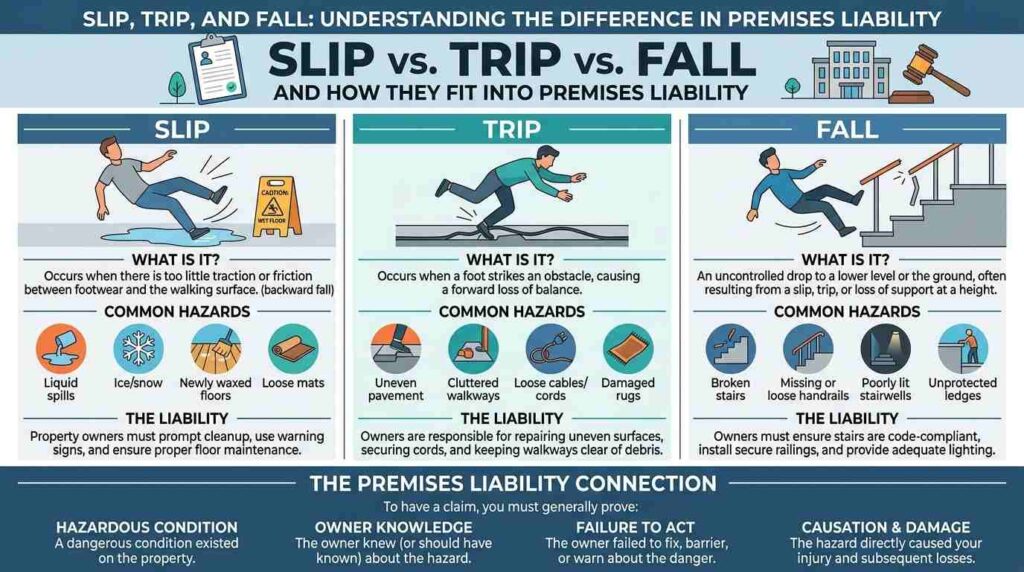
Not every fall leads to a valid case. If you fell because of your own carelessness, or if no real hazard existed, you may have no claim. The law does not make owners the insurers of every visitor.
Do You Have a Valid Case? The Four Elements
Courts treat a slip and fall claim as a negligence case. You must prove four things:
- Duty: The owner or occupier owed you a duty of care.
- Breach: The owner failed to act like a reasonable owner would.
- Causation: That failure caused your fall and your injuries.
- Damages: You suffered real losses, such as medical bills or lost pay.
These same building blocks drive many injury cases. Our report on the American Airlines passenger attack lawsuits shows how duty, breach, and proof of harm shape a claim against a large company.
In most slip and fall cases, breach is the hardest part. You usually have to show the owner had notice of the hazard. The next section explains how that works.
How to Prove the Owner Knew About the Hazard
Most states require proof of notice. Lawyers call it actual knowledge or constructive knowledge. There are three common ways to show it:
- The owner created the hazard. An employee mopped the floor and left no warning sign.
- The owner actually knew. A worker saw the spill and walked away.
- The owner should have known. The hazard sat there long enough that a reasonable inspection would have caught it.
Texas shows how strict this rule can be. In Wal-Mart Stores, Inc. v. Reece, the Texas Supreme Court set a four-part framework that federal courts still apply. In a recent Fifth Circuit opinion about a fall at a Houston Walmart, the court looked at whether the store had knowledge of the substance on the floor. It found no evidence that the store did.
Some states ease the burden. A few use a mode of operation rule, which can help when a store’s self-service setup makes spills likely. Always check how your state handles notice.
Hypothetical example: Maria slips on a puddle near the produce misters at a grocery store. Store video shows the puddle sat there for 25 minutes, and two workers walked past it. That timeline supports constructive knowledge. If the puddle had formed 30 seconds before she fell, the store would argue it never had a fair chance to find it.
Visitor Status and Why It Matters
In many states, the duty owed to you depends on why you were on the property. The old labels are invitee, licensee, and trespasser. Cornell’s Legal Information Institute explains that an invitee, such as a store customer, is usually owed reasonable care and a warning about known dangers that are not obvious.
| Visitor type | Example | Typical duty owed |
|---|---|---|
| Invitee | A customer in a store | Reasonable inspections, repairs, and warnings |
| Licensee | A social guest at a home | Warning about known dangers the guest may not see |
| Trespasser | Someone with no permission | Limited duty, and no intentional harm |
Some states, including California, moved away from these labels after Rowland v. Christian (1968). They now use one reasonable care standard for most visitors. Special rules also often apply to children.
Common Causes of a Slip and Fall Accident
Hazards behind a slip and fall lawsuit come in many forms. These show up most often:
- Wet or freshly mopped floors with no warning sign
- Ice and snow that were not cleared or treated
- Broken stairs, loose handrails, or uneven steps
- Poor lighting in stairwells and parking lots
- Torn carpet, curled mats, and loose cords
- Cracked sidewalks and potholes
The numbers show why this matters. The National Safety Council reports that 43,020 adults aged 65 and older died from falls in 2024, and more than 3.85 million were treated in emergency departments in 2023. Fall deaths in that age group rose 51% over ten years.

Who Can You Sue After a Fall?
The right defendant depends on who controlled the property. Possible defendants include:
- The property owner
- A landlord or property manager
- The business that runs the space
- A cleaning or maintenance contractor
- A homeowners association
- A city, county, or other government body
A slip and fall lawsuit can name several defendants, because more than one party can share fault. Hypothetical example: Dev slips on an icy apartment walkway. The landlord says a snow removal contractor was responsible. The contract and the maintenance logs decide who answers for the ice.
What to Do After a Slip and Fall Accident
These are steps people commonly take after a fall. Your situation may call for different ones.
- Get medical care. Head injuries, back pain, and fractures can show up hours or days later.
- Report the fall. Tell the owner or manager, and ask for a written incident report.
- Photograph the scene. Capture the hazard, the lighting, and the surrounding area before anything changes.
- Collect witness details. Names and phone numbers matter months later.
- Keep your shoes and clothes. Defense lawyers sometimes blame footwear.
- Write notes. Record what happened while the memory is fresh.
- Save every record. Keep bills, receipts, and pay stubs.
- Be careful online. Posts and photos can be used against you.
- Talk to a personal injury lawyer before signing a release or giving a recorded statement to an insurance adjuster.
Evidence That Strengthens a Claim
Every slip and fall lawsuit rises or falls on proof, not memory. Useful evidence includes:
- Surveillance video. Stores often overwrite footage within days, so lawyers send preservation letters fast.
- Incident reports. These show what the owner admitted at the time.
- Cleaning and inspection logs. Gaps in the schedule can prove constructive knowledge.
- Prior complaints or earlier falls. A repeat problem at the same spot is powerful.
- Weather records. These matter in ice and rain cases.
- Medical records. They link your injuries to the fall.
- Expert opinions. Safety experts can measure slip resistance and compare the scene to building codes.
Experts must do their homework. In one reported ruling, a court excluded a premises liability expert who never inspected the floor in question.
How a Slip and Fall Lawsuit Works Step by Step
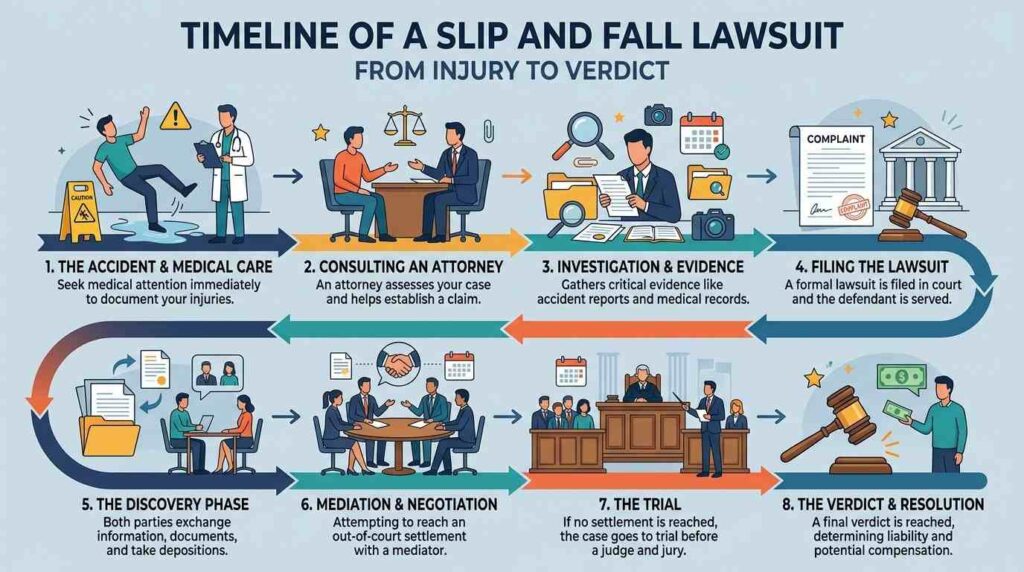
Here is the usual path:
- Case review. A lawyer checks the facts, the notice issue, and the deadlines.
- Treatment and records. Many lawyers wait until the full cost of care is clear, because a settlement usually closes the claim for good.
- Demand letter. Your side sends the insurer a summary of the injuries and the money sought.
- Negotiation. The adjuster responds, often with a low first offer.
- Filing the complaint. If talks fail, your lawyer files a lawsuit in court.
- Discovery. Both sides swap documents, answer written questions, and give depositions.
- Mediation. A neutral person helps both sides try to settle.
- Trial. A judge or jury decides if the owner is liable and sets damages.
Time Limits for Filing
Every state sets a statute of limitations, which is the deadline to file. File a slip and fall lawsuit after that date, and a court will usually dismiss it, no matter how strong the facts are.
In Texas, Civil Practice and Remedies Code section 16.003 gives you two years for personal injury and for death claims. Other states differ.
| State | Filing deadline | Fault rule |
|---|---|---|
| Texas | 2 years | Barred at 51% fault or more |
| Florida | 2 years for claims that arose after March 24, 2023 | Barred at more than 50% fault |
| California | 2 years | Pure comparative fault |
| New York | 3 years | Pure comparative fault |
| Illinois | 2 years | Barred at more than 50% fault |
Florida is a good example of why freshness matters. A 2023 tort reform law, HB 837, cut the negligence deadline from four years to two and moved the state to a modified fault rule. Some states go the other way. Tennessee and Kentucky allow only one year, while Maine and North Dakota allow six.
Watch for notice of claim rules too. If a city or county owns the property, you may need to give written notice in as little as 90 days in some places, such as New York. In Texas, notice to a government unit is generally due in about six months. Confirm your local rules with a licensed attorney.
How Much Compensation Can You Get?
There is no standard payout. Each slip and fall lawsuit depends on the injuries, the proof, and the insurance coverage. Damages usually fall into these groups:
- Economic damages: Medical bills, future care, lost wages, and reduced earning power
- Non-economic damages: Pain, suffering, and loss of enjoyment of life
- Punitive damages: Rare, and only for very reckless conduct
Some injury firms estimate that moderate cases land between $10,000 and $50,000, while permanent injuries can reach far higher. Treat any range as a rough guide, not a promise.
Hypothetical example: Sam has $18,000 in medical bills and $6,000 in lost pay. A jury values his pain and suffering at $26,000, for a total of $50,000. The jury also finds Sam 20% at fault for texting while he walked. His award drops by 20% to $40,000. In a state with a 51% bar, a finding of 51% fault would have wiped out the claim.
Large companies settle all kinds of cases. For one recent example of how a big retailer resolved a consumer lawsuit, see our Walmart $5.6 million lawsuit report.
Common Defenses Owners and Insurers Use
Expect pushback in any slip and fall lawsuit. Common defenses include:
- No notice. The owner says it never knew and had no time to find the hazard.
- Open and obvious. The hazard was easy to see, so you should have avoided it.
- Comparative fault. You were distracted, rushing, or wearing unsafe shoes.
- No control. The defendant did not own or manage that part of the property.
- Pre-existing injury. The insurer says an old condition caused your pain.
- Causation. The insurer claims the fall did not cause the injuries.
Good records answer most of these points.
How Long Does a Case Take, and Do Cases Go to Trial?
A simple case can settle in a few months. A serious one can take years, especially if liability is disputed or treatment is ongoing.
Estimates vary, but many sources say about 95% of personal injury cases settle before trial. Trials are costly, slow, and uncertain for both sides. A case is more likely to reach a courtroom when the parties disagree about fault, or when the insurer undervalues the damages.
How Much Does a Slip and Fall Lawsuit Cost?
Most injury lawyers handle a slip and fall lawsuit on contingency. You pay no fee up front, and the lawyer takes a percentage only if money is recovered. The share is often around one third, and it can be higher if the case goes to trial.
Ask how case costs are handled. Filing fees, records, and expert reports are often separate from the fee. Many firms offer free consultations.
You may also wonder about the difference between the words attorney and lawyer. Our guide to attorney vs lawyer clears it up.
Mistakes That Can Hurt Your Slip and Fall Lawsuit
- Waiting weeks to see a doctor
- Skipping follow-up care, which creates gaps in your records
- Posting about the fall or your activities on social media
- Accepting the first offer without knowing the full cost of your injuries
- Assuming the store will keep its video forever
- Missing a deadline because you did not know a shorter notice rule applied
Special Situations
Workplace falls. Workers’ compensation is usually the main route against your employer. You may still have a separate claim against an outside property owner.
Rental homes. Landlords must often follow housing codes and keep common areas safe. Your lease and local law matter.
Government property. Shorter notice rules apply, and some places limit damages.
Children. Courts often treat child injuries differently, and deadlines may pause until the child turns 18 in many states.
Older adults. Falls cause most hip fractures in older people. A CDC study of 2019 data found that about 88% of hip fracture related ER visits and hospital stays among adults 65 and older came from falls.
Fatal falls. When a fall leads to death, family members may bring a wrongful death claim. Our wrongful death attorney guide explains how those claims, costs, and compensation work.
When to Talk to a Lawyer
Consider a consultation before you file a slip and fall lawsuit if you have serious injuries, large bills, or a disputed account of what happened. The same goes if the property is public, several parties may share fault, or an insurer is pressing you to sign something. A short call also helps you learn your exact deadline.
Want to judge a legal website before trusting it? Read our guide on CNLawBlog and how to trust a legal blog.
Frequently Asked Questions
What is a slip and fall lawsuit?
A slip and fall lawsuit is a personal injury case where you ask a court to hold a property owner responsible for a fall caused by an unsafe condition. You must show the owner had a duty, failed to act reasonably, and caused your injuries.
How long do I have to file a slip and fall lawsuit?
Most states allow one to three years from the date of the fall. Texas, Florida, California, and Illinois use two years, and New York uses three. Claims against government bodies can have much shorter notice deadlines.
Can I recover money if I was partly at fault?
Often yes, but it depends on your state. In pure comparative fault states, your award is reduced by your share of blame. In modified states like Texas and Florida, you are barred if your share passes the cutoff.
Does a missing wet floor sign prove the owner was negligent?
Not by itself. It can support your claim, but you usually still need to show the owner knew or should have known about the hazard and had time to fix it.
Do I need a lawyer for a slip and fall claim?
You are not required to have one. Many people hire a lawyer because notice rules, evidence, and insurance tactics are hard to handle alone. Most injury lawyers offer free consultations.
How much is a slip and fall lawsuit worth?
It depends on medical costs, lost income, pain, fault, and insurance limits. Minor cases may settle for a few thousand dollars, while serious injuries can be worth far more.
Do slip and fall cases go to trial?
Most do not. Estimates suggest about 95% of personal injury cases settle before trial. A case may go to court when fault or damages are disputed.
Can I sue if I fell on a sidewalk or on city property?
Possibly. The answer depends on who owns and maintains the sidewalk. Claims against a city or county often require written notice within a short window, so act quickly.
Conclusion
A slip and fall lawsuit comes down to proof. You must show the owner had a duty, knew or should have known about the hazard, and caused your injuries by failing to act. Fast medical care, solid evidence, and a close eye on your filing deadline protect your rights.
Rules differ by state, and a few missing facts can change the outcome. If you were hurt, speaking with a licensed personal injury attorney in your area is a smart next step.