



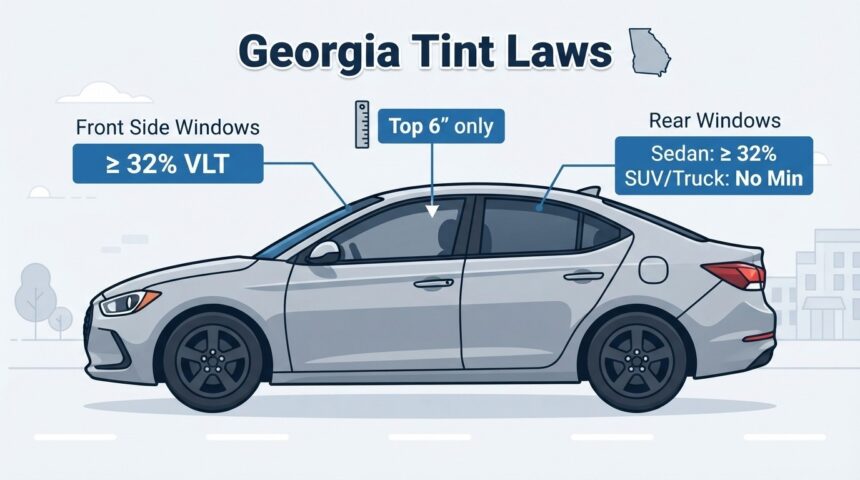
Georgia tint laws require most vehicle windows to allow at least 32% of visible light through, with a small enforcement tolerance. Front side windows—and on sedans, rear windows—must meet this rule, while SUVs and trucks can go darker in the back.
- Quick Summary: What’s Legal in Georgia?
- How Dark Can You Tint Your Windows in Georgia?
- Front Side Windows: The 32% Rule Explained
- Back Side & Rear Windows: Sedans vs. SUVs/Trucks
- How the 3% Tolerance Works in Real Life
- Windshield Tint Rules: How Much Is Allowed on the Front Windshield?
- The Top 6 Inches: Where Tint Is Allowed
- Stickers, Decals & Corner Exceptions
- Sedans vs. SUVs/Trucks: Different Rules for Rear Windows
- Real‑World Examples: Legal vs. Illegal Setups
- Color & Reflectivity Rules: What Tint Finishes Are Banned?
- No Red or Amber Tint—Ever
- Reflective, Mirrored & Metallic Tints: What’s Allowed?
- Medical Exemptions: How to Get a Dark Tint Permit in Georgia
- Who Qualifies for a Medical Tint Exemption?
- Step‑by‑Step: Applying for a Dark Tint Permit
- Penalties, Fines & What Happens If You Get a Tint Ticket
- Typical Fines & How They Vary by County
- From Stop to Citation: How Officers Enforce Tint Laws
- First Offense vs. Repeat Violations
- Can You Go to Jail for Illegal Tint in Georgia?
- How Strict Is Georgia on Window Tint? (Enforcement Reality)
- Metro Atlanta vs. Rural Counties: Where Is Tint Policed More?
- Out‑of‑State Drivers: Are You Targeted More?
- Moving to Georgia With Out‑of‑State Tint: Are You Legal?
- Common Scenarios: Coming From Florida, Texas, California, etc.
- Temporary Compliance Options & Re‑Tinting Tips
- Installer Liability: What Tint Shops Must Follow in Georgia
- Certified Film & Documentation Requirements
- How to Vet a Tint Shop Before You Pay
- Step‑by‑Step: Check If Your Tint Is Legal in Georgia
- 2026 Legislative Updates: What’s Changing (or Not) in Georgia Tint Law
- Current Status of O.C.G.A. § 40‑8‑73.1 in 2026
- Proposed Changes: Electric/Adjustable Tint & Other Bills
- FAQs: Georgia Tint Laws
- Is 35% Tint Legal in Georgia?
- Is 30% Front Tint Legal in Georgia?
- Is 28% or 25% Tint Legal on Front Windows?
- Does Georgia Require a Tint Sticker or Certification Label?
- What Happens If Your Tint Is Too Dark in Georgia?
- How Do I Fix or Contest a Tint Ticket in Georgia?
- Can I Get a Medical Exemption for Darker Tint in Georgia?
- Are Red or Amber Tints Ever Legal in Georgia?
This guide explains exactly what’s legal, how the rules differ by vehicle, what fines look like, and how to handle a tint stop or ticket. It’s written for real drivers, not lawyers—but it’s built on the actual statute and state guidance so you can trust it.
Quick Summary: What’s Legal in Georgia?
Georgia tint laws set a 32% minimum visible light transmission (VLT) for most windows, with about a ±3% tolerance in enforcement. SUVs, trucks and vans can have darker rear windows, but front side windows still must be around 32%. All tint must stay under a 20% reflectivity cap and cannot be red or amber.
Here’s what that looks like in practice:
| Window / Vehicle Type | Minimum VLT (light allowed through) | Reflectivity Limit | Key Notes |
|---|---|---|---|
| Front windshield (top strip only) | ≥ 32% on the top 6″ | ≤ 20% | No tint below the top 6″, except small sticker zones. |
| Front side windows (all vehicles) | ≥ 32% (±3%) | ≤ 20% | This is the rule most tickets are based on. |
| Rear side & rear window – sedans | ≥ 32% | ≤ 20% | Same 32% rule all around on standard cars. |
| Rear side & rear window – SUVs, trucks, vans | No minimum VLT | ≤ 20% | Front sides still must be ≥ 32%; rear can be darker. |
The core rule lives in O.C.G.A. § 40‑8‑73.1, revived by H.B. 20 in 2005 after a state Supreme Court issue. That statute makes it a misdemeanor to violate specified tint restrictions and applies to anyone driving in Georgia, not just residents.
How Dark Can You Tint Your Windows in Georgia?
Front side windows must allow at least 32% of light through, and on sedans the rear windows must also be 32% or lighter. SUVs, pickups and vans can have much darker rear windows, but their front side windows still must meet the 32% rule. All tint must stay under 20% reflectivity and follow color restrictions.
Front Side Windows: The 32% Rule Explained
When officers talk about “legal tint,” they’re usually looking first at your front side windows—the driver and front passenger windows. The law targets visible light transmission (VLT), which is simply how much outside light passes through the glass plus film.
Georgia’s baseline is 32% VLT, with roughly a ±3% tolerance in the field. That means a reading around 29–35% is often treated as compliant, depending on the meter and the officer.
What if your front tint measures 30%? In most cases, that’s within the acceptable range and unlikely to be a problem on its own. What if it measures 25%? That’s clearly below the 32% target and well outside the tolerance, so you’re at real risk of a citation.
The law looks at the total light transmission through the glass plus any film. If your vehicle has factory‑tinted glass, that factory tint counts toward the 32% limit, so adding a dark aftermarket film on top can easily push you below the legal threshold.
Back Side & Rear Windows: Sedans vs. SUVs/Trucks
For sedans and coupes, the law expects all side and rear windows to be around 32% or lighter. If you put “limo tint” (for example, 5% VLT) on the back of a standard car, you’re not compliant under Georgia law.
For SUVs, pickup trucks and most passenger vans, the rules relax in the back. These are treated as multi‑purpose vehicles (MPVs), and their rear side and back windows can be much darker than 32%. The catch is that front side windows still must be ≥ 32%, and all windows must follow the reflectivity and color rules.
Example: A family sedan with 32% front tint and 5% rear tint is not legal. An SUV with 32% front tint and 5% rear tint can be legal, as long as the film isn’t red/amber and doesn’t exceed the 20% reflectivity cap.
How the 3% Tolerance Works in Real Life
The statute itself sets the 32% minimum, and Georgia’s regulatory guidance allows about a 3% enforcement tolerance. Officers use a tint meter pressed against the glass to get a reading.
Because meters vary slightly and conditions matter (angle, pressure, multiple layers of film), the tolerance acknowledges that a “perfect 32%” is unrealistic in the field. If your front windows read 31% or 30%, you can often argue you’re within tolerance. If they read 27% or lower, that argument gets much harder.
Windshield Tint Rules: How Much Is Allowed on the Front Windshield?
Georgia allows tint only on the top 6 inches of the front windshield, and that strip must still meet the 32% VLT rule and be non‑red/non‑amber. The rest of the windshield must stay clear, except for small sticker or decal zones in the lower corners.
The Top 6 Inches: Where Tint Is Allowed
Think of a horizontal band across the very top of your windshield. Georgia law allows a non‑red, non‑amber transparent material on the uppermost 6 inches only. Everything below that line must be clear glass, aside from required stickers.
This rule exists to protect visibility and reduce glare for you and other drivers. Even if a shop suggests “just a little more” tint down the windshield, that’s outside what the statute allows for standard passenger vehicles.
Stickers, Decals & Corner Exceptions
The law carves out small zones in the lower corners of the windshield for inspection, registration, and certain safety stickers. These are typically described as 5‑inch or 7‑inch square areas in the lower left or right.
Importantly, Georgia no longer requires a certification sticker on compliant tint. That requirement was removed when the tint statute was revived in 2005. In fact, the current law prohibits certification stickers on windows for compliant tint. If a shop places a “legal tint” sticker on your glass and claims it’s required by Georgia, that’s outdated information.
Sedans vs. SUVs/Trucks: Different Rules for Rear Windows
In Georgia, sedans must keep all side and rear windows at about 32% VLT or lighter, while SUVs, pickups and vans can have much darker rear windows. The front side windows on all vehicles still must be at least 32%, and all windows must follow color and reflectivity rules.
This difference between sedans and multi‑purpose vehicles (MPVs) is one of the most common sources of confusion—and tickets. Many drivers assume “if it’s legal in the back of my friend’s truck, it’s legal in my car,” but that’s not how the statute works.
Real‑World Examples: Legal vs. Illegal Setups
- Sedan with 32% front, 5% rear: Not legal. Rear windows on a standard car must be around 32% or lighter.
- SUV with 32% front, 5% rear: Can be legal, assuming the film is not red/amber and stays under 20% reflectivity.
- Truck with 20% front tint: Not legal. Front side windows on any vehicle must be around 32% or lighter.
If you’re unsure whether your vehicle is classified as an MPV, check your registration or ask your insurer or a reputable tint shop. They can tell you whether your rear windows fall under the stricter sedan rule or the more relaxed MPV rule.
Color & Reflectivity Rules: What Tint Finishes Are Banned?
Georgia bans red and amber tint on all windows and caps reflectivity at 20%, so mirrored or highly reflective films can get you cited even if the VLT percentage is legal. These rules apply to every car, SUV and truck on the road.
These rules apply to any window tinting material added to your glass, whether it’s dyed, carbon, ceramic, or metallic film.
No Red or Amber Tint—Ever
The statute explicitly prohibits red or amber tinting material on any window. That’s true even if the film is light enough to meet the 32% VLT rule.
These colors are restricted because they can be confused with emergency vehicles or create unusual light patterns that affect other drivers’ perception. If a shop offers you a “custom color” film in red or amber tones for street use in Georgia, that’s a clear warning sign.
Reflective, Mirrored & Metallic Tints: What’s Allowed?
Beyond color, the law limits how much light reflectance your tint can add. The rule is that tint must not increase reflectivity by more than 20%.
Highly reflective “chrome,” mirror‑like, or strong metallic finishes often exceed this cap. They may look striking, but they also increase glare for other drivers and are more likely to draw enforcement attention. If your windows look like mirrors from the outside, you’re probably over the limit.
Medical Exemptions: How to Get a Dark Tint Permit in Georgia
Georgia allows darker‑than‑legal tint for drivers with certain medical conditions, but only with a state‑issued dark tint permit signed by a doctor or optometrist. You must carry the permit in the vehicle and follow the specific VLT limits listed on your approval.
Who Qualifies for a Medical Tint Exemption?
The Georgia Department of Public Safety (DPS) and Department of Driver Services (DDS) handle dark tint permits for people with special medical needs. Common qualifying situations include:
- Severe light sensitivity or photophobia
- Certain eye diseases or post‑surgery conditions
- Skin conditions aggravated by sun exposure (in some cases)
Approval is case‑by‑case. Even with a medical condition, the state may not authorize extremely dark film like 5% all around. The permit will specify what VLT is allowed for your situation.
Step‑by‑Step: Applying for a Dark Tint Permit
- Get medical certification. A licensed physician or optometrist must complete a state form confirming your condition and need for darker tint.
- Complete the DPS/DDS application. Use the current dark tint exemption form (for example, DPS‑431 or its updated version).
- Submit as instructed. Follow the submission directions on the form (mail, in‑person, or online as available).
- Receive written approval. The permit will state the allowed VLT and any conditions.
- Carry the permit in your vehicle. If you’re stopped, you’ll need to show it to the officer.
If you move out of Georgia, understand that your Georgia medical tint permit may not be recognized in other states. You may need to re‑apply under that state’s rules.
Penalties, Fines & What Happens If You Get a Tint Ticket
Violating Georgia’s tint law is a misdemeanor under O.C.G.A. § 40‑8‑73.1, and you can be fined, cited, and possibly ordered to remove illegal tint. Maximum penalties can reach $1,000 and up to 12 months in jail, though most first‑time cases involve smaller fines and a fix‑it requirement.
The statute applies to “any person” who violates the tint restrictions, which means it covers both Georgia residents and out‑of‑state drivers. If you’re just visiting or passing through with illegal front tint, you can still be cited under the same misdemeanor law.
Under O.C.G.A. § 40‑8‑73.1, it’s a misdemeanor not just to drive a car with illegal tint, but also to own a vehicle knowing it has non‑compliant tint or to install tint that violates the law. That’s why both vehicle owners and shop owners can be on the hook, not just the driver at the moment of the stop.
Typical Fines & How They Vary by County
In practice, most drivers caught with illegal front tint face fines in the $50–$250 range for a first offense, depending on the county and circumstances. Repeat violations, refusal to fix the tint, or combining tint with other moving violations can push penalties higher.
Metro counties like Fulton, Gwinnett, Cobb, and DeKalb tend to see more tint stops simply because of traffic volume and enforcement patterns. Rural counties may ticket less often, but the law is the same statewide.
From Stop to Citation: How Officers Enforce Tint Laws
A typical tint stop looks like this:
- An officer notices your windows look very dark during a routine stop or traffic check.
- They use a tint meter on your front side windows to get a VLT reading.
- If the reading is clearly below the legal range (for example, 20–25% on the fronts), they issue a misdemeanor citation under § 40‑8‑73.1.
You may also be told you need to remove or replace the tint to resolve the case or pass any required inspection.
First Offense vs. Repeat Violations
A first offense with no other issues often ends with a fine and a requirement to fix the tint. Repeat offenses can lead to higher fines, more scrutiny from the court, and in extreme cases, additional consequences if you ignore citations or court orders.
Can You Go to Jail for Illegal Tint in Georgia?
The statute allows up to 12 months in jail for a misdemeanor violation, but in reality, jail time solely for tint is rare. Custody becomes more likely only when tint violations are tied to other serious charges, probation violations, or repeated contempt of court orders.
How Strict Is Georgia on Window Tint? (Enforcement Reality)
Georgia enforces its tint laws statewide, but how strictly varies by county and officer, with metro Atlanta areas generally more active in tint stops. If your front windows are clearly below 32%, you’re at real risk of being pulled over and cited, especially in busy urban corridors.
Metro Atlanta vs. Rural Counties: Where Is Tint Policed More?
Large metro areas like Atlanta and its suburbs see more traffic stops overall, including tint checks. Officers there are accustomed to seeing a wide range of aftermarket tint and are more likely to meter windows during stops.
Rural counties may focus tint enforcement more on obvious cases or combine it with other violations. That doesn’t mean the law is softer there; it just means fewer dedicated tint stops. While the state statute is the same everywhere, local jurisdictions may have their own interpretations and enforcement priorities when it comes to tint.
Out‑of‑State Drivers: Are You Targeted More?
Some drivers believe out‑of‑state plates get singled out for tint. In reality, the law applies equally to residents and non‑residents driving in Georgia. An officer is more likely to act on what they see—very dark front windows—than on where your plates are from.
If you’re road‑tripping through Georgia with front tint below 32%, understand you’re technically in violation and could be stopped.
Moving to Georgia With Out‑of‑State Tint: Are You Legal?
Georgia’s tint law applies to any vehicle operated in the state, even if the tint was legal where you registered it. If your front windows are darker than about 32%, you’re not compliant and could be cited; re‑tinting the front windows is the safest option.
Common Scenarios: Coming From Florida, Texas, California, etc.
Many states have different VLT rules. For example:
- Florida often allows 25% front tint, which is darker than Georgia’s 32% target.[rapidwindowtinting]
- Texas rules vary by vehicle type and can allow darker front tint in some cases, but not all of those setups are legal in Georgia.
If you move to Georgia with 25% front tint from another state, you’re technically in violation here. The same is true if you’re just passing through on a long road trip.
Temporary Compliance Options & Re‑Tinting Tips
If you’re planning a move or long trip:
- Consider having your front windows re‑tinted to around 32% before entering Georgia.
- Ask the shop to document the VLT on your receipt so you have proof of compliance.
- If you have a medical condition, start the dark tint permit process as soon as you establish residency.
Driving with clearly illegal front tint increases your odds of a stop, especially in metro areas.
Installer Liability: What Tint Shops Must Follow in Georgia
Georgia law makes it a misdemeanor for installers to apply tint that violates § 40‑8‑73.1, so reputable shops use certified film and can explain how your tint meets the 32% rule. Always ask for the film’s VLT rating and confirm it’s legal for your specific vehicle type.
Certified Film & Documentation Requirements
Installers must ensure that, after installation, your windows meet the state’s VLT and reflectivity limits. The legal standard is the measured VLT after the film is installed, not just the manufacturer’s rating on the box. A reputable shop knows that the final, on‑vehicle reading must still meet Georgia’s 32% minimum on front windows.
Reputable shops:
- Use certified film from known manufacturers.
- Keep records of the film brand, series, and VLT.
- Can tell you whether your setup is legal for a sedan or an SUV.
If a shop can’t tell you the VLT they’re installing or says “don’t worry, nobody checks,” that’s a serious red flag.
How to Vet a Tint Shop Before You Pay
Before you commit:
- Ask: “What VLT are you installing on my front windows?” The answer should be around 32% or higher for legal front tint.
- Confirm they know the 32% ±3% rule and the difference between sedan and SUV rear windows.
- Request a written receipt that lists the film brand, series, and VLT percentage.
This documentation can be valuable if you’re ever questioned about your tint.
Step‑by‑Step: Check If Your Tint Is Legal in Georgia
Use this as a quick self‑audit before you drive, or after a shop installs new film.
- Identify your vehicle type. Are you in a sedan/coupe or an SUV/truck/van (MPV)? This determines your rear window rules.
- Confirm the VLT rating of each window film. Ask your shop or check the film specs; don’t guess based on how dark it looks.
- Verify front side windows are ≥ 32%. Both driver and front passenger windows must be around 32% or lighter.
- Check rear windows based on vehicle type. Sedans: rear side and back windows should also be around 32%. SUVs/trucks: rear can be darker, but fronts still must be 32%.
- Inspect color and reflectivity. Make sure there’s no red or amber tint and that the finish isn’t highly mirrored or reflective.
- If needed, obtain a medical dark tint permit. If you need darker tint for medical reasons, complete the DPS/DDS process and keep the permit in the car.
If any of these steps don’t line up, you’re at higher risk of a citation and should consider corrective action.
2026 Legislative Updates: What’s Changing (or Not) in Georgia Tint Law
As of July 2026, Georgia’s core 32% VLT rule for front windows remains in effect under O.C.G.A. § 40‑8‑73.1, with no enacted change to the basic percentage limits. Legislators have discussed related issues like electric or adjustable tint, but the fundamental VLT standards have not been rewritten.
Current Status of O.C.G.A. § 40‑8‑73.1 in 2026
The statute revived in 2005 via H.B. 20 still governs window tint today. It defines:
- Minimum VLT (32% with tolerance)
- Reflectivity limits (20%)
- Windshield rules (top 6″)
- Color restrictions (no red/amber)
- Misdemeanor penalties for violations
Courts and officers continue to cite this same section when handling tint cases.
Proposed Changes: Electric/Adjustable Tint & Other Bills
In the 2026 legislative session, committees have considered measures related to electric or adjustable window tint and other traffic provisions. Some proposals have discussed aligning certain front‑window limits with neighboring states, but as of mid‑2026, those changes have not been enacted into law.
Because bills can change quickly, it’s smart to:
- Check the Georgia General Assembly website for new bill status.
- Watch for updates from the Georgia Department of Public Safety.
- Revisit this guide, noting the “Last updated” date at the top.
FAQs: Georgia Tint Laws
Is 35% Tint Legal in Georgia?
Yes, 35% tint is generally legal in Georgia. It’s above the 32% target and comfortably within the typical enforcement tolerance, especially on front side windows.
Is 30% Front Tint Legal in Georgia?
Yes, 30% front tint is usually considered legal in Georgia. It falls within the 32% ±3% tolerance that officers and meters commonly apply in the field.
Is 28% or 25% Tint Legal on Front Windows?
No, 25–28% front tint is typically not legal in Georgia. Those readings are below the 32% target and outside the usual tolerance, so you’re at real risk of a citation.
Does Georgia Require a Tint Sticker or Certification Label?
No, Georgia does not require a tint sticker or certification label on compliant tint. That requirement was removed when the tint statute was revived in 2005. In fact, such certification stickers are prohibited under current law.
What Happens If Your Tint Is Too Dark in Georgia?
You can be cited for a misdemeanor, fined, and possibly ordered to remove or replace the tint. Repeat violations increase penalties and court scrutiny.
How Do I Fix or Contest a Tint Ticket in Georgia?
You can pay the fine, have the tint brought into compliance and show proof to the court, or contest the ticket with measurement evidence. An attorney can help if you face larger penalties or have prior citations.
Can I Get a Medical Exemption for Darker Tint in Georgia?
Yes, through a DPS/DDS dark tint permit with doctor or optometrist certification. You must carry the permit in the vehicle and follow its specified VLT limits.
Are Red or Amber Tints Ever Legal in Georgia?
No, red and amber tints are prohibited on all windows in Georgia, regardless of VLT percentage or vehicle type.