


Window tint percentage laws set how dark your car windows can legally be. They are measured in VLT, or Visible Light Transmission, which is the percent of light that passes through the glass and film together. Each state writes its own rules. There is no single federal darkness limit. Most states let front side windows sit around 30% to 50% VLT and allow darker tint on the rear. Your state may be stricter or looser, so always check local rules before you buy film. This is general information only, not legal advice from a qualified attorney. Tint laws vary by state and change often.
- Key Takeaways
- What VLT Means in Window Tint Percentage Laws
- The Net VLT Rule Most Drivers Miss
- Legal Tint Limits by Window and Vehicle Type
- Recent 2025-2026 Tint Law Changes
- Penalties, Enforcement, and Medical Exemptions
- The Bottom Line
- FAQ
- What is the legal window tint percentage in my state?
- What does VLT mean?
- Why does my 35% tint read darker on the meter?
- What is the darkest legal tint for front windows?
- Can I get a ticket for illegal tint in another state?
- Are medical exemptions for darker tint available?
- Is there a federal window tint law?
- How is window tint measured by police?
Key Takeaways
- VLT is the core measure – A lower percentage means darker glass; 5% is near-black “limo” tint, and 70% looks almost clear.
- The film box number is not the final number – Your factory glass and the film multiply, so the officer’s meter often reads darker than the film you bought.
- Front side windows are the strictest – Rules there protect driver visibility and officer safety, so limits are tightest.
- Several states changed limits in 2025 and 2026 – Louisiana, North Dakota, Hawaii, Iowa, and North Carolina all updated rules recently.
- Penalties range from fines to fix-it tickets – Officers use handheld meters, and many states build in a small tolerance.
- Medical exemptions exist in most states – They usually need a physician’s certificate, but not every state offers them.
What VLT Means in Window Tint Percentage Laws
VLT stands for Visible Light Transmission. It is the percentage of visible light that passes through your window glass and any tint film combined.
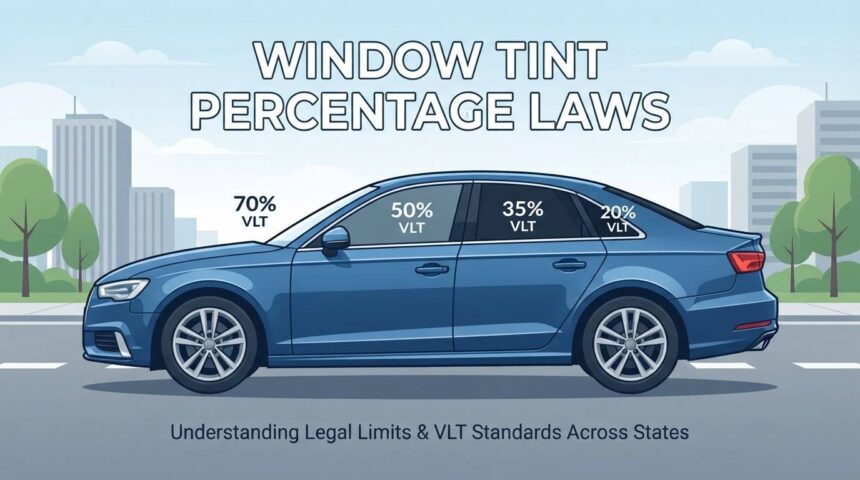
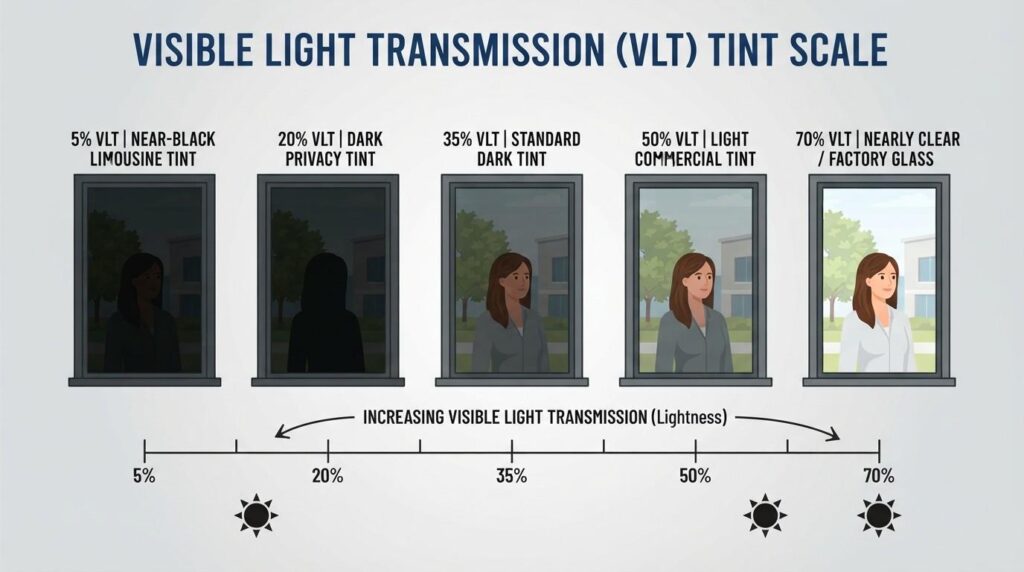
The scale works backward from what many people expect. A lower ** number means darker ** glass. A higher number means lighter, clearer glass. So 5% VLT is very dark limo tint, while 70% VLT looks close to no tint at all.
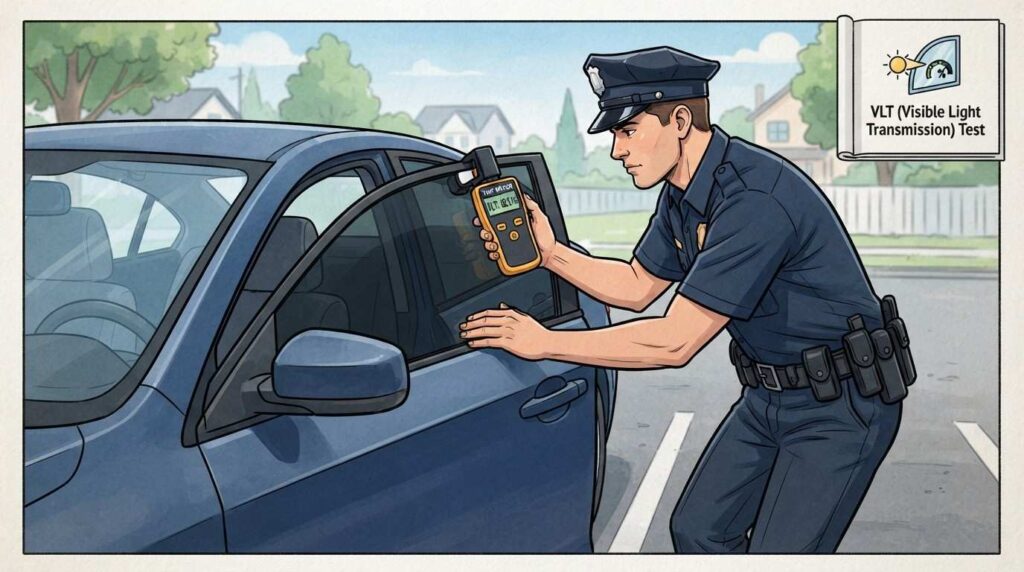
State laws are written entirely in VLT terms. During a stop, officers use a small handheld tint meter placed right on the glass to read the combined number.
Here is a quick reference so you can picture each level.
| VLT % | How It Looks | Common Use | Typical Legality |
|---|---|---|---|
| 5% | Near-black, cannot see inside | Limousines, rear privacy glass | Rear only in many states; illegal on front sides |
| 20% | Dark, hard to see inside | Rear windows, privacy | Often legal on rear, rarely on front sides |
| 35% | Moderately dark, some view in | Front sides in sun-belt states | Legal front side in many states |
| 50% | Light shade, easy view in | Front sides in stricter states | Widely legal on front sides |
| 70% | Almost clear | Windshields, strict-state front sides | Legal nearly everywhere |
The Net VLT Rule Most Drivers Miss
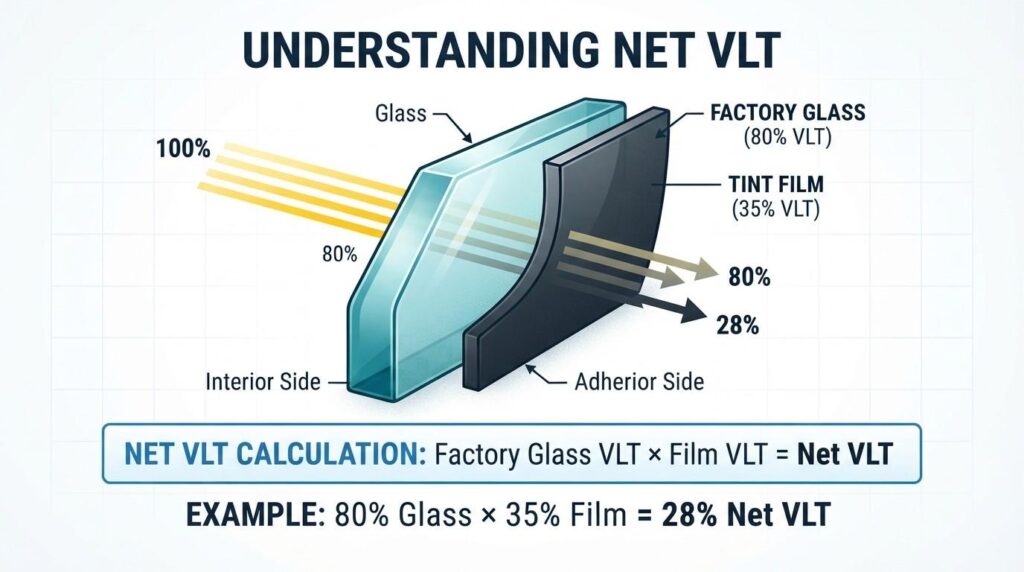
The number printed on the film box is not the number the officer’s meter reads. Your factory glass already blocks some light on its own. When you add film, the two values multiply.
The plain-language formula for net VLT looks like this:
- Net VLT = factory glass VLT × film VLT
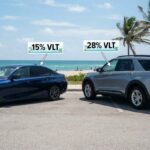
Here is a simple example. Say your factory glass measures about 80% VLT, and you install a 35% film. Multiply 0.80 by 0.35 and you get roughly 28% net VLT. That reads darker than the 35% you thought you bought, and it can push you below a 35% legal limit.
SUVs and trucks hide a bigger trap. Factory “privacy glass” on the rear can already be very dark, often around 15% to 26% VLT. Add even a light film on top, and those windows can turn nearly opaque and become illegal in states that regulate the rear.
Before you commit, ask your installer to measure your actual glass with a tint meter first. Then pick your film percentage from that real baseline, not from a guess.
Legal Tint Limits by Window and Vehicle Type
Limits change based on where the window sits and, often, what kind of vehicle you drive. Front side windows almost always face the strictest rules because they affect what the driver can see and what an officer can see during a stop.
Most states split the rules this way:
| Window | How Strictly Regulated | Typical Rule | Notes |
|---|---|---|---|
| Windshield | Very strict | Only a non-reflective strip above the AS-1 line | Full-windshield tint is rarely legal |
| Front side windows | Strictest | Around 35% to 70% VLT, varies by state | Same rule for cars and SUVs |
| Rear side windows | More lenient | Often any darkness on SUVs, vans, trucks | Sedans may face limits |
| Rear window | More lenient | Often any darkness, dual mirrors required | Sedans may face limits |
Vehicle class matters, too. Many states let you go as dark as you want on the back side and rear windows of an SUV, van, or truck, while front side rules stay the same for every vehicle type.
The exact numbers swing widely by region. Stricter states like New York and Pennsylvania often require around 70% VLT on front sides, while many sun-belt states allow much darker film. A few states even ban aftermarket film on the front side windows entirely.
Because the precise percentages differ everywhere, always confirm your own state. You can start with a state-specific guide such as our California tint law, Texas tint laws, Florida window tint law, New York tint laws, or Ohio tint laws pages.
Recent 2025-2026 Tint Law Changes
Several states recently changed their VLT limits or enforcement rules. Older shop pages and guides may now be out of date, so check the date on anything you read.
| State | What Changed | Effective Date |
|---|---|---|
| Louisiana | Front side minimum eased from 40% to 25% VLT (Act 143) | Aug 1, 2025 |
| North Dakota | Front side minimum eased from 50% to 35% VLT (HB 1340) | Aug 1, 2025 |
| Hawaii | Rear vehicle-type gap removed, higher fines, roll-down rule (Act 129) | May 29, 2025 |
| Utah | Officers can no longer trigger license or registration suspension for front tint (HB 112) | May 7, 2025 |
| Iowa | Front side minimum eased from 70% to 50% VLT (HF 766) | July 1, 2026 |
| North Carolina | Tint no longer checked at annual safety inspection (SB 43) | Dec 1, 2025 |
Here is where those numbers come from. As the Louisiana Illuminator reported, Louisiana reduced the light that front side windows must allow from 40% to 25% through Act 143, letting residents run darker front tint than has been allowed in decades. The North Dakota Highway Patrol confirms that, effective August 1, 2025, other windows must allow at least 35% light transmittance, and factory tint must be included when calculating the total.
In Hawaii, Hawaii News Now reported that House Bill 226 became Act 129 when the governor signed it, with a 90-day window for the DOT to build a uniform enforcement plan. The law also added a requirement that drivers with tint fully roll down their windows during a traffic stop. For Utah, BillTrack50’s summary of HB 112 explains the bill prevents peace officers from requesting that the state revoke or suspend a person’s registration or license for windshield and front side window tint violations.
Iowa’s change is the newest. As LegalClarity notes, House File 766 dropped Iowa’s front side window minimum from 70 percent to 50 percent, effective July 1, 2026. Since today is July 13, 2026, that rule is now in effect. Still, confirm current status with the state before relying on it. In North Carolina, WBTV reported the new law took effect December 1, 2025, and eliminated the need for window tint checks during vehicle inspections. You can read more on our North Carolina window tint law changes page.
Laws like these change often. Always check the official state DMV or statute for the latest rule.
Penalties, Enforcement, and Medical Exemptions
If your tint is too dark, the usual result is a fine, a “fix-it” ticket that gives you time to remove the film, or a failed inspection in states that still check tint. Costs stay modest in many places but add up if you ignore them.
Enforcement usually works one of two ways. Officers use a calibrated handheld tint meter at a traffic stop, and some states also check tint during the annual safety inspection. Many states build in a tolerance, often around 3 to 7 percentage points, to account for meter differences. Hawaii, for example, allows a ±6% variance on the 35% front side window standard to account for measurement differences between meters.
Illegal film can create other headaches beyond a ticket. In some cases it may complicate an insurance claim or a glass warranty, so it is worth thinking about those possible consequences before you go dark.
Many states offer a medical exemption for people with qualifying conditions like lupus or severe light sensitivity. Rules vary widely, though. As one North Carolina tint guide explains, the state’s exemption requires a physician’s signature, goes through the NC DMV, and is valid for five years. Other states, like Hawaii, take a different path. LegalClarity reports that Hawaii does not offer medical exemptions for darker tint, and fines now range from $300 to $1,200 depending on whether you own the car or installed the tint. Penalties and exemption rules differ by state, so check yours.
The Bottom Line
Buy your film based on your car’s real, metered glass, not the number on the box, and match it to your own state’s front side limit. That one habit prevents most tint tickets and failed inspections.
Your clearest next step is simple. Look up your state’s current VLT limits on your official DMV site or a trusted state guide, then ask your installer to meter your glass before any film goes on. If you want a plain-English breakdown for your state, browse our state-by-state tint law guides to confirm the rules that apply to you.
FAQ
What is the legal window tint percentage in my state?
Limits are set by each state, not the federal government. Many states allow around 35% to 50% VLT on front side windows and are more lenient on the rear, but strict states can require up to 70%. Check your state DMV or a Legal Expertise state guide for the exact number.
What does VLT mean?
VLT stands for Visible Light Transmission. It is the percentage of light that passes through your window and film combined. A lower number means darker tint, and a higher number means lighter, clearer glass.
Why does my 35% tint read darker on the meter?
Your factory glass already blocks some light, and it multiplies with the film. This is called net VLT. A 35% film on glass that measures about 80% VLT reads near 28% on the meter, which can put you over the limit.
What is the darkest legal tint for front windows?
It depends on your state. Strict states can require about 70% VLT on the front sides, while many sun-belt states allow 35% or darker. No state allows 5% limo tint on the front side windows.
Can I get a ticket for illegal tint in another state?
Yes. You must follow the tint law of the state you are driving in, even if your film is legal at home. If you cross state lines often, it is safer to install to the strictest limit that applies to your travels.
Are medical exemptions for darker tint available?
Most states offer them for qualifying conditions like lupus or severe photosensitivity. They usually require a physician’s certificate kept in the vehicle, and renewal rules vary. Not every state allows them, so confirm before you rely on one.
Is there a federal window tint law?
There is no federal aftermarket VLT limit. The federal standard, FMVSS 205, covers factory glass and glazing materials, not the film you add later. Tint darkness rules are set state by state.
How is window tint measured by police?
Officers use a calibrated handheld tint meter placed directly on the glass. It reads the combined VLT of the glass and film. Some states allow a small tolerance of a few percentage points to account for meter variation.