



The Kash Patel girlfriend defamation lawsuit is not one case. It is a set of four separate lawsuits filed by country singer Alexis Wilkins against a news network and three online commentators. As of November 2, 2026, one case was dismissed over court location, one ended with a dismissal filing after settlement talks, and two are still active.
- Kash Patel Girlfriend Defamation Lawsuit Explained in Simple Words
- Who Is Alexis Wilkins and Why Did She Sue
- The Four Lawsuits at a Glance
- The MS NOW Case in Tennessee
- The Kyle Seraphin Case in Texas
- The Elijah Schaffer Case in Florida
- The Sam Parker Case in Utah
- Timeline of Key Events
- How Defamation Law Works in the United States
- Why Public Figures Face a Higher Bar
- What Is False Light
- Opinion, Satire and Hyperbole
- Why Jurisdiction Can End a Case Early
- Anonymous Sources and Defamation Claims
- The Separate Atlantic Case Filed by Patel
- Rumors Versus Facts
- Costs, Damages and Timelines
- What to Do If You Face Online Defamation
- When to Talk to a Lawyer
- Frequently Asked Questions
- Who is suing in the Kash Patel girlfriend defamation lawsuit?
- Who has Alexis Wilkins sued?
- Did Alexis Wilkins win any of her cases?
- Why was the Sam Parker case dismissed?
- Is the MS NOW lawsuit still active?
- How much money is Wilkins asking for?
- Does Wilkins have to prove actual malice?
- Can a public figure win a defamation case?
- Conclusion
Wilkins and FBI Director Kash Patel announced their engagement on October 4, 2026. So the search term says girlfriend, but she is now his fiancee. Her post carried the caption “Went and got the law involved.”
This guide explains each case, what the courts have done so far, and the legal rules behind them. You will also find a timeline, a case table, and answers to common questions.
Kash Patel Girlfriend Defamation Lawsuit Explained in Simple Words
Defamation means a false statement of fact that harms someone’s reputation. Wilkins says several people did exactly that. She says they falsely linked her to a foreign spy plot, or falsely implied she misused federal agents and drank heavily.
The people and companies she sued dispute her claims. Kyle Seraphin calls his comments satire. MS NOW says it stands behind its reporting.
Here is the quick status as of November 2, 2026:
- MS NOW (Tennessee): The request to dismiss or transfer the case was still pending in the latest reports from September 2026.
- Kyle Seraphin (Texas): A judge denied his motion to dismiss in May 2026, so the case moved forward.
- Elijah Schaffer (Florida): A stipulation of dismissal was filed on August 31, 2026.
- Sam Parker (Utah): A judge dismissed the case in August 2026 because the Utah court lacked jurisdiction.
No trial has happened. No court has found anyone liable, and no court has ruled that the spy claims were true.
Who Is Alexis Wilkins and Why Did She Sue
Alexis Wilkins is a Nashville-based country singer, actress, and former congressional press secretary. She grew up in Arkansas. CNBC reported that her relationship with Patel began in January 2023.
Her public profile grew fast after Patel became FBI director in 2025. She attended his swearing-in, sang at high-profile events, and became a regular subject of online talk. Some of that talk turned into the claims at the center of these cases.
Her lawyers say the posts and reports hurt her career and brought threats and harassment. The defendants say the claims should not survive in court. That clash is what each judge has to sort out.
The Four Lawsuits at a Glance
| Defendant | Court | Filed | What Wilkins alleges | Status |
|---|---|---|---|---|
| Sam Parker | Federal court in Utah | Fall 2025 | An X thread called her an Israeli “honeypot” | Dismissed August 2026 for lack of jurisdiction |
| Kyle Seraphin | Federal court in Austin, Texas | August 2025 | A podcast called her a “former Mossad agent” | Motion to dismiss denied May 2026 |
| Elijah Schaffer | Federal court in Southern Florida | October 28, 2025 | A wordless repost implied she was a spy | Dismissal stipulation filed August 31, 2026 |
| MS NOW, Versant, Carol Leonnig, Ken Dilanian | Federal court in Nashville, Tennessee | Late May 2026 | A December 2025 report said she demanded rides home for drunk friends | Motion to dismiss or transfer pending |
Three cases involve the same kind of claim. Online commentators suggested she was a foreign agent sent to compromise Patel. The MS NOW case is different, because it involves a news report and anonymous sources.
The MS NOW Case in Tennessee
On December 5, 2025, MS NOW reporters Carol Leonnig and Ken Dilanian published a story. It said, citing anonymous sources, that Patel more than once asked the security detail protecting Wilkins to take her intoxicated friends home after nights out in Nashville. The FBI denied the story and called it made up.
Wilkins sued MS NOW, its parent company Versant, and the two reporters in the Middle District of Tennessee. According to NBC News, her complaint says the outlet used “sham” sources and that she very rarely drinks. She asks for a jury trial and more than $75,000 in damages. Her claims are defamation and false light invasion of privacy.
Her lawyers also say she had only recently received a security detail because of credible death threats. MS NOW says it stands firmly behind its reporting. The case was assigned to Judge Eli Richardson.
MS NOW asked the court to dismiss the case or move it to Washington, D.C. It argues Tennessee does not have power over the defendants. In a September 2026 filing, Wilkins argued the statements could portray her as misusing federal agents like a car service, and that the request should be denied.
We found no ruling on that request in the latest reports. Check the docket before you rely on this section.
The Kyle Seraphin Case in Texas
Seraphin is a former FBI agent turned podcaster. In August 2025, Wilkins sued him over an August 22 episode. She says he called her a “former Mossad agent” and described her relationship with Patel as a “honeypot.” CNBC reported that she asked for $5 million.
Her complaint says these claims accuse her of spying and even treason. It also says they are categorically false. Seraphin pushed back and said similar claims were already all over social media.
His legal argument is that his words were satire and rhetorical hyperbole. He also said the suit was meant to silence a critic. In May 2026, a federal judge rejected his request to dismiss, so the case moved forward.
That ruling does not mean Wilkins won. It means the judge found her claim could go forward to the next stage.
The Elijah Schaffer Case in Florida
Schaffer is a podcaster who runs the streaming outlet RiftTV. On September 14, 2025, he reposted a thread on X without adding a caption. The repost included a photo of Wilkins with Patel at a formal event.
Wilkins sued on October 28, 2025, in the Southern District of Florida. She argued the pairing of the thread and the photo accused her of seducing Patel to compromise him. She asked for $5 million, and Schaffer called the suit “delusional.”
Judge Donald Middlebrooks denied Schaffer’s motion to dismiss in February 2026. Reports say he found the captionless repost sat in a gray area between opinion and factual suggestion. He also said Schaffer’s wider posting history gave context a viewer could consider.
By late August 2026, the two sides told the court they were near a settlement. The public court docket on CourtListener shows a stipulation of dismissal filed by Wilkins on August 31, 2026. The terms were not public in the sources we reviewed.
The Sam Parker Case in Utah
Sam Parker is a former Republican Senate candidate. Wilkins sued him in federal court in Utah over an X thread that suggested she was an undercover Israeli “honey-pot.” Her lawsuit says the thread passed 1.6 million views, and she sought $5 million.
In August 2026, a federal judge dismissed the case. The reason was personal jurisdiction. The judge ruled that the Utah court was not the right place to hear the claim.
The judge did not decide whether Parker’s words were false or defamatory. This is the most misunderstood part of the whole story, and we explain why below.
Timeline of Key Events
- January 2023: Wilkins and Patel begin dating.
- August 2025: Wilkins sues Kyle Seraphin in Texas.
- October 28, 2025: Wilkins sues Elijah Schaffer in Florida.
- Late 2025: Wilkins sues Sam Parker in Utah.
- December 5, 2025: MS NOW publishes the report about the security detail.
- February 2026: The Schaffer motion to dismiss is denied.
- May 2026: The Seraphin motion to dismiss is denied, and Wilkins files the MS NOW suit.
- August 2026: The Parker case is dismissed, and the Schaffer dismissal stipulation is filed.
- September 2026: MS NOW and Wilkins argue over the dismiss or transfer request.
- October 4, 2026: Wilkins and Patel announce their engagement.
Want to see how another celebrity case moves through court? Read our guide to the Tyler Perry lawsuit and the legal process.
How Defamation Law Works in the United States
Defamation is a civil claim, not a crime in most states. The Cornell Law School Legal Information Institute explains that it covers both libel, which is written, and slander, which is spoken. Rules differ by state, so the details can change from one court to the next.
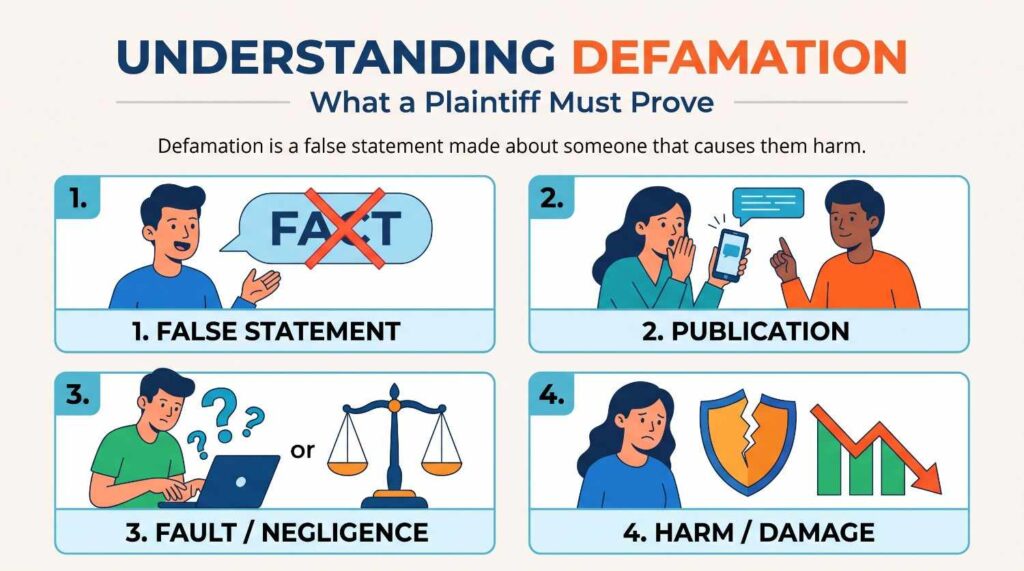
In general, a plaintiff must show four things:
- The defendant made a false statement of fact.
- The statement was published to at least one other person.
- The defendant was at fault, which can mean negligence or something higher.
- The statement caused harm, such as damage to reputation or income.
Truth is a complete defense in most places. Courts also look at whether a reasonable reader would see a statement as fact or as opinion.
Example (hypothetical): A podcaster says a local mayor “took cash bribes from a developer.” If that is false and he has no evidence, the mayor may have a claim. If he says “this mayor is the worst leader I have ever seen,” that is likely opinion.
Why Public Figures Face a Higher Bar
In New York Times Co. v. Sullivan (1964), the U.S. Supreme Court ruled that public officials must prove actual malice. That means the defendant knew the statement was false or acted with reckless disregard for the truth. Later cases extended the rule to public figures.
The Reporters Committee for Freedom of the Press has a helpful guide that explains what actual malice really means. Here is the key point. It is not about hate or bad feelings. It is about what the speaker knew or doubted when they published.
Courts also recognize limited-purpose public figures. These are people who step into a public debate. A person with a large public profile, who often appears at political events, may face this question early in a case.
If Wilkins is a public figure for these topics, she would likely need to meet the actual malice standard. If she is a private figure, she may only need to show negligence in some situations. This label can decide a case, so expect arguments about it.
What Is False Light
False light is a privacy claim. It applies when someone publishes information that puts a person in a highly offensive and misleading light. The statement does not have to be a clear lie about facts. A misleading impression can be enough.
Wilkins used this claim in the MS NOW case. Her lawyers say the story painted her as a heavy drinker who misused federal agents. Not every state allows false light claims, and courts often treat them like defamation claims when the facts overlap.
Opinion, Satire and Hyperbole
The First Amendment protects opinion, satire and loose, exaggerated language. Courts ask whether a reasonable person would take a statement as a claim of actual fact. Context matters a lot.
Seraphin relied on this defense. Schaffer’s wordless repost raised a harder question, because there were no words to judge. The Florida judge found it fell in a gray area, which is why the case moved forward at that stage.
Example (hypothetical): A user shares a news thread with a photo and no caption. One reader sees a joke, while another sees a hidden accusation. A court must decide which reading a reasonable viewer would take.
Why Jurisdiction Can End a Case Early
Every court needs power over the person it is judging. This is called personal jurisdiction. In online speech cases, courts often ask whether the speaker aimed their conduct at the state where the case was filed.
That is why the Parker case ended the way it did. The Utah court did not decide if the thread was defamatory. It decided Utah was not the right place.
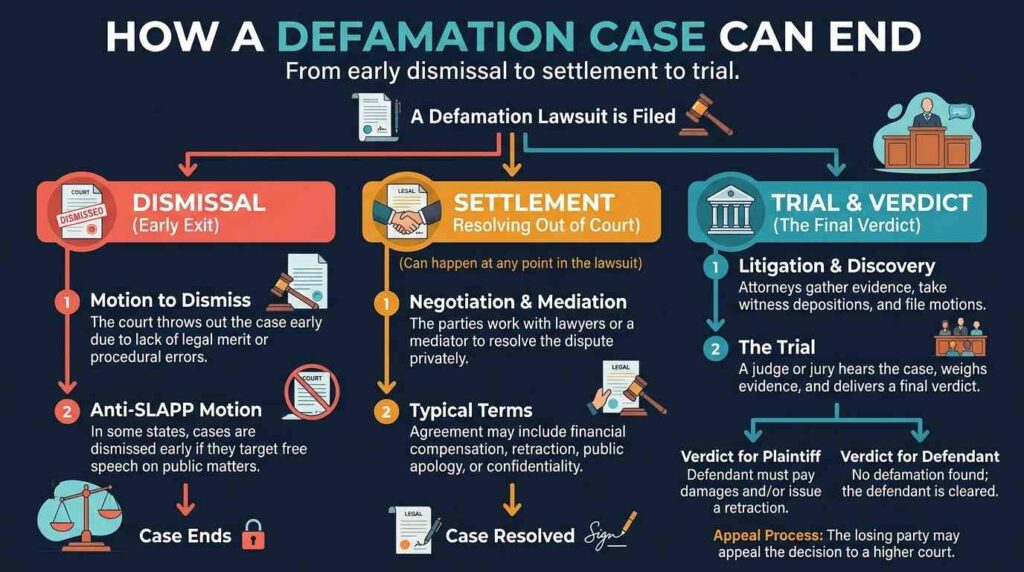
A dismissal like this usually does not decide the truth of the claims. A plaintiff may be able to refile in a proper court, but deadlines can get in the way. The MS NOW case faces a similar argument, since the outlet wants it dismissed or moved out of Tennessee.
Dismissals happen for many reasons. Our explainer on the Blingle franchise lawsuit shows how one federal case ended in dismissal. For another federal example, see our guide to the Rhode Island voter data lawsuit.
Anonymous Sources and Defamation Claims
Wilkins’s lawyers argue that MS NOW used “sham” anonymous sources. MS NOW says its reporting is accurate. Both sides will fight over this point if the case continues.
Using anonymous sources is not illegal. Journalists use them often, and the law does not require a reporter to name a source. But a reporter can face trouble if they publish a claim they know is false, or if they have strong reasons to doubt it.
To win, Wilkins may need evidence about what the reporters knew when they published. Discovery could reach emails, notes and source communications, although courts often protect journalists in ways that limit how far such requests go.
The Separate Atlantic Case Filed by Patel
Patel filed his own, separate lawsuit in April 2026. He sued The Atlantic and writer Sarah Fitzpatrick for $250 million over an article about alleged excessive drinking and absences. On July 27, 2026, The Atlantic asked a federal court in Washington, D.C. to dismiss the case.
The magazine argued that Patel cannot plausibly show actual malice. Patel’s attorney pushed back and vowed accountability. The Atlantic also said Patel has filed several similar suits without a win, which his side disputes.
This case is not part of the Wilkins lawsuits. The cases share some themes, such as public figure rules and the role of the press. Reports also say Wilkins and Patel use the same law firm in these matters.
Rumors Versus Facts
Online claims about this story spread fast. Our guide on what is true and what is just rumor, like the one in our Emuaid lawsuit explainer, applies here too. Use this table as a quick check.
| Claim you may see | What the record shows |
|---|---|
| Wilkins is a former foreign agent | She denies it, and her lawsuits call it false. No court has found it true. |
| A judge ruled her claims were meritless | The Parker case was dismissed over jurisdiction, not the merits. |
| Wilkins has won her cases | Two judges let cases pass the dismissal stage. That is not a win on the merits. |
| MS NOW lost the case | The request to dismiss or transfer was still pending in the latest reports. |
| The reports are proven false | No court has made that finding. |
The safest approach is simple. Treat every claim as an allegation until a court decides it.
Costs, Damages and Timelines
Defamation cases can be slow and costly. A contested federal case often runs for a year or longer. Legal fees can reach tens of thousands of dollars, and sometimes far more.
Courts can award compensatory damages for harm, special damages for proven financial loss, and punitive damages in some cases. Falsely accusing someone of a crime is often treated as especially serious. Even so, big payouts are rare, and many cases end in dismissal or a quiet settlement.
Deadlines matter. Many states give one to three years to sue, and some are shorter for spoken statements. Our guide on slip and fall lawsuit steps, costs and legal deadlines shows how strict filing windows work in another type of case.
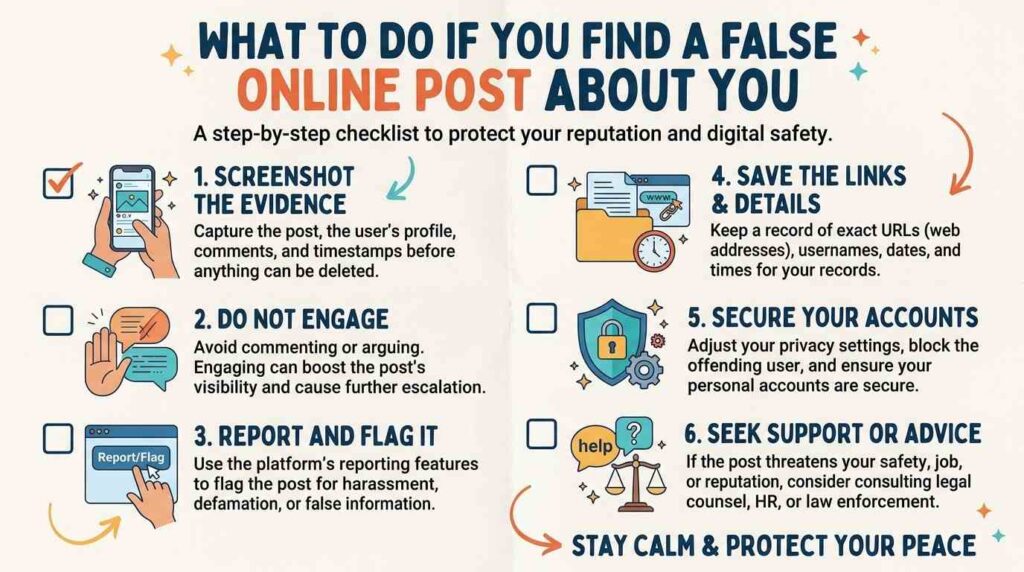
What to Do If You Face Online Defamation
These steps are general information, not legal advice. The FindLaw guide to online defamation is a good starting point for the basics.
- Save the evidence. Take screenshots with dates, links and usernames before anything is deleted.
- Do not fire back in anger. A heated reply can create new legal problems.
- Check whether it is fact or opinion. Only false statements of fact can support a claim.
- Look at the deadline. Time limits can be short.
- Ask whether a retraction is required. Some states require a retraction request before suing.
- Talk to a licensed attorney. The right court and the right defendant matter a lot.
When to Talk to a Lawyer
Talk to a lawyer early if you are being accused of defamation or want to bring a claim. Early advice can help you avoid mistakes, like filing in the wrong state, which is what ended the Parker case. A lawyer can also tell you if a claim is worth the cost.
Not sure which professional you need? Our explainer on attorney vs lawyer clears up the terms. Look for someone licensed in the state where your case would be filed, with real experience in media or defamation law.
Frequently Asked Questions
Who is suing in the Kash Patel girlfriend defamation lawsuit?
Alexis Wilkins, a country singer and the fiancee of FBI Director Kash Patel, is the plaintiff. She filed four separate suits. Patel is not named as a party in those four cases, based on the reports we reviewed.
Who has Alexis Wilkins sued?
She sued Sam Parker, Kyle Seraphin, Elijah Schaffer, and MS NOW along with Versant, Carol Leonnig and Ken Dilanian. Three suits involve claims that she was a foreign agent. The MS NOW suit involves a report about her security detail.
Did Alexis Wilkins win any of her cases?
Not in the sense of a verdict. Judges denied motions to dismiss in the Seraphin and Schaffer cases, which let them move forward. The Parker case was dismissed on jurisdiction, and the Schaffer case ended with a dismissal filing after settlement talks.
Why was the Sam Parker case dismissed?
A federal judge in Utah ruled that the court lacked personal jurisdiction over Parker. The judge did not decide whether his posts were defamatory. That means the dismissal says nothing about the truth of the claims.
Is the MS NOW lawsuit still active?
As of the latest reports we found, yes. MS NOW asked the court to dismiss the case or move it to Washington, D.C., and that request was still pending in September 2026. Check the court docket for any newer ruling.
How much money is Wilkins asking for?
She asked for $5 million in the Parker, Seraphin and Schaffer cases. In the MS NOW case, she asks for more than $75,000. That figure matches the minimum amount needed to bring many state-law disputes in federal court.
Does Wilkins have to prove actual malice?
It depends on whether a court treats her as a public figure for the topic. If it does, she would likely have to meet the actual malice standard. Courts often look at how much a person has stepped into public debate.
Can a public figure win a defamation case?
Yes, but the bar is high. They must show the speaker knew the statement was false or recklessly ignored the truth. Many cases fail on this point, and many end in settlements instead.
Conclusion
The Kash Patel girlfriend defamation lawsuit is really four cases with four different paths. One ended on jurisdiction, one ended with a dismissal filing after settlement talks, and two are still active as of November 2026. No court has decided that any statement was true or that any defendant is liable.
The big lessons are simple. Public figures face a tougher legal test, opinion and satire get strong protection, and where you file can decide the outcome. Treat every claim as an allegation until a court rules.
Bookmark this page, because we update it when courts issue new rulings. If you face a similar problem, speak with a licensed attorney in your state before you act.