



There is a real, documented Emuaid lawsuit. It’s an ADA website accessibility case filed in December 2020, not the “false advertising class action” you may have seen described on other sites.
- The Real Emuaid Lawsuit: Clark v. Speer Laboratories
- Who Is Speer Laboratories?
- What the ADA Lawsuit Actually Alleges
- What Happened After the Lawsuit Was Filed
- The “False Advertising Class Action” Claim Fact-Checked
- How to Spot a Fake or Speculative Lawsuit Page
- Can You Actually Sue Over Skincare Marketing Claims?
- What To Do If You Believe You Were Misled
- FAQ
- Conclusion
As of today, there’s no confirmed FTC case or certified class action against Emuaid over its marketing claims. Some websites report one as if it’s already happening. It isn’t at least not yet, and not based on anything we could verify in court records or FTC filings.
This article is for general information only. It is not legal advice and not a substitute for advice from a licensed attorney in your state.
The Real Emuaid Lawsuit: Clark v. Speer Laboratories

The confirmed Emuaid lawsuit is Clark v. Speer Laboratories, LLC, case number 1:20-CV-00343.
It was filed on December 1, 2020, in federal court in Pennsylvania. The plaintiff, Karen Clark, sued Speer Laboratories the company behind the Emuaid and EmuaidMAX brand over her website, not over the product itself.
This is a digital accessibility lawsuit. It has nothing to do with product safety, side effects, or health claims. It’s about whether blind and low-vision users could use the Emuaid website with a screen reader.
That distinction matters a lot. Most people searching “Emuaid lawsuit” are actually looking for information about product claims, not website code. So it’s worth being clear about what this case really covers.
Who Is Speer Laboratories?
Speer Laboratories, LLC is a family-run company based in Fort Lauderdale, Florida. It makes the Emuaid and EmuaidMAX line of topical ointments, along with other skin and first-aid products.
The company markets its products as homeopathic, over-the-counter treatments for a wide range of skin issues, including:
- Eczema and psoriasis
- Fungal infections
- Hemorrhoids
- Acne
- Minor cuts and skin irritation
Speer Laboratories says its products are made under FDA guidelines for OTC and homeopathic drugs. That’s a specific regulatory category. It does not mean the FDA has evaluated or approved specific health claims for these products homeopathic OTC products follow a different, more limited compliance pathway than prescription drugs.
What the ADA Lawsuit Actually Alleges

According to the complaint, Karen Clark alleged that www.emuaid.com had several accessibility problems for screen reader users, including:
- An inaccessible product matrix. The website used an image-based chart to explain what each ointment treats. Screen readers only announced the word “label” instead of reading the actual content.
- A broken navigation menu. Only the “home” menu item could be reached using the keyboard’s tab key. Pressing tab again skipped past the rest of the menu entirely.
- Inaccessible “how to use” instructions. The site had five tabs explaining product use, but screen reader users couldn’t navigate into them or hear the content.
The lawsuit claimed these issues violated Title III of the Americans with Disabilities Act (ADA), which requires places of “public accommodation” a category that has been extended to many commercial websites to be usable by people with disabilities.
Clark asked the court for:
- A declaratory judgment that the website violated the ADA
- A permanent injunction ordering Speer Laboratories to fix the accessibility problems
- Damages, attorney’s fees, and court costs
- Continued court oversight to make sure the fixes actually happened
This is a very common type of lawsuit. Thousands of ADA website accessibility cases get filed against retailers and product companies every year. It is not unique to Emuaid, and it doesn’t mean the product itself is dangerous or fraudulent.
What Happened After the Lawsuit Was Filed
Most ADA website accessibility cases like this one settle privately rather than going to trial. Settlements typically involve the company agreeing to:
- Update the website to meet WCAG (Web Content Accessibility Guidelines) standards
- Pay the plaintiff’s attorney’s fees and a modest settlement amount
- Allow ongoing monitoring for a set period
Court dockets for cases like this often don’t get widely reported once they’re resolved, since there’s usually no public trial or big settlement announcement. If you want the current status of this specific case, the most reliable option is to search the case number (1:20-CV-00343) on PACER (the federal court’s public records system) or check with a Pennsylvania federal court clerk.
The “False Advertising Class Action” Claim Fact-Checked
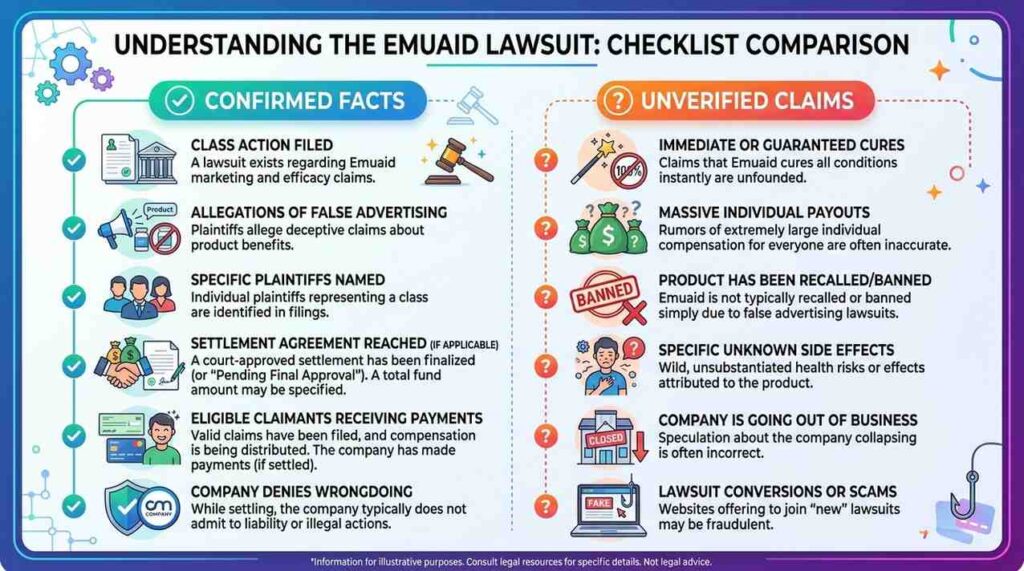
Here’s where things get messy. Several websites describe a different, much bigger lawsuit one where Speer Laboratories is accused of false advertising, facing FTC scrutiny, and possibly heading toward a class action with consumer payouts.
We looked into this claim directly. Here’s what we found:
| Claim | What We Found |
|---|---|
| FTC has sued or is investigating Speer Laboratories | Not found. No matching case in the FTC’s public case database as of this writing. |
| A false advertising class action is “certified” or “active” | Not found. No court docket, case number, or named plaintiff for this claim could be located. |
| Consumers can expect a specific payout ($10–$100) | Not verifiable. No settlement fund, claims administrator, or court order supports this figure. |
| A claim deadline “could open with little notice” | Not verifiable. This is speculative language, not a reported legal deadline. |
To be fair, this doesn’t prove nothing will ever happen. Companies do sometimes face FTC action or private lawsuits over health claims, and Emuaid’s marketing which references treating “over 100 conditions” is the kind of broad claim that regulators have scrutinized in other industries.
But as of today, we could not confirm that this specific action exists. Readers should treat any site promising a guaranteed payout or urging you to “file a claim now” for this alleged case with real skepticism.
How to Spot a Fake or Speculative Lawsuit Page
This isn’t just an Emuaid problem. It’s a pattern across a lot of “lawsuit” content online. Watch for these red flags:
- No case number. Real lawsuits have one. If a page never cites it, be cautious.
- No named plaintiff or court. “Consumers are suing” isn’t the same as an actual filed complaint.
- Vague urgency. Phrases like “act now” or “the window could close soon” with no real deadline attached.
- Guaranteed payout amounts before any settlement has been reached.
- Multiple sites with nearly identical wording. This often means the content was copied or generated from the same unverified source, not independently reported.
Can You Actually Sue Over Skincare Marketing Claims?
In general terms not specific to Emuaid consumers in the U.S. do have legal tools available if a company’s health claims are misleading:
- State consumer protection laws. Most states have statutes against unfair or deceptive business practices, and many allow individual lawsuits.
- The Lanham Act. This federal law lets competitors (and in some cases consumers) sue over false statements in advertising.
- FTC complaints. Consumers can file a complaint with the FTC, which can lead to an investigation, though the FTC doesn’t represent individual consumers directly.
Example scenario: Imagine someone buys a topical ointment after seeing an ad claim it “cures” a specific skin condition. If that claim isn’t backed by evidence and the buyer suffered a financial loss as a result, they may have grounds to explore a claim under their state’s consumer protection law. Whether that claim would succeed depends heavily on the specific facts, the exact wording used in the ad, and the jurisdiction.
This is general education, not a case evaluation. Whether any of this applies to your situation requires a licensed attorney to review your specific facts.
You can see a similar pattern play out in the Meaningful Beauty lawsuit, where marketing claims for a beauty product came under similar scrutiny
What To Do If You Believe You Were Misled

If you used an Emuaid product and believe the marketing misled you, here are reasonable, practical next steps:
- Save your receipts and packaging. Proof of purchase and the exact marketing language you saw both matter.
- Screenshot the specific claims. Product pages and ads change over time, so capture what you actually saw when you bought it.
- Document what happened. Note the condition you were treating, what you expected, and what actually occurred.
- File a complaint with the FTC at reportfraud.ftc.gov if you believe the marketing was deceptive.
- Consult a consumer protection attorney in your state before assuming you’re part of any class action especially one you only read about on a blog.
- Be wary of any site asking for money or personal information to “join” a lawsuit that doesn’t have a verifiable case number.
FAQ
Is there really a lawsuit against Emuaid?
Yes. A verified ADA website accessibility lawsuit, Clark v. Speer Laboratories (case 1:20-CV-00343), was filed in December 2020. Claims of a separate false-advertising class action could not be confirmed in court or FTC records.
Is Emuaid facing an FTC investigation?
No confirmed FTC case against Speer Laboratories appears in the FTC’s public case database as of this writing. If that changes, it would show up as a public filing.
Can I join an Emuaid class action lawsuit right now?
Not that we could verify. There is no certified class action with a claims process for Emuaid marketing claims as of today. Be cautious of any site claiming otherwise without a case number.
Is Emuaid FDA-approved?
Emuaid products are marketed as homeopathic over-the-counter products, made under FDA manufacturing guidelines for that category. This is different from the FDA approving specific health claims for the product.
What is EmuaidMAX used for?
It’s marketed as a topical first-aid ointment for skin issues like minor cuts, fungal infections, and irritation. Effectiveness for more serious or chronic conditions varies by individual and isn’t something this article can evaluate.
Did Speer Laboratories fix its website after the ADA lawsuit?
Public reporting on the case outcome is limited, since many ADA accessibility cases settle privately. Checking the case number on PACER is the most reliable way to confirm the current status.
Where can I check if a class action against Emuaid actually exists?
Search the company name on the FTC’s case database (ftc.gov/legal-library), or search federal court records through PACER. You can also check with your state attorney general’s consumer protection division.
Should I stop using Emuaid because of these lawsuit claims?
That’s a personal and medical decision, not a legal one this article can make for you. If you have concerns about a product’s safety or effectiveness, talk to a healthcare provider.
Conclusion
The real Emuaid lawsuit Clark v. Speer Laboratories is about website accessibility, not product safety or false advertising. It’s a legitimate, documented ADA case filed in 2020.
The false-advertising class action described on several other sites could not be confirmed through court records or FTC filings. That doesn’t mean it will never happen, but readers should be careful about treating unverified claims as settled fact, especially on sites pushing urgency or promising specific payouts.
If you believe you were personally misled by Emuaid’s marketing, your best move is documenting what you saw and experienced, then speaking with a licensed consumer protection attorney in your state — not relying on a blog post to tell you whether you have a case.
This article is for general informational purposes only and does not constitute legal advice. Laws vary by state and change over time. For advice about your specific situation, consult a qualified attorney licensed in your jurisdiction.