



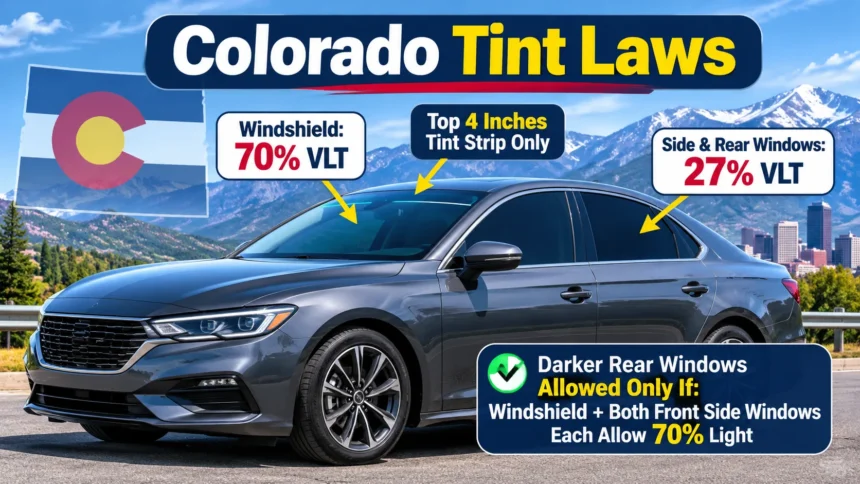
Colorado tint laws say your side and rear windows must let at least 27% of light through, and your windshield must let at least 70% through. One exception lets the rear windows go much darker, but only if the front windows stay almost clear. The rules come from Colorado Revised Statutes § 42-4-227, and they have not changed for 2026.
- Quick Answer
- What Is VLT and Why the Number on the Box Can Mislead You
- Colorado Tint Limits by Window
- The 70% Rule: How Rear Windows Can Legally Go Darker
- Windshield Rules and the 4-Inch Strip
- Tint Colors and Finishes Colorado Bans
- Medical Exemptions: Colorado Does Not Offer One
- Penalties: The Real Fine, and the $5,000 Myth
- How Police Test Your Tint
- Out-of-State Cars and Moving to Colorado
- How Colorado Compares With Other States
- Can Illegal Tint Hurt You After a Crash?
- How to Stay Legal
- Frequently Asked Questions
- Is 20% tint legal in Colorado?
- Is 35% tint legal in Colorado?
- Is 5% limo tint legal in Colorado?
- How much is a window tint ticket in Colorado?
- Does Colorado offer a medical exemption for window tint?
- Can you tint your windshield in Colorado?
- Do SUVs and trucks have different tint rules in Colorado?
- Can police pull you over for tint alone in Colorado?
- Conclusion
This guide explains each limit in plain English, the real fine you face (it is much smaller than many websites claim), and the mistakes that get Colorado drivers ticketed.
Quick Answer
Under Colorado tint laws, every window except the windshield must allow at least 27% light transmittance (VLT). The windshield must allow at least 70%. Windows behind the driver may go darker than 27% only when the windshield and both front side windows each allow at least 70%. A strip of tint is allowed on the top 4 inches of the windshield. Mirrored or metallic film is banned, and Colorado has no medical exemption. Driving with illegal tint is a class B traffic infraction.
What Is VLT and Why the Number on the Box Can Mislead You
VLT stands for Visible Light Transmission: the share of visible light that passes through your window, shown as a percentage. A high number means a light window, a low number a dark one. A 70% film looks almost clear; a 5% film is near-black “limo tint.”
Here is the part many drivers miss. The law measures the combined light transmission of your factory glass and the film together. Most factory glass already blocks some light on its own, often reading around 75% to 80% VLT before any film is added.
Say your car’s glass reads 80% on its own and you add a popular 35% film. The combined reading is roughly 0.80 × 0.35, which is about 28%. That barely passes Colorado’s 27% floor. Add the same film to slightly darker factory glass and you can fail a roadside test even though the box said “35%.” If you want a fuller walk-through of the numbers, our guide to how window tint percentages work breaks down each common percentage.
Common mistake: buying film by the box percentage alone. A good installer measures your glass first, then picks a film that keeps the combined reading safely above 27%.
Colorado Tint Limits by Window
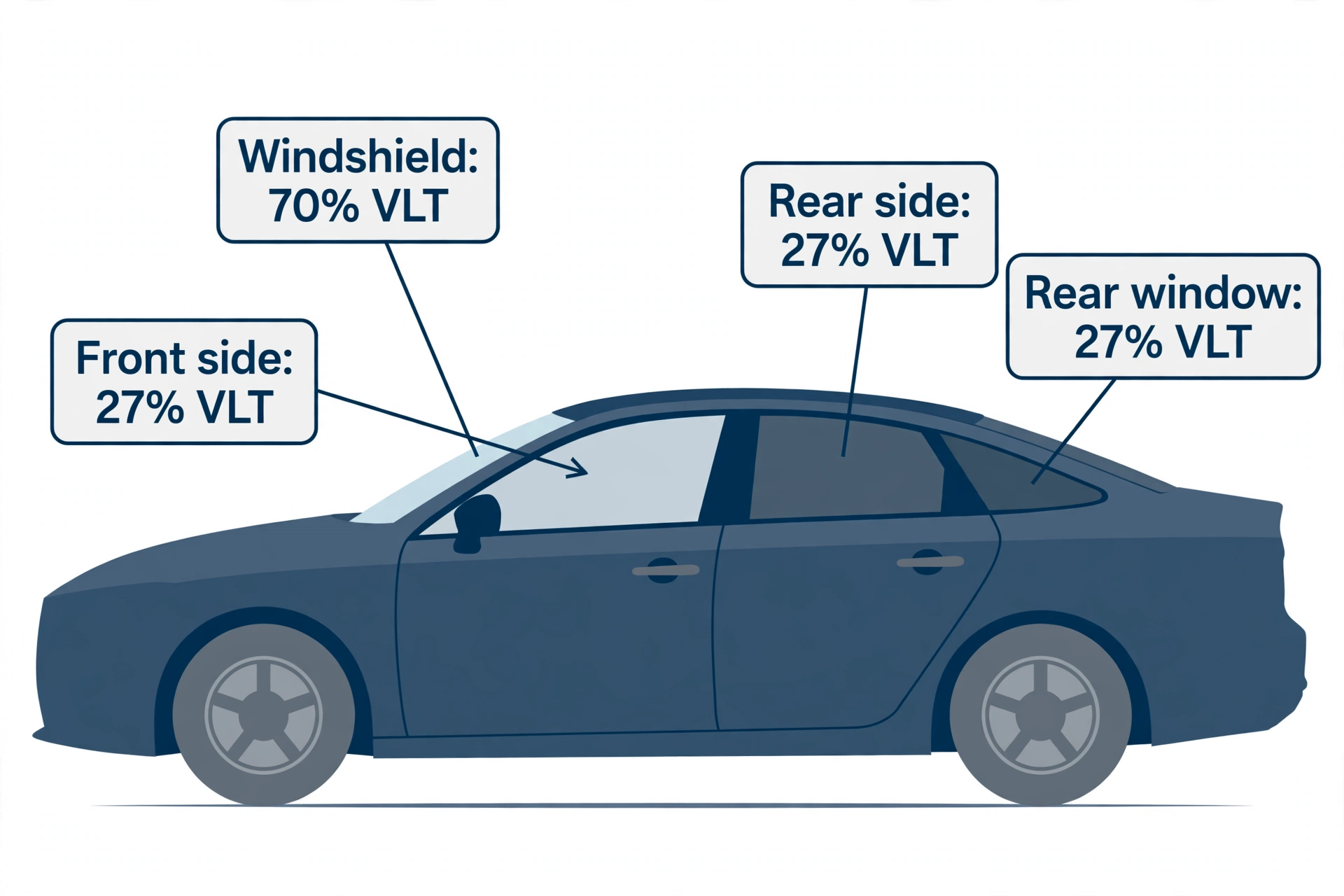
Colorado keeps its limits simple. The same numbers apply to sedans, coupes, SUVs, trucks, and vans. Unlike many states, Colorado does not give SUVs and trucks a darker rear-window allowance as a separate category.
| Window | Legal minimum light transmission |
|---|---|
| Windshield | 70% VLT (plus a tint strip on the top 4 inches) |
| Front side windows | 27% VLT |
| Rear side windows | 27% VLT (darker allowed only under the 70% rule below) |
| Rear window | 27% VLT (darker allowed only under the 70% rule below) |
Windshield
The windshield must allow at least 70% light transmittance. In practice, that means no full-windshield tint film. The only tint allowed on a windshield is the narrow strip at the very top, covered in its own section below.
Front side windows
The driver and front passenger windows must allow at least 27% VLT. This is the limit officers check most often, because these windows affect how well you can see pedestrians, cyclists, and cross traffic, and how well an officer can see you during a stop.
Rear side windows and rear window
The standard limit is also 27% VLT. There is one exception, and it is the most misunderstood part of Colorado’s window tint law. It is explained next.
The 70% Rule: How Rear Windows Can Legally Go Darker
Section 42-4-227(1)(a)(II) says the windows to the rear of the driver, including the rear window, may allow less than 27% light through — but only if the front side windows and the windshield each allow at least 70%.
Read that condition carefully. Some websites claim you can darken the rear windows as long as you have two side mirrors. That is not what the Colorado statute says. Mirrors are sensible, and you still need a clear view to the rear, but the legal trigger is the 70% reading at the front, not your mirrors.
The trade-off is real. A 70% front side window looks almost untinted. So you choose one of two legal setups:
- Setup one: 27% or lighter everywhere. Your front windows can be moderately dark, and the rear matches them.
- Setup two: 70% or lighter at the front, and the rear windows as dark as you like, even 5%.
What if scenario: A Denver driver puts 20% film on the front side windows for a matched look, then 5% on the rear. Both ends break the law. The front is below 27%, and the dark rear is only allowed when the front reads 70% or more. One stop can bring a citation for the whole car.
One group is exempt from this trade-off. Law enforcement vehicles may use tint darker than 27% on every window except the windshield when the tint serves a law enforcement purpose — but a vehicle tinted that way may not be used for traffic enforcement stops.
Windshield Rules and the 4-Inch Strip
Colorado allows nontransparent material on the topmost part of the windshield, with three conditions in § 42-4-227(1)(b):
- The bottom edge of the material extends no more than four inches down from the top of the windshield.
- The material is not red or amber, does not distort your perception of primary colors or your vision, and carries no lettering that distorts or blocks vision.
- It does not reflect sunlight or headlight glare into the eyes of drivers in oncoming or preceding vehicles any more than the bare windshield would.
One trap hides here. Many windshields carry an AS-1 line, a small factory mark that on many cars sits about five or six inches down. Colorado’s statute does not use the AS-1 line. It uses four inches. A strip that stops at the AS-1 line can still be too deep in Colorado, so measure from the top of the glass.
Tint Colors and Finishes Colorado Bans
Two bans apply no matter how light your tint is.
First, § 42-4-227(1)(d) states it plainly: “No material shall be used on any window in the motor vehicle that presents a metallic or mirrored appearance.” Chrome-look and mirror films are illegal on every window, front or back, even at a legal VLT.
Second, the red and amber ban applies to the windshield strip material, because those colors can be confused with brake lights and emergency lighting. Some sites claim red and amber film is banned on every window by name. The statute ties that color rule to the windshield strip. Either way, reputable shops steer drivers to neutral charcoal, smoke, or ceramic films, which stay clear of both bans.
Note what Colorado does not do. Some articles invent a reflectivity cap, such as “27% reflectivity.” No such number appears in § 42-4-227. The test is appearance: metallic or mirrored is banned, full stop.
Medical Exemptions: Colorado Does Not Offer One
This point surprises many drivers. Colorado tint laws contain no medical exemption at all. Section 42-4-227 has no provision for a doctor’s note, a DMV certificate, or a waiver for conditions like lupus, photosensitivity, or a history of skin cancer.
A few tint websites still claim Colorado offers a medical exemption with a physician’s certification. That is wrong, and acting on it is expensive. If you move to Colorado from a state that allowed your darker tint for medical reasons, that paperwork does not transfer. Your car must meet Colorado limits once it is registered here.
You still have legal options if sunlight is a genuine health problem for you:
- Use the darkest legal setup. That means 27% on the side and rear windows, or the 70% front setup with a dark rear.
- Choose a quality ceramic film at a legal VLT. Good ceramic films block up to 99% of UV rays even at lighter shades, because UV blocking and visible darkness are different things.
Penalties: The Real Fine, and the $5,000 Myth
Search this topic and you will see a scary claim repeated on law firm and tint shop sites: fines of $500 to $5,000, even a possible misdemeanor, for a tint ticket. For a driver, that claim is wrong. Here is what the current statute actually says.
Under § 42-4-227(3)(a), a driver who violates the tint rules commits a class B traffic infraction. Under Colorado’s penalty schedule, that carries a fine of $15 to $100, plus court surcharges. It is not a criminal offense, and it adds no points to your driver’s license.
So where does the $5,000 figure come from? Older versions of the statute punished the person who installed illegal tint as a misdemeanor with a fine of $500 to $5,000. Colorado later reclassified that offense. Under the current text, § 42-4-227(3)(b), an installer who applies tint that fails the requirements commits a class A traffic infraction — still a more serious charge than the driver’s, but not the old misdemeanor. Sites quoting $500 to $5,000 are working from an outdated copy of the law.
The fine is not the real cost anyway. Officers commonly treat a tint citation like a fix-it ticket: remove the illegal film, show the car now complies, and the court may reduce or dismiss the penalty. Professional removal typically runs about $50 to $250, and then you pay again for legal film. The ticket is cheap. The do-over is not.
What if scenario: A Colorado Springs driver buys a used SUV with 15% front tint installed by the last owner. She is stopped on I-25 and cited. It does not matter who installed the film. The person operating the car answers for its condition, which is why a tint-meter check belongs on any used-car inspection.
How Police Test Your Tint
Officers use a handheld tint meter. The device slides over a partly lowered window and shines light through the glass and film. It reads the combined VLT in seconds. If the reading is below 27% on a side window, that reading is the evidence behind the citation.
Two practical points follow. The meter reads glass plus film together, so the combined-VLT math above is what keeps you safe. And an officer who reasonably suspects your tint is too dark can stop you for the tint alone — no second violation, like speeding, is needed.
Out-of-State Cars and Moving to Colorado
Section 42-4-227 speaks of a motor vehicle “registered in Colorado.” Read plainly, its limits target Colorado-registered vehicles. A visitor passing through on out-of-state plates, with tint that is legal at home, is in a different position — though an officer can still stop any car whose windows look dangerously dark, and other equipment rules still apply.
Lawmakers once tried to close this gap. A 2019 bill, HB19-1067, proposed a 20% floor for vehicles registered outside Colorado. That proposal never made it into the statute, so no such rule exists today.
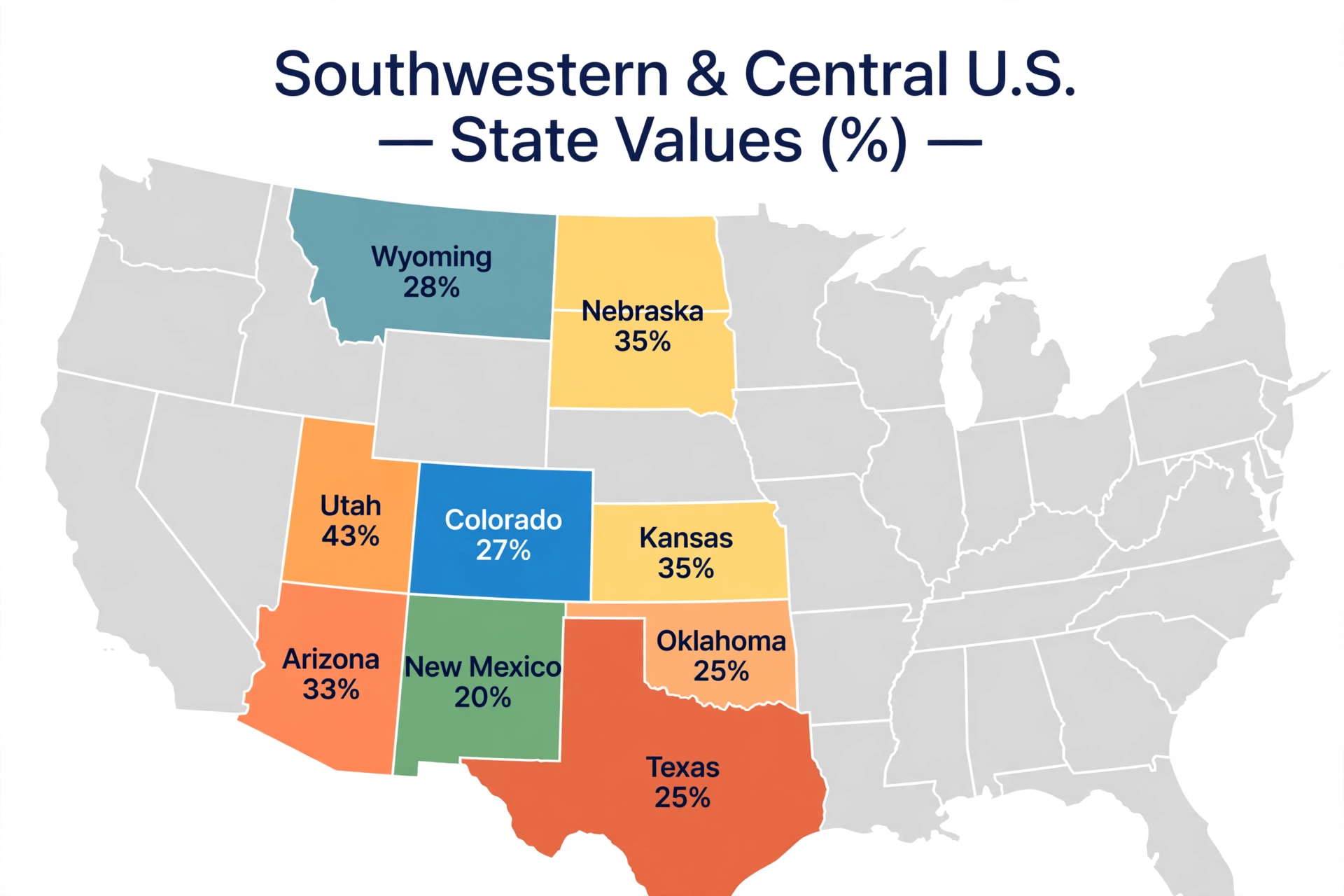
The moment you move here and register your car in Colorado, Colorado limits apply in full. Drivers arriving from states with looser rules get caught by this often. Texas tint laws, for example, allow front side windows down to 25%, which is darker than Colorado’s 27% floor. A car that was legal in Houston can fail in Denver by two points.
There is also no separate city rule to learn. Searches for a “Colorado Springs tint law” or a Denver ordinance turn up nothing because there is nothing to find. The state statute governs everywhere in Colorado.
How Colorado Compares With Other States
Colorado sits in the stricter half of the country because it regulates the rear windows too, instead of only the front:
- California’s tint law effectively keeps front side windows at 70% once factory glass is counted, far lighter than Colorado’s 27%.
- Florida’s window tint law allows 28% on the front sides but lets the rear windows go to 15%, with no 70% trade-off rule like Colorado’s.
- New York’s tint laws are among the strictest, requiring 70% on front and rear side windows for most cars, and tint is checked at the annual inspection.
- Ohio’s tint laws set 50% for front side windows, lighter than Colorado, while the rear can go darker.
- Virginia’s tint law allows 50% at the front and 35% at the rear for cars.
- Georgia’s tint laws use a flat 32% minimum on all side and rear windows.
- North Carolina’s window tint law sets 35% for cars and has seen recent legislative changes.
The lesson is simple: tint that is legal in one state is routinely illegal in the next. If you are moving, check the new state’s numbers before you register the car, not after your first stop.
Can Illegal Tint Hurt You After a Crash?
A tint ticket is minor. Its echo in a crash claim may not be. Colorado uses modified comparative negligence: your compensation is reduced by your share of fault, and if you are 50% or more at fault, you recover nothing.
If your windows were illegally dark, the other driver’s insurer may argue the tint cut your visibility at dusk or at an intersection and helped cause the crash. That argument does not win on its own, but it can push your fault percentage up and your payout down — one more reason the 27% floor is worth respecting on the windows you actually see through.
How to Stay Legal
A short checklist keeps you on the right side of § 42-4-227:
- Pick the setup first. Decide between 27% all around or 70% at the front with a dark rear. You cannot mix the two.
- Ask for the combined reading. Have the installer measure your factory glass and confirm the glass-plus-film total stays above 27% with a small safety margin.
- Keep the paperwork. A receipt or certificate showing the film’s VLT helps if you are ever questioned at a stop.
- Skip mirror and metallic films entirely. They are banned at any darkness.
- Measure the windshield strip. Four inches from the top of the glass, not the AS-1 line.
- Check a used car before you buy. A two-minute meter test is cheaper than a citation plus a strip-and-retint bill.
Frequently Asked Questions
Is 20% tint legal in Colorado?
No. 20% tint is below Colorado’s 27% minimum for front side windows, so it is illegal there. On rear windows, 20% is legal only under the 70% rule, meaning your windshield and front side windows must each read 70% or lighter.
Is 35% tint legal in Colorado?
Yes. A 35% film sits above the 27% floor, so it is legal on front side, rear side, and rear windows. Just confirm the combined reading with your factory glass stays above 27%, since darker factory glass can pull a 35% film close to the line.
Is 5% limo tint legal in Colorado?
Only on the rear side windows and rear window, and only if your windshield and front side windows each allow at least 70% of light through. On front side windows, 5% tint is always illegal in Colorado.
How much is a window tint ticket in Colorado?
Driving with illegal tint is a class B traffic infraction, with a fine of $15 to $100 plus surcharges, and no points on your license. Websites quoting $500 to $5,000 fines are using an outdated version of the law that once applied to installers, not drivers.
Does Colorado offer a medical exemption for window tint?
No. Colorado has no medical tint exemption. There is no doctor’s note, certificate, or waiver process in § 42-4-227, and exemption paperwork from another state is not valid for a Colorado-registered car.
Can you tint your windshield in Colorado?
Not the full windshield. The windshield must allow at least 70% light transmission. The only tint allowed is a strip on the top four inches, which cannot be red or amber and cannot add glare for other drivers.
Do SUVs and trucks have different tint rules in Colorado?
No. Colorado applies the same 27% and 70% limits to every vehicle type. Factory privacy glass is treated differently, though: windows installed by the manufacturer that meet federal standards are exempt under § 42-4-227(1)(c), which is why new SUVs can leave the lot with dark rear glass.
Can police pull you over for tint alone in Colorado?
Yes. An officer who reasonably suspects your tint is darker than the law allows can stop you for the tint by itself and test the windows with a tint meter during the stop.
Conclusion
Colorado tint laws rest on two numbers: 27% for side and rear windows, and 70% for the windshield. Keep the front at 70% and the rear can go as dark as you want. Ignore the myths — there is no medical exemption, no mirror shortcut around the 70% rule, and no $5,000 driver fine hiding in the current statute. The full text of the law is Colorado Revised Statutes § 42-4-227, also available through Justia’s Colorado code library.
If you have been cited and believe the reading or the stop was wrong, talk to a Colorado traffic attorney before you pay or strip the film — a short consultation can cost less than replacing tint you were entitled to keep.
Disclaimer: This article is general information about Colorado law, not legal advice. It is not a substitute for advice from a qualified attorney licensed in Colorado. Laws and court practice can change, so check the current statute or speak to a lawyer about your situation.