




The European Law Students’ Association (ELSA) is an independent, non-political, non-profit organisation run by and for law students and young lawyers. If you study law in Europe, or plan to build an international legal career, ELSA is probably the single biggest student network you can join.
- 1. What Is ELSA and What Does It Do
- 2. A Short History of ELSA
- 3. How ELSA Is Structured
- 4. ELSA’s Main Areas of Activity
- Academic Activities
- Moot Court Competitions
- STEP: The Student Trainee Exchange Programme
- Legal Research and Seminars & Conferences (S&C)
- 5. Benefits of Joining ELSA
- 6. How to Join ELSA: Step by Step
- 7. ELSA Membership Fees and Costs
- 8. ELSA’s International Recognition
- 9. Common Pitfalls and What to Check Before Joining
- 10. Is ELSA Worth It?
- FAQ
- Is ELSA only for law students?
- Is ELSA free to join?
- What is STEP in ELSA?
- How old is ELSA?
- Where is ELSA International headquartered?
- Can ELSA help me find a job after graduation?
- Does ELSA operate outside Europe?
- How is ELSA different from a university law society?
- Conclusion
Five law students from Austria, Hungary, Poland, and West Germany founded ELSA on 4 May 1981 in Vienna. Since then, it has grown into a huge network with members across dozens of countries. It offers academic programmes, traineeships, moot court competitions, and international events, and it holds consultative status with bodies such as the United Nations Economic and Social Council (ECOSOC).
This guide explains what ELSA is, how it is organised, what it offers, and how you can become a member. We also cover common questions, practical tips, and things to watch out for before you sign up.
1. What Is ELSA and What Does It Do
ELSA stands for the European Law Students’ Association. It is a student led network built around three simple goals. These goals are to contribute to legal education, to build mutual understanding between students from different countries, and to promote social responsibility among law students and young lawyers.
ELSA is not a law firm and it does not give legal advice to the public. It is a platform. Think of it as a bridge between law school and the international legal profession.
Example: Imagine a second year law student in Warsaw who wants to understand how contract law works in Germany. Through ELSA, that student could attend a seminar, apply for an international traineeship, or take part in a moot court against students from other countries. None of this happens through her university alone. ELSA is the connector.

2. A Short History of ELSA
ELSA was founded on 4 May 1981 by five students from Austria, Hungary, Poland, and West Germany. At the time, this was a notable act. It brought together students from both sides of the Iron Curtain during the Cold War, at a moment when cross border cooperation between East and West was rare.
Over more than four decades, ELSA grew from a small student initiative into what it now calls the world’s largest independent law students’ association. According to the organisation’s own figures and third party sources, ELSA today reaches tens of thousands of students across dozens of countries and hundreds of law faculties. You can read the full background on the organisation’s Wikipedia entry, which documents its founding and structure in detail.
Why this history matters: ELSA was built on the idea that legal education works better when it crosses borders. That founding principle still shapes everything the association does today, from moot court competitions to international traineeships.
3. How ELSA Is Structured
ELSA operates on three levels. Understanding this structure helps you know where to start if you want to join.
- Local Groups: These are based at individual universities or law faculties, for example ELSA Leiden or ELSA Tilburg. This is where most students first sign up.
- National Groups: Local Groups belong to a National Group, such as ELSA the Netherlands or ELSA Poland. National Groups coordinate activities across the whole country.
- ELSA International: This is the umbrella body, headquartered in Brussels, Belgium. It coordinates the network as a whole and represents ELSA internationally.
The International Board is the association’s top executive body. Its members are elected once a year at the International Council Meeting (ICM), a gathering that brings together delegates from every National Group. This structure means ELSA is genuinely run by students, not by outside administrators.
If you are also researching the difference between career paths in law, such as becoming a practicing attorney versus other legal roles, our breakdown of attorney versus lawyer explains the terminology many ELSA members encounter later in their careers.
4. ELSA’s Main Areas of Activity
ELSA groups its work into a few broad categories. Here is what each one actually involves.
Academic Activities
This includes law schools, seminars, conferences, and study visits. ELSA regularly runs Winter and Summer Law Schools in different European cities, where students spend one to two weeks studying a specific legal topic while also experiencing student life in a new country.
Moot Court Competitions
The ELSA Moot Court Competition (EMC2) is one of the association’s flagship programmes. Students argue simulated legal cases in front of judges, often modelled on real international courts. This is one of the best known ways law students build advocacy and research skills before they ever step into a real courtroom.
STEP: The Student Trainee Exchange Programme
STEP connects law students and young lawyers with law firms, companies, and organisations for traineeships lasting from a few weeks up to two years. This is often the reason students join ELSA in the first place, since international work experience is hard to arrange on your own.
Example scenario: A final year student in Portugal wants summer experience at a firm in Belgium. Instead of cold emailing dozens of firms, she applies through STEP, which already has a network of partner organisations looking for ELSA trainees.
Legal Research and Seminars & Conferences (S&C)
ELSA also runs research groups on emerging legal topics, plus lectures, panel discussions, and institutional visits, such as visits to embassies, parliaments, or international courts.

For readers comparing ELSA’s academic offerings against broader legal services available to students, our legal services resource hub covers related topics such as internships, clinics, and student advisory programmes.
5. Benefits of Joining ELSA
Here is what most members say they get out of ELSA, based on the association’s own stated goals and member testimonials from local groups.
- International network. You meet law students and young lawyers from more than 40 countries.
- Career exposure. Events connect members with law firms, corporate legal departments, and international organisations.
- Skill building. Moot court, public speaking, negotiation, and research skills all get practical use.
- Traineeship access. STEP opens doors to work experience that would be hard to find independently.
- Cultural exchange. Many members say the friendships and cross cultural experience matter as much as the professional benefits.
A word of caution: ELSA is what you make of it. Simply paying a membership fee and never attending events will not build your network or your resume. The benefits come from active participation.
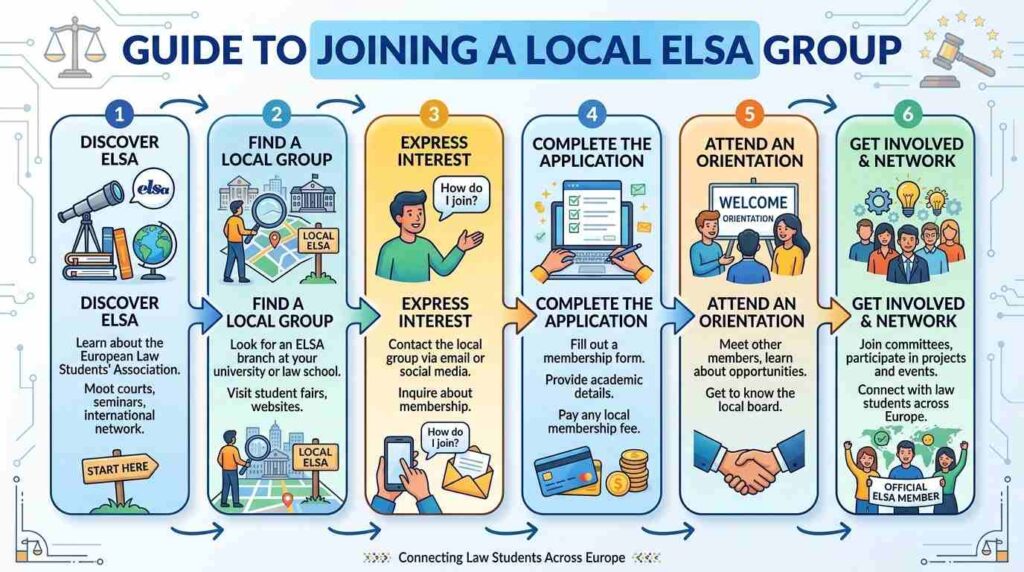
6. How to Join ELSA: Step by Step
Joining ELSA generally works the same way across most countries, though small details vary by Local Group.
- Find your Local Group. Search for the ELSA group at your own university or the nearest one to you.
- Check eligibility. Most Local Groups accept law students, though some also welcome non-law students or recent graduates, depending on local rules.
- Register and pay the membership fee. Fees are usually set locally and are relatively small compared to other student associations.
- Attend an introductory event. Many groups run onboarding sessions or socials for new members.
- Pick an area of interest. Decide whether you want to focus on moot court, STEP traineeships, academic activities, or organisational roles.
- Get involved. Volunteer for events, apply for STEP, or run for a position within your Local Group.
7. ELSA Membership Fees and Costs
Because ELSA is decentralised, fees are set by each Local Group and National Group, not by ELSA International. This means costs vary depending on your country and university.
As a general pattern:
| Cost Type | Typical Range |
|---|---|
| Annual local membership | Low, often comparable to a textbook or two |
| Law school / seminar participation | Varies by event and location, may include travel |
| STEP application | Usually free to apply, though trainees may cover their own travel and housing |
Always confirm exact figures with your own Local Group, since these numbers change year to year and country to country.
8. ELSA’s International Recognition
ELSA is not just a student club. It has built formal relationships with major international institutions over the decades.
According to background documented on the European Law Institute’s own membership page, ELSA has gained consultative or observer status with several bodies, including Special Consultative Status with the UN Economic and Social Council (ECOSOC) and Consultative Status with UNCITRAL, the UN Commission on International Trade Law. ELSA also holds recognised status with UNESCO.
This matters practically. It means ELSA delegates can sometimes attend and observe sessions at these institutions, giving members rare exposure to how international law and policy actually get made.
If you want to verify claims like this yourself, always check primary sources such as the official ELSA international website, the relevant UNESCO NGO partnership records, or independent references like Wikipedia, rather than relying only on secondary blog posts.
9. Common Pitfalls and What to Check Before Joining
Most Local Groups are legitimate and well run, since they operate under the official ELSA umbrella. Still, it is smart to do basic checks before you commit time or money to any student organisation, ELSA included.
- Confirm the group is officially affiliated. Check the group against the official national ELSA website, not just a social media page.
- Ask about fee transparency. A legitimate group should be able to explain exactly what your fee covers.
- Watch for fake or copycat pages. As with any well known name, scam or outdated pages sometimes appear in search results. Our guide on how to check whether an online legal platform is legitimate walks through general red flags that apply well beyond just one platform, and the same due diligence habits are useful when evaluating any student or legal organisation online.
- Understand time commitment. Organisational roles, such as running events or coordinating STEP applications, take real time. Be honest with yourself about your schedule before taking on a leadership position.
- Do not expect guaranteed jobs. ELSA opens doors and builds networks. It does not promise employment.
10. Is ELSA Worth It?
For most law students who want international exposure, ELSA is generally considered a strong investment of time, especially given the low membership cost compared to the opportunities on offer. The value comes from active participation, not passive membership.
Students who get the most out of ELSA tend to:
- Attend events regularly rather than joining once and disappearing.
- Apply for STEP early, since competitive placements fill up.
- Take on at least one organisational or volunteer role.
- Use moot court or seminar experience directly in later job applications.
Students who are only looking for a line on their resume, without attending anything, generally get far less value.
For broader context on legal career paths that ELSA experience can feed into, see our overview of the attorney profession and related legal careers.
FAQ
Is ELSA only for law students?
Most members are law students, but many Local Groups also welcome young lawyers, recent graduates, and in some cases non-law students who are interested in legal topics. Rules vary by country, so check with your Local Group.
Is ELSA free to join?
No, most Local Groups charge a small annual membership fee. The exact amount depends on your country and university, and it is generally low compared to other student organisations.
What is STEP in ELSA?
STEP stands for the Student Trainee Exchange Programme. It connects members with traineeships at law firms, companies, and organisations, ranging from a few weeks up to two years.
How old is ELSA?
ELSA was founded on 4 May 1981 in Vienna by five law students from Austria, Hungary, Poland, and West Germany.
Where is ELSA International headquartered?
ELSA International is headquartered in Brussels, Belgium.
Can ELSA help me find a job after graduation?
ELSA does not guarantee employment, but its network, traineeships, and events give members exposure to law firms and organisations that can lead to future opportunities.
Does ELSA operate outside Europe?
ELSA’s core network is European, though its international recognition, including status with UN bodies and UNESCO, gives it reach and visibility beyond the continent.
How is ELSA different from a university law society?
A university law society usually serves one institution. ELSA connects students across many universities and countries through Local, National, and International levels, offering a much wider network.
Conclusion
The European Law Students’ Association (ELSA) has grown from five founding students in 1981 into one of the largest law student networks in the world. It offers academic programmes, moot court competitions, international traineeships through STEP, and a genuine cross border community for law students and young lawyers.
Joining is usually simple and affordable through your local university group, but the real value comes from showing up, applying for opportunities, and staying active rather than treating membership as a passive credential.
If you are weighing ELSA against other options for building legal experience, browse our broader collection of resources on law and legal education, or reach out through our about us page for more guidance. And remember, this article is general information only. For advice specific to your situation, speak with your university’s career office, your Local ELSA Group, or a qualified legal professional in your jurisdiction.