


Introduction
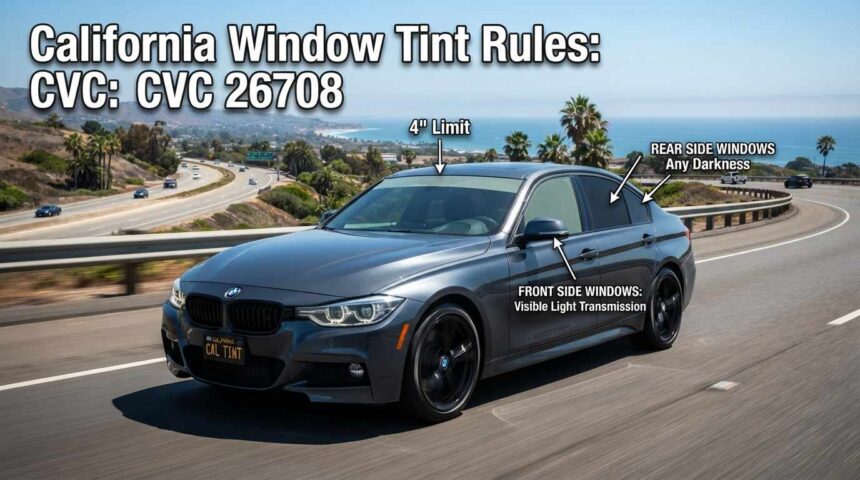
California tint law sets a 70% VLT limit on front side windows and allows only the top 4 inches of the windshield to be tinted. This law applies to every car, SUV, van, and truck registered in the state. This guide is general information only. It is not a substitute for advice from a qualified attorney licensed in your jurisdiction.
- Introduction
- What Does California Law Say About Window Tint?
- California Window Tint Law by Window Type
- California Tint Law by Vehicle Type
- Restricted Tint Colors and Reflectivity Rules
- Certificates, Stickers, and Documentation Requirements
- Medical Exemptions for Window Tint in California
- How Police Measure Window Tint
- Penalties and Fines for Illegal Window Tint
- Headlight and Taillight Tint Laws in California
- Moving to California With Out-of-State Tint
- Choosing Legal Tint: Film Types and Cost
- Does Illegal Tint Affect an Accident Claim?
- California Tint Law Updates: 2025-2026
- Q1. What is the law on tinted windows in California?
- Q2. What is the window tint law in California?
- Q3. What are the tint laws in California?
- Q4. What is the law for tinted windows in California?
- Q5. Is 5% tint legal in California?
- Q6. Can I tint my entire windshield?
- Q7. What happens if I do not fix a tint ticket within 30 days?
- Q8. Does California accept a tint certificate from another state?
Window tint feels like a small choice. But get it wrong, and you could face a fine, a fix-it ticket, or even trouble with your insurance company after a crash. Below, we break down every rule in plain English, from VLT percentages to medical exemptions.
What Does California Law Say About Window Tint?
California tint law comes from Vehicle Code Section 26708. This law has been on the books since 1999. It controls how dark, how reflective, and where you can apply window film on a vehicle.
The rule exists for two reasons. First, it keeps drivers able to see clearly. Second, it lets police officers see into a vehicle during a stop.
California tint law does not care about your reason for tinting. Privacy, style, and heat reduction are all common reasons drivers choose tint. The law treats every vehicle the same way, no matter why the tint was added.
California Window Tint Law by Window Type
Each window on your car follows a different rule. Here is the full breakdown.
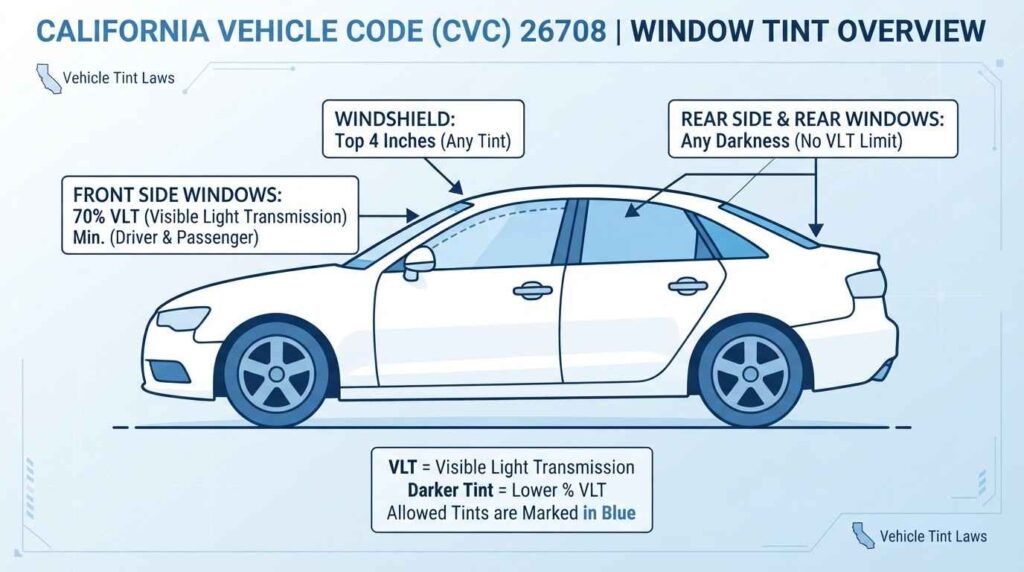
| Window | VLT Rule |
| Windshield | Tint allowed only on the top 4 inches, above the AS-1 line |
| Front side windows | Must allow more than 70% VLT |
| Back side windows | Any darkness allowed |
| Rear window | Any darkness allowed (dual side mirrors required) |
The windshield rule is the strictest. The top strip must stay clear, colorless, and non-reflective. It cannot include lettering or graphics that block your view.
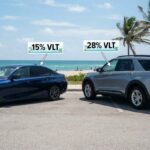
Front side windows are where most drivers get a ticket. The 70% rule sounds simple. But most factory glass already blocks 15% to 25% of light on its own. Add a film rated at 70% VLT, and the combined result often drops below the legal limit.
Example: Sarah’s sedan has factory glass at 80% VLT. She adds a film rated at 70% VLT. The combined VLT often falls near 56%, which fails inspection. A professional shop can test this before installing anything.
California Tint Law by Vehicle Type
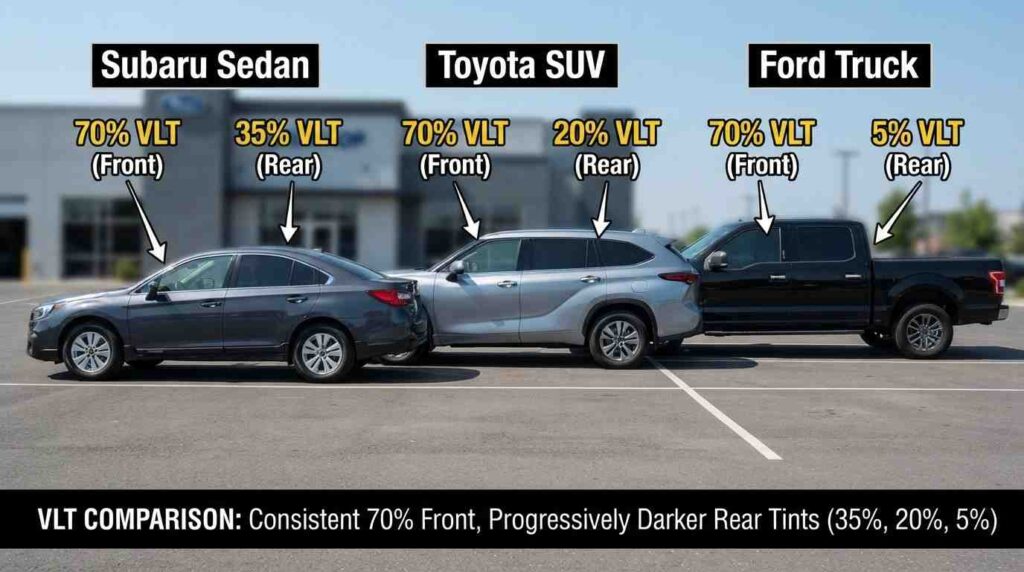
California tint law applies the same VLT numbers to sedans, SUVs, vans, and trucks. Window position decides the rule, not the vehicle body style.
Sedans, coupes, and hatchbacks: front side windows must meet 70% VLT.
SUVs, vans, and trucks: back side and rear windows can use any darkness.
Tesla Model Y and other EVs: many EVs come with factory-tinted glass. Always test the combined VLT before adding film, since EV glass is often darker than older gas vehicles.
Motorcycles: California tint law does not apply to motorcycles, since they have no side or rear windows in the traditional sense. Windshield rules can still apply to motorcycle fairings in some cases.
RVs and commercial vehicles: these follow the same front-window VLT rule as passenger vehicles, but rear cargo or living area windows are typically treated like rear windows on a van.
Restricted Tint Colors and Reflectivity Rules
California law bans certain tint colors outright. Red, amber, and blue tints are illegal on any window. These colors can be confused with emergency vehicle lights, which is a safety issue.
Reflective or mirrored tint is also restricted. Your tint cannot be more reflective than the untinted glass itself. A shop using quality film should be able to confirm this before installation.
Certificates, Stickers, and Documentation Requirements
California tint law requires paperwork, not just correct darkness. Film manufacturers must certify their product for sale in the state. Installers must give drivers a certificate or sticker showing the film meets legal standards.
Keep this certificate in your glove box. If an officer asks, you can show proof your tint is compliant. This single step can turn a possible ticket into a quick conversation.
Medical Exemptions for Window Tint in California
Some drivers need extra sun protection for medical reasons. California tint law allows a medical exemption under Vehicle Code 26708.2.
To qualify:
- Get a signed statement from a licensed physician.
- Complete DMV Form REG 256A.
- Keep the signed form in the vehicle at all times.
Medical exemption tint must still fall between 20% and 35% VLT. It must also be green, gray, or neutral smoke in color. Darker tint, even with a doctor’s note, is not automatically legal, and the film cannot be used after dark under CVC 26708.2.
How Police Measure Window Tint
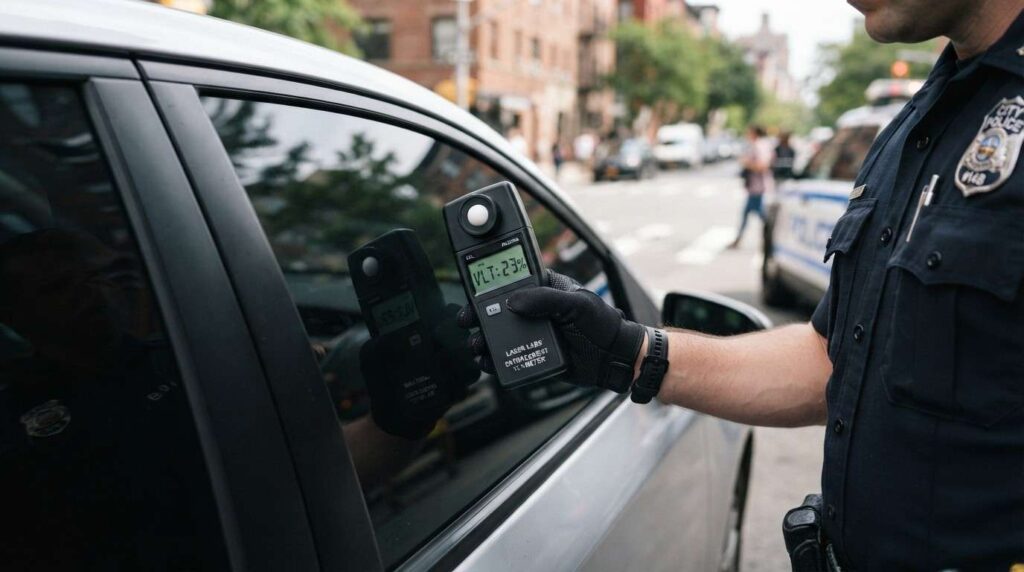
Officers use a handheld VLT meter during a traffic stop. This device measures the light passing through both the glass and the film together, not the film alone.
Many drivers assume window tint alone is not a reason to get pulled over. In practice, officers can and do stop vehicles specifically for suspected illegal tint, especially at checkpoints focused on vehicle equipment.
Penalties and Fines for Illegal Window Tint
A first offense typically results in a fix-it ticket under Vehicle Code Section 26708. The base cost is around $25.
Here is what usually happens after a citation:
| Offense | Typical Outcome |
| First offense | Fix-it ticket, about $25, 30 days to correct |
| Second or later offense | Fine up to $197 or more |
| Ongoing non-compliance | Vehicle may be flagged, tint removal ordered |
You generally have 30 days to remove or fix the tint. After that, a law enforcement officer or authorized station must sign off on your correction before the ticket is dismissed. Court fees and administrative costs can push the real cost closer to $100 to $250 total, even though the base fine looks small.
Example: Marcus gets pulled over for dark front side windows. The officer measures 45% VLT, well below the 70% requirement. He receives a fix-it ticket, has the tint removed within two weeks, and gets it signed off by his local police station. His ticket is dismissed with no further cost beyond the original fee.
A repeat citation is treated more seriously. If you are cited again for the same vehicle, expect a higher fine and closer scrutiny at any future stop.
Headlight and Taillight Tint Laws in California
Window tint law and light tint law are not the same rule, though drivers often confuse them. California restricts tinting or covering headlights and taillights if it reduces the required brightness or changes the light color.
Headlights must stay white or amber. Taillights must stay red. A dark film over either light can lead to a separate equipment citation, apart from any window tint violation.
Moving to California With Out-of-State Tint
California does not recognize tint rules from other states. If you move here from a state with looser tint law, like Nevada, Texas, or Florida, your existing tint may not pass in California.
You can be cited even if the tint was installed and fully legal somewhere else. If you’re relocating, have your tint checked and re-verified with a calibrated VLT meter as soon as possible. States update their own tint rules often. For example, North Carolina recently changed its own window tint law, so rules you knew from a previous state may already be outdated too.
Choosing Legal Tint: Film Types and Cost
Not all films perform the same, even at the same VLT rating.
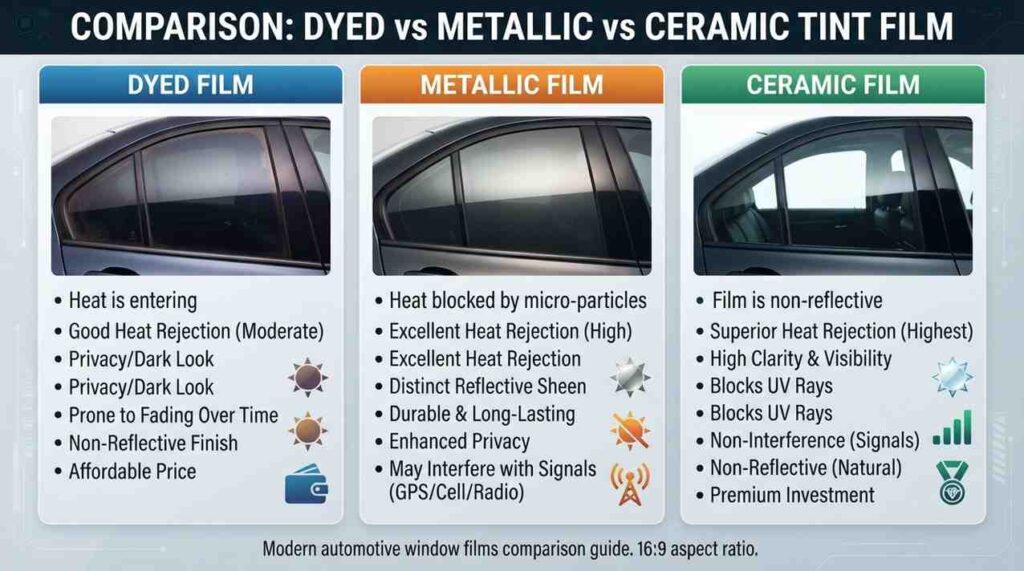
Dyed film: the cheapest option, but it fades over time and offers the least heat rejection.
Metallic film: blocks more heat but can interfere with radio, GPS, or toll transponder signals.
Ceramic film: costs more, but rejects heat well and does not interfere with electronics.
Cost for a full legal tint job typically runs from $150 for basic dyed film to $600 or more for premium ceramic film, depending on vehicle size and shop.
DIY tint kits are available, but they carry a real risk. Most drivers cannot measure VLT accurately at home. A professional installer can verify compliance before you drive off, which protects you from a future ticket.
Does Illegal Tint Affect an Accident Claim?
Illegal window tint can come up after a crash. If tint reduced visibility and contributed to a collision, an insurance company or opposing attorney may raise it as a factor.
This does not mean illegal tint always causes an accident. But it can complicate a claim, especially if a police report already notes a tint violation. If you are dealing with a crash where tint may be involved, speak with a licensed attorney about your specific situation.
California Tint Law Updates: 2025-2026
California tint law itself has not changed dramatically since Vehicle Code 26708 was enacted in 1999. The core VLT numbers, 70% for front windows and any darkness for rear windows, remain the same heading into 2026.
What has shifted is enforcement awareness. More checkpoints now include tint meter checks alongside standard safety inspections. Always check for updates before assuming last year’s rules still apply, since traffic law can shift from one legislative session to the next.
FAQ
Q1. What is the law on tinted windows in California?
Front side windows must allow more than 70% VLT. Windshields can only be tinted on the top 4 inches. Back side and rear windows can use any darkness, as long as you have dual side mirrors.
Q2. What is the window tint law in California?
It is Vehicle Code Section 26708. It sets VLT limits by window position and bans red, amber, and blue tint colors on any window.
Q3. What are the tint laws in California?
The main rules cover VLT percentage by window, banned colors, reflectivity limits, and a documentation requirement showing your film is certified for sale in the state.
Q4. What is the law for tinted windows in California?
Front windows need at least 70% VLT. Rear windows can be any darkness. Medical exemptions allow 20% to 35% VLT with a signed doctor’s note and DMV Form REG 256A.
Q5. Is 5% tint legal in California?
Only on rear side windows and the rear window, and only if the vehicle has dual side mirrors. It is not legal on front side windows.
Q6. Can I tint my entire windshield?
No. Only the top 4 inches, above the AS-1 line, can be tinted, and that strip must stay clear and non-reflective.
Q7. What happens if I do not fix a tint ticket within 30 days?
The citation can turn into a more serious violation, and you may face additional fines or a court appearance requirement.
Q8. Does California accept a tint certificate from another state?
No. California requires its own compliance standard, regardless of where the tint was originally installed or certified.
Conclusion
California tint law comes down to a few core numbers: 70% VLT on front windows, any darkness in the back, and no red, amber, or blue film anywhere. Get your tint checked by a professional before you assume it passes, since factory glass alone can push you over the legal limit.
If you are dealing with a tint-related ticket or an accident where tint may be a factor, a licensed local attorney can review your specific case. For more state-by-state tint law comparisons, check our related coverage on how other states are updating their rules.
This article is for general informational purposes only and is not legal advice.