



Do you want to know the full story of how bankruptcy forced an ice cream chain to close 500 locations? That was the headline in 2025, and it left many people wondering if their favorite cone was gone for good.
- Thrifty Ice Cream Closures at a Glance
- Why Did Bankruptcy Force the Ice Cream Chain to Close 500 Locations?
- Rite Aid’s Two Bankruptcies: A Quick Timeline
- What Is Chapter 11 Bankruptcy?
- How Does a Chapter 11 Asset Sale Work?
- Who Bought Thrifty Ice Cream, and for How Much?
- Where Can You Still Buy Thrifty Ice Cream?
- A Short History of Thrifty Ice Cream
- What Bankruptcy Closures Mean for Employees, Customers, and Creditors
- Do Employees Get Notice When Stores Close in Bankruptcy?
- What Happens to Gift Cards and Store Credit?
- How Do Creditors Get Paid?
- Common Mistakes When a Company You Deal With Files for Bankruptcy
- What Rite Aid and Fans Said
- Other Ice Cream Bankruptcies: How Thrifty Compares
- What Happens Next for Thrifty Ice Cream?
- Frequently Asked Questions
- Q1. Did Thrifty Ice Cream go out of business?
- W2. Why did Rite Aid close its Thrifty ice cream counters?
- Q3. How many Thrifty Ice Cream locations closed?
- Q4. Who owns Thrifty Ice Cream now?
- Q5. Can I still buy Thrifty ice cream?
- Q6. What happens to gift cards when a company files Chapter 11?
- Q7. Do I get a warning if my workplace closes in bankruptcy?
- Q8. Will Thrifty Ice Cream counters come back?
- Conclusion
The short answer: Thrifty Ice Cream did not go bankrupt. Its parent company, Rite Aid, did. Roughly 500 Thrifty scoop counters inside Rite Aid stores closed as a result. But the brand was later sold for $19.2 million, and its cartons are still in grocery freezers.
Why does this matter? The same thing can happen to any small business that lives inside a bigger company’s store. It also matters if you work for, buy from, or are owed money by a company in Chapter 11 bankruptcy. Below, I explain what happened, how the law works, and what it means for real people.
Thrifty Ice Cream Closures at a Glance
| Question | Short answer |
|---|---|
| Who went bankrupt? | Rite Aid, Thrifty’s parent company (not Thrifty itself) |
| What type of bankruptcy? | Chapter 11 (reorganization), filed in May 2025 |
| How many Thrifty locations closed? | Roughly 500 scoop counters inside Rite Aid pharmacies |
| Is the Thrifty brand gone? | No. It was sold in bankruptcy court |
| Who owns it now? | Hilrod Holdings, linked to Monster Beverage executives |
| What was the price? | $19.2 million |
| When was the sale approved? | July 1, 2025, in New Jersey bankruptcy court |
| Where can I still buy it? | Grocery freezers such as Albertsons, Vons, and Ralphs |
A note on the number 500. Early reports said about 500 Thrifty counters would close. Other outlets, including the SF Chronicle and SFGate, described a Rite Aid announcement that 500 stores would close, many with Thrifty counters inside. SFGate counted 19 of those stores in California. The difference faded in the end. Rite Aid said all of its stores had closed by October 3, 2025, so every counter inside went with them.
Why Did Bankruptcy Force the Ice Cream Chain to Close 500 Locations?
Rite Aid filed for Chapter 11 bankruptcy in May 2025 and began closing its stores. Roughly 500 Thrifty Ice Cream counters sat inside those stores, so they closed too. The counters were generally part of Rite Aid’s own operations and could not be sold separately. The Thrifty brand itself was later sold.
Business writers call this collateral damage. A healthy brand takes a hit because its parent company has money problems. It may be sold to a new owner, or it may be lost.
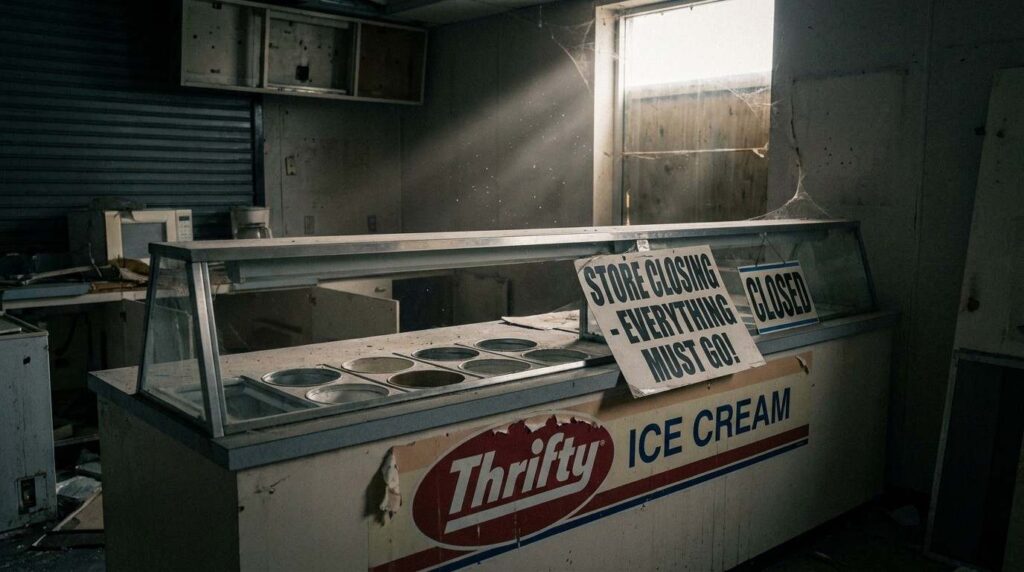
Hypothetical example: Maria rents a small coffee cart inside a department store. Her coffee sells well. Then the department store files for Chapter 11 and closes the building. Maria’s cart closes too, even though her business was healthy. That is the Thrifty story in miniature.
Did Thrifty Ice Cream Go Bankrupt?
No. Thrifty Ice Cream did not file for bankruptcy. Its parent company, Rite Aid, did. Thrifty was one of Rite Aid’s assets, so it was put up for sale to help pay creditors. A new owner, Hilrod Holdings, bought the brand for $19.2 million in July 2025.
Rite Aid had owned Thrifty since 1996. Selling assets is a normal way to raise cash in Chapter 11, and Thrifty was one of them.
Why Couldn’t the Counters Be Sold Separately?
Most Thrifty counters were not stand-alone shops. They were small departments inside Rite Aid pharmacies, run as part of Rite Aid’s own business. When a pharmacy closed, there was no separate storefront or lease left to sell. The brand and recipes, however, could be sold on their own.
Think of it like a shelf inside someone else’s house. If the house is sold or emptied, the shelf goes with it. The recipes, the name, and the factory are different. Those can move to a new owner.
Rite Aid never owned some Thrifty scoop counters. TheStreet reported that a few franchised counters run by other businesses were not affected by the Rite Aid closures.
Rite Aid’s Two Bankruptcies: A Quick Timeline
Rite Aid’s May 2025 filing was its second Chapter 11 case in less than two years.
| Date | What happened |
|---|---|
| 1996 | Rite Aid buys the Thrifty drugstore chain, and with it the Thrifty Ice Cream brand |
| 2008 | Rite Aid reaches its peak of about 5,000 stores |
| 2018 | A planned Albertsons deal that would have included Rite Aid and Thrifty falls apart |
| October 2023 | Rite Aid files its first Chapter 11 case with nearly $4 billion in debt; it later cuts about $2 billion |
| September 2024 | Rite Aid emerges from its first Chapter 11 case |
| May 2025 | Rite Aid files its second Chapter 11 case with about 1,240 stores in 15 states |
| May 2025 | News breaks that about 500 stores or counters will close, depending on the report |
| June 26, 2025 | Rite Aid names Hilrod Holdings the winning bidder for Thrifty |
| July 1, 2025 | The U.S. Bankruptcy Court in New Jersey approves the $19.2 million sale |
| August 7, 2025 | Hilrod announces plans for new flavors, packaging and wider distribution |
| October 3, 2025 | Rite Aid says all stores have closed |
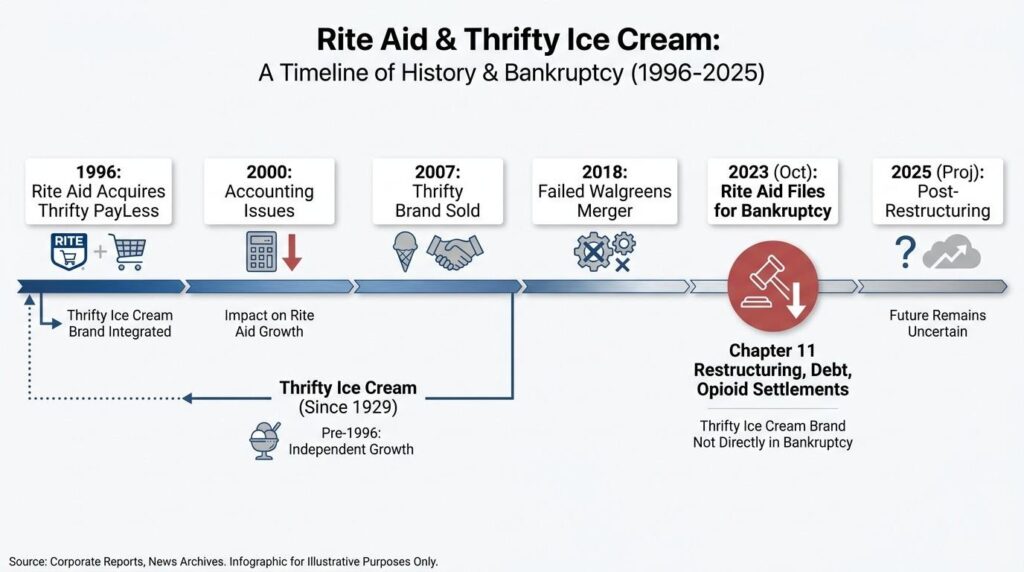
The slide was steep: about 5,000 stores in 2008, about 1,240 at the May 2025 filing, and zero by October 3, 2025. Reported causes include falling sales, heavy debt, competition from CVS, Walgreens, and online pharmacies, and billions of dollars in opioid-related claims. The first Chapter 11 case also produced settlements with lenders and plaintiffs in various lawsuits, according to Newsweek’s summary of Reuters reporting.
The Independent reported that Rite Aid was low on cash and preparing a sale by April 2025, a month after talks with creditors began. It also noted that the first bankruptcy included selling the company’s pharmacy benefit business. Store closures had already hit California, New York, New Jersey, Pennsylvania, New Hampshire, Oregon and Washington, among other states.
What Is Chapter 11 Bankruptcy?
Chapter 11 is the part of the U.S. Bankruptcy Code built for reorganizing a business. A company asks a federal court for protection from creditors, keeps running, and works on a plan to fix its debts. Sometimes the plan includes closing stores or selling assets, as Rite Aid did.
The U.S. Courts describe it as a way for a company “to keep its business alive and pay creditors over time.” Here are the three ideas that matter most for the Thrifty story.
The automatic stay. Once a company files, most creditors must stop collecting. This pause comes from 11 U.S.C. § 362. It gives the company room to decide what to keep, sell, or close.
Debtor in possession. In most cases, the company’s own leaders keep running the business while the case moves forward. The court calls this a debtor in possession.
Closing leases. Under 11 U.S.C. § 365, a company can usually ask the court to end leases it no longer wants. This is a big reason bankruptcies lead to waves of store closures.
Chapter 11 does not always end in a rescue. A case can end with a plan that lets the company continue, a sale of the whole business, or a switch to Chapter 7 liquidation. Rite Aid ended up selling off nearly everything.
How Does a Chapter 11 Asset Sale Work?
In a Chapter 11 asset sale, the company asks the bankruptcy judge to approve selling property, often after an auction. Bidders compete, the judge holds a hearing, and the winning bid is approved if the judge finds it sound. Under 11 U.S.C. § 363, the buyer often takes the assets free of many old claims.
That is how Thrifty changed hands. Reports said Rite Aid asked buyers to submit indications of interest by a deadline in late May 2025. Sale hearings followed in late June.
Here is the usual path, step by step.
- The company asks for approval. It files a request with the bankruptcy court to sell certain assets.
- Bidders are invited. Interested buyers send in offers by a set deadline. Sometimes one buyer is picked first as a stalking horse, which sets the floor price. Friendly’s owner played that role in its 2011 case.
- An auction may be held. If more than one serious bidder appears, they bid against each other.
- The company names a winner. Rite Aid named Hilrod Holdings the winning bidder on June 26, 2025.
- The judge holds a hearing. Creditors and other parties can object.
- The court approves the sale. Judge Michael B. Kaplan approved the Thrifty sale on July 1, 2025.
- The money goes to the estate. The cash is used to pay creditors in the order the law requires.
Hypothetical example: A bakery chain files for bankruptcy. Its ovens are old, but its name and secret croissant recipe are worth far more. Three companies bid. The winner pays the most, the judge approves, and the old bakery’s debts do not follow the recipe to its new home. That is the power of a § 363 sale, and it is why brands often survive when their parent company does not.
The Thrifty auction did well by that standard. The law firm that represented the buyer reported that the competitive auction more than doubled the opening bid.
Before the sale, Newsweek reported that Rite Aid’s auction list included Thrifty’s intellectual property and the El Monte factory. TheStreet outlined three possible outcomes: a buyer keeps supplying grocery stores and non-Rite Aid counters, a buyer takes the factory for other uses, or no buyer appears. The first, best case happened.
Who Bought Thrifty Ice Cream, and for How Much?
Hilrod Holdings bought Thrifty Ice Cream for $19.2 million. It is a limited partnership linked to Monster Beverage executives Hilton Schlosberg and Rodney Sacks. A federal bankruptcy judge in New Jersey approved the sale on July 1, 2025, after an auction that more than doubled the opening bid.
Here are the deal details in one place.
| Detail | What was reported |
|---|---|
| Buyer | Hilrod Holdings (limited partnership) |
| People linked to the buyer | Hilton Schlosberg and Rodney Sacks of Monster Beverage |
| Price | $19.2 million |
| What was included | Rite Aid’s Thrifty Payless subsidiary, which holds the Thrifty brand, plus KPH Healthcare Services |
| Winning bid named | June 26, 2025 |
| Court approval | July 1, 2025, U.S. Bankruptcy Court, District of New Jersey |
| Judge | Michael B. Kaplan |
This was not the first time a buyer circled the brand. In 2018, Albertsons planned to buy Rite Aid, which would have brought Thrifty along. That deal was abandoned.
One thing to note: The sale covered the brand and its business, not the closed Rite Aid counters. Newsweek reported that the El Monte, California factory was on Rite Aid’s auction list, and Hilrod later said it is upgrading manufacturing and logistics. The sale documents I reviewed do not spell out the factory’s status.
Where Can You Still Buy Thrifty Ice Cream?
Yes. Thrifty ice cream is still sold in cartons at grocery stores such as Albertsons, Vons, and Ralphs, mostly on the West Coast. The in-store scoop counters inside Rite Aid pharmacies are gone. Some independent shops and non-Rite Aid scoop counters may still serve it, so check your local store before you go.
Before the closures, the brand listed Albertsons and Vons freezers, plus scoop counters in California, Arizona and a growing number of places in the U.S. and Mexico. After the sale, Parade named Albertsons, Vons and Ralphs. The SF Chronicle also named Foods Co., Food for Less and some independent markets. Men’s Journal, pointing to LA Times reporting, noted that some Los Angeles-area restaurants serve Thrifty.
Best-selling cartons have included Black Cherry, Caramel Cookie Crunch, and Red Velvet. Availability changes by store, so call ahead if you want a specific flavor.
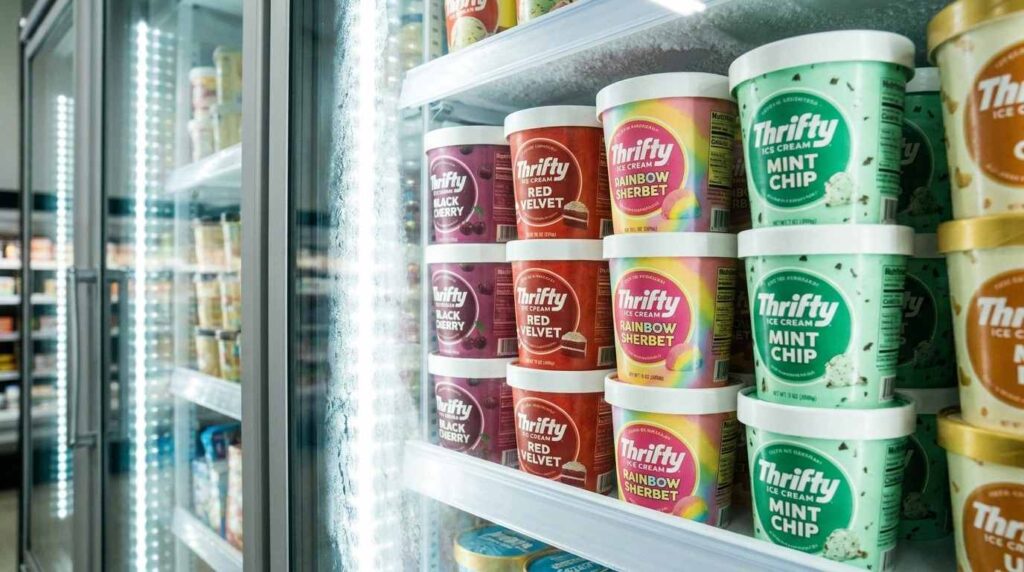
Quick tip: Thrifty’s old scoop counter locator was taken down during the bankruptcy, so it is hard to know which scoop counters remain. Call a shop before you drive, and ask whether it still serves Thrifty.
A Short History of Thrifty Ice Cream
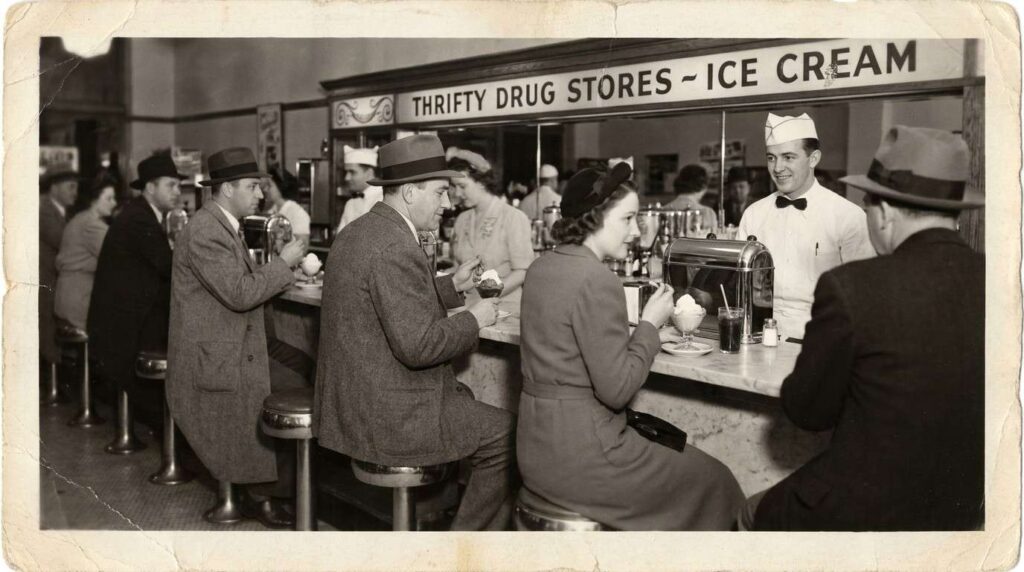
Thrifty began as a drugstore soda fountain in Los Angeles. Reports differ slightly on the start date. The drugstore opened in 1929, and the ice cream plant followed in 1940. Here is the path from there.
| Year | Milestone |
|---|---|
| 1929 | Brothers Harry and Robert Borun open a Los Angeles drugstore with a soda shop |
| 1940 | Thrifty starts making its own ice cream at a plant in West Hollywood |
| 1940s | The cylindrical scoop comes into use a few years after the plant opens |
| 1948 | Thrifty wins gold medals at the Los Angeles County Fair and the California State Fair |
| 1970s | The brand reaches cult status on the West Coast, with celebrity shout-outs |
| 1976 | Production moves to a larger factory in El Monte, California |
| 1996 | Rite Aid buys Thrifty and its ice cream brand |
| September 2024 | Thrifty launches a Birthday Cake flavor with Chuck E. Cheese, starting in Southern California |
Thrifty became known for low prices, many flavors, and the cylindrical scoop. TheStreet described the scoop as patented. It comes from a barrel-shaped tool that gives each serving a uniform shape and is easier on workers’ wrists. The Hustle, citing Eater, reported that Thrifty once sold scoops for a nickel to draw shoppers in, even though it lost money on each one.
The company also advertised custom flavors such as Sriracha Swirl and Bacon & Cheddar, and said it tested hundreds of new flavors each year. Many workers at the El Monte plant had been there for around three decades.
What Bankruptcy Closures Mean for Employees, Customers, and Creditors
A store closing in bankruptcy touches many people at once. Here is how the law treats each group. These are general rules, and your own case may differ.
Do Employees Get Notice When Stores Close in Bankruptcy?
Often, yes, but it depends on the employer’s size and the closure. The federal WARN Act generally requires employers with 100 or more employees to give 60 days’ written notice of a plant closing or mass layoff. Some exceptions apply, and some states, like California, have their own rules.
The U.S. Department of Labor explains that WARN (29 U.S.C. § 2101 et seq.) covers a closing or layoff that affects 50 or more employees at a single site. Many states add their own laws. California’s is often called Cal-WARN (California Labor Code § 1400 et seq.).
Real-world example: Before its 2011 Chapter 11 filing, Friendly’s closed 63 restaurants. Each had about 20 workers, or roughly 1,260 jobs in all. Headcounts like that sit below WARN’s 50-employee trigger at a single site, which is why store-by-store closures often do not require federal notice.
If you lose your job in a closure, ask your former employer in writing about final pay, accrued vacation, and benefits. Then contact your state labor agency or an employment attorney.
What Happens to Gift Cards and Store Credit?
A gift card may be treated as a claim against the company, not cash in hand. Some companies keep honoring gift cards during Chapter 11, while others stop. Check the company’s website and court notices, and use any card soon. Rules differ by case and by state.
Real-world example: When Friendly Ice Cream filed Chapter 11 in October 2011, it said gift cards would still be honored. Not every company makes that promise, so check each case.
How Do Creditors Get Paid?
Creditors file a proof of claim and wait in line. The Bankruptcy Code sets the order of payment: secured creditors first, then priority claims, then general unsecured creditors. Sale proceeds, like Thrifty’s $19.2 million, are used to pay these claims, usually starting with secured lenders. Missing a claims deadline can cost you your place in line.
The order comes from the priority rules in 11 U.S.C. § 507. Courts also set a claims bar date, which is the last day to file a claim in many Chapter 11 cases (see Federal Rule of Bankruptcy Procedure 3003(c)(3).
Hypothetical example: A small supplier is owed $8,000 for ice cream cones. It hears the customer filed for bankruptcy but ignores the court mailing. The bar date passes. The supplier may lose the right to be paid from the case.
Common Mistakes When a Company You Deal With Files for Bankruptcy
- Assuming the brand is dead. Often only the locations close. Thrifty is proof.
- Ignoring court notices. Mailings about deadlines are not junk mail.
- Missing the proof-of-claim deadline. A late claim can be denied.
- Waiting on gift cards or refunds. Use them or claim them early.
- Shipping on credit without checking the case. Suppliers should confirm payment terms in writing after a filing.
What Rite Aid and Fans Said
Rite Aid’s CEO, Matt Schroeder, said in a May 2025 statement that the company faced ongoing financial pressure. He also said Rite Aid saw real interest from potential buyers. His stated priorities were keeping pharmacy services running and protecting as many jobs as possible.
Evan Lovett, host of L.A. in a Minute, posted that Thrifty would likely keep “scooping up smiles” for years, just not at Rite Aid.
The closures also hit small retailers. A store owner in Maricopa, Arizona, told a local news site that ice cream made up roughly 30% of her revenue. She expected a buyer to appear and keep the brand going.
Other Ice Cream Bankruptcies: How Thrifty Compares
Thrifty is not the first ice cream business to land in bankruptcy court. These cases show how different the endings can be.
| Company | What happened | Key numbers |
|---|---|---|
| Thrifty Ice Cream / Rite Aid (2025) | Parent filed Chapter 11; stores and counters closed; brand sold | About 500 counters or stores; $19.2 million sale |
| Friendly Ice Cream (2011) | Filed Chapter 11 on Oct. 5, 2011 after closing 63 restaurants; owner Sun Capital was the lead bidder in a § 363 sale | 63 closed (about 1,260 jobs); 424 stayed open; about $70 million in financing |
| Totally Cool Ice Creams (2024 to 2025) | Chapter 11 filing in August 2024; exited March 2025 after selling its assets | About $650,000 from the asset sale |
When a company files Chapter 11, a beloved brand can survive even if the company does not. Value often sits in the name and recipes, not the buildings.
What Happens Next for Thrifty Ice Cream?
On Aug. 7, 2025, Hilrod Holdings said it will keep Thrifty’s original recipes and signature scoop, add new flavors and packaging, and bring the brand to new stores and regions. It also said it plans to keep and grow the current management team and upgrade manufacturing and logistics. Wider distribution was expected to ramp up in fall 2025 and through 2026.
In a Q&A published by KTLA, the owners said they are exploring retail partnerships and creative new locations, including possible stand-alone shops. I did not find any confirmed new scoop counters in the sources I reviewed.
The bottom line: the ice cream survived the bankruptcy, and its new owners say they plan to grow it.
Frequently Asked Questions
Q1. Did Thrifty Ice Cream go out of business?
No. Thrifty Ice Cream is still in business. Only the roughly 500 scoop counters inside Rite Aid stores closed, because Rite Aid went through Chapter 11 and shut its stores. The brand was sold to Hilrod Holdings for $19.2 million, and cartons are still sold in grocery stores.
W2. Why did Rite Aid close its Thrifty ice cream counters?
Rite Aid filed for Chapter 11 bankruptcy in May 2025 and closed its stores to cut costs and raise cash. The Thrifty counters were inside those stores, so they closed with them. It was a result of the pharmacy’s financial trouble, not a sign that the ice cream itself failed.
Q3. How many Thrifty Ice Cream locations closed?
Early reports said roughly 500 Thrifty counters inside Rite Aid pharmacies would close. Other reports describe 500 Rite Aid stores, many with Thrifty counters. Rite Aid had about 1,240 stores in 15 states in May 2025 and closed all of them by October 3, 2025.
Q4. Who owns Thrifty Ice Cream now?
Hilrod Holdings owns Thrifty Ice Cream. It is a limited partnership linked to Monster Beverage executives Hilton Schlosberg and Rodney Sacks. It paid $19.2 million, and a New Jersey bankruptcy judge approved the sale on July 1, 2025.
Q5. Can I still buy Thrifty ice cream?
Yes. Cartons are still sold at grocery chains such as Albertsons, Vons, and Ralphs, mostly on the West Coast. The scoop counters inside Rite Aid pharmacies are gone. Some independent shops may still serve it by the scoop, so call ahead before making a trip.
Q6. What happens to gift cards when a company files Chapter 11?
It depends on the case. Some companies keep honoring gift cards during Chapter 11, and others stop. If a company stops, your card may become a claim you must file with the court. Use gift cards early, and watch for official notices from the company or the court.
Q7. Do I get a warning if my workplace closes in bankruptcy?
Maybe. The federal WARN Act generally requires 60 days’ notice of plant closings and mass layoffs affecting 50 or more workers at one site, for employers with 100 or more employees. Smaller closings may not qualify, and some states add protections. Ask your employer in writing and check your state labor agency.
Q8. Will Thrifty Ice Cream counters come back?
Not confirmed yet. The new owners said in 2025 they are exploring retail partnerships and new locations, including possible stand-alone shops. I found no announced new scoop counters. Watch Thrifty’s official channels. Grocery cartons are the most dependable way to find it today.
Conclusion
Bankruptcy forces ice cream chain to close 500 locations sounds like the end of the story. It is not. The closures came from Rite Aid’s Chapter 11 bankruptcy, not from a failure of Thrifty’s ice cream. The counters closed because they lived inside Rite Aid stores. The brand was sold for $19.2 million and lives on in grocery freezers.
The bigger lesson is practical. When a company you work for, buy from, or are owed money by files for bankruptcy, read every court notice, watch the deadlines, and act early. Gift cards, final paychecks, and unpaid invoices can all be affected.
Disclaimer: This is general information only and not a substitute for advice from a qualified attorney licensed in your jurisdiction.