



Introduction
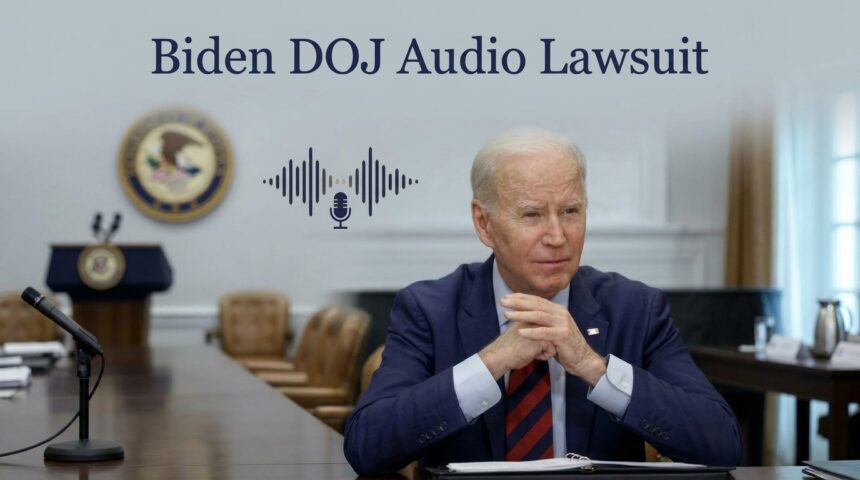
The Biden DOJ audio lawsuit is a real court case. Former President Joe Biden sued the U.S. Department of Justice on May 26, 2026. He wanted to stop the release of about 70 hours of private audio recordings. He lost twice in court and dropped the case in July.
- Introduction
- Key Facts at a Glance
- What Is the Biden DOJ Audio Lawsuit About?
- Background: Robert Hur’s Investigation and the Zwonitzer Recordings
- The Heritage Foundation’s FOIA Request and the DOJ’s Reversal
- Why Is Biden Suing the DOJ?
- The Privacy Argument
- The Administrative Procedure Act Claim
- The Privacy Act Claim
- The Congressional Authority Argument
- How Courts Actually Weigh Privacy Against Disclosure
- Timeline of the Biden DOJ Audio Lawsuit
- The Court Rulings: District Court and the D.C. Circuit
- How the Case Ended
- Political Reactions to the Lawsuit
- How This Compares to Trump’s Own Records Fight
- What This Case Means, and Mix-Ups to Avoid
- FAQ
- Q1. Why is Biden suing the DOJ?
- Q2. Who is Joe Biden suing?
- Q3. What are the Biden ghostwriter recordings?
- Q4. Is Biden still suing the DOJ?
- Q5. Did Biden win or lose the DOJ audio lawsuit?
- Q6. Who is Mark Zwonitzer?
- Q7. What laws did Biden say the DOJ violated?
- Q8. Could a private citizen make the same Privacy Act argument Biden made?
- Conclusion
This story matters beyond the headlines. It touches three things that affect ordinary people too: your privacy rights, what the government can release about you under FOIA, and how courts decide when public interest beats personal privacy. This article walks through the whole case in plain English, from the first filing to the final outcome.
Joe Biden sued the DOJ on May 26, 2026, to block the release of about 70 hours of audio and transcripts from his 2016 to 2017 interviews with ghostwriter Mark Zwonitzer. Special Counsel Robert Hur had reviewed the tapes during his classified-documents probe. Biden lost at the district court and the D.C. Circuit, then dropped the case on July 25, 2026, letting the material go public.
Key Facts at a Glance
What Is the Biden DOJ Audio Lawsuit About?
The Biden DOJ audio lawsuit is a fight over whether the public gets to hear private conversations Biden had with his ghostwriter, years before he ran for president.
In 2016 and 2017, Biden sat down at his own home with writer Mark Zwonitzer. They were working on Biden’s memoir. Federal investigators later obtained the tapes. By 2026, two outside groups wanted them made public. Biden sued to stop that.
This case blends three legal ideas that come up again and again in records disputes: FOIA, personal privacy rights, and how judges balance the two.
Background: Robert Hur’s Investigation and the Zwonitzer Recordings
To understand why Biden sued, you need the backstory first.
In early 2023, classified documents turned up at Biden’s home and a former office. The Justice Department named Special Counsel Robert Hur to look into it. Hur’s team pulled in Biden’s older conversations with Zwonitzer, since a few of them touched on sensitive topics from Biden’s time as vice president.
Who Is Mark Zwonitzer?
Mark Zwonitzer is a writer who helped Biden with his memoirs, including his 2017 book “Promise Me, Dad: A Year of Hope, Hardship, and Purpose.” Their recorded sessions happened at Biden’s home in 2016 and 2017, in the years after Biden’s son Beau died of brain cancer, and while Biden was weighing a run for president. Court filings say Biden also read aloud from personal notebooks during these sessions. Investigators later found some of that material touched on classified information. Biden has maintained he never shared classified information with Zwonitzer directly.
What Did Hur’s Report Find?
Hur’s investigation wrapped up in February 2024. His 345-page report found that Biden had willfully retained and disclosed some classified material, but Hur recommended no criminal charges. He questioned the mental competence of Biden, then 81 years old, and gave his stated reason: he doubted a jury would convict a man he described as a “sympathetic, well-meaning, elderly man with a poor memory.”
Testifying before Congress about a month later, Hur explained that he had to weigh how a jury would likely see Biden’s memory and mental state in a real trial. That single line, about memory and mental state, is part of why the Zwonitzer tapes became so politically charged. People wanted to hear the actual recordings for themselves.
The Heritage Foundation’s FOIA Request and the DOJ’s Reversal
In March 2024, the conservative group The Heritage Foundation filed a Freedom of Information Act request for records tied to Hur’s probe, including the Zwonitzer tapes. The DOJ said no, citing FOIA exemptions. Heritage sued to force the issue.
For about two years, the department held that line. Then, in February 2026, the DOJ reversed course, with no formal public explanation. It told Biden’s team it planned to release the material, with some redactions, to Heritage and to the House Judiciary Committee, chaired by Rep. Jim Jordan. The target release date was June 15, 2026.
Biden’s lawyers spent weeks in what court filings describe as a frenzied back-and-forth with the DOJ, working through which passages might be redacted and which wouldn’t. When those talks didn’t resolve things, Biden moved to intervene in the Heritage case and filed his own lawsuit.
Why Is Biden Suing the DOJ?
Biden sued the DOJ under the Administrative Procedure Act and the Privacy Act, arguing release would be an unlawful invasion of his privacy. Attorney Amy Jeffress filed the case in U.S. District Court for the District of Columbia on his behalf. The complaint made several distinct legal arguments.
The Privacy Argument
Biden’s lawyers argued that everyone, even a former president, has a right to privacy in conversations held inside their own home. The complaint itself put it plainly: Biden has “a right to privacy in personal conversations he had within his own home.” His lawyers argued the DOJ had a heightened duty here, because it got the recordings through a criminal investigation, not voluntarily.
The Administrative Procedure Act Claim
The complaint brought three counts under the Administrative Procedure Act, 5 U.S.C. § 706(2)(A). It argued the DOJ’s decision to release the recordings was arbitrary and capricious, an abuse of discretion, and contrary to law.
The Privacy Act Claim
Biden also cited the Privacy Act, 5 U.S.C. § 552a. This law generally blocks federal agencies from releasing personal records without written consent. There’s an exception for congressional committee requests, but Biden’s team argued the exception didn’t apply because Jordan’s request fell outside the committee’s real investigative authority.
The Congressional Authority Argument
Biden’s lawyers pointed out that the 2016 to 2017 conversations happened years before the classified-documents investigation even started. In their words, the material “could not possibly shed light on” the committee’s stated purpose of examining the politicization of the Biden-era Justice Department.
The DOJ pushed back hard. A spokesperson said Biden’s own Justice Department had tried to hide recordings that showed a decline in his cognitive abilities, calling the current administration “the most transparent Department of Justice in history.” Biden’s spokesperson, TJ Ducklo, called the push to release the tapes politically motivated.
How Courts Actually Weigh Privacy Against Disclosure
This case is a good example of a standard that comes up in FOIA disputes generally, not just for former presidents.
A court reviewing a records request doesn’t just ask, is this private? It asks a narrower question: does the public interest in disclosure outweigh what’s left of the person’s privacy once sensitive material is redacted? That’s almost word-for-word the standard both courts applied to Biden.
You can see the standard in action in how this case actually played out. The DOJ redacted the most sensitive parts of the recordings before release. Once that happened, both courts found Biden’s remaining privacy interest wasn’t strong enough to block disclosure. Judge Friedrich pointed directly to those redactions in her opinion. The D.C. Circuit majority did the same. Heavy redactions tend to tip the scale toward release, because they strip out the parts that matter most for privacy, like family details or health information, and leave only what serves the public interest.
The lesson for anyone facing a similar records fight: the redaction process is often where the case is actually decided, not the courtroom argument that follows it.
Timeline of the Biden DOJ Audio Lawsuit
The Court Rulings: District Court and the D.C. Circuit
Two courts ruled against Biden. Both found the public interest in disclosure outweighed his remaining privacy interest once the material was redacted.
District court, June 19, 2026: U.S. District Judge Dabney Friedrich, a Trump appointee, denied Biden’s request for a preliminary injunction. In a 26-page opinion, she found the DOJ’s redactions had already shrunk Biden’s privacy interest, and that he hadn’t shown any real public harm from release. She then paused her own ruling for three weeks so Biden could appeal.
D.C. Circuit, July 21, 2026: A divided panel, made up of Chief Judge Sri Srinivasan (an Obama appointee), Judge Gregory Katsas (a Trump appointee), and Judge Florence Pan (a Biden appointee), voted 2 to 1 against Biden. The majority found a “substantial” public interest in disclosure. The split didn’t run along party lines: Srinivasan, an Obama nominee, sided with Katsas against Pan’s dissent. Pan warned the ruling would effectively decide the whole case by letting release happen immediately.
How the Case Ended
Facing long odds at the Supreme Court, Biden’s team chose not to keep fighting. On July 25, 2026, they dropped the lawsuit. The recordings and transcripts went to the Heritage Foundation, with copies to the House Judiciary Committee.
One nuance worth knowing: the appeals court never issued a final ruling on the merits. It only decided whether to pause release during the appeal. Because Biden withdrew the case, no court ever formally resolved the underlying privacy and FOIA questions.
Political Reactions to the Lawsuit
This got political fast. President Trump criticized Biden on Truth Social, calling him “a Crooked Politician.” Asked whether the DOJ should push for release, Trump said he’d want to hear the department’s reasoning, but suggested the country couldn’t afford a repeat of what he called Biden’s incompetence in office.
The decision ultimately sat with Todd Blanche, who has served as Acting Attorney General since April 2026, when Trump fired Pam Bondi. Trump has since said he wants to make Blanche’s appointment permanent. Blanche previously worked as Trump’s own criminal defense attorney, and he has been an outspoken critic of how the Biden-era DOJ handled Trump-related investigations. That history gives his role in this release decision an added layer of political weight. Some congressional Republicans went further than Blanche, suggesting Biden was simply afraid to let the public hear the tapes. Democrats countered that Hur’s probe ended with no charges, and that Biden had cooperated with investigators the whole way through.
How This Compares to Trump’s Own Records Fight
It’s worth pausing on a comparison most coverage skips. Trump has also gone to court over government records, and he was separately the subject of his own classified-documents case.
Trump faced a 40-count federal indictment in 2023 over classified material found at Mar-a-Lago. Those charges were dropped in 2024, after he won re-election. Both cases involve a former president and classified-document handling, but they’re legally different animals. Biden’s case was a privacy fight over already-reviewed recordings. Trump’s case was a criminal prosecution over the documents themselves.
Republicans point to both cases to argue Biden got favorable treatment. Democrats point to the same two cases to argue the opposite. Either way, knowing one case sharpens your read on the other.
What This Case Means, and Mix-Ups to Avoid
This case is a useful study guide for anyone watching how courts balance transparency laws against personal privacy. A few practical takeaways:
FOIA exemptions aren’t permanent. An agency can change its mind about whether records are exempt, especially under a new administration, and courts don’t demand a detailed explanation for that shift by itself.
Redactions carry real legal weight. Both courts here leaned hard on the fact that the DOJ had redacted sensitive material. That single fact did most of the work in weakening Biden’s privacy claim.
Dropping a case isn’t the same as losing it. Because Biden withdrew instead of continuing to fight, no court ever issued a final written ruling on the merits.
A few mix-ups also come up constantly in search queries and comment sections about this case. Worth clearing up directly:
- This is not the same audio as the 2024 contempt fight. That earlier fight was over Biden’s own interview with Hur. This 2026 case is about Biden’s separate interviews with his ghostwriter, Zwonitzer. The House held then-Attorney General Merrick Garland in contempt of Congress in 2024 after the White House invoked executive privilege to withhold the Hur interview audio specifically. The written transcript of that came out in 2024; the audio fight was resolved on its own track.
- The appeals court did not “rule Biden guilty” of anything. It only decided whether to pause disclosure while the case proceeded. It never ruled on guilt, wrongdoing, or the underlying privacy claim.
- This case has no connection to the Epstein files. If you searched for Biden DOJ records hoping for Epstein-related material, you’re thinking of a completely separate controversy involving different agencies and different records.
FAQ
Q1. Why is Biden suing the DOJ?
Biden sued to stop the release of about 70 hours of audio and transcripts from his 2016 to 2017 interviews with ghostwriter Mark Zwonitzer. He argued the release would violate his privacy and break the Administrative Procedure Act and the Privacy Act.
Q2. Who is Joe Biden suing?
He’s suing the U.S. Department of Justice. He also intervened in a related case brought by the Heritage Foundation, which had filed the original FOIA request for the same recordings.
Q3. What are the Biden ghostwriter recordings?
They are audio and transcripts of Biden’s 2016 to 2017 conversations with Mark Zwonitzer, made while writing his memoir “Promise Me, Dad.” Special Counsel Robert Hur later reviewed them during his classified-documents probe.
Q4. Is Biden still suing the DOJ?
No. Biden’s team dropped the lawsuit on July 25, 2026, after losing at both the district court and the D.C. Circuit.
Q5. Did Biden win or lose the DOJ audio lawsuit?
He lost both court rounds he fought, then withdrew rather than appeal further. The recordings were released.
Q6. Who is Mark Zwonitzer?
A writer who worked with Biden on his memoirs. His 2016 to 2017 recorded interviews with Biden are the material at the center of this case.
Q7. What laws did Biden say the DOJ violated?
The Administrative Procedure Act (5 U.S.C. § 706(2)(A)) and the Privacy Act (5 U.S.C. § 552a), plus a general privacy argument tied to conversations held in his own home.
Q8. Could a private citizen make the same Privacy Act argument Biden made?
In theory, yes. The Privacy Act protects anyone’s personal records held by a federal agency, not just former presidents. What made Biden’s case unusual was the mix of a criminal investigation, a congressional request, and a public figure’s memoir interviews all in one dispute. A private citizen’s case would likely turn on the same core question: does redaction leave enough privacy interest to outweigh the public interest in disclosure?
Conclusion
The Biden DOJ audio lawsuit ran its full course in just two months. Filed in May 2026, decided twice against Biden, and dropped by the end of July. It’s a clean example of how courts balance FOIA disclosure against personal privacy once redactions are on the table, and a reminder that even a former president doesn’t get an automatic pass on either front.
If you’re dealing with your own records dispute, whether it’s a FOIA request, a Privacy Act question, or a fight over what an agency can release about you, the redaction stage is usually where the case gets won or lost. Talk to a licensed attorney in your state before you file anything or respond to a records request.