



The Ed Sheeran lawsuit that most people search for is the copyright fight over “Thinking Out Loud,” which Sheeran won at trial in 2023 and again on appeal in 2024. But that is not the only case tied to his name. Sheeran has faced multiple copyright claims over “Shape of You” and “Photograph” too.
- What Is the Ed Sheeran Lawsuit?
- The Thinking Out Loud Case: Griffin v. Sheeran
- The Second Case: Structured Asset Sales v. Sheeran
- The Shape of You Lawsuit
- The Photograph Settlement
- How Courts Decide Music Copyright Cases
- 1. Copyright protects expression, not building blocks
- 2. What counts as “the work” matters
- 3. “Substantial similarity” needs more than one shared element
- 4. Independent creation is a real defense
- What This Means for Songwriters and Fans
- Timeline of All Ed Sheeran Lawsuits
- Frequently Asked Questions
- Did Ed Sheeran actually copy Marvin Gaye’s song?
- How much money did Ed Sheeran have to pay?
- Why were there two separate lawsuits over the same song?
- Is it legal to use a common chord progression in a new song?
- What happened with the Shape of You lawsuit?
- Is the Ed Sheeran copyright case still ongoing in 2026?
- Can I still be sued if my song sounds similar to another artist’s work?
- Where can I read the actual court documents?
- Conclusion
This matters because these cases shape how courts treat common chords, melodies, and lyrics in music today. If you write songs, run a label, or just follow entertainment law, the outcomes affect you.
This article is general information only. It is not a substitute for advice from a qualified attorney licensed in your jurisdiction. If you have a specific legal question about copyright or entertainment law, talk to a licensed lawyer in your state or country.

What Is the Ed Sheeran Lawsuit?
The main Ed Sheeran lawsuit refers to two related copyright cases claiming his 2014 song “Thinking Out Loud” copied Marvin Gaye’s 1973 classic “Let’s Get It On.” A New York jury cleared Sheeran in May 2023. A second lawsuit over the same songs was later thrown out by a federal court, and the U.S. Supreme Court declined to revive it in June 2025.
Sheeran also faced separate lawsuits over “Shape of You” and “Photograph.” He won the “Shape of You” case in the UK in 2022. The “Photograph” dispute settled quietly out of court in 2017.
For a broader look at how these disputes typically unfold, this guide to how lawsuits move through the legal system breaks down the general process step by step.
The Thinking Out Loud Case: Griffin v. Sheeran
This is the case most people mean when they search “Ed Sheeran lawsuit.” It started in 2017.
Who sued him: Kathryn Griffin, the daughter of songwriter Ed Townsend, along with other Townsend heirs. Townsend co-wrote “Let’s Get It On” with Marvin Gaye in 1973.
What they claimed: The heirs said Sheeran’s “Thinking Out Loud,” released in 2014, copied the chord progression, harmony, and rhythm of the Gaye song.
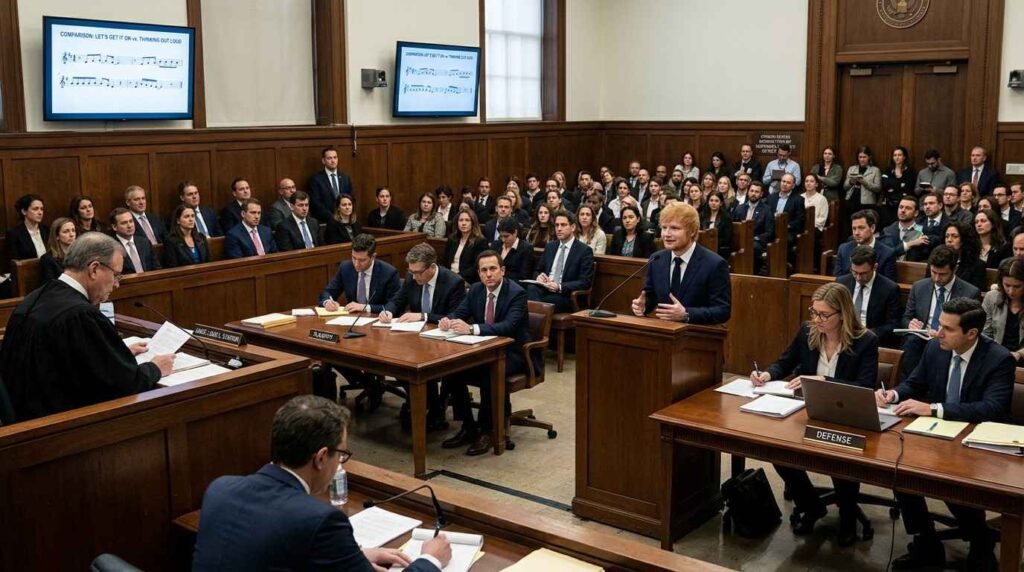
What happened at trial: The case went to a full jury trial in Manhattan federal court in 2023. Sheeran testified and even played guitar in the courtroom to show how common the chord progression really is in pop music. He argued that the four chords in question show up in thousands of songs and cannot belong to one artist.
After roughly three hours of deliberation, the jury sided with Sheeran. They found he did not commit copyright infringement, willful or otherwise.
Sheeran’s reaction: Speaking outside the courthouse, Sheeran said he felt relieved but frustrated that a case built on such thin evidence made it all the way to trial. He has since spoken about the case publicly, including during his 2026 Loop Tour stop in Sydney, where he told the crowd the experience of handing over years of personal recordings and voice memos as evidence was one of the strangest parts of his career.
The Second Case: Structured Asset Sales v. Sheeran
Here is where the story gets confusing for a lot of people. A separate company, not the Townsend family, filed its own lawsuit over the exact same two songs.
Who sued him: Structured Asset Sales, LLC (SAS), a company that owns a small partial share of the royalties in “Let’s Get It On.” SAS is run by investment banker David Pullman and owns roughly one ninth of the composition’s rights.
Case history:
- 2018: SAS filed its lawsuit in the Southern District of New York.
- 2023: After the Griffin jury verdict, the district court granted Sheeran summary judgment, meaning the case was dismissed without going to trial.
- November 2024: The Second Circuit Court of Appeals affirmed that dismissal. . The appeals court found that copyright protection for songs registered before 1978, like “Let’s Get It On,” only covers the sheet music filed with the U.S. Copyright Office at the time. It does not extend to elements only heard on the audio recording.
- March 2025: SAS asked the U.S. Supreme Court to hear the case, arguing the lower courts wrongly deferred to Copyright Office guidance.
- June 2025: The Supreme Court declined to hear the appeal, closing the door on this line of litigation for good.
The Second Circuit found that the four chord progression and syncopated harmonic rhythm SAS pointed to were too basic, on their own, to qualify for copyright protection. That distinction, between what is protected and what is simply a common musical building block, is the legal heart of the entire saga.
If you want to understand how appeals courts weigh technical evidence like this, our overview of what attorneys actually do at each stage of a case explains the roles different legal professionals play from filing through appeal.
The Shape of You Lawsuit
“Thinking Out Loud” is not the only Ed Sheeran hit that ended up in court.
Who sued him: Grime artist Sami Chokri, known as Sami Switch, along with co-writer Ross O’Donoghue.
What they claimed: That the “Oh I” hook in Sheeran’s 2017 global smash “Shape of You” copied a similar phrase from Chokri’s 2015 song “Oh Why.”
What happened: Sheeran actually filed first, asking a UK court to declare he had not infringed the copyright, after Chokri’s camp raised the claim privately. In April 2022, the High Court of England and Wales ruled in Sheeran’s favor, finding he had neither deliberately nor subconsciously copied the phrase.
A key detail: The judge noted that short, simple melodic phrases like the one in question appear often across pop and R&B music, independent of any copying. This “commonplace elements” reasoning would later echo through the Structured Asset Sales appeal too.
The Photograph Settlement
Before either of the above cases, Sheeran quietly settled a dispute in 2017.
Who claimed infringement: Songwriters connected to Matt Cardle, the 2010 winner of The X Factor UK, alleged that Sheeran’s 2014 song “Photograph” copied elements of Cardle’s track “Amazing.”
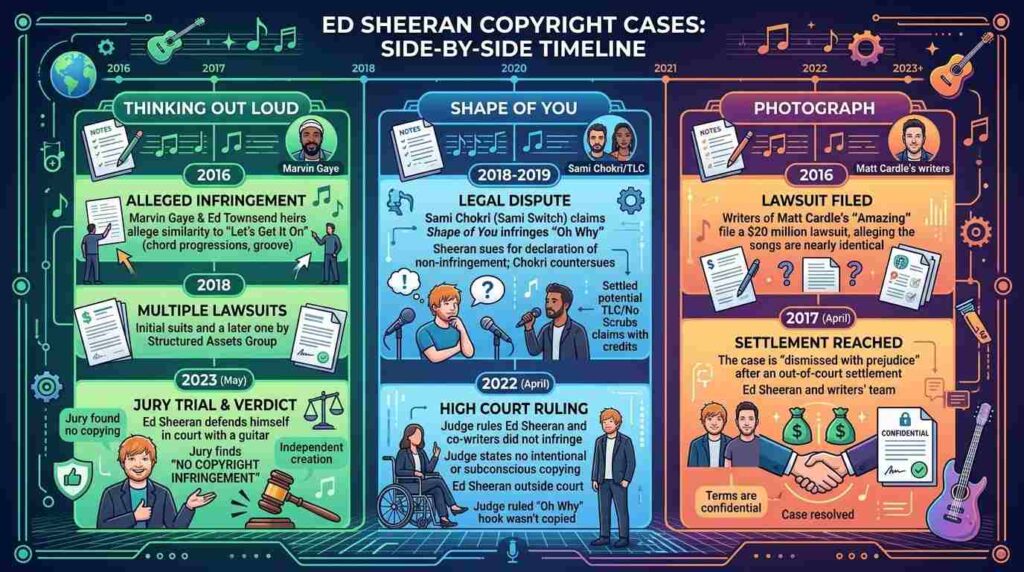
How it ended: Sheeran and the claimants reached a private settlement. Court filings show the case was dismissed with prejudice in 2017, which means it cannot be refiled. Terms of the settlement were never made public.
This case rarely gets attention next to the bigger trials, but it shows something important: most copyright disputes never reach a jury. Most either settle privately or get dismissed early.
How Courts Decide Music Copyright Cases
If you are trying to understand why some of these cases succeeded and others failed, it comes down to a few legal principles.
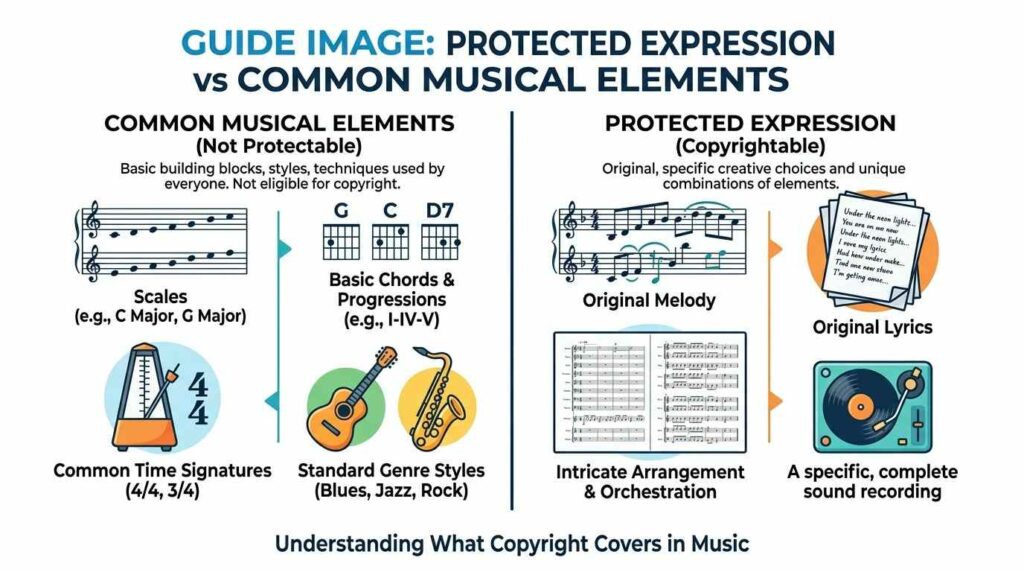
1. Copyright protects expression, not building blocks
Courts consistently draw a line between original creative choices and basic musical elements like a common chord progression, a standard beat, or a simple scale run. As WIPO Magazine explains, basic elements belong to everyone.
2. What counts as “the work” matters
For older songs registered before 1978, like “Let’s Get It On,” U.S. copyright law only protects what was written down in the sheet music filed with the Copyright Office. This surprised a lot of fans, but it was central to the SAS appeal.
3. “Substantial similarity” needs more than one shared element
Judges look at the “heart” of both works as a whole, not just one matching phrase or chord. A shared rhythm alone rarely proves copying.
4. Independent creation is a real defense
Sheeran’s legal team argued repeatedly that with millions of songs released every year and only twelve notes to work with, some overlap between unrelated songs is statistically unavoidable. Courts have generally accepted versions of this argument when the shared elements are common enough.
A general breakdown of how civil lawsuits are structured can help if you want the bigger legal picture beyond just music cases.
What This Means for Songwriters and Fans
If you are a songwriter: These rulings offer some reassurance. Using a common chord progression or a familiar melodic shape is not automatically infringement. But documentation still matters. Keep your writing sessions, voice memos, and drafts organized in case you ever need to show your own creative process.
Hypothetical example: Imagine two songwriters in different countries, who have never met, both write a chorus using the same four popular chords in the same order, a progression found in hundreds of existing hits. Under the reasoning courts used in the Sheeran cases, that overlap alone would likely not support a copyright claim, because the progression itself is too common to belong to one person.
If you are a fan or industry observer: These cases show that even massive celebrity lawsuits often hinge on narrow, technical legal questions, not just “does it sound similar to my ear.”
If you run a business or brand and get hit with a copyright claim: Consider speaking with an intellectual property attorney early. Our explainer on choosing the right kind of legal representation is a useful starting point for understanding your options.
Timeline of All Ed Sheeran Lawsuits
| Year | Case | Song | Outcome |
|---|---|---|---|
| 2016 to 2017 | Cardle dispute | “Photograph” | Settled privately, dismissed with prejudice |
| 2017 | Griffin v. Sheeran filed | “Thinking Out Loud” | Case proceeds to trial |
| 2018 | Structured Asset Sales v. Sheeran filed | “Thinking Out Loud” | Case proceeds separately |
| 2018 | Chokri dispute begins | “Shape of You” | Sheeran files for declaratory judgment |
| April 2022 | UK High Court ruling | “Shape of You” | Sheeran wins, no infringement found |
| May 2023 | Griffin trial verdict | “Thinking Out Loud” | Jury clears Sheeran |
| 2023 | SAS case dismissed | “Thinking Out Loud” | Summary judgment for Sheeran |
| November 2024 | Second Circuit appeal | “Thinking Out Loud” | Dismissal affirmed |
| June 2025 | Supreme Court petition | “Thinking Out Loud” | Cert denied, case ends |
Even high-profile celebrity disputes like these follow the same basic legal roadmap as smaller cases. Our look at how a well-known entertainment lawsuit unfolded shows those same stages of filing, discovery, and resolution playing out in a different kind of case.
Frequently Asked Questions
Did Ed Sheeran actually copy Marvin Gaye’s song?
No court ever found that he did. A jury cleared him in 2023, and a separate case brought by Structured Asset Sales was dismissed and later affirmed on appeal in 2024. The Supreme Court refused to reopen it in 2025.
How much money did Ed Sheeran have to pay?
None from these cases. Sheeran won or had every one of the “Thinking Out Loud” and “Shape of You” claims dismissed or decided in his favor. The earlier “Photograph” dispute settled privately, and the payment terms, if any, were never disclosed.
Why were there two separate lawsuits over the same song?
Because different parties own different shares of the copyright to “Let’s Get It On.” The Townsend family (Griffin) and Structured Asset Sales each held separate ownership interests and filed independently, which is legally allowed even when the underlying claim is similar.
Is it legal to use a common chord progression in a new song?
Generally yes, as long as you are not copying the specific original expression, like a unique melody or arrangement, tied to that progression. Courts have repeatedly ruled that basic chords and rhythms are not protected on their own.
What happened with the Shape of You lawsuit?
A UK court ruled in April 2022 that Sheeran did not deliberately or subconsciously copy Sami Chokri’s song “Oh Why.” Sheeran had proactively sought the ruling after the claim was raised.
Is the Ed Sheeran copyright case still ongoing in 2026?
No. The Supreme Court’s June 2025 decision not to hear the Structured Asset Sales appeal effectively closed the last open thread of this specific dispute.
Can I still be sued if my song sounds similar to another artist’s work?
Yes, similarity alone can trigger a lawsuit even if you never heard the other song. Courts still require proof of actual or presumed access plus substantial similarity in protected elements before finding infringement.
Where can I read the actual court documents?
The Second Circuit’s opinion in the Structured Asset Sales case is publicly available through official court record databases, and legal publications like WIPO Magazine and Justia have published detailed case summaries.
Conclusion
The Ed Sheeran lawsuit story is really three or four separate stories that all circle back to the same question: where does inspiration end and infringement begin? Across the “Thinking Out Loud,” “Shape of You,” and “Photograph” disputes, courts and juries repeatedly landed on the side of Sheeran, largely because common musical building blocks are not something one artist can lock up for themselves.
For songwriters, these rulings offer a bit of breathing room. For fans following the headlines, they show that even the biggest pop stars are not immune to years of litigation over a four chord progression. If you are dealing with a copyright question of your own, especially anything involving your own creative work, it is worth talking to a licensed intellectual property attorney rather than relying on how a case involving someone else turned out.
Want to keep learning about how major legal disputes actually play out? Browse more breakdowns like this one in our lawsuit news and case updates section, or reach out if you would like help finding the right kind of legal resource for your situation.