


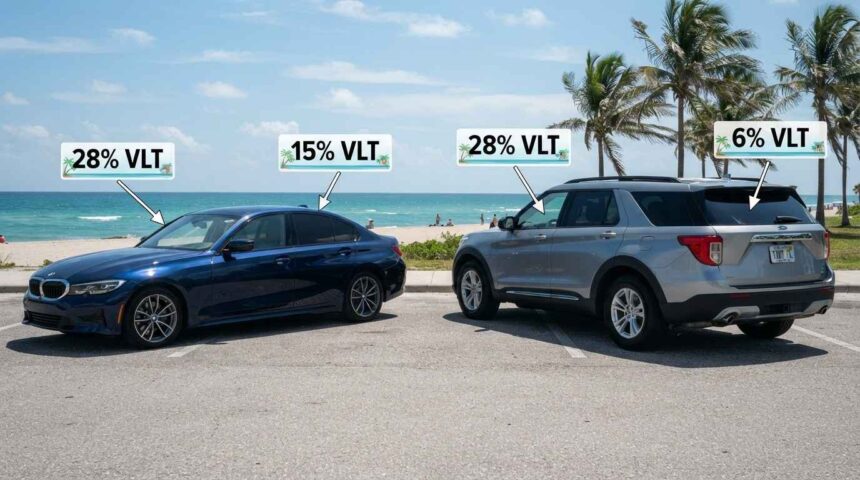
In Florida, your front side windows must let in at least 28% of light, your back and rear windows must allow at least 15% on a sedan, and SUVs, vans, and trucks can go as dark as 6% on the windows behind the driver. The windshield can only have non-reflective tint above the AS-1 line near the top. That is the short version of the Florida tint laws most drivers ask about.
- Key Takeaways
- Legal Tint Limits by Vehicle Type
- Windshield, Reflectivity, and Color Rules
- Penalties, Enforcement, and What Happens If You Get a Ticket
- Medical Exemptions for Darker Tint
- The Bottom Line
- FAQ
- What are the tint laws in Florida?
- How strict are Florida tint laws?
- Is 20% tint legal in Florida?
- How much is a tint ticket in Florida?
- Can I tint my front windshield in Florida?
- Are colored or mirrored tints allowed?
- Who qualifies for a medical tint exemption in Florida?
- Do Florida tint laws apply to out-of-state cars?
- Read Also
One thing trips up almost everyone: a lower VLT number means darker tint. So 5% is very dark, and 50% is light. Florida sets a floor, not a ceiling.
This is general information only and not a substitute for advice from a qualified attorney licensed in Florida. These limits are current as of 2026, and rules can change, so confirm the latest details with official state sources before you tint.
Key Takeaways
- Front side windows – Every car, SUV, van, and truck needs at least 28% VLT on the front side windows.
- Rear windows differ by vehicle – Sedans need 15% VLT on back and rear glass; SUVs, vans, and trucks can drop to 6%.
- Windshield – Only non-reflective tint above the AS-1 line is legal, no matter the film.
- Lower number = darker – VLT is the percent of light that passes through, so a smaller number blocks more light.
- Fines are moderate – A tint ticket often runs about $116 per window with no license points, but each window can count separately.
- Colored and mirrored films are out – No red, amber, or blue tint, and no heavy chrome-style reflection.
- Medical exemptions exist – Drivers with qualifying light-sensitive conditions can apply through FLHSMV for darker tint.
What Florida Tint Laws Actually Say
Florida’s tint rules live in Florida Statutes sections 316.2951 through 316.2957, with medical exemptions covered under section 316.29545. The Florida Department of Highway Safety and Motor Vehicles (FLHSMV) handles vehicle standards and issues exemption certificates.
Here is the one term you need. VLT stands for Visible Light Transmission, the percentage of light that passes through the glass and film together. VLT means visible light transmission through the glass and film together, a higher VLT number means lighter tint, and a window at 28% VLT lets in 28% of light.
Florida sets a minimum VLT, a floor on how much light must pass through. It does not set a maximum. Florida law sets minimum VLT levels not maximum levels, and tint darker than the minimum violates Florida window tint laws. Many drivers get this backward and assume any dark film is fine.
These statutes are long-standing, dating to the 1980s and 1990s, and the 2025 Florida Statutes still carry the same limits. Enforcement details can shift over time, so check the current text on the official Florida Legislature website before you make a decision.
Legal Tint Limits by Vehicle Type
The front rule is the same for everyone, and the rear rule depends on your vehicle. This table answers what the legal tint limit is for cars, SUVs, and trucks in Florida.
| Window | Sedans (min VLT) | SUVs / Vans / Trucks (min VLT) | Reflectivity Limit |
|---|---|---|---|
| Windshield | Non-reflective tint above AS-1 line only | Non-reflective tint above AS-1 line only | No reflectivity allowed |
| Front side windows | 28% VLT | 28% VLT | No more than 25% reflective |
| Back side windows | 15% VLT | 6% VLT | No more than 35% reflective |
| Rear window | 15% VLT | 6% VLT | No more than 35% reflective |
The key difference is simple. The front side window ** rule of28% VLT ** applies to all vehicles, butmultipurpose vehicles, which covers most SUVs, vans, and trucks, can run much darker tint behind the driver than sedans can. Florida Statutes divide vehicles into passenger cars, such as sedans and coupes, and multipurpose passenger vehicles, a category that generally covers trucks, SUVs, vans, and similar vehicles.
Here is a quick example. Say you put 20% tint on the front windows of your sedan. It fails, because 20% is darker than the 28% minimum. That same 20% film would be legal on the rear windows of that sedan, since the rear only needs 15%.
Windshield, Reflectivity, and Color Rules
Windshield tint is the strictest rule in Florida. Only non-reflective tint above the AS-1 line is allowed. That line is the etched mark about 5 to 6 inches from the top of the glass. Florida permits non-reflective tint above the manufacturer’s AS-1 line on windshields, that line runs roughly four inches below the top parallel with the top edge, and tint is not permitted anywhere else on the windshield no matter the percentage.
Clear ceramic windshield film is a gray area worth flagging honestly. It keeps a high VLT and blocks heat, and many shops sell it. Still, the statute does not clearly permit aftermarket film below the AS-1 line, so be cautious and ask your installer about compliance.
Reflectivity has its own limits, separate from darkness. Front side windows cannot exceed 25% solar reflectance, rear windows cannot exceed 35% solar reflectance, and reflectance and darkness are separate limits under state law. Heavily mirrored or chrome-style tint is not allowed.
Color matters too. Florida does not allow colored tints, and red, amber, and blue are specifically off-limits, partly because they can be confused with emergency-vehicle lighting. Neutral gray, black, or charcoal shades stay compliant. One more detail: if the rear window is tinted so you cannot see through it, the vehicle needs working side mirrors on both sides.
Penalties, Enforcement, and What Happens If You Get a Ticket
Illegal tint is a noncriminal, nonmoving traffic infraction under section 316.2956, so it adds no points to your license. You can still be fined and told to fix it. A tint violation is a noncriminal traffic infraction, the state treats it as a nonmoving violation, a nonmoving violation adds no points to a license, and each noncompliant window can count as a separate infraction.
The base fine is low, but the total climbs once fees are added. The statutory base fine for a nonmoving violation is $30, but county court costs and surcharges typically bring a tint ticket to roughly $100 to $150, with some courts assessing about $116. According to the Hollander Law Firm, each window that violates the law may result in a separate ticket, and the cost of a window in violation is $116.00. Multiple bad windows add up fast.
Installers face harsher treatment than drivers. As FloridaCourtRules.com notes, selling or installing tint in violation of the statutes is a second-degree misdemeanor, punishable by up to 60 days and a $500 fine, a liability aimed at tint shops, not drivers.
Florida does not require annual safety inspections, so tint gets checked during traffic stops. Florida considers illegal window tint a primary offense, which means a law enforcement officer can pull you over solely for having tinted windows. Officers use handheld meters, and enforcement is heavier in some areas. Certain corridors see far more tint stops, including I-95 through Miami-Dade and Broward, the I-4 corridor between Tampa and Orlando, and I-75 through Hillsborough and Lee counties.
If you get cited, common practical steps include:
- Correct the tint by removing or replacing the film.
- Keep the installer receipt that shows the VLT reading.
- Show proof of correction by the deadline on your citation.
Some drivers also raise meter calibration or Florida heat as issues in court. Florida’s heat and humidity can affect meter calibration, readings taken in direct sunlight or extreme heat may vary, and this is one legitimate basis for contesting a tint ticket in court. Anyone fighting a citation should talk to a licensed Florida attorney.
Medical Exemptions for Darker Tint
Florida lets drivers with qualifying light-sensitive medical conditions apply for a state exemption for darker tint under section 316.29545. A valid certificate can cover every window, including the windshield.
Qualifying conditions include a range of light-sensitivity issues. Florida allows window tinting medical exemptions for lupus, dermatomyositis, albinism, vitiligo, xeroderma pigmentosum, or other autoimmune disease or medical condition. Severe photosensitivity certified by a licensed provider also fits.
The process runs like this:
- A qualifying licensed provider completes the Physician’s Statement of Certification on Form HSMV 83390.
- You fill out the rest of the form with your driver-license number and vehicle details.
- You submit it to FLHSMV with a small per-vehicle fee (recently around $6; confirm the current amount, since fees change).
- You keep the issued certificate in the vehicle to show at a stop.
You can download the form directly from FLHSMV. A few key limits apply. The certificate has no expiration date but can be revoked if the law changes or the vehicle is sold, it is non-transferable, a new application is required for a different vehicle, and it must be kept in the vehicle at all times to show law enforcement.
An out-of-state exemption does not carry over, so new Florida residents must apply through FLHSMV after registering. Non-medical exemptions exist too. Section 316.29545 also exempts certain vehicles for non-medical reasons, such as some undercover or canine law enforcement vehicles and certain vehicles owned or leased by licensed process servers or private investigators.
The Bottom Line
If you want the darkest legal look without risking tickets, match the film to your window and vehicle type: 28% up front for any vehicle, 15% for a sedan’s rear, and as low as 6% behind the driver on an SUV, van, or truck. Before you book an install, ask the shop to certify the VLT in writing and confirm it against the table above.
For deeper reading on traffic infractions and your rights, browse the free guides at Legal Expertise. If you are already fighting a citation, talk to a licensed Florida attorney about your specific case.
FAQ
What are the tint laws in Florida?
Florida requires at least 28% VLT on the front side windows of every vehicle. Sedans need at least 15% VLT on the back side and rear windows, while SUVs, vans, and trucks can go down to 6%. The windshield only allows non-reflective tint above the AS-1 line.
How strict are Florida tint laws?
Florida is moderate compared with some neighboring states, and it is fairly permissive on rear windows for SUVs and trucks. The catch is enforcement. Florida treats illegal tint as a primary offense, so an officer can pull you over solely for having tinted windows, and they measure it with a calibrated meter.
Is 20% tint legal in Florida?
Not on front side windows, because 20% is darker than the 28% minimum. It is legal on the rear windows of a sedan, which only need 15% VLT, and on the rear windows of SUVs, vans, and trucks, which allow as little as 6%. Always check the specific window before you install.
How much is a tint ticket in Florida?
A tint ticket usually costs roughly $100 to $150, and the cost of a window in violation of Florida tinting laws is $116.00. It is a nonmoving violation with no license points. Amounts vary by county, and each bad window can be a separate charge.
Can I tint my front windshield in Florida?
Only non-reflective tint above the AS-1 line, the etched mark about 5 to 6 inches from the top, is legal. Full windshield tint is not allowed no matter the film type. Clear ceramic film below the line is common but sits in a legal gray area, so ask your installer and stay cautious.
Are colored or mirrored tints allowed?
No. Colored films like red, amber, and blue are off-limits, partly because they can be mistaken for emergency lights. Heavily mirrored tint is banned too, with reflectivity capped at 25% on front side windows and 35% on rear windows.
Who qualifies for a medical tint exemption in Florida?
Drivers with certain light-sensitive conditions can apply. Qualifying conditions include lupus, dermatomyositis, albinism, vitiligo, xeroderma pigmentosum, or other autoimmune disease or medical condition. You apply using Form HSMV 83390 with a physician’s certification.
Do Florida tint laws apply to out-of-state cars?
The rules mainly apply to Florida-registered vehicles. Visitors with legal home-state tint are generally not cited while passing through. New residents, though, must meet Florida limits after they register their car here.