



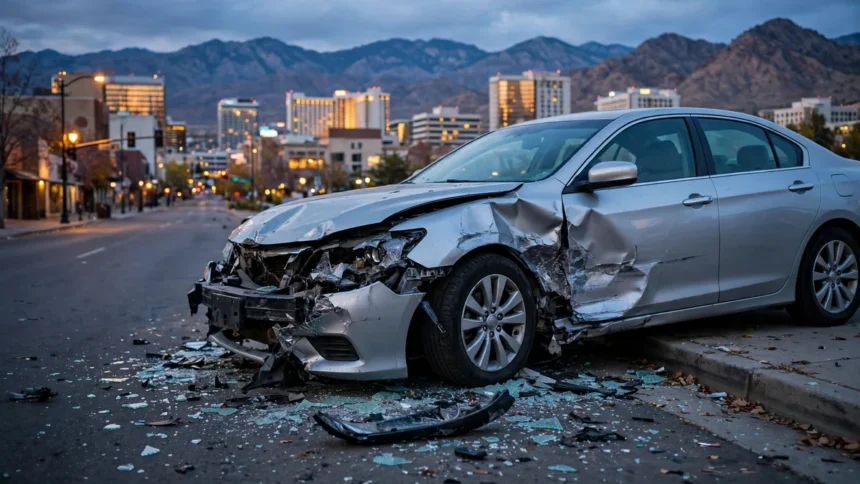
Evidence disappears on a schedule. That’s the single most important thing to understand about hit-and-run crashes.
Skid marks fade. Broken glass gets swept up. Store cameras record over themselves, sometimes within a week. Witnesses go home and forget the color of the car. Every hour that passes after a driver flees makes it harder to find them, and harder to prove what happened even if you never do.
In Reno, where hit-and-runs happen everywhere from downtown side streets to U.S. 395 at rush hour, the people who recover best tend to act fast and in the right order. Here’s what that looks like, broken down by the clock.
The First Hour
Get safe and get help. Move out of traffic if you can. Call 911, even if your injuries seem minor. Adrenaline hides pain, and some injuries, like concussions and internal bleeding, don’t show up right away.
Report it as a hit-and-run. Depending on where you are, the Reno Police Department, the Washoe County Sheriff’s Office or the Nevada Highway Patrol will respond. A police report is the backbone of almost every insurance claim that follows. Make sure the officer knows the other driver left.
Capture what you can while it’s fresh. Even a few details help:
- Partial plate numbers, even two or three characters
- Make, model, color and any damage to the other car
- Which way it went
- Photos of your car, the road, debris and any paint transfer
- Names and phone numbers of anyone who stopped
A broken piece of headlight or trim can carry a part number that narrows down the make and model. Don’t toss anything.
The First Day
See a doctor. If you didn’t go to the ER, go to urgent care or your own doctor within 24 hours. Medical records that start right after the crash make it much harder for an insurer to argue your injuries came from something else.
Notify your insurance company. In a hit-and-run, your own policy usually does the heavy lifting. Report the crash promptly. Many policies require it, and delays give the company a reason to push back. Stick to facts. You don’t have to give a recorded statement on the first call.
Write it all down. Your memory of the crash is evidence. Write a detailed account tonight, while it’s still sharp.
The First Week
This is when video evidence lives or dies.
Walk or drive the area and look for cameras: gas stations, apartment complexes, convenience stores, doorbells on nearby homes. Ask managers to save footage from the time of the crash. Many systems overwrite automatically in a matter of days.
Also check whether your own car or a witness’s car had a dash camera. That clip can be the difference between a closed case and an identified driver.
If the crash caused injuries and police didn’t investigate, Nevada drivers generally must file an SR-1 crash report with the DMV within 10 days. Missing that step can create problems later.
The First Month
Figure out your coverage. If the driver is never found, payment usually comes from your own policy. Two coverages matter most:
- Uninsured motorist (UM) coverage often treats an unidentified hit-and-run driver like an uninsured one, covering medical bills, lost wages and pain and suffering up to your limits.
- Medical payments coverage can help with immediate medical bills no matter who was at fault.
Nevada insurers have to offer UM coverage, but drivers can turn it down in writing. Pull out your declarations page and see what you actually have.
Track every cost. Keep medical bills, pharmacy receipts, mileage to appointments and records of missed work in one folder. These numbers become the core of your personal injury claim.
For a general walkthrough of how injury claims move from start to settlement, this guide to the personal injury claim process covers the basic steps.
Months Later
Here’s a frustrating truth: your own insurer isn’t always on your side in a UM claim. Once you’re asking for UM benefits, the company is essentially standing in the shoes of the driver who hit you, and it has every reason to pay as little as possible.
That’s when the evidence you gathered in the first hours and days pays off. Clear photos, early medical records, saved video and a solid police report make it hard to argue the crash didn’t happen the way you say, or that your injuries aren’t serious.
Insurers also sometimes argue that the “hit-and-run” was really a single-car crash. Physical evidence, like paint transfer or damage that only another vehicle could cause, shuts that argument down.
Many injured people bring in a Reno hit and run accident lawyer at this stage, especially if the UM claim stalls or the offer doesn’t come close to covering medical bills and lost income. A lawyer can also keep looking for the driver, since a found driver can mean access to their insurance too.
One Deadline to Remember
Nevada generally gives injured people two years from the date of the crash to file a personal injury lawsuit. Your insurance policy may have its own, shorter notice requirements for UM claims. Read it, or have someone read it with you.
The driver who hit you chose to leave. You didn’t get a say in that. What you do get a say in is how much of the story you preserve, and in a hit-and-run, that story is often the only thing standing between you and a fair recovery.