




What is a power of attorney? It is a legal document that lets you name a person you trust, called your agent, to sign papers and make decisions for you. Depending on how it is written, your agent can handle money, property, legal tasks or health care.
- Quick Answers: Power of Attorney at a Glance
- What Is a Power of Attorney?
- The Key Roles: Principal, Agent and Successor Agent
- What Can an Agent Do With a Power of Attorney?
- Types of Power of Attorney
- What Is a Durable Power of Attorney?
- What Is a Medical Power of Attorney?
- What Is a Springing Power of Attorney?
- What Is a Power of Attorney Used For? Real-Life Examples
- When Does a Power of Attorney Go Into Effect?
- How to Get a Power of Attorney: Step by Step
- How Much Does a Power of Attorney Cost?
- Power of Attorney Rules by State
- What To Do If a Bank Refuses a Power of Attorney
- Social Security, the IRS and Other Agencies: When a Regular POA Is Not Enough
- How to Choose the Right Agent
- Capacity and Timing: Why You Should Sign Before You Need It
- Power of Attorney Abuse: Warning Signs and What To Do
- How to Revoke a Power of Attorney and When It Ends
- Power of Attorney vs Guardianship, Conservatorship, a Will and a Living Trust
- Debt, Bankruptcy and Other Money Questions
- Online Accounts and Digital Assets
- Common Mistakes To Avoid
- Quick Checklist Before You Sign
- Frequently Asked Questions
- Is a power of attorney the same as a will?
- Does a power of attorney have to be notarized?
- Can an agent sell my house?
- How long does a power of attorney last?
- Can I have more than one agent?
- Do I need a lawyer to make a power of attorney?
- What is the difference between a durable and a medical power of attorney?
- Will Social Security accept my power of attorney?
- Conclusion
People use a power of attorney when they are sick, traveling, deployed or planning for old age. Without one, a family may have to ask a court to appoint a guardian. The Consumer Financial Protection Bureau warns that this process can be slow, costly and very public.
Quick Answers: Power of Attorney at a Glance
- A power of attorney (POA) gives an agent legal authority to act for you. It is not a will, and it ends when you die.
- The main types are general, limited, durable, springing, financial and medical.
- A durable POA keeps working if you lose mental capacity. Check your state’s default rule, because it differs.
- Most states require a notary. Some also require two witnesses. Florida requires both.
- Costs range from free state forms to a few hundred dollars with a lawyer. A court guardianship usually costs far more.
- Social Security does not accept a regular POA. The IRS wants its own form too.
- You can revoke a POA at any time while you have mental capacity.
What Is a Power of Attorney?
A power of attorney, often called a POA, is a written legal document. In it, one person gives another person the legal power to act for them. The person who signs is the principal. The person who receives the power is the agent.
Some states and lawyers use the older term attorney-in-fact for the agent. The word attorney here does not mean the person is a lawyer. If the two words confuse you, our guide on attorney vs lawyer explains the difference.
People use the phrase for two things: the paper itself and the authority it creates. The paper is the proof. The power is what the agent is allowed to do with it.
Example: Maria is a night nurse. Her father lives two states away and is starting to forget things. He signs a POA naming Maria as his agent.
Now Maria can talk to his bank, pay his bills and deal with his insurance company. She does not need to fly out every time a form needs a signature. She still has to act in his best interest and keep records.
The Key Roles: Principal, Agent and Successor Agent
Every POA has the same basic cast. Knowing each role helps you read any form.
- Principal: The person who creates the POA. The principal must understand what they are signing when they sign it.
- Agent: The person who acts. The agent owes the principal duties of loyalty and care. Lawyers call this a fiduciary duty.
- Successor agent: A backup who steps in if the first agent cannot or will not serve.
- Co-agents: Two or more agents named together. This can work, but it can also cause delays and disputes.
An agent has real responsibilities. They must act within the powers listed in the document. They must keep the principal’s money separate from their own, keep records, and follow the principal’s known wishes.
The National Council on Aging notes that agents can be held accountable if they misuse their authority. That is why who you pick matters more than which form you use.
What Can an Agent Do With a Power of Attorney?
It depends on what the document says. A broad financial POA can cover almost every money task. A narrow one may allow a single act, like selling a car.
Common financial and legal tasks include:
- Paying bills and managing bank accounts
- Handling investments and insurance claims
- Buying, selling or managing property
- Signing contracts for the principal
- Applying for government help such as Medicaid
A medical POA is different. It covers health care decisions only. We explain it in its own section below.

What an agent cannot do
A POA has limits. In most states an agent cannot:
- Act after the principal dies
- Make or change the principal’s will
- Vote for the principal in an election
- Go beyond the powers written in the document
- Use the principal’s money for personal gain unless the document clearly allows it
Many states also treat some powers as risky. These include making gifts, changing who receives insurance or retirement money, creating or changing a trust, and changing survivorship rights. States that follow the Uniform Power of Attorney Act generally require the document to name these powers one by one.
This matters because the CFPB lists unauthorized gifts and beneficiary changes as common forms of POA abuse. If you do not want your agent to have these powers, simply do not grant them.
Types of Power of Attorney
There are many types, and they often overlap. One document can be general, financial and durable at the same time. The table below shows how the main types compare.
| Type | What it does | When it starts | Survives incapacity? |
|---|---|---|---|
| General | Gives broad authority over money and legal matters | Usually when signed | Only if it is also durable |
| Limited or special | Covers one task or a short list, like selling a house | When signed or when the task begins | Only if it is also durable |
| Durable | Keeps working if the principal loses capacity | When signed, unless it is springing | Yes |
| Nondurable | Ends if the principal loses capacity | When signed | No |
| Springing | Starts only after a named event, such as a doctor’s finding of incapacity | When the event happens | Yes, if written to last |
| Financial | Covers banking, bills, taxes and property | Depends on the document | Depends on the document |
| Medical | Covers health care decisions | Usually when you cannot decide for yourself | Yes, by design |
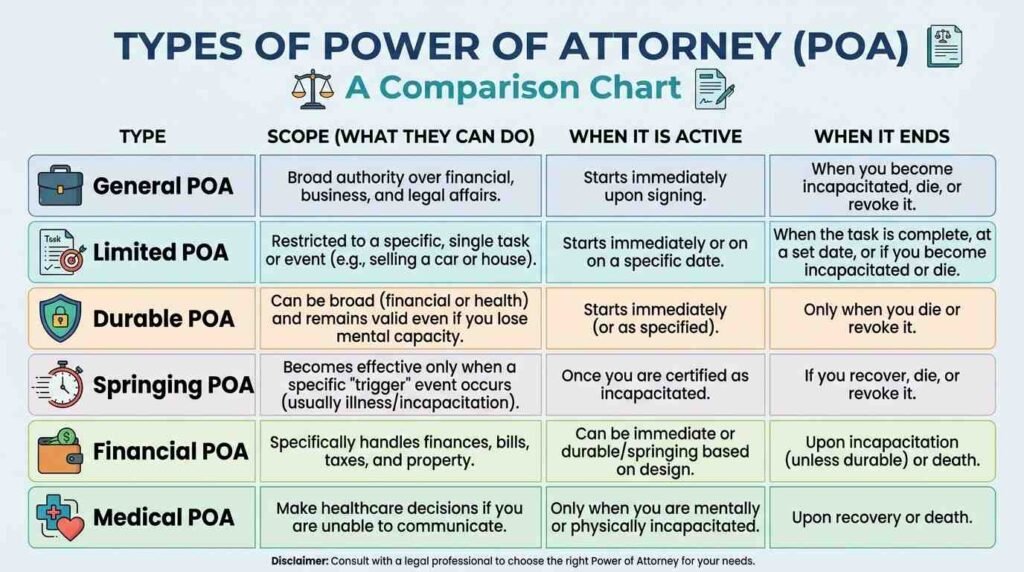
General power of attorney
A general POA gives the agent wide power over the principal’s affairs. People often use it for short-term needs, like a long trip. The NCOA explains that a general POA that is not durable ends if the principal becomes incapacitated.
Limited power of attorney
A limited POA, also called a special POA, covers only what you list. Examples include signing closing papers on a home sale or handling one tax matter. It is a good fit when you want to give the least power possible.
Other forms you may see
Some states publish an official statutory form, which uses wording written into state law. Other forms are task specific, such as a motor vehicle form in Florida or the IRS form for tax matters. Banks may also ask you to use their own form, so ask before you sign anything.
What Is a Durable Power of Attorney?
A durable power of attorney stays in effect if the principal becomes incapacitated. Illness, injury, a stroke or dementia are the usual reasons. This is the main reason older adults and their families choose one.
The default rule differs by state. In states that follow the Uniform Power of Attorney Act, a POA is durable unless it says it ends on incapacity. In other states, the document must state clearly that it is durable. Florida is one state that does not make a POA durable by default.
You may see several names for the same idea. A general durable power of attorney covers many matters. A durable financial power of attorney focuses on money. A statutory durable power of attorney uses the form found in state law.
Example: Tom signs a plain general POA at age 60. At 72, a stroke leaves him unable to make decisions. His document has no durability wording, and his state requires it.
The bank stops honoring the POA. Tom’s family now has to go to court to ask for a guardian. That is the exact problem a durable POA is meant to prevent.
What Is a Medical Power of Attorney?
A medical power of attorney names a person to make health care decisions if you cannot speak for yourself. It may also be called a health care power of attorney, health care proxy or health care agent. Your agent can speak with doctors about treatment, surgery, long-term care and end-of-life care.
A medical POA is not the same as a living will. A living will states your wishes about treatment. A medical POA names the person who speaks for you. Both are parts of what lawyers call an advance directive, and many people sign both.
Ask your doctor or lawyer about a HIPAA release too. It lets your agent see your medical records. Give copies of the signed document to your doctor, your hospital and your family.
Keep the roles apart in your mind. A medical agent usually cannot manage your bank account. A financial agent usually cannot make your medical choices.
What Is a Springing Power of Attorney?
A springing power of attorney starts only when a certain event happens. The most common event is incapacity, often confirmed in writing by one or two doctors. You decide the trigger when you sign.
The upside is privacy. Your agent has no power while you are well. The downside is delay, because someone has to prove the event happened. Banks may also hesitate to accept a springing document.
Some states restrict springing POAs. Florida is a clear example: for a POA signed on or after October 1, 2011, the law says it takes effect when signed, and a delayed start is not valid. Because rules differ, ask a local lawyer how to handle this in your state.
What Is a Power of Attorney Used For? Real-Life Examples
People use a POA for far more than old age planning. Here are the most common situations.
- Hospital stay or surgery: An agent pays the bills and handles mail while you recover.
- Deployment or long travel: The CFPB gives the example of a service member who names someone to pay bills or sell property while overseas.
- Planning for dementia: A durable POA lets a trusted person step in without a court.
- Selling property from far away: A limited POA lets someone sign closing papers for you.
- Government benefit applications: An agent can help with forms such as Medicaid applications.
- Paperwork after a serious injury: A person who cannot sign or mail forms may name a trusted helper. Our guide to a personal injury claim explains how claims work and why you should still involve a lawyer for big decisions.
When Does a Power of Attorney Go Into Effect?
A power of attorney usually takes effect the moment it is properly signed, unless it says it starts later. Florida’s law says this directly: a POA is exercisable when executed. Many other states work the same way.
This surprises many people. An agent does not have to wait for the principal to become ill. If the document is immediate, the agent can act while the principal is still healthy.
If you want a delayed start, the document must say so, and your state must allow it. Medical POAs work differently. They normally become active only when doctors find you cannot make your own choices.
In real life, one more step matters. A bank or hospital may need a few days to review the document before it lets your agent act.
How to Get a Power of Attorney: Step by Step
Getting a POA is simple when you take it one step at a time. Here is the basic path.
- Decide what you need. Choose financial, medical or both. Decide if it should be durable.
- Pick your agent and a backup. Talk to them first. Make sure they are willing and able.
- Get the right form. Many states offer standard forms. You can also use a lawyer or a legal aid office. The CFPB points to the American Bar Association’s free legal help directory if you cannot afford a lawyer.
- Fill it in with care. List each power you want to give. Skip the risky ones unless you truly want them. You can also require your agent to report to another person.
- Sign the right way. Most states require a notary. Some also require two adult witnesses who are not the agent. Some states allow remote notarization, so check yours.
- Make copies and share them. Give copies to your agent, your doctor if it is a medical POA, and your bank.
- Store the original safely. Tell trusted family members it exists. The CFPB says this helps others spot a forged document.
What you need before you start
- Full legal names and addresses for you, your agent and your backup
- A clear list of the powers you want to grant
- A start date or trigger, if it will not take effect right away
- Valid photo ID for you and for the notary visit
- Witnesses, if your state requires them
Online legal sites also offer POA forms. Before you pay, check who runs the site and whether licensed lawyers stand behind it. Our guide to how to check any online legal platform shows what to look for.
How Much Does a Power of Attorney Cost?
Costs vary by state, provider and how complex your situation is. Use the table below as a rough guide, not a price quote.
| Option | Typical cost | Best for |
|---|---|---|
| State or legal aid form | Often free | Simple needs with a standard form |
| Online form service | Usually a modest fee that varies by site | Straightforward situations |
| Lawyer-drafted POA | Often a flat fee, commonly a few hundred dollars alone or more as part of an estate plan | Large assets, blended families, businesses |
| Notary | A small fee set by state law | Every signed POA |
| Court guardianship if you have no POA | Usually far higher, plus court time | A last resort |
The CFPB says that getting a lawyer’s help to name an agent is relatively inexpensive. It also says that a guardianship process can be lengthy and costly. Setting up a POA early is usually the cheaper path.
Does an agent get paid?
Often not, because many agents are family members who volunteer. In states that follow the Uniform Power of Attorney Act, an agent can receive repayment for reasonable expenses and reasonable pay, unless the document says otherwise. If you do not want your agent paid, say so in the document.
Power of Attorney Rules by State
Power of attorney law is set by each state, not by Congress. Many states use the Uniform Power of Attorney Act, a model law written by the Uniform Law Commission. Sources count the adopting states differently, but more than 30 states and the District of Columbia have enacted a version. Check the commission’s map for the latest number.
The table shows a few examples. It is not a full state guide.
| State | Framework | Worth knowing |
|---|---|---|
| Florida | Florida Power of Attorney Act, Chapter 709 | Needs the principal’s signature, two witnesses and a notary. New springing POAs are not valid. Florida also recognizes POAs validly signed in another state. |
| Texas | Enacted a Uniform Power of Attorney Act version in 2017 | Check the state’s current signing rules and statutory form |
| Georgia | Enacted a version in 2018 | Check signing rules and bank acceptance rules |
| Ohio | Enacted a version in 2012 | Check signing rules before you rely on an older form |
| Washington | Enacted a version, effective January 1, 2017 | Check who may serve as a witness |
| Illinois | Has its own Power of Attorney Act | Does not follow the uniform model, so read local rules closely |
Moving to a new state? Many states accept a POA that was valid where it was signed. Banks and hospitals may still ask for a fresh document, so ask them before an emergency happens.
What To Do If a Bank Refuses a Power of Attorney
This is one of the most common problems families face. A bank may want its own form, may not recognize the document, or may worry about abuse. A refusal does not always mean the POA is invalid.
In states that follow the Uniform Power of Attorney Act, a bank has a set time to respond to a properly notarized POA. Within seven business days, it must accept the POA, refuse on a permitted ground, or ask for an agent’s certification, a translation or an opinion of counsel. North Carolina, Utah, Idaho and South Carolina all use this timing.
If the bank asks for one of those items, it generally has five business days after getting it to decide. A bank that refuses without a valid reason can face a court order to accept the POA. Other states use different time frames, so check yours.
Here is what families can do:
- Ask the bank to explain the reason in writing.
- Ask whether it wants a certification from the agent, and offer one.
- Speak with the branch manager and the bank’s legal department.
- Keep dated notes of every call and visit.
- See a lawyer if the bank still refuses. You can also file a complaint with the CFPB.
The best fix is prevention. Before you sign, ask your bank whether it has its own form. Give the bank a copy early.
Social Security, the IRS and Other Agencies: When a Regular POA Is Not Enough
Here is a fact many families learn too late. Some agencies do not accept a normal POA. They need their own forms.
Social Security does not recognize a POA for managing benefits. Treasury rules do not allow a general POA to be used for recurring federal benefit payments. Instead, the agency names a representative payee, and the Social Security Administration explains how that role works.
A payee manages only the Social Security or SSI payments. As of December 2024, about 4.65 million Social Security recipients had a payee, according to agency data reported by AARP. You can also name someone in advance through the agency, so ask about that option while you are well.
The IRS has its own Form 2848. It lets you name someone to speak with the IRS about specific tax matters and tax years. The IRS may accept a regular POA only if it contains certain details, and a completed Form 2848 must still be attached. The instructions for Form 2848 explain the rules.
The takeaway is simple. A POA is powerful, but it does not replace every agency form. Plan for these extra steps when you set up your documents.
How to Choose the Right Agent
Picking an agent is the biggest decision in this process. Look for someone who is:
- Honest and good with money
- Organized enough to keep records
- Calm under pressure
- Able to talk with doctors, banks and relatives
- Willing to follow your wishes even when family disagrees
Be careful with anyone who pressures you, has serious money problems, or is new to your life and offering to take over your finances. The CFPB warns about people who suddenly become a new best friend.
Name a successor agent too. Some families name one agent for money and a different one for health care. Tell your relatives your choice and your reasons, so no one is surprised later.
Capacity and Timing: Why You Should Sign Before You Need It
To sign a POA, the principal must understand what the document is and what it does. This is called capacity. If capacity is lost, the principal can no longer sign a new POA.
When that happens and no POA exists, the family may need a court to appoint a guardian. That is the lengthy, costly and public process the CFPB describes.
Example: Lena’s mother is diagnosed with early dementia. She still understands who she trusts and what she wants, so a lawyer helps her sign a durable POA right away. Two years later, her condition has changed, and Lena can manage the bills without going to court.
Capacity is judged one decision at a time, and a person with early memory loss may still have it. A lawyer, and sometimes a doctor, decides whether it is present. Do not wait for a crisis.
Power of Attorney Abuse: Warning Signs and What To Do
A POA gives someone broad access to your money, usually without regular oversight. Most agents act honestly. A few do not.
The CFPB describes three common problems: an agent pressures a person into giving authority, spends the money on themselves, or does things they were never allowed to do, such as making gifts. Warning signs include unpaid bills, missing belongings, sudden changes to accounts and a person who is cut off from family.
If you suspect abuse, take these steps:
- Ask the agent for a written accounting of money in and out.
- Contact the bank and ask what it can see and freeze.
- Report concerns to Adult Protective Services in the principal’s state.
- Contact the police if money or property was stolen.
- Speak with a lawyer. Many states let a court review an agent’s actions and remove an agent.
You can reduce the risk before it starts. Tell trusted people about the POA, require your agent to report to another person, and revoke the document if trust breaks down.
How to Revoke a Power of Attorney and When It Ends
A principal can revoke a POA at any time while they have mental capacity. A POA also ends in other ways:
- The principal dies
- The document has an end date, or the task is finished
- The agent dies, resigns or cannot serve, and no successor is named
- A court ends the agent’s authority
Divorce matters too. In states that follow the Uniform Power of Attorney Act, an agent who is the principal’s spouse loses authority when a divorce, annulment or legal separation action is filed, unless the document says otherwise. If a divorce is on the horizon, our guide on what is alimony covers the support questions that often come next.
To revoke a POA, follow these steps:
- Write and sign a revocation. Having it notarized is a smart move.
- Give a copy to your agent.
- Notify every bank, doctor and company that has the old POA.
- Ask them to destroy old copies.
- Sign a new POA if you still need one.
What happens after death
A POA ends at death. Authority then moves to the executor named in the will, or to a personal representative the court appoints. The former agent should not keep spending the person’s money.
Legal claims after a death follow the estate and family process, not the old POA. If a death may involve someone else’s fault, our guide to a wrongful death attorney explains how those claims work.
Power of Attorney vs Guardianship, Conservatorship, a Will and a Living Trust
These tools are often mixed up. They solve different problems, and many people use more than one.
| Tool | Who decides | Court involved? | When it works |
|---|---|---|---|
| Power of attorney | The agent you choose | Not to create it | As the document says, and ends at death |
| Guardianship or conservatorship | A person the court appoints | Yes, with ongoing oversight | After a court finds the person cannot manage alone |
| Will | An executor carries it out | Yes, through probate | Only after death |
| Living trust | The trustee you name | Usually not for routine matters | During life and after death |
| Living will | Your written wishes guide doctors | No | When you cannot speak for yourself |
Terms vary by state. Some states call a person who manages money for another a conservator, and others use the word guardian for both roles.
Debt, Bankruptcy and Other Money Questions
An agent can pay the principal’s bills from the principal’s funds. Acting as an agent does not make the agent personally responsible for the principal’s debts, as long as the agent signs properly in that role.
A POA also does not erase debt. When debts become overwhelming, bankruptcy is a separate federal court process. Our guide on what is a bankruptcy explains the main types and costs.
Online Accounts and Digital Assets
Money and health are not the only things people manage now. Email, photos, cloud storage and online banking matter too. Many states have laws that treat digital accounts differently from bank accounts.
In many states, an agent needs clear permission in the document to access the content of someone’s electronic messages. If you want your agent to handle your online life, say so. Keep a secure list of accounts, and ask a lawyer how your state treats passwords and platform rules.
Common Mistakes To Avoid
- Skipping durability wording in a state that requires it
- Using vague language that does not say what the agent may do
- Naming only one agent with no backup
- Signing without the notary or witnesses your state requires
- Never telling the bank or doctor that the document exists
- Waiting until a health crisis to start
- Letting the agent mix the principal’s money with their own
Quick Checklist Before You Sign
- I know whether I need a financial POA, a medical POA or both
- I chose an agent and a backup, and both agreed
- I checked my state’s signing rules
- I listed the powers I want and left out the ones I do not
- I asked my bank whether it has its own form
- I know about the Social Security and IRS forms
- I will give copies to the people who need them
- A licensed lawyer in my state reviewed the final document
Frequently Asked Questions
Is a power of attorney the same as a will?
No. A power of attorney works while you are alive, and it ends at death. A will only takes effect after death.
Does a power of attorney have to be notarized?
In most states, yes. Some states also require witnesses, and Florida requires both witnesses and a notary. Check your state’s law before you sign.
Can an agent sell my house?
Only if the document gives that power. Real estate sales usually need a properly signed and notarized POA, and a title company will check it. Some states also require the POA to be recorded.
How long does a power of attorney last?
It lasts until it ends. That can mean revocation, death, an end date, a finished task or a court order. A durable POA continues through incapacity.
Can I have more than one agent?
Yes. You can name co-agents or a successor agent. Some people name separate agents for money and health care to avoid conflicts.
Do I need a lawyer to make a power of attorney?
Not always, because many states offer standard forms. A lawyer is wise for large assets, family conflict, a business or a complex plan. The CFPB notes that legal help to name an agent is relatively inexpensive.
What is the difference between a durable and a medical power of attorney?
A durable POA usually covers money and legal matters and stays valid if you become incapacitated. A medical POA covers health care decisions only. Many people have both.
Will Social Security accept my power of attorney?
No. Social Security does not recognize a regular POA for managing benefits. It uses a representative payee instead.
Conclusion
So, what is a power of attorney? It is a legal document that lets someone you trust act for you in money, legal or health matters. The right type, the right agent and the right signing steps decide whether it works when you need it.
Start early, and be specific about the powers you grant. Check your state’s rules, talk to your bank and plan for Social Security and the IRS. Then ask a licensed attorney in your state to review the final document.