



The Trump White House ballroom lawsuit is a real federal court case testing whether a president can demolish part of the White House and build a new structure without approval from Congress. The short answer, as of early September 2026, is that construction is continuing while the legal fight plays out in the courts.
- What Is the White House Ballroom Project?
- Why Was the Lawsuit Filed?
- Who Is the National Trust for Historic Preservation?
- The Legal Claims Explained
- Full Case Timeline
- What the Supreme Court Actually Decided
- Why Legal Standing Is the Real Battleground
- The Funding and Ethics Questions
- What Happens Next in the Case
- What This Case Means for Future Presidents
- Frequently Asked Questions
- Conclusion
This case matters because it touches on a question bigger than one building. It asks how much power a president has over federal property, and who gets to challenge that power in court.
What Is the White House Ballroom Project?
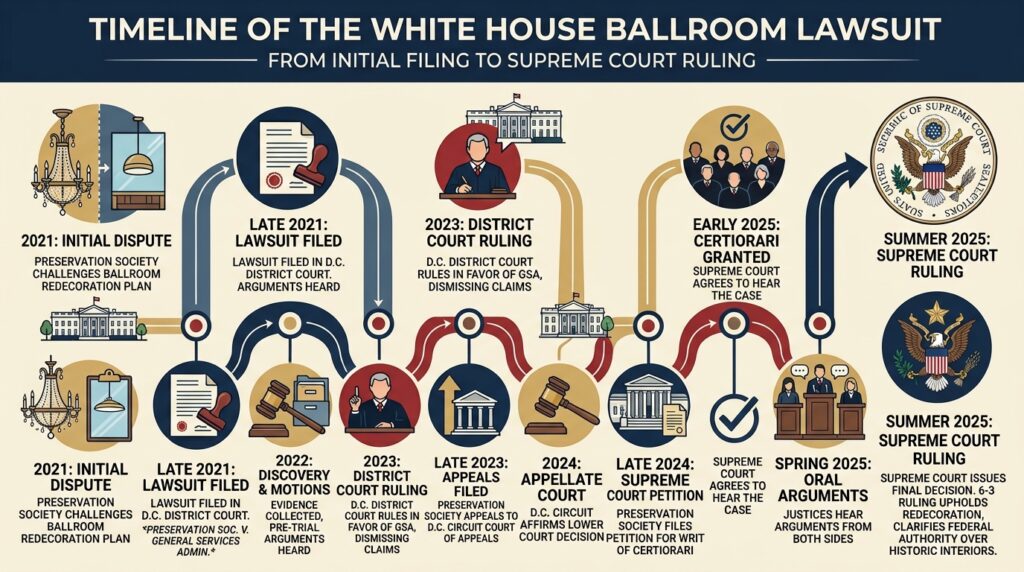
In October 2025, the Trump administration began demolishing the East Wing of the White House. The East Wing was originally built in 1902 and expanded in 1942. In its place, the administration is building a roughly 90,000 square foot ballroom and event space.
The project has been reported to cost somewhere between $300 million and $400 million, depending on the source and the stage of construction. Officials describe it as a privately funded addition, meaning the money comes from donors rather than taxpayers.
The administration says the ballroom will host state dinners and large official events that the current White House cannot accommodate. Critics argue the scale of the demolition and construction went far beyond routine White House maintenance.
Why Was the Lawsuit Filed?
On December 12, 2025, the National Trust for Historic Preservation filed a lawsuit in the U.S. District Court for the District of Columbia. The group asked the court to immediately stop construction.
The lawsuit argues that no president is allowed to tear down part of the White House, or build something new on the grounds, without going through federal review processes first. According to the complaint, those processes were skipped entirely.
The Trust also said the public was denied any chance to weigh in before demolition began. That is a central theme throughout the case. For background on how public comment periods normally work in federal projects, see our guide to administrative review requirements.
Who Is the National Trust for Historic Preservation?
The National Trust is a private, nonprofit organization chartered by Congress in 1949. Its mission is to help protect historic sites and buildings across the country.
The organization is not a government agency. It is not affiliated with the federal government, even though Congress created its charter decades ago. This distinction became important later, when the case turned on whether the Trust had the legal right to sue in the first place.
The Trust hired the law firm Foley Hoag to represent it in the litigation.
The Legal Claims Explained
The lawsuit rests on several separate legal theories. Understanding each one helps explain why the case has moved through so many courts.
Administrative Procedure Act (APA). The Trust claims the administration failed to consult the National Capital Planning Commission and the Commission of Fine Arts before starting construction, steps it says are legally required.
National Environmental Policy Act (NEPA). Federal projects of this size typically require an environmental assessment, and sometimes a full environmental impact statement, before work begins. The complaint alleges the East Wing demolition was already finished before an adequate environmental review was completed.
Property Clause of the Constitution. This clause gives Congress, not the president alone, authority over property belonging to the United States. The lawsuit argues the ballroom project bypassed that authority.
Ultra vires action. After an early setback in the case, the Trust added a claim that the administration acted outside the specific powers Congress has granted it under 40 U.S.C. § 8106, a statute limiting construction on federal property in Washington, D.C. without express congressional authorization.
If you want a plain-language breakdown of how these federal review laws normally apply to construction projects, read our overview of NEPA compliance.
Table: Key Claims at a Glance
| Legal Claim | What It Argues |
|---|---|
| Administrative Procedure Act | Required agency review was skipped |
| NEPA | No adequate environmental review before demolition |
| Property Clause | Congress, not the president, controls federal property |
| Ultra vires | Officials acted beyond powers Congress granted |
Full Case Timeline
Here is how the case has unfolded, step by step.
- October 2025: Demolition of the East Wing begins.
- December 12, 2025: The National Trust files its lawsuit in federal district court.
- December 15, 2025: The National Park Service publishes an environmental assessment, after demolition was already underway.
- February 2026: Judge Richard Leon partly agrees that one named defendant, the Office of the Executive Residence, is not a federal agency subject to the APA.
- March 2, 2026: The Trust files an amended complaint adding the ultra vires claim.
- March 31, 2026: Judge Leon grants a preliminary injunction, halting above ground construction and ruling the administration lacked statutory authority.
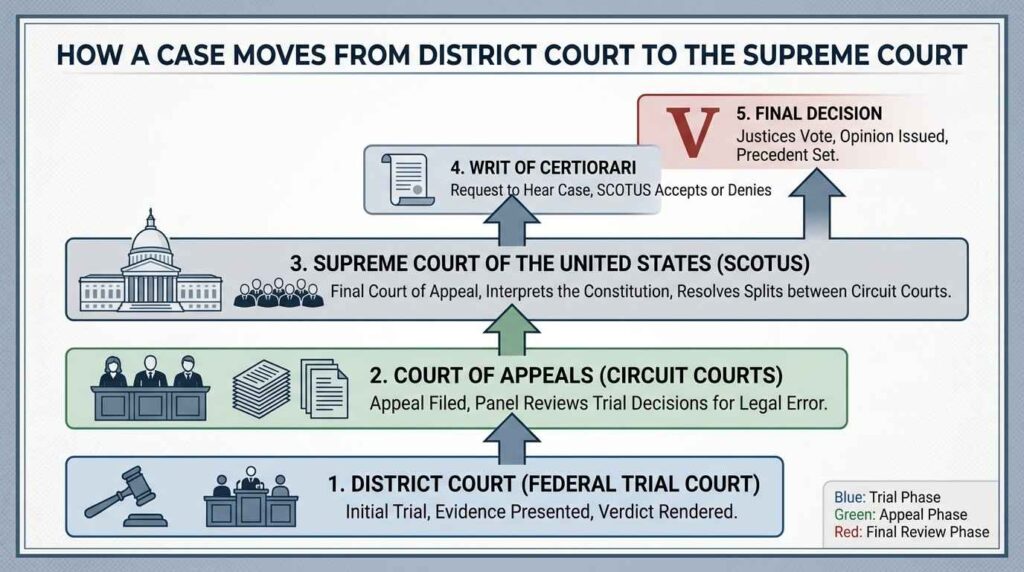
- April 12 to 17, 2026: The D.C. Circuit Court of Appeals temporarily pauses the injunction, allowing work to continue while it reviews the case, and schedules oral argument for June 5.
- August 7, 2026: A three judge D.C. Circuit panel rules 2 to 1 that the project requires explicit congressional authorization, upholding the halt on construction but staying enforcement for two weeks.
- Mid August 2026: The administration appeals to the Supreme Court on an emergency basis.
- August 31, 2026: The Supreme Court, in a 5 to 4 unsigned order, allows construction to continue while the case proceeds, ruling that the Trust likely lacks standing to sue.
For readers who want the original court filings and docket entries, the Civil Rights Litigation Clearinghouse case page tracks the full record.
What the Supreme Court Actually Decided
This is one of the most misunderstood parts of the case, so it deserves its own section.
The Supreme Court did not rule that the ballroom project is legal. The justices explicitly said they were not deciding that question. Instead, the five justice majority found that the Trust likely does not have Article III standing, the legal right to bring the case to federal court at all.
Chief Justice John Roberts and the court’s three liberal justices dissented from that order. Brent Leggs, president and CEO of the National Trust, said in a statement that the group was disappointed with the ruling and pointed out that the majority did not address whether the ballroom project was actually legal.
Because this was an emergency order rather than a final ruling, the underlying lawsuit is still active in the lower courts. Construction can continue for now, but the legal questions about congressional authority have not been resolved.
Why Legal Standing Is the Real Battleground
Standing is a legal doctrine that decides who is allowed to sue over a government action. Under the Supreme Court’s long standing framework from Lujan v. Defenders of Wildlife, a plaintiff generally must show an injury that is concrete, particularized, and actual or imminent.
The Trust based its standing on a declaration from one of its members, an architectural historian who says her professional enjoyment of the White House as a historic structure is harmed by the transformation. The D.C. Circuit accepted that argument. The Supreme Court’s emergency order suggested it likely will not.
This might sound like a technical detail, but it decides everything. If a court rules a plaintiff lacks standing, the case can be dismissed without ever reaching the actual legal question of whether the president had authority to act. To understand how standing challenges work in other types of federal lawsuits, see our explainer on who can sue the federal government.
The Funding and Ethics Questions
Because the ballroom is being paid for through private donations rather than congressional appropriations, watchdog groups have raised separate concerns.
The Campaign Legal Center and Citizens for Responsibility and Ethics in Washington filed a joint amicus brief warning that private funding of a project this size creates a risk of corruption or the appearance of corruption, particularly when donors may have business before the federal government.
Senate Democrats have also written to the White House chief of staff asking for a full accounting of donors, expressing concern that contributions from companies holding federal contracts could raise conflict of interest questions. The administration has maintained that all donations are voluntary gifts with no favors attached.
These ethics concerns are separate from the core lawsuit but often appear in the same news coverage, so it is easy to confuse the two. For a deeper look at how conflict of interest rules apply to government projects generally, check our guide to public corruption law basics.
What Happens Next in the Case
The Supreme Court’s order was about a temporary stay, not a final decision. The lawsuit itself continues in the lower courts. A few paths are possible from here.
- The district court could eventually rule on the merits of the APA, NEPA, and ultra vires claims.
- The Trust could try to establish standing through a different plaintiff or a revised argument.
- Congress could weigh in directly, either by authorizing the project after the fact or by objecting to it.
- The case could ultimately return to the Supreme Court for a decision on the merits, though that would likely take considerable time.
Because construction is proceeding rapidly, with reports of crews working around the clock, the practical reality is that much of the building may be finished before any final ruling arrives. That raises a separate question courts sometimes face: what remedy is even available once a disputed structure is already built.
What This Case Means for Future Presidents
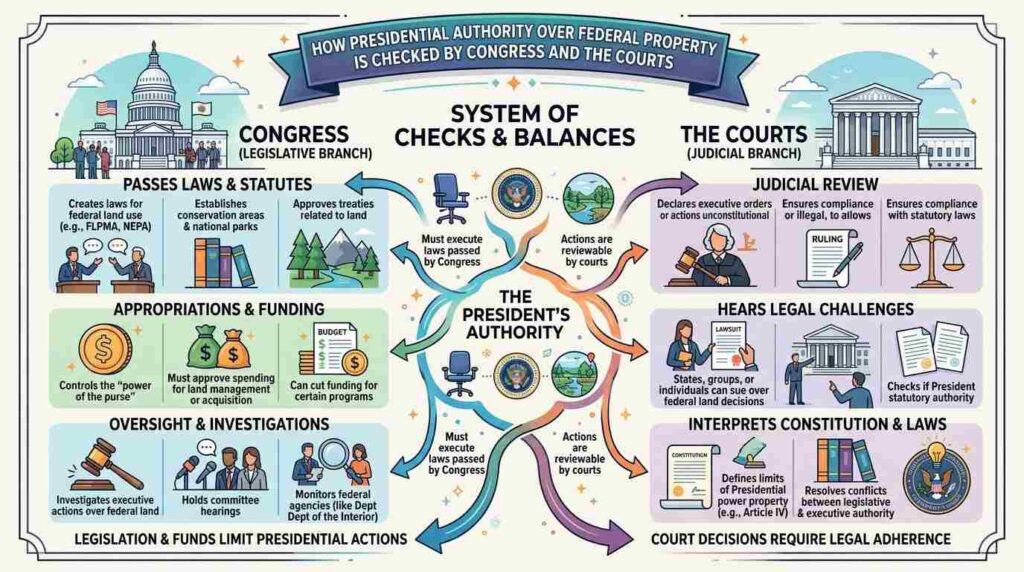
Regardless of how this specific case ends, it has already clarified a few things about the limits, or lack of limits, on presidential authority over the White House complex.
No express legal authorization currently exists for major new construction on the White House grounds without congressional involvement, according to the D.C. Circuit’s reasoning. Standing remains a high hurdle for private organizations trying to challenge presidential building decisions in court. The White House is exempt from the National Historic Preservation Act, though past administrations have often voluntarily followed similar review steps anyway.
Future disputes over federal property, whether involving a different president or a different building, will likely reference this case as a key example of how these fights actually play out in court.
Frequently Asked Questions
Is the White House ballroom construction currently legal?
No court has issued a final ruling on that question. The Supreme Court allowed construction to continue for now, based on standing, without deciding whether the underlying project itself is lawful.
Who filed the lawsuit against the ballroom project?
The National Trust for Historic Preservation, a private nonprofit chartered by Congress in 1949, filed the case on December 12, 2025.
Why did the Supreme Court allow construction to continue?
A five justice majority found that the Trust likely lacks Article III standing to bring the lawsuit, meaning it may not have the legal right to sue over the project in federal court.
What does Article III standing mean?
It is a constitutional requirement that a person or group suing in federal court show a real, specific injury caused by the action they are challenging. Without standing, a court generally cannot hear the case.
How much does the White House ballroom cost?
Estimates reported in court filings and news coverage range from about $300 million to $400 million, funded through private donations rather than taxpayer money.
Did Congress approve the ballroom project?
According to the lawsuit and the D.C. Circuit’s ruling, no explicit congressional authorization was obtained before construction began. The administration disputes that this approval was legally required.
What laws does the lawsuit claim were violated?
The complaint cites the Administrative Procedure Act, the National Environmental Policy Act, the Property Clause of the Constitution, and a statute limiting unauthorized federal construction in Washington, D.C.
Is this lawsuit over?
No. The Supreme Court’s order addressed only a temporary stay. The underlying case continues in the lower courts, and a final ruling on the merits has not been issued.
Conclusion
The Trump White House ballroom lawsuit is far from finished, even though construction is moving forward. The Supreme Court’s August 2026 order settled a narrow question about standing, not the larger question of whether a president can bypass Congress to build on federal property.
Watch this case closely if you care about the balance of power between the presidency and Congress, because the final outcome could shape how future administrations handle major changes to federal buildings. If you are dealing with a legal question involving government property, environmental review, or standing to sue, connect with an attorney who can look at your specific situation.