


QUICK ANSWER
North Carolina window tint law changed on December 1, 2025, under Session Law 2025-47 (SB 43). Tint is no longer checked at annual safety inspections, and the $10 tint fee is eliminated. However, the 35% VLT legal limit is unchanged. Drivers and passengers must now roll down tinted windows when a law enforcement officer approaches during a traffic stop.
Introduction
North Carolina window tint law changes took effect on December 1, 2025. Many drivers heard that tint is no longer checked at inspections and assumed the rules are gone. They are not.
- Introduction
- 1. What Are the North Carolina Window Tint Law Changes?
- 2. Old Law vs. New Law: Side-by-Side Comparison
- 3. What Is the Legal Window Tint Percentage in North Carolina?
- 4. Tint Limits by Vehicle Type
- Passenger Vehicles (Sedans, Coupes, Hatchbacks, Convertibles, Station Wagons)
- Multipurpose Vehicles (SUVs, Trucks, Vans, Minivans)
- 5. Windshield Tint Rules (Including Clear UV Film)
- Where Tinted Film Is Allowed on the Windshield
- Clear UV Film on the Windshield — Explicitly Permitted
- 6. Reflectivity Limits and Prohibited Tint Colors
- 7. The New Roll-Down Window Rule at Traffic Stops
- What the Rule Requires
- Why This Rule Was Added
- What Happens If You Refuse to Roll Down the Window?
- Practical Tip
- 8. Does NC Still Enforce Tint Laws After the Inspection Change?
- 9. Penalties for Illegal Window Tint in North Carolina
- Important Classification: Non-Moving Traffic Violation
- Fines and Court Costs
- Other Consequences of a Tint Citation
- Repeat Offenses: When It Escalates to a Misdemeanor
- Cost Perspective
- 10. Illegal Tint and Car Accident Liability in NC
- North Carolina Is a Pure Contributory Fault State
- Example Scenario
- Why This Makes Tint Compliance More Important
- 11. North Carolina Medical Exemption for Window Tint
- Who Qualifies?
- How to Apply and What the Permit Covers
- The Windshield Restriction — Even With a Medical Exemption
- Does a Medical Exemption Override the Roll-Down Rule?
- Reminder
- 12. Which Vehicles Are Exempt from NC Tint Laws?
- 13. How to Check If Your Tint Is Legal in NC
- 14. Choosing the Right Tint Film Under NC Law
- 15. Frequently Asked Questions
- Q1: Did the 35% VLT limit change in December 2025?
- Q2: Do passengers have to roll down their windows too?
- Q3: Do I still need an annual vehicle inspection in NC?
- Q4: Can an officer pull me over just for my window tint?
- Q5: Is a tint violation a criminal charge in NC?
- Q6: Can I put tint on my full windshield with a medical exemption?
- Q7: Do SUV rear windows need to meet the 35% VLT rule?
- Q8: What is the maximum fine for illegal tint in NC?
- Q9: Can illegal tint affect a car accident claim in NC?
- Q10: Can I put clear film on my entire windshield in NC?
- 16. Key Takeaways for NC Drivers
- 17. Conclusion
Three things changed. The annual inspection check was removed. The $10 fee was eliminated. A new roll-down rule now requires drivers and passengers to lower tinted windows at traffic stops. The 35% VLT legal limit stayed exactly the same.
This article explains everything in plain English. It covers what changed, what did not, your obligations at every traffic stop, the penalties for violations, and how to keep your tint fully legal going forward.
This is general information only. It is not legal advice and is not a substitute for guidance from a qualified attorney licensed in North Carolina. Laws can change after publication.
1. What Are the North Carolina Window Tint Law Changes?
On December 1, 2025, Session Law 2025-47 (enacted as Senate Bill 43 and companion SB 391, signed by Governor Josh Stein) made three specific changes to how North Carolina handles aftermarket window tint.
The 3 things that changed:
- Annual safety inspection mechanics no longer check window tint darkness.
- The $10 tint inspection fee was eliminated.
- A new roll-down rule now applies: drivers AND passengers must lower tinted windows when approached by law enforcement during a traffic stop.
The 1 thing that did NOT change:
- The 35% VLT legal limit under G.S. 20-127 remains fully in force. You can still be cited for illegal tint at any roadside stop.
The practical shift is this: enforcement moved from the inspection lane to the roadside. Tint that was illegal before December 1, 2025 is still illegal today.
Important Legal Reminder
Under G.S. 20-127, all existing tint standards remain fully enforceable. Vehicle owners must still comply with darkness and reflectivity limits. Failing to do so can result in citations, fines, mandatory removal, and in repeat cases, a Class 3 misdemeanor charge.
2. Old Law vs. New Law: Side-by-Side Comparison
The table below shows exactly what changed and what stayed the same under Session Law 2025-47.
| Factor | Before December 1, 2025 | After December 1, 2025 |
| Annual tint inspection | Required at inspection station | Removed from inspection checklist |
| $10 tint inspection fee | Charged to vehicle owners | Eliminated |
| 35% VLT front window limit | Enforced at inspection + roadside | Enforced roadside only (limit unchanged) |
| Enforcement location | Inspection station (annual) | Roadside traffic stops (ongoing) |
| Roll-down requirement | No requirement | Mandatory for drivers AND passengers |
| Clear UV film on windshield | Permitted | Still permitted (no change) |
| Medical exemption availability | Available with NCDMV permit | Available (roll-down rule still applies) |
| Prohibited tint colors | Red, amber, yellow | Red, amber, yellow (unchanged) |
| Tint reflectivity limit | 20% maximum | 20% maximum (unchanged) |
3. What Is the Legal Window Tint Percentage in North Carolina?
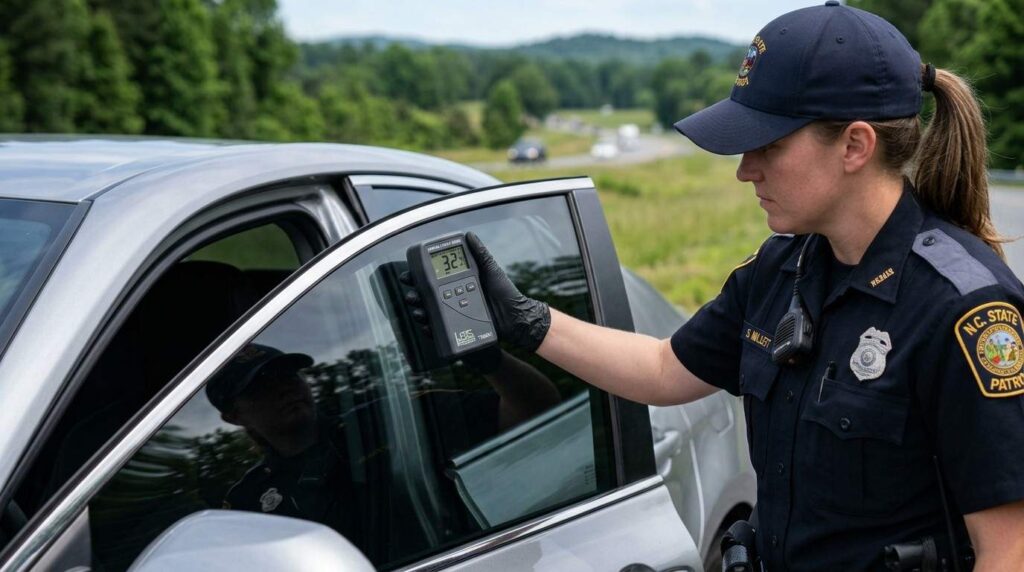
Window tint darkness in North Carolina is measured using Visible Light Transmission (VLT) percentage. VLT tells you how much light passes through both the glass and the film together.
A higher VLT means lighter tint. A lower VLT means darker tint. For example, 50% VLT lets in more light than 20% VLT.
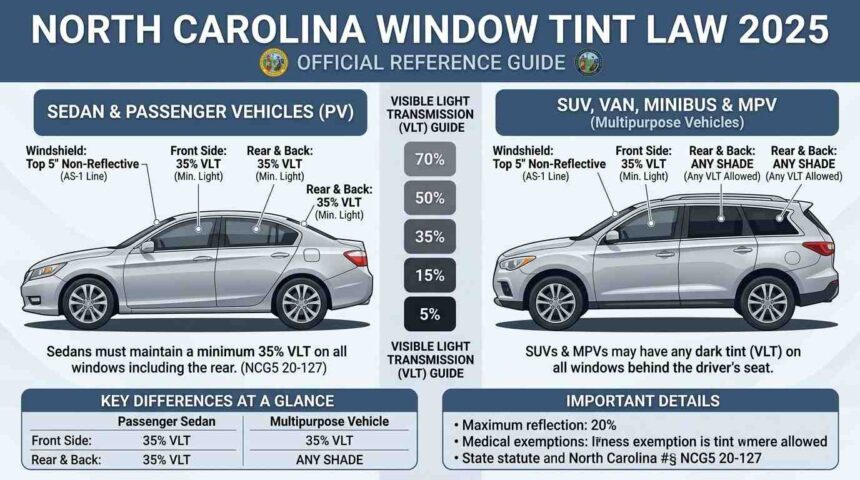
North Carolina’s legal limit is 35% VLT. That means the window must let in at least 35% of visible light. This measurement includes both the factory glass and any aftermarket film applied on top.
The 35% vs. 32% VLT Distinction
You will often hear two numbers: 35% and 32%. Both matter, and they mean different things.
- 35% VLT: The legal standard set by G.S. 20-127.
- 32% VLT: The enforcement threshold. If a state-approved tint meter reads 32% or above, the window is conclusively presumed compliant. This accounts for a 3% calibration tolerance in portable light meters.
Professional tint installers aim for the 32 to 35% zone on front windows. This gives you the darkest legal result without putting you in a gray area during a traffic stop.
Always ask for a post-installation meter reading that reflects the combined VLT of your glass and film, not just the film’s product spec sheet. A film labeled 35% can read lower than 32% once installed on factory glass.
Example: Why the Combined Reading Matters
A driver installs a film labeled 35% VLT. However, the factory glass on their sedan already blocks some light. The combined reading after installation measures 30% VLT. That tint is illegal, even though the film alone met the 35% requirement. Always ask for a combined meter reading after installation.
4. Tint Limits by Vehicle Type
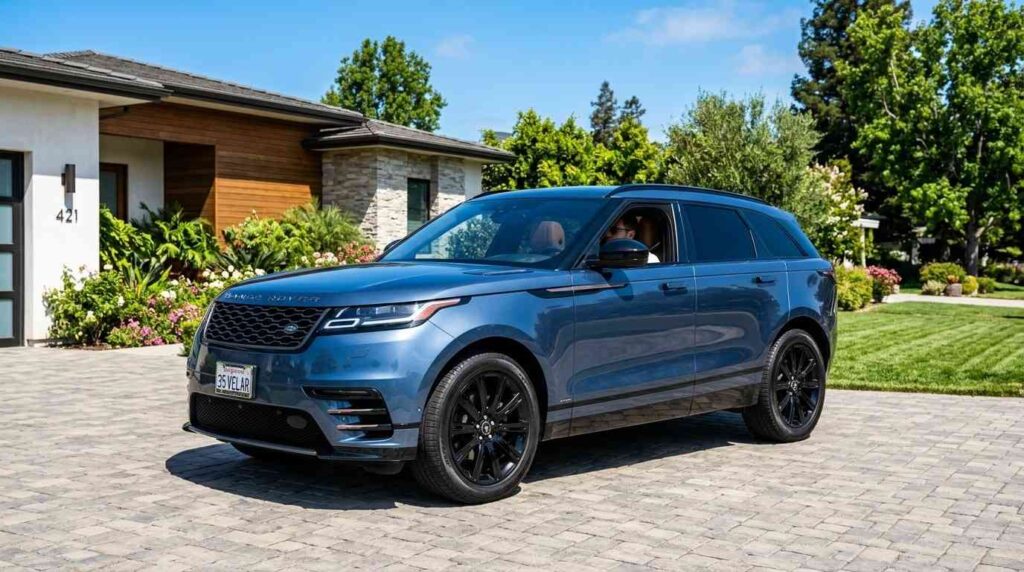
North Carolina applies different rules depending on whether you drive a passenger vehicle or a multipurpose vehicle.
Passenger Vehicles (Sedans, Coupes, Hatchbacks, Convertibles, Station Wagons)
| Window Position | Legal VLT Limit | Special Notes |
| Windshield | Non-reflective tint only | Above AS-1 line or top 5 inches, whichever is longer |
| Front Side Windows | 35% VLT minimum | Applies to combined glass + film reading |
| Rear Side Windows | 35% VLT minimum | Dual side mirrors required if rear window tinted |
| Rear Windshield | 35% VLT minimum | Dual side mirrors required if tinted |
Multipurpose Vehicles (SUVs, Trucks, Vans, Minivans)
| Window Position | Legal VLT Limit | Special Notes |
| Windshield | Non-reflective tint only | Above AS-1 line or top 5 inches, whichever is longer |
| Front Side Windows | 35% VLT minimum | Same rule as passenger vehicles |
| Rear Side Windows | No darkness restriction | Any VLT percentage is legal |
| Rear Windshield | No darkness restriction | Any VLT percentage is legal |
This is a significant advantage for SUV, truck, and van owners. You can go as dark as you want on rear windows. Only the front side windows must meet the 35% VLT limit.
5. Windshield Tint Rules (Including Clear UV Film)
Windshield tint rules in NC are more specific than most drivers realize. There are two permitted zones and one often-overlooked film type.
Where Tinted Film Is Allowed on the Windshield
Non-reflective tinted film on the windshield is only permitted above the manufacturer’s AS-1 line, or within the top 5 inches from the top of the windshield, whichever measurement is longer.
- If your vehicle has an AS-1 line marked by the manufacturer, tint may go up to that line.
- If the AS-1 line sits lower than 5 inches from the top, the 5-inch rule takes over.
- Tinted film below that zone on the windshield is illegal, regardless of VLT percentage.
Clear UV Film on the Windshield — Explicitly Permitted
North Carolina law explicitly allows an untinted clear film to be applied to the full windshield. This type of film blocks or reduces ultraviolet radiation without affecting light transmission or creating visible tint.
- Clear UV film does not need to stay above the AS-1 line.
- It can cover the entire windshield surface.
- It must comply with the light transmission requirements that apply to all other windows.
Many drivers use clear UV film for heat reduction and interior protection without any of the restrictions that apply to colored or tinted windshield film. If UV protection is your main goal for the windshield, clear film is the better choice under NC law.
6. Reflectivity Limits and Prohibited Tint Colors
Reflectivity Limit: 20% Maximum
North Carolina limits tint reflectivity to 20% or less on all windows, both front and rear.
- Front side windows: must not exceed 20% reflective.
- Rear side windows: must not exceed 20% reflective.
A tint that looks like a mirror from the outside is almost certainly illegal. Officers can flag excessive reflectivity visually without a meter, which means any stop can result in a citation.
Prohibited Tint Colors
North Carolina prohibits the following tint film colors on all vehicles:
- Red
- Amber
- Yellow
These colors are banned because they resemble emergency vehicle lighting. Colored tint can be identified by officers without a meter and can result in an immediate citation at any stop.
Other NC Tint Requirements
- No certification sticker is required to identify legal tint in North Carolina.
- Film manufacturers are not required to certify their products with the state.
- Dual side mirrors are required on sedans when the rear window is tinted.
- Clear UV film is explicitly permitted on the full windshield surface.
7. The New Roll-Down Window Rule at Traffic Stops
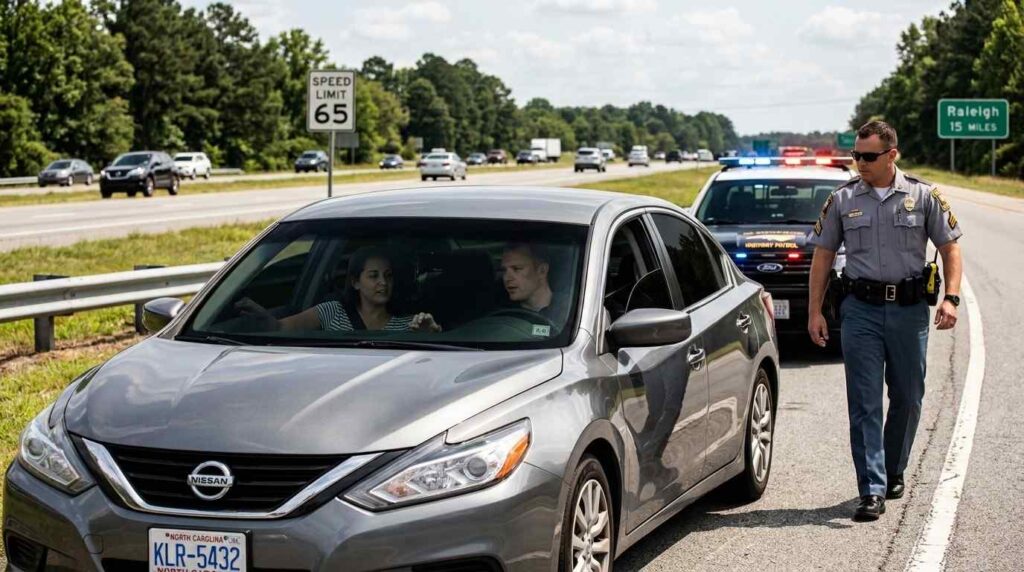
This is the part of the law change that most drivers have not heard about. It is also the part that will affect you every time you get pulled over.
What the Rule Requires
Under Session Law 2025-47, if your vehicle has any tinted window, both the driver and any passenger seated on the side the officer is approaching must roll down that window.
- Officer approaches from driver’s side: driver rolls down driver’s window.
- Officer approaches from passenger side: the passenger on that side must roll down the window.
- This applies regardless of how light or dark the tint is.
- This applies even if your tint is fully legal within the 35% VLT limit.
- This applies even if you hold a valid medical exemption permit.
This is a mandatory legal obligation under G.S. 20-127. It takes effect the moment the officer begins approaching your vehicle.
Why This Rule Was Added
Law enforcement agencies cited officer safety as the main reason. Tinted windows make it harder for officers to see inside a vehicle as they approach. The roll-down rule creates a clear line of sight and supports safer communication during any stop.
A Greensboro police officer explained the intent when the law took effect: the rule ensures officers can see the occupants inside any tinted vehicle and conduct the stop safely for everyone involved.
What Happens If You Refuse to Roll Down the Window?
- You may receive a separate citation for failing to lower the window, on top of whatever the original stop was for.
- Refusal can escalate the traffic stop significantly.
- Non-compliance is its own violation under G.S. 20-127, separate from any tint darkness issue.
Practical Tip
As soon as you see emergency lights behind you, begin rolling down the window on the officer’s approach side. Do not wait until the officer reaches the vehicle. Immediate compliance keeps the stop as routine as possible.
If a passenger is seated on the officer’s side, remind them of this requirement. Both the driver and that passenger share the obligation under NC law.
8. Does NC Still Enforce Tint Laws After the Inspection Change?
Yes. Removing tint from the annual inspection did not end enforcement. It moved enforcement from the inspection lane to the roadside.
Here is how roadside enforcement works now:
- An officer can initiate a traffic stop based on visual appearance alone if your tint appears too dark.
- The officer must use a state-approved, calibrated tint meter before issuing a citation. Visual estimates alone cannot support a citation.
- If the meter reads below 32% VLT on a covered window, the officer can cite you under G.S. 20-127.
- If you are stopped for another reason (speeding, registration, etc.) and the officer notices your tint, a secondary tint citation can be added.
One key point from the new law: removing the inspection check actually makes your choice of installer more important, not less. You no longer have an annual checkpoint where problems get caught early. The quality of the installation matters more now from day one.
9. Penalties for Illegal Window Tint in North Carolina
The penalties for illegal tint were not changed by Session Law 2025-47. They remain the same as before December 1, 2025.
Important Classification: Non-Moving Traffic Violation
Standard tint violations in North Carolina are classified as non-moving traffic violations, not criminal charges. This is an important distinction.
- A non-moving violation is a civil traffic infraction, not a criminal charge.
- It does not carry criminal penalties on its own.
- It can still appear on your driving record and may affect your insurance premium.
- Repeat violations, however, can escalate to a Class 3 misdemeanor, which is a criminal charge.
Fines and Court Costs
| Penalty Type | Amount | Notes |
| Base fine | $50 | Minimum penalty for a first tint offense |
| Court costs | Typically $150 to $188 | Varies by jurisdiction across NC |
| Total (typical first offense) | $200 to $238+ | Most first-time citations fall in this range |
| Medical sticker violation | Up to $200 | For improper placement or failure to display |
Other Consequences of a Tint Citation
- Mandatory court order to remove non-compliant tint film.
- Re-inspection fee to confirm compliance after removal.
- Vehicle registration renewal delays until the tint issue is resolved.
- Potential increase in auto insurance premiums (non-moving violation on driving record).
- Secondary tint citation added on top of the original stop reason.
Repeat Offenses: When It Escalates to a Misdemeanor
Multiple tint violations in North Carolina can escalate beyond a traffic citation. Repeat violations may be charged as a Class 3 misdemeanor under state law.
A Class 3 misdemeanor is the lowest level of criminal charge in North Carolina, but it creates a permanent criminal record entry. It carries consequences beyond the fine itself.
Cost Perspective
A first-time tint citation typically costs $200 to $238 in combined fines and court fees. Mandatory tint removal adds $100 to $300 in labor costs. Reinstalling compliant tint after removal often costs more than getting a professional legal installation in the first place. Investing in proper installation upfront almost always costs less.
10. Illegal Tint and Car Accident Liability in NC
This section covers something no major competitor has addressed. It is one of the most serious reasons to keep your tint legal in North Carolina.
North Carolina Is a Pure Contributory Fault State
North Carolina follows a legal rule called pure contributory negligence. Under this standard, if you are found even partially at fault for causing a car accident, you may be barred from recovering any damages at all.
This matters for tint because if your vehicle had illegal tint and an officer or attorney argues that the illegal tint contributed to the accident (for example, by blocking your visibility or making it harder for another driver to see your vehicle), you could lose your right to compensation entirely.
Example Scenario
Suppose another driver rear-ends you at an intersection. However, your rear window had illegal dark tint, and the other driver argues they could not see your brake lights clearly. Even if you were 10% at fault due to this factor, North Carolina’s pure contributory fault rule could bar you from recovering medical expenses, lost income, or any other damages. This is not a hypothetical risk. NC courts apply this standard strictly.
Why This Makes Tint Compliance More Important
- Illegal tint on any window can become evidence in a civil lawsuit following a crash.
- The other driver’s attorney may argue your non-compliant tint reduced visibility or contributed to the incident.
- NC’s pure contributory negligence rule means even a small percentage of attributed fault can eliminate your entire recovery.
- Compliant tint removes this legal exposure entirely.
This is general information only. If you have been in an accident and have questions about how tint laws may affect your case, speak with a licensed NC attorney as soon as possible.
11. North Carolina Medical Exemption for Window Tint
North Carolina allows drivers with qualifying medical conditions to use darker tint than the standard 35% VLT limit through the NCDMV Medical Review Program, also called the Drivers Medical Evaluation Program.
Who Qualifies?
- Individuals with photosensitivity (sensitivity to light).
- Individuals with other qualifying medical conditions, as determined by a licensed North Carolina physician.
- The physician must sign the application. Self-certification is not accepted.
How to Apply and What the Permit Covers
- Obtain an application from the NCDMV Medical Review Program.
- Have a licensed NC physician sign and complete the medical section.
- Submit the completed application to the NC Division of Motor Vehicles.
- If approved, the permit specifies: the vehicle it applies to, which windows may be darkened, and the permitted tint level.
- Carry the permit in the vehicle at all times when driving.
- Display the medical exemption sticker in the lower left-hand corner of the rear window.
Permits are valid for up to 5 years and must be renewed. A person may hold a maximum of 2 medical exception permits at one time. Permits are non-transferable and apply only to the specific vehicle listed.
The Windshield Restriction — Even With a Medical Exemption
This is a detail that many guides miss. Even with a valid medical exemption, darker tint on the windshield is only permitted within the top 5 inches.
A 2019 update to NC tint law tightened the medical exemption rule for windshields. Drivers who received their permits before that change may be surprised to find the full-windshield coverage they expected is no longer permitted.
- With a medical exemption: darker film on side and rear windows (as specified in your permit).
- With a medical exemption: windshield tint is still limited to the top 5 inches only.
- The exemption does NOT allow full windshield coverage regardless of medical need.
Does a Medical Exemption Override the Roll-Down Rule?
No. The roll-down requirement applies to all drivers and passengers with tinted windows, including those with valid medical exemptions. The exemption only covers the permissible darkness level. It does not change your obligations at a traffic stop.
Reminder
If you have a medical exemption, carry the permit in the vehicle at all times. Failure to produce it when requested, or failure to display the rear window sticker in the lower left-hand corner, can result in a fine of up to $200. The sticker is specific to the vehicle listed on the permit. You cannot transfer it to another vehicle.
12. Which Vehicles Are Exempt from NC Tint Laws?
Certain vehicle categories are not subject to North Carolina’s standard tint restrictions. NC tint laws apply statewide, including in Durham, Charlotte, Raleigh, and all other cities. These exemptions are the only exceptions to those statewide rules.
- Excursion vehicles: designed and used for sightseeing or tourism.
- For-hire vehicles: vehicles that transport individuals for payment, such as taxis and rideshare vehicles.
- Limousines: rear and side windows can be any darkness under NC law.
- Law enforcement vehicles: all vehicles operated by police and other agencies.
- Ambulances and emergency medical vehicles.
- Property haulers: vehicles such as semi-trailers used for transporting property.
If you believe your vehicle qualifies under one of these categories, verify your exemption status through the official NCDOT guidelines or consult a licensed NC attorney.
13. How to Check If Your Tint Is Legal in NC
The removal of tint from annual inspections makes it more important, not less, to verify your tint through a professional installer. You no longer have an annual checkpoint to catch problems. Getting it right at installation matters more now.
- Visit a professional tint shop and ask for a tint meter reading on your windows.
- Make sure the reading reflects the combined VLT of both the factory glass and the film together.
- Ask the technician to note the meter brand, serial number, calibration date, and exact VLT reading for each window.
- If the reading is 32% VLT or above on all covered windows, you are compliant under current NC enforcement standards.
- If any front side window reads below 32% VLT, the tint is likely illegal and should be replaced before your next roadside encounter.
- Keep the documentation in your vehicle. A verified meter reading with supporting installation records has helped drivers dispute citations in court.
Many professional shops offer free tint meter verification. It takes a few minutes and eliminates uncertainty.
14. Choosing the Right Tint Film Under NC Law
North Carolina law does not specify which film type you must use. The requirement is that the result meets VLT, reflectivity, and color standards. Here is a quick comparison.
| Film Type | Heat Rejection | Price Range | Notes |
| Dyed Film | Low | $ | Budget option; fades over time; meets legal VLT if installed correctly |
| Carbon Film | Medium | $$ | Good heat and UV rejection; no metallic fade; popular mid-range choice |
| Ceramic Film | High | $$$ | Best heat performance at any VLT; same legal limits apply |
| Metalized Film | Medium-High | $$ | Check reflectivity; metallic content can push past 20% limit |
| Clear UV Film | Low-Medium | $ | Windshield-safe; fully permitted; blocks UV without visible tint |
Ceramic tint is popular in North Carolina summers because it rejects significantly more heat than dyed or carbon film at the exact same VLT percentage. A legally compliant 35% ceramic film keeps a car noticeably cooler than a 35% dyed film.
Metalized films require careful installation because some products exceed the 20% reflectivity limit. Ask your installer to confirm the reflectivity reading, not just the VLT.
Regardless of film type, always confirm the final combined VLT reading after installation, not just the film’s product specification sheet.
15. Frequently Asked Questions
Q1: Did the 35% VLT limit change in December 2025?
No. The legal tint limit of 35% VLT for front side windows on all passenger and multipurpose vehicles is unchanged. Only the enforcement mechanism changed. Tint that was illegal before December 1, 2025 is still illegal now.
Q2: Do passengers have to roll down their windows too?
Yes. The roll-down requirement covers both the driver and any passenger seated on the side the officer is approaching. Both share this obligation under NC law. This is a common point of confusion, as many sources only mention the driver.
Q3: Do I still need an annual vehicle inspection in NC?
Yes. The full annual safety inspection is still required. Only the tint measurement was removed from the checklist. You still need to pass inspection for brakes, lights, emissions, and all other standard components.
Q4: Can an officer pull me over just for my window tint?
Yes. A law enforcement officer can initiate a stop if your tint appears darker than legal limits based on visual observation. The officer must then use a state-approved calibrated meter before issuing a citation. Visual estimates alone are not enough to write a ticket.
Q5: Is a tint violation a criminal charge in NC?
Typically no. Standard tint violations are classified as non-moving traffic violations, which are civil infractions, not criminal charges. However, repeat violations can escalate to a Class 3 misdemeanor, which is a criminal charge under NC law.
Q6: Can I put tint on my full windshield with a medical exemption?
No. Even with a valid medical exemption permit, windshield tint is still limited to the top 5 inches of the windshield. A 2019 update to NC tint law tightened this restriction for medical exemption holders. The exemption only allows darker film on side and rear windows as specified in your permit.
Q7: Do SUV rear windows need to meet the 35% VLT rule?
No. Multipurpose vehicles, including SUVs, trucks, vans, and minivans, have no darkness restriction on rear side windows or the rear windshield. Only the front side windows must meet the 35% VLT requirement. This exemption does not apply to sedans, coupes, or hatchbacks.
Q8: What is the maximum fine for illegal tint in NC?
The base fine is $50. Court costs typically bring the total to $200 to $238 depending on jurisdiction. Improper medical sticker placement carries a fine of up to $200 separately. Repeat violations can result in a Class 3 misdemeanor charge with more serious consequences.
Q9: Can illegal tint affect a car accident claim in NC?
Potentially yes. North Carolina follows pure contributory negligence. If illegal tint on your vehicle is found to have contributed to an accident in any way, you could be barred from recovering any compensation at all, even if the other driver was mostly at fault. Consult a licensed NC attorney if you have been in an accident involving tint as a factor.
Q10: Can I put clear film on my entire windshield in NC?
Yes. NC law explicitly permits an untinted clear UV film on the full windshield. This film blocks ultraviolet radiation without visible tint or reflectivity. It must comply with the light transmission requirements that apply to all other windows but is not subject to the 5-inch restriction that applies to tinted windshield film.
16. Key Takeaways for NC Drivers
Action Checklist: What to Do Right Now
- Check your tint: Verify front windows read 32% VLT or above with a professional combined meter reading.
- Know the roll-down rule: Both the driver and any passenger on the officer’s side must lower the window immediately.
- Windshield rules: Non-reflective tint permitted above AS-1 line or top 5 inches, whichever is longer. Clear UV film is permitted on the full windshield.
- Medical exemption holders: The windshield restriction (top 5 inches only) still applies even with your permit.
- Keep your medical exemption permit in the vehicle and display the sticker in the lower left-hand corner of the rear window.
- After any new installation, request a combined VLT meter reading for each window, not just the film’s spec sheet.
- Illegal tint can affect your car accident recovery in NC due to pure contributory negligence rules.
- Choose a professional installer familiar with G.S. 20-127 and current NC enforcement standards.
- Keep your installation invoice and meter records in case of a citation dispute in court.
17. Conclusion
North Carolina window tint law changes that took effect on December 1, 2025 made the inspection process simpler. But they also added a new behavioral rule that affects every driver and passenger in a vehicle with tinted windows. The $10 fee is gone. The annual inspection check is gone. The 35% VLT limit under G.S. 20-127 is not.
The enforcement moved from the inspection station to the roadside. Officers across North Carolina use portable calibrated meters at traffic stops. A tint violation is a non-moving traffic citation for a first offense, but it stays on your driving record, can raise your insurance premiums, and can escalate to a Class 3 misdemeanor for repeat violations.
There is also a risk most drivers never consider: in a car accident, illegal tint can be used as evidence that you contributed to the crash. North Carolina’s pure contributory negligence rule means any percentage of fault attributed to your illegal tint could eliminate your right to compensation entirely.
If you are unsure whether your current tint is legal, visit a professional tint shop and ask for a combined VLT meter reading. It takes minutes and could prevent a significant problem.